



Community hub
Recent from talks
Knowledge base stats:
Talk channels stats:
Members stats:
Moundville Archaeological Site
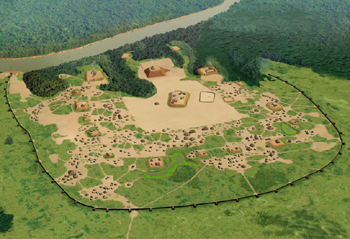
Moundville Archaeological Site, also known as the Moundville Archaeological Park, is a Mississippian culture archaeological site on the Black Warrior River in Hale County, near the modern city of Tuscaloosa, Alabama. Extensive archaeological investigation has shown that the site was the political and ceremonial center of a regionally organized Mississippian culture chiefdom polity between the 11th and 16th centuries. The archaeological park portion of the site is administered by the University of Alabama Museums and encompasses 185 acres (75 ha), consisting of 29 platform mounds around a rectangular plaza.
The site was declared a National Historic Landmark in 1964 and was added to the National Register of Historic Places in 1966.
Moundville is the second-largest site in the United States of the classic Middle Mississippian era, after Cahokia in Illinois. The culture was expressed in villages and chiefdoms throughout the central Mississippi River Valley, the lower Ohio River Valley, and most of the Mid-South area, including Kentucky, Tennessee, Alabama, and Mississippi as the core of the classic Mississippian culture area. The park contains a museum and an archaeological laboratory.
Moundville was mentioned by E. G. Squier and Edwin Hamilton Davis in their work, Ancient Monuments of the Mississippi Valley (c1848), a survey conducted for the Smithsonian Institution. Later in the century, Nathaniel Thomas Lupton created a fairly accurate map of the site.
Little excavation work was conducted at Moundville by the Bureau of Ethnology's Division of Mound Exploration, partly because the landowner imposed a fee. The first significant archaeological investigations were not conducted until the early 20th century, by Clarence Bloomfield Moore, a lawyer from Philadelphia. He dug extensively at Moundville in 1906, and his detailed records of his work and finds have been of use to modern archaeologists. But looters dug into the mounds over the next two decades and took many artifacts, in addition to destroying stratigraphy of some structures.
In the mid-1920s concerned citizens, including Walter B. Jones (geologist) (after whom the site's museum is named) had begun a concerted effort to save the site. With the help of the Alabama Museum of Natural History, they purchased the land containing the mounds. By 1933 the site had officially become known as Mound State Park, but the park was not developed for visitors until 1938. During this period of the Great Depression, workers of the Civilian Conservation Corps were brought in to stabilize the mounds against erosion. They also constructed roads and buildings to allow public uses at the site. The name of the park was changed to Mound State Monument and was opened to the public in 1939.
The Jones Archaeological Museum was constructed on the park property in 1939 for display of artifacts collected at the site and interpretation of the ancient peoples and culture. It served as a valuable teaching center for many decades. In the 21st century, the museum was remodeled and equipped with the latest technological improvements in 2010. The University of Alabama maintains an archaeological lab at the park and sponsors summer field seasons and public events.
During a 1980 break-in at the Erskine Ramsay Archaeological Repository at Moundville, 264 pottery vessels, one fifth of the vessel collection curated by the Alabama Museum of Natural History, were stolen. The highest-quality specimens were taken. Despite an investigation by the Federal Bureau of Investigation, none of the artifacts was seen again until 2018 when three ceremonial bowls were anonymously returned.
Hub AI
Moundville Archaeological Site AI simulator
(@Moundville Archaeological Site_simulator)
Moundville Archaeological Site
Moundville Archaeological Site, also known as the Moundville Archaeological Park, is a Mississippian culture archaeological site on the Black Warrior River in Hale County, near the modern city of Tuscaloosa, Alabama. Extensive archaeological investigation has shown that the site was the political and ceremonial center of a regionally organized Mississippian culture chiefdom polity between the 11th and 16th centuries. The archaeological park portion of the site is administered by the University of Alabama Museums and encompasses 185 acres (75 ha), consisting of 29 platform mounds around a rectangular plaza.
The site was declared a National Historic Landmark in 1964 and was added to the National Register of Historic Places in 1966.
Moundville is the second-largest site in the United States of the classic Middle Mississippian era, after Cahokia in Illinois. The culture was expressed in villages and chiefdoms throughout the central Mississippi River Valley, the lower Ohio River Valley, and most of the Mid-South area, including Kentucky, Tennessee, Alabama, and Mississippi as the core of the classic Mississippian culture area. The park contains a museum and an archaeological laboratory.
Moundville was mentioned by E. G. Squier and Edwin Hamilton Davis in their work, Ancient Monuments of the Mississippi Valley (c1848), a survey conducted for the Smithsonian Institution. Later in the century, Nathaniel Thomas Lupton created a fairly accurate map of the site.
Little excavation work was conducted at Moundville by the Bureau of Ethnology's Division of Mound Exploration, partly because the landowner imposed a fee. The first significant archaeological investigations were not conducted until the early 20th century, by Clarence Bloomfield Moore, a lawyer from Philadelphia. He dug extensively at Moundville in 1906, and his detailed records of his work and finds have been of use to modern archaeologists. But looters dug into the mounds over the next two decades and took many artifacts, in addition to destroying stratigraphy of some structures.
In the mid-1920s concerned citizens, including Walter B. Jones (geologist) (after whom the site's museum is named) had begun a concerted effort to save the site. With the help of the Alabama Museum of Natural History, they purchased the land containing the mounds. By 1933 the site had officially become known as Mound State Park, but the park was not developed for visitors until 1938. During this period of the Great Depression, workers of the Civilian Conservation Corps were brought in to stabilize the mounds against erosion. They also constructed roads and buildings to allow public uses at the site. The name of the park was changed to Mound State Monument and was opened to the public in 1939.
The Jones Archaeological Museum was constructed on the park property in 1939 for display of artifacts collected at the site and interpretation of the ancient peoples and culture. It served as a valuable teaching center for many decades. In the 21st century, the museum was remodeled and equipped with the latest technological improvements in 2010. The University of Alabama maintains an archaeological lab at the park and sponsors summer field seasons and public events.
During a 1980 break-in at the Erskine Ramsay Archaeological Repository at Moundville, 264 pottery vessels, one fifth of the vessel collection curated by the Alabama Museum of Natural History, were stolen. The highest-quality specimens were taken. Despite an investigation by the Federal Bureau of Investigation, none of the artifacts was seen again until 2018 when three ceremonial bowls were anonymously returned.