Recent from talks
Nothing was collected or created yet.
Mount Sidley
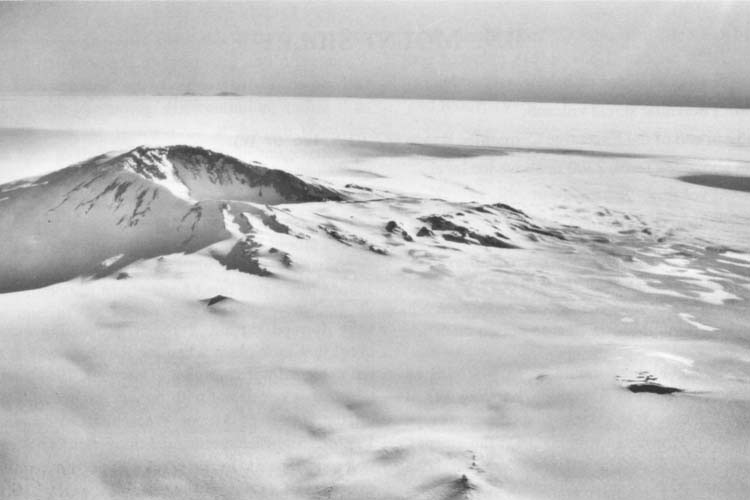
View on WikipediaMount Sidley is the highest dormant volcano in Antarctica, and a member of the Volcanic Seven Summits (the highest volcanoes on each of the seven continents) with a summit elevation of 4,181–4,285 metres (13,717–14,058 ft).[1][2] It is a massive, mainly snow-covered shield volcano, and the highest of the five volcanoes that comprise the Executive Committee Range of Marie Byrd Land. The feature is marked by a 5-kilometre-wide (3.1 mi) caldera[3] on the southern side and stands northeast of Mount Waesche in the southern part of the range.
Key Information
History
[edit]The mountain was discovered by Rear Admiral Richard E. Byrd on an airplane flight, on November 18, 1934, and named by him for Mabelle E. Sidley, the daughter of William Horlick who was a contributor to the 1933–1935 Byrd Antarctic Expedition.[4] Despite its height, the volcano's extremely remote location means that it is little known even in the mountaineering world compared to the much more accessible Mount Erebus, the second-highest Antarctic volcano, which is located near the U.S. and New Zealand bases on Ross Island.
The first recorded ascent of Mount Sidley was by New Zealander Bill Atkinson on January 11, 1990, whilst working in support of a United States Antarctic Program scientific field party.[5]


See also
[edit]Notes
[edit]- ^ a b c d "Antarctica Ultra-Prominent Summits". peaklist.org. Archived from the original on 2018-09-08. Retrieved 2013-12-24.
- ^ a b . The map above showed the elevation as 4,181 m (13,717 ft).
- ^ Panter, Kurt S.; Kyle, Philip R.; Smellie, John L. (September 1997). "Petrogenesis of a Phonolite-Trachyte Succession at Mount Sidley, Marie Byrd Land, Antarctica". Journal of Petrology. 38 (9): 1225–1253. doi:10.1093/petroj/38.9.1225. ISSN 0022-3530.
- ^ "Mount Sidley". Geographic Names Information System. United States Geological Survey, United States Department of the Interior. Retrieved 2013-12-24.
- ^ Gildea, Damien (2015). Mountaineering in Antarctica: complete guide: Travel guide. Primento. ISBN 9782511031346.
References
[edit]- LeMasurier, W. E.; Thomson, J. W., eds. (1990). Volcanoes of the Antarctic Plate and Southern Oceans. American Geophysical Union. pp. 203–207. ISBN 0-87590-172-7.
- "Skiing the Pacific Ring of Fire and Beyond". Amar Andalkar's Ski Mountaineering and Climbing Site. 2007 [1997]. Retrieved 14 January 2005.
Mount Sidley
View on GrokipediaGeography
Location
Mount Sidley is located at coordinates 77°02′S 126°06′W in Marie Byrd Land, West Antarctica.[5] This positions it on the Antarctic polar plateau, far from major coastal features and human settlements.[1] The mountain forms part of the Executive Committee Range, a north-south trending chain of five extinct volcanic mountains spanning approximately 80 kilometers along the 126th meridian west.[2] The range is isolated amid the vast West Antarctic ice sheet, with Mount Sidley as its highest and most prominent peak, rising about 4,285 meters above sea level and approximately 2,200 meters above the surrounding ice surface.[1][2] This elevation makes it the loftiest point in the range and Antarctica's tallest volcano.[5] Environmentally, Mount Sidley lies roughly 200 kilometers west of the Pacific coast along the Amundsen Sea and about 200 kilometers inland from the eastern margin of the Ross Ice Shelf to the east.[2] The site's extreme remoteness, characterized by thick ice cover and harsh polar conditions, limits access primarily to ski-equipped aircraft such as LC-130 Hercules operated by the U.S. Antarctic Program, with flights typically originating from bases like McMurdo Station or intermediate hubs such as Union Glacier Camp.[6] Over-ice traverses are possible but rare due to logistical challenges.[7]Topography
Mount Sidley rises to a summit elevation of 4,181–4,285 meters (13,720–14,058 feet) above sea level, with measurements varying slightly across sources due to differences in surveying methods and ice cover assessments.[8][9] Its topographic prominence measures 2,517 meters (8,258 feet), making it a highly distinct feature amid Antarctica's vast ice landscape.[9] The mountain's base sits at approximately 2,000–2,200 meters above sea level on the surrounding ice sheet, emphasizing its steep rise from the polar plateau.[8][10] The volcano exhibits a massive, shield-like form, largely blanketed in snow and ice, which gives it a broad, gently sloping profile that transitions abruptly to steeper flanks near the summit.[10] A prominent sheer-walled amphitheater on the northwest side provides the primary access route to the summit, carved into the mountain's upper structure.[8] At the peak lies a breached caldera, approximately 5 kilometers (3 miles) wide, open to the south and partially filled with glacial ice that exposes inner walls rising up to 1,200 meters (3,900 feet) high.[10][8] This caldera dominates the summit's appearance, with its shadowed, near-vertical walls contrasting against the ice-filled interior. Mount Sidley emerges from the flat expanse of the West Antarctic Ice Sheet, a vast, low-relief terrain with perennial snow cover but lacking major outlet glaciers in immediate proximity.[8] The mountain interrupts southward-flowing ice streams draining toward the Ross Ice Shelf, its elevated mass enhancing visibility from distances exceeding 100 kilometers under clear conditions.[8] This isolation and height contribute to its status as Antarctica's highest volcano and a key peak in the Volcanic Seven Summits.[9]Geology
Composition
Mount Sidley is composed primarily of phonolitic and trachytic lavas, with subordinate pyroclastic deposits, forming part of the alkaline volcanic series characteristic of the Marie Byrd Land Volcanic Province.[11] The volcanic edifice includes two distinct alkaline rock series: a silica-undersaturated lineage ranging from basanite to phonolite, and a more silica-saturated to oversaturated series from alkali basalt to trachyte.[11] The mineralogy is dominated by alkali feldspars such as sanidine and anorthoclase, sodic plagioclase ranging from labradorite to more sodic compositions, and mafic phases including clinopyroxene (diopside to hedenbergite) and olivine (Fo86 to Fo1) in earlier eruptive stages.[11] Later stages feature enrichment in sanidine and nepheline, accompanied by accessories like titaniferous magnetite, apatite, arfvedsonite amphibole, and mica.[11] Lower crustal xenoliths, including granulites and pyroxenites, are entrained in the basanitic lavas and provide critical insights into the underlying mantle and crustal sources.[12] These xenoliths consist of metaigneous gabbros, norites, and pyroxenites with minerals such as clinopyroxene, spinel, olivine or orthopyroxene, and secondary kaersutite replacing clinopyroxene; rhönite occurs as a breakdown product in some pyroxenites, indicating formation at temperatures of 1090–1190°C and pressures below 0.5 kbar.[13][12] Isotopic analyses reveal mantle-derived signatures with 87Sr/86Sri of 0.7028–0.7032 and 143Nd/144Ndi of 0.51285–0.51290, while trace elements show high LREE/HREE ratios ((La/Yb)N = 9–19) and a HIMU-OIB affinity (e.g., La/Nb = 0.68), supporting small-degree partial melting of a garnet-bearing mantle source; crustal contamination is evident in evolved rocks with elevated 87Sr/86Sri (0.7033–0.7042) and δ18O (6.5–8.4‰).[11] Petrogenesis involves fractional crystallization of basanitic parent magmas, with the silica-undersaturated series evolving through ~35% crystallization to mugearite, ~25% to benmoreite, and ~20% to phonolite, as evidenced by major element trends and incompatible trace element enrichment.[11] Trachytes exhibit high silica contents (>65% SiO2) and result from a two-step assimilation-fractional crystallization (AFC) process: initial high-r (assimilation/crystallization ratio) in the middle crust depleting Ta and Nb, followed by low-r AFC in the upper crust enriching Zr (>1000 ppm) and Th (>100 ppm).[11] This model aligns with the HIMU-like isotopic and trace element signatures, indicating derivation from a plume-influenced mantle with subsequent crustal interaction.[11]Structure
Mount Sidley is a complex polygenetic stratovolcano characterized by a shield-like base constructed through alternating layers of lava flows and pyroclastic deposits erupted from multiple vents.[3] This architectural form reflects repeated volcanic episodes that built a broad, elevated edifice rising to 4,285 meters above sea level, with the upper portions dominated by more viscous dome-forming lavas and explosive pyroclastic units.[3] The summit features a prominent 5 km diameter caldera that is breached to the south, forming a sheer-walled amphitheater interpreted as the result of sector collapse.[14] The caldera walls expose 300–600 meters of vertical stratigraphy, revealing nested collapse structures indicative of multiple caldera-forming events superimposed on earlier edifices.[15] These exposures highlight the volcano's evolutionary architecture, where progressive structural failures have shaped the current morphology. Internally, the stratigraphy consists of a basal sequence of phonolite flows overlain by trachyte domes and ignimbrite deposits, with evidence of sector collapse contributing to the amphitheater's formation.[3] This layering demonstrates the volcano's polygenetic nature, with phonolitic units representing early central-vent activity and overlying trachytic materials from later, more localized vents. The rock types exposed in the walls, such as phonolites and trachytes, underscore the structural transitions without delving into their mineralogical details. Subsurface investigations reveal seismological evidence of magma chambers beneath the overlying ice sheet, integrated with POLENET seismic data indicating a crustal thickness of approximately 30 km in the Marie Byrd Land region.[16] Data from the POLENET/ANET network have detected swarms of deep long-period earthquakes at 25–40 km depth, approximately 55 km south of the volcano, suggesting ongoing magmatic processes near the Moho interface.[17] As of 2025, recent seismic studies have detected low-frequency earthquakes indicative of widespread active magmatism across eastern Marie Byrd Land, supporting the persistence of volcanic activity in the province.[18]Volcanic History
Formation
Mount Sidley is situated within the Marie Byrd Land Volcanic Province (MBLVP), a Cenozoic intraplate volcanic field on the northern flank of the West Antarctic Rift System (WARS), where alkaline volcanism has been active since approximately 37 Ma.[19] This volcanism occurs without associated subduction zones, resembling hotspot activity driven by small-degree partial melting of a garnet-bearing mantle source enriched in incompatible trace elements, potentially influenced by lithospheric extension or a deep mantle plume thermal anomaly extending to 200–800 km depth.[20] The MBLVP's development is tied to regional tectonic processes, including extension along the WARS and uplift of the Marie Byrd Land dome, which has elevated the terrain to over 1 km above surrounding areas.[19] The initial formation of Mount Sidley occurred around 5.7 Ma during the Pliocene, marking it as one of the younger polygenetic stratovolcanoes in the Executive Committee Range of the MBLVP.[3] It developed on continental crust thickened to approximately 30 km beneath the Marie Byrd Land dome, contrasting with thinner crust (as low as 21 km) in the adjacent WARS rift basins.[21] Early volcanic activity produced phonolitic and trachytic lavas that built the initial shield structure, with the volcano's base influenced by the underlying extended lithosphere.[19] Mount Sidley's evolution involved multiple shield-building phases over about 1.5 million years, from 5.7 to 4.2 Ma, including caldera formation and parasitic cone development, shaped by progressive regional uplift and interactions with the expanding Antarctic ice sheet.[3] This polygenetic growth reflects episodic magma ascent through the thickened crust, with southward migration of vents along the Executive Committee Range linked to ongoing lithospheric stresses.[19]Activity
Mount Sidley's volcanic activity spanned approximately 1.5 million years, from 5.7 Ma to 4.2 Ma, characterized by distinct pulses of eruptions that built its stratovolcano structure and formed its prominent caldera.[3] The initial major phase, between 5.7 Ma and 4.8 Ma, involved the construction of phonolitic central vent edifices, including explosive plinian eruptions that led to caldera formation through collapse events exceeding 1,200 meters in depth.[3] Subsequent pulses included trachytic eruptions from multiple vents around 4.6–4.5 Ma, followed by minor activity at 4.4–4.3 Ma with small-volume benmoreite-mugearite lavas and tephra deposits, culminating in the final effusive phase of basanite cone-building at about 4.2 Ma.[3] Eruptions at Mount Sidley were predominantly explosive, featuring phonolitic-trachytic events that generated ignimbrites, pyroclastic flows, and widespread tephra layers, interspersed with effusive phases that produced lava flows and dome-like structures.[3] Tephra evidence from this period, including layers distributed across early ice surfaces, indicates atmospheric dispersal during the onset of regional glaciation, though specific ice core attributions to Sidley remain limited.[3] These styles reflect a polygenetic evolution, with southward migration of vents along a fracture system at rates of about 6 cm per year.[22] The volcano has been dormant since its last eruption around 4.2 Ma, with no recorded historical activity and no evidence of Holocene eruptions.[3] Seismic monitoring through Antarctic networks as of 2024 indicates low to moderate seismicity in the Marie Byrd Land region, but a 2013 study identified an active subglacial magmatic complex approximately 55–60 km south of Mount Sidley, raising the possibility of resurgence in the volcanic province due to ongoing mantle-derived magmatism.[17] A 2025 study further reports seismic evidence for widespread active magmatism in eastern Marie Byrd Land, detecting over 280 earthquakes (magnitudes 1.2–3.2) from 2019 to 2024, suggesting continued volcanic processes that may influence West Antarctic ice dynamics.[23] Major impacts from Mount Sidley's activity include the catastrophic caldera collapses during the 5.7–4.8 Ma phase, which reshaped the local topography into a 5 × 7 km depression, and interactions with the evolving Antarctic ice sheet, such as tephra deposition on ice and potential subglacial melting leading to jökulhlaup-like flood events in later pulses.[3] These events likely influenced early glacial dynamics in West Antarctica, though direct paleoclimate records are sparse.[24]Exploration
Discovery
Mount Sidley was first sighted on November 18, 1934, by Rear Admiral Richard E. Byrd during an aerial flight from the expedition's base ship, USS Bear, as part of the Second Byrd Antarctic Expedition (1933–1935).[10] This flight marked the initial human observation of the massive, snow-covered volcanic peak rising prominently from the ice sheet in Marie Byrd Land.[1] Byrd named the mountain in honor of Mabelle E. Sidley, the daughter of William Horlick, a manufacturer and major financial contributor to the expedition who supported its scientific endeavors, including the geological program.[1] Aerial photographs taken during the flight captured the mountain's striking features, including its snow-blanketed summit and the jagged rim of its summit caldera, providing the first visual documentation of the landmark.[25] The discovery occurred amid the intensive 1930s exploration of Marie Byrd Land, a vast, remote sector of West Antarctica named by Byrd in 1929 after his wife and remaining unclaimed territory at the time, with no national sovereignty asserted over the region.[26]Mountaineering
The first recorded ascent of Mount Sidley occurred on January 11, 1990, when New Zealand climber Bill Atkinson completed a solo climb while working as a field assistant for the United States Antarctic Program (USAP).[27] Starting from a camp at approximately 2,380 meters on the west side of the mountain, Atkinson navigated in poor visibility to reach the highest point on the crater rim via what is described as the northwest amphitheater route, marking the peak's initial human summit in its remote Antarctic setting.[27][28] The second ascent followed on January 21, 1994, by a scientific team from the Dunbar/McIntosh expedition, including Nelia Dunbar, Bill McIntosh (on his second visit), and Thom Wilch.[29] Commercial guided ascents began in the 2010s, with the first such expedition in 2011 by an ALE-guided team of four, who pioneered a new route up the west ridge from the Bennett Platform, highlighting the mountain's potential for varied lines despite its isolation.[30][31] These efforts, along with earlier scientific trips, have since enabled over 20 teams comprising more than 100 climbers to summit as of 2025, often combining the climb with broader Antarctic itineraries like Mount Vinson.[29][32] Expeditions have increased in the 2020s, with a record 19 climbers reaching the summit on January 5, 2025, led by the 7 Summits Club, including several who completed the Volcanic Seven Summits challenge.[33][32] Climbing Mount Sidley demands alpine-style ascents with significant elevation gain of about 2,225 meters from base camp at around 2,000 meters, typically involving two intermediate camps en route to the 4,285-meter summit.[34][35] Routes, such as the standard northwest approach or steeper west ridge variations, feature glacier travel with crevasse fields requiring rope teams and rescue proficiency, alongside ice climbing on blue-ice slopes and exposure to whiteout conditions that can halt progress for days.[31][28] Temperatures often plummet to -40°C, compounded by katabatic winds, resulting in a success rate of approximately 50% primarily due to unpredictable weather windows limited to the austral summer.[36][28] As one of the world's most remote summits, located over 1,000 kilometers from the nearest Antarctic station, Mount Sidley requires specialized access via ski-equipped LC-130 Hercules aircraft for base camp drops, underscoring the logistical hurdles of deep-field operations.[30] All expeditions adhere to strict environmental protocols under the Antarctic Treaty System, including waste minimization, site leave-no-trace principles, and permits to protect the pristine Marie Byrd Land ecosystem.[37][38] Its dormancy status minimizes eruption risks during climbs, allowing focus on meteorological and terrain challenges.[36]References
- https://www.earthobservatory.[nasa](/page/NASA).gov/images/85238/antarcticas-tallest-volcano
