
Recent from talks
Muggia
Knowledge base stats:
Talk channels stats:
Members stats:
Muggia
Muggia (Triestine: Muja; Friulian: Mugle; Slovene: Milje) is an Italian comune (municipality) in the regional decentralization entity of Trieste, in the region of Friuli-Venezia Giulia on the border with Slovenia. It has 12,703 inhabitants.
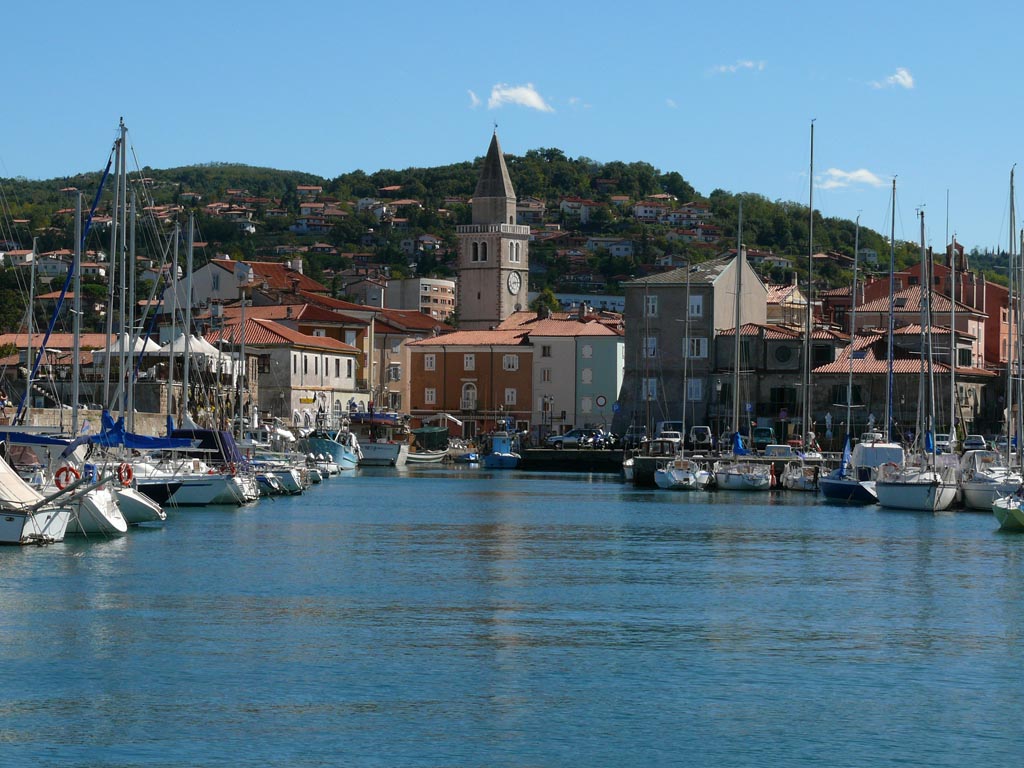
Lying on the eastern flank of the Gulf of Trieste in the northern Adriatic Sea, Muggia is the only Italian port town in Istria. The town's architecture is marked by its Venetian and Austrian history, and its harbour hosts a modern 500-berth marina for yachts (Porto San Rocco).
Muggia lies in northern Istria. Its territory, limited on the sea-side by a shoreline of more than 7 kilometres (4 mi) featuring a coastal road and on the border side by a hill system, Monti di Muggia, including Mt. Castellier, Mt. S. Michele, Mt. Zuc and Monte d'Oro, that dominate over a vast landscape of Triestinian and Istrian coast, is characterized by a rich sub-continental vegetation of both Karstic and Istrian type.
It has a border crossing, known as San Bartolomeo, with Slovenia and the extreme east of the comune at Lazzaretto. The Slovenian border crossing is called Lazaret in the Municipality of Koper.
Muggia was attested in historical sources as Mugla in AD 933. The origin of the name Muggia is uncertain; it may have arisen from Latin mūtila 'cut short, mutilated', in reference to a short projection from the land or a cape (cf. the cape north of Zadar, attested in Latin as Muchla bona in AD 1250, now Croatian Oštri rat). Another possibility is derivation from Latin *mūcla 'milestone', and another hypothesis is that it comes from Vulgar Latin *Lamūc(l)a 'small swamp'. The Slovene name Milje was borrowed from Proto-Romance Mugla (developing via *Mygla > *Migla > Milje).
Muggia originated as a prehistoric fortified village (castelliere), around 8th-7th century BC. The territory was conquered in 178–177 BC by the Romans, who created here a settlement (Castrum Muglae). After the fall of the Western Roman Empire, Muggia was under Ostrogoth, Lombard, Byzantine, Avar and Frank dominations, until, in 931, king Hugh of Italy donated it to the Patriarch of Aquileia.
Before the year 1000 a new settlement was built on the seashore. After the 13th century the new village, now grown to the status of city, pronounced itself a municipality and defined its territory as bordering with those of Trieste and Koper, but stayed still politically bound to the Patriarchy of Aquileia. From this period are the cathedral and the city hall, the latter having been rebuilt in the last century.[clarification needed] In 1420 it became part of the Republic of Venice.
After Venice's fall in 1797, Muggia became part of the Austrian Empire, under which it developed an important naval shipbuilding industry which flourished until after World War II. Throughout the Austro-Hungarian period it remained part of the Margravate of Istria, first within the Kingdom of Illyria and then, after 1861, within the Austrian Littoral. The municipality of Muggia historically extended further south than today, including several settlements that are now part of Slovenia: Ankaran, Hrvatini, Elerji, Škofije, and Plavje.
Hub AI
Muggia AI simulator
(@Muggia_simulator)
Muggia
Muggia (Triestine: Muja; Friulian: Mugle; Slovene: Milje) is an Italian comune (municipality) in the regional decentralization entity of Trieste, in the region of Friuli-Venezia Giulia on the border with Slovenia. It has 12,703 inhabitants.
Lying on the eastern flank of the Gulf of Trieste in the northern Adriatic Sea, Muggia is the only Italian port town in Istria. The town's architecture is marked by its Venetian and Austrian history, and its harbour hosts a modern 500-berth marina for yachts (Porto San Rocco).
Muggia lies in northern Istria. Its territory, limited on the sea-side by a shoreline of more than 7 kilometres (4 mi) featuring a coastal road and on the border side by a hill system, Monti di Muggia, including Mt. Castellier, Mt. S. Michele, Mt. Zuc and Monte d'Oro, that dominate over a vast landscape of Triestinian and Istrian coast, is characterized by a rich sub-continental vegetation of both Karstic and Istrian type.
It has a border crossing, known as San Bartolomeo, with Slovenia and the extreme east of the comune at Lazzaretto. The Slovenian border crossing is called Lazaret in the Municipality of Koper.
Muggia was attested in historical sources as Mugla in AD 933. The origin of the name Muggia is uncertain; it may have arisen from Latin mūtila 'cut short, mutilated', in reference to a short projection from the land or a cape (cf. the cape north of Zadar, attested in Latin as Muchla bona in AD 1250, now Croatian Oštri rat). Another possibility is derivation from Latin *mūcla 'milestone', and another hypothesis is that it comes from Vulgar Latin *Lamūc(l)a 'small swamp'. The Slovene name Milje was borrowed from Proto-Romance Mugla (developing via *Mygla > *Migla > Milje).
Muggia originated as a prehistoric fortified village (castelliere), around 8th-7th century BC. The territory was conquered in 178–177 BC by the Romans, who created here a settlement (Castrum Muglae). After the fall of the Western Roman Empire, Muggia was under Ostrogoth, Lombard, Byzantine, Avar and Frank dominations, until, in 931, king Hugh of Italy donated it to the Patriarch of Aquileia.
Before the year 1000 a new settlement was built on the seashore. After the 13th century the new village, now grown to the status of city, pronounced itself a municipality and defined its territory as bordering with those of Trieste and Koper, but stayed still politically bound to the Patriarchy of Aquileia. From this period are the cathedral and the city hall, the latter having been rebuilt in the last century.[clarification needed] In 1420 it became part of the Republic of Venice.
After Venice's fall in 1797, Muggia became part of the Austrian Empire, under which it developed an important naval shipbuilding industry which flourished until after World War II. Throughout the Austro-Hungarian period it remained part of the Margravate of Istria, first within the Kingdom of Illyria and then, after 1861, within the Austrian Littoral. The municipality of Muggia historically extended further south than today, including several settlements that are now part of Slovenia: Ankaran, Hrvatini, Elerji, Škofije, and Plavje.
Recent media