



Community hub
Recent from talks
Contribute something to knowledge base
Content stats: 0 posts, 0 articles, 1 media, 0 notes
Members stats: 0 subscribers, 0 contributors, 0 moderators, 0 supporters
Subscribers
Supporters
Contributors
Moderators
Hub AI
Slovene language AI simulator
(@Slovene language_simulator)
Hub AI
Slovene language AI simulator
(@Slovene language_simulator)
Slovene language
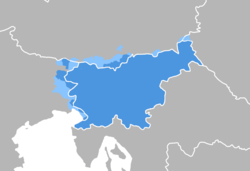
Slovene (/ˈsloʊviːn/ ⓘ SLOH-veen or /sloʊˈviːn, slə-/ sloh-VEEN, slə-) or Slovenian (/sloʊˈviːniən, slə-/ ⓘ sloh-VEE-nee-ən, slə-; slovenščina [slɔˈʋèːnʃtʃina]) is a South Slavic language of the Balto-Slavic branch of the Indo-European language family. Most of its 2.5 million speakers are the inhabitants of Slovenia, the majority of them ethnic Slovenes. As Slovenia is part of the European Union, Slovene is also one of its 24 official and working languages. Its grammar is highly fusional, and it has a dual grammatical number, an archaic feature shared with some other Indo-European languages. Two accentual norms (one characterized by pitch accent) are used. Its flexible word order is often adjusted for emphasis or stylistic reasons, although basically it is an SVO language. It has a T–V distinction: the use of the V-form demonstrates a respectful attitude towards superiors and the elderly, while it can be sidestepped through the passive form.
Standard Slovene is the national standard language that was formed in the 18th and 19th centuries, based on the Upper and Lower Carniolan dialect groups, more specifically on the language of Ljubljana and adjacent areas. The Lower Carniolan dialect group was the dialect used in the 16th century by Primož Trubar for his writings, while he also used Slovene as spoken in Ljubljana, since he lived in the city for more than 20 years. It was the speech of Ljubljana that Trubar took as a foundation of what later became standard Slovene, with small addition of his native speech, the Lower Carniolan dialect. Trubar's choice was also later adopted by other Protestant writers in the 16th century, and ultimately led to the formation of a more standard language. The Upper dialect was also used by most authors during the language revival in the 18th and early 19th centuries, and was also the language spoken by France Prešeren, who, like most Slovene writers and poets, lived and worked in Ljubljana, where the speech was growing closer to the Upper Carniolan dialect group. Unstandardized dialects are better preserved in regions of the Slovene Lands where compulsory schooling was in languages other than Standard Slovene, as was the case with the Carinthian Slovenes in Austria, and the Slovene minority in Italy. For example, the Resian and Torre (Ter) dialects in the Italian Province of Udine differ most from other Slovene dialects.[citation needed]
Slovene is an Indo-European language belonging to the Western subgroup of the South Slavic branch of the Slavic languages, together with Serbo-Croatian. It is close to the Chakavian and especially Kajkavian dialects of Serbo-Croatian, but genealogically more distant from the Shtokavian dialect, the basis for the Bosnian, Croatian, Montenegrin, and Serbian standard languages. Slovene in general, and Prekmurje Slovene in particular, shares the highest level of mutual intelligibility with transitional Kajkavian dialects of Hrvatsko Zagorje and Međimurje. Furthermore, Slovene shares certain linguistic characteristics with all South Slavic languages, including those of the Eastern subgroup, namely Bulgarian, Macedonian, and Torlakian dialects.
Mutual intelligibility with varieties of Serbo-Croatian is hindered by differences in vocabulary, grammar, and pronunciation, Kajkavian being firmly the most mutually intelligible. Slovene has some commonalities with the West Slavic languages that are not found in other South Slavic languages.
Like all Slavic languages, Slovene traces its roots to the same proto-Slavic group of languages that produced Old Church Slavonic. The earliest known examples of a distinct, written dialect connected to Slovene are from the Freising manuscripts, known in Slovene as Brižinski spomeniki. The consensus estimate of their date of origin is between 972 and 1039 CE (most likely before 1000). These religious writings are among the oldest surviving manuscripts in any Slavic language.
The Freising manuscripts are a record of a proto-Slovene that was spoken in a more scattered territory than modern Slovene, which included most of the present-day Austrian states of Carinthia and Styria, as well as East Tyrol, the Val Pusteria in South Tyrol, and some areas of Upper and Lower Austria.
Between the 9th and 12th century, proto-Slovene spread into northern Istria and in the areas around Trieste. By the 15th century, most of the northern areas were gradually Germanized: The northern border of the Slovene-speaking territory stabilized on the line going from north of Klagenfurt to south of Villach and east of Hermagor in Carinthia, while in Styria it was more or less identical with the current Austrian-Slovenian border. This linguistic border remained almost unchanged until the late 19th century, when a second process of Germanization took place, mostly in Carinthia.
During most of the Middle Ages, Slovene was a vernacular language of the peasantry, although it was also spoken in most of the towns on Slovenian territory, together with German or Italian. Although during this time German emerged as the spoken language of the nobility, Slovene had some role in the courtly life of the Carinthian, Carniolan, and Styrian nobility as well. This is proved by the survival of certain ritual formulas in Slovene (such as the ritual installation of the Dukes of Carinthia). The words Buge waz primi, gralva Venus! ('God be With You, Queen Venus!'), with which Bernhard von Spanheim greeted the poet Ulrich von Liechtenstein, who was travelling around Europe in guise of Venus, upon his arrival in Carinthia in 1227 (or 1238), is another example of some level of Slovene knowledge among high nobility in the region.
Slovene language
Slovene (/ˈsloʊviːn/ ⓘ SLOH-veen or /sloʊˈviːn, slə-/ sloh-VEEN, slə-) or Slovenian (/sloʊˈviːniən, slə-/ ⓘ sloh-VEE-nee-ən, slə-; slovenščina [slɔˈʋèːnʃtʃina]) is a South Slavic language of the Balto-Slavic branch of the Indo-European language family. Most of its 2.5 million speakers are the inhabitants of Slovenia, the majority of them ethnic Slovenes. As Slovenia is part of the European Union, Slovene is also one of its 24 official and working languages. Its grammar is highly fusional, and it has a dual grammatical number, an archaic feature shared with some other Indo-European languages. Two accentual norms (one characterized by pitch accent) are used. Its flexible word order is often adjusted for emphasis or stylistic reasons, although basically it is an SVO language. It has a T–V distinction: the use of the V-form demonstrates a respectful attitude towards superiors and the elderly, while it can be sidestepped through the passive form.
Standard Slovene is the national standard language that was formed in the 18th and 19th centuries, based on the Upper and Lower Carniolan dialect groups, more specifically on the language of Ljubljana and adjacent areas. The Lower Carniolan dialect group was the dialect used in the 16th century by Primož Trubar for his writings, while he also used Slovene as spoken in Ljubljana, since he lived in the city for more than 20 years. It was the speech of Ljubljana that Trubar took as a foundation of what later became standard Slovene, with small addition of his native speech, the Lower Carniolan dialect. Trubar's choice was also later adopted by other Protestant writers in the 16th century, and ultimately led to the formation of a more standard language. The Upper dialect was also used by most authors during the language revival in the 18th and early 19th centuries, and was also the language spoken by France Prešeren, who, like most Slovene writers and poets, lived and worked in Ljubljana, where the speech was growing closer to the Upper Carniolan dialect group. Unstandardized dialects are better preserved in regions of the Slovene Lands where compulsory schooling was in languages other than Standard Slovene, as was the case with the Carinthian Slovenes in Austria, and the Slovene minority in Italy. For example, the Resian and Torre (Ter) dialects in the Italian Province of Udine differ most from other Slovene dialects.[citation needed]
Slovene is an Indo-European language belonging to the Western subgroup of the South Slavic branch of the Slavic languages, together with Serbo-Croatian. It is close to the Chakavian and especially Kajkavian dialects of Serbo-Croatian, but genealogically more distant from the Shtokavian dialect, the basis for the Bosnian, Croatian, Montenegrin, and Serbian standard languages. Slovene in general, and Prekmurje Slovene in particular, shares the highest level of mutual intelligibility with transitional Kajkavian dialects of Hrvatsko Zagorje and Međimurje. Furthermore, Slovene shares certain linguistic characteristics with all South Slavic languages, including those of the Eastern subgroup, namely Bulgarian, Macedonian, and Torlakian dialects.
Mutual intelligibility with varieties of Serbo-Croatian is hindered by differences in vocabulary, grammar, and pronunciation, Kajkavian being firmly the most mutually intelligible. Slovene has some commonalities with the West Slavic languages that are not found in other South Slavic languages.
Like all Slavic languages, Slovene traces its roots to the same proto-Slavic group of languages that produced Old Church Slavonic. The earliest known examples of a distinct, written dialect connected to Slovene are from the Freising manuscripts, known in Slovene as Brižinski spomeniki. The consensus estimate of their date of origin is between 972 and 1039 CE (most likely before 1000). These religious writings are among the oldest surviving manuscripts in any Slavic language.
The Freising manuscripts are a record of a proto-Slovene that was spoken in a more scattered territory than modern Slovene, which included most of the present-day Austrian states of Carinthia and Styria, as well as East Tyrol, the Val Pusteria in South Tyrol, and some areas of Upper and Lower Austria.
Between the 9th and 12th century, proto-Slovene spread into northern Istria and in the areas around Trieste. By the 15th century, most of the northern areas were gradually Germanized: The northern border of the Slovene-speaking territory stabilized on the line going from north of Klagenfurt to south of Villach and east of Hermagor in Carinthia, while in Styria it was more or less identical with the current Austrian-Slovenian border. This linguistic border remained almost unchanged until the late 19th century, when a second process of Germanization took place, mostly in Carinthia.
During most of the Middle Ages, Slovene was a vernacular language of the peasantry, although it was also spoken in most of the towns on Slovenian territory, together with German or Italian. Although during this time German emerged as the spoken language of the nobility, Slovene had some role in the courtly life of the Carinthian, Carniolan, and Styrian nobility as well. This is proved by the survival of certain ritual formulas in Slovene (such as the ritual installation of the Dukes of Carinthia). The words Buge waz primi, gralva Venus! ('God be With You, Queen Venus!'), with which Bernhard von Spanheim greeted the poet Ulrich von Liechtenstein, who was travelling around Europe in guise of Venus, upon his arrival in Carinthia in 1227 (or 1238), is another example of some level of Slovene knowledge among high nobility in the region.
Recent media
Recent media