
Recent from talks
Munsell color system
Knowledge base stats:
Talk channels stats:
Members stats:
Munsell color system
The Munsell color system is a color space that specifies colors based on three properties of color: hue (basic color), value (lightness), and chroma (color intensity). It was created by Albert H. Munsell in the first decade of the 20th century and adopted by the United States Department of Agriculture (USDA) as the official color system for soil research in the 1930s.
Several earlier color order systems in the field of colorimetry had placed colors into a three-dimensional color solid of one form or another, but Munsell was the first to separate hue, value, and chroma into perceptually uniform and independent dimensions, and he was the first to illustrate the colors systematically in three-dimensional space. Munsell's system, particularly the later renotations, is based on rigorous measurements of human subjects' visual responses to color, putting it on a firm experimental scientific basis. Because of this basis in human visual perception, Munsell's system has outlasted its contemporary color models, and though it has been superseded for some uses by models such as CIELAB (L*a*b*) and CIECAM02, it is still in wide use today.
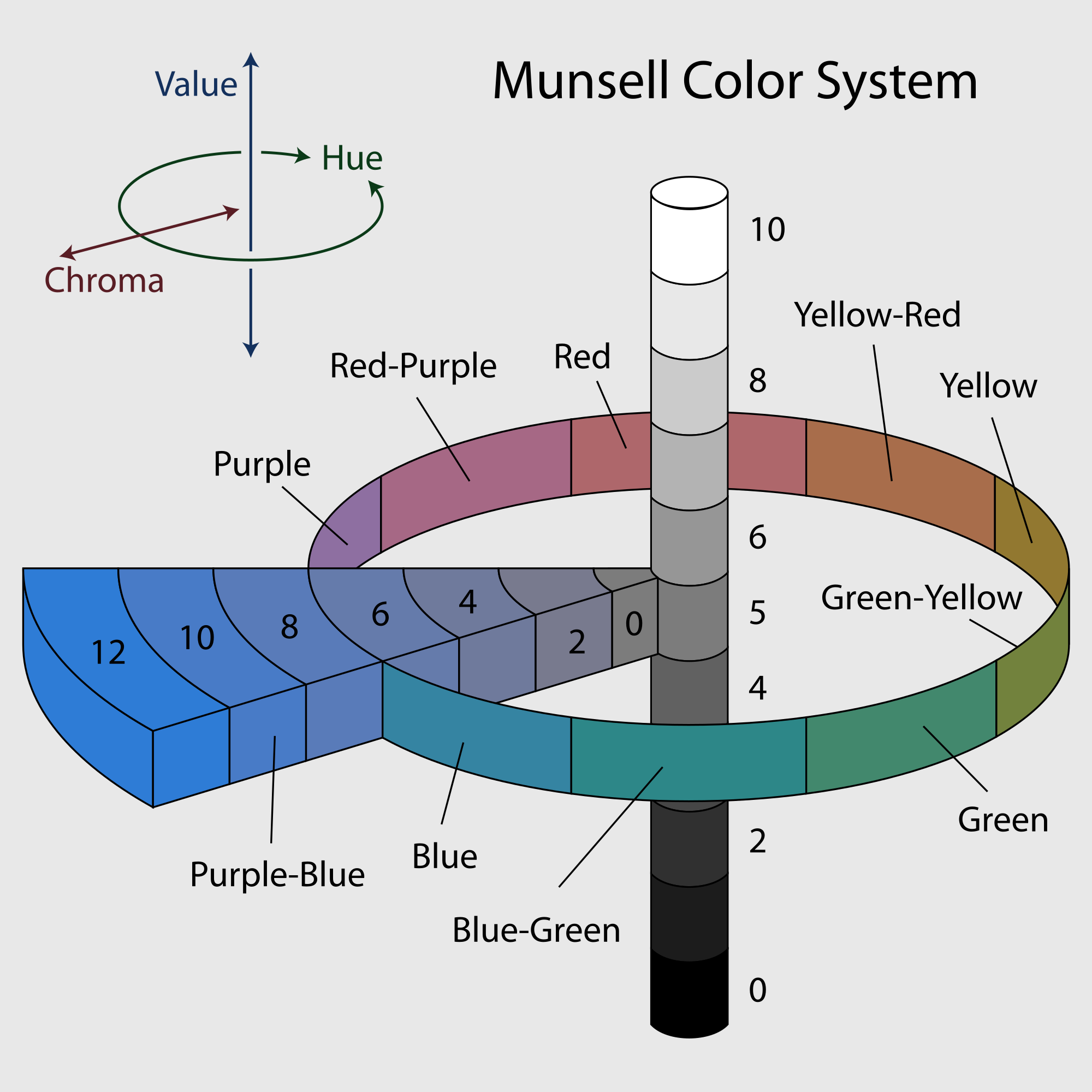
The system consists of three independent properties of color which can be represented cylindrically in three dimensions as an irregular color solid:
Munsell determined the spacing of colors along these dimensions by taking measurements of human visual responses. In each dimension, Munsell colors are as close to perceptually uniform as he could make them, which makes the resulting shape quite irregular. As Munsell explains:
Desire to fit a chosen contour, such as the pyramid, cone, cylinder or cube, coupled with a lack of proper tests, has led to many distorted statements of color relations, and it becomes evident, when physical measurement of pigment values and chromas is studied, that no regular contour will serve.
— Albert H. Munsell, "A Pigment Color System and Notation"
Since the first rendition of the Munsell color system, each horizontal circle is divided into five principal hues: Red, Yellow, Green, Blue, and Purple, along with 5 intermediate hues between adjacent principal hues: YR, GY, BG, PB, and RP. Despite trichromatic color being best described with 3 primary colors or 4 unique hues, Munsell chose to define his color space with 5 principal hues to keep it decimalized. Munsell describes the intermediate hues as orange, grass green, peacock blue, violet and plum, but opts to simplify the notation with the portmanteaus of the principal colors for the sake of intuition.
In later renditions, these 10 principal and intermediate colors were further subdivided into 10 steps each, so that at least 100 hues are definable. The sub-steps are numbered 1 to 10, which prepends the hue letter(s), e.g. 8GY. However, further subdivisions are possible through interpolation, e.g. 8.7GY. In practice, color charts conventionally specify 40 hues, in increments of 2.5, progressing as for example 10R to 2.5YR.
Hub AI
Munsell color system AI simulator
(@Munsell color system_simulator)
Munsell color system
The Munsell color system is a color space that specifies colors based on three properties of color: hue (basic color), value (lightness), and chroma (color intensity). It was created by Albert H. Munsell in the first decade of the 20th century and adopted by the United States Department of Agriculture (USDA) as the official color system for soil research in the 1930s.
Several earlier color order systems in the field of colorimetry had placed colors into a three-dimensional color solid of one form or another, but Munsell was the first to separate hue, value, and chroma into perceptually uniform and independent dimensions, and he was the first to illustrate the colors systematically in three-dimensional space. Munsell's system, particularly the later renotations, is based on rigorous measurements of human subjects' visual responses to color, putting it on a firm experimental scientific basis. Because of this basis in human visual perception, Munsell's system has outlasted its contemporary color models, and though it has been superseded for some uses by models such as CIELAB (L*a*b*) and CIECAM02, it is still in wide use today.
The system consists of three independent properties of color which can be represented cylindrically in three dimensions as an irregular color solid:
Munsell determined the spacing of colors along these dimensions by taking measurements of human visual responses. In each dimension, Munsell colors are as close to perceptually uniform as he could make them, which makes the resulting shape quite irregular. As Munsell explains:
Desire to fit a chosen contour, such as the pyramid, cone, cylinder or cube, coupled with a lack of proper tests, has led to many distorted statements of color relations, and it becomes evident, when physical measurement of pigment values and chromas is studied, that no regular contour will serve.
— Albert H. Munsell, "A Pigment Color System and Notation"
Since the first rendition of the Munsell color system, each horizontal circle is divided into five principal hues: Red, Yellow, Green, Blue, and Purple, along with 5 intermediate hues between adjacent principal hues: YR, GY, BG, PB, and RP. Despite trichromatic color being best described with 3 primary colors or 4 unique hues, Munsell chose to define his color space with 5 principal hues to keep it decimalized. Munsell describes the intermediate hues as orange, grass green, peacock blue, violet and plum, but opts to simplify the notation with the portmanteaus of the principal colors for the sake of intuition.
In later renditions, these 10 principal and intermediate colors were further subdivided into 10 steps each, so that at least 100 hues are definable. The sub-steps are numbered 1 to 10, which prepends the hue letter(s), e.g. 8GY. However, further subdivisions are possible through interpolation, e.g. 8.7GY. In practice, color charts conventionally specify 40 hues, in increments of 2.5, progressing as for example 10R to 2.5YR.
Recent media