
Recent from talks
Munsey's Magazine
Knowledge base stats:
Talk channels stats:
Members stats:
Munsey's Magazine
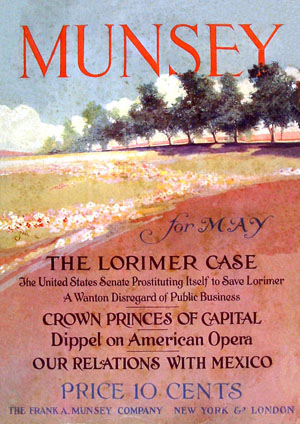
Munsey's Magazine was an American magazine founded by Frank Munsey in 1889 as Munsey's Weekly, a humor magazine edited by John Kendrick Bangs. It was unsuccessful, and by late 1891 had lost $100,000 ($3.58 million in 2025). Munsey converted it into an illustrated general monthly in October of that year, retitled Munsey's Magazine and priced at twenty-five cents ($8.96 in 2025). Richard Titherington became the editor, and remained in that role throughout the magazine's existence. In 1893 Munsey cut the price to ten cents ($3.58 in 2025). This brought him into conflict with the American News Company, which had a near-monopoly on magazine distribution, as they were unwilling to handle the magazine at the price Munsey proposed. Munsey started his own distribution company and was quickly successful: the first ten cent issue began with a print run of 20,000 copies but eventually sold 60,000, and within a year circulation had risen to over a quarter of a million copies.
Munsey's Magazine included both fiction and non-fiction on art, music and the theatre, and celebrities. In 1893 Munsey became one of the first publishers to regularly depict a pretty young woman on the cover, and circulation was also boosted by the liberal use of illustrations. During the mid-1890s Munsey's often included images of nude and semi-nude women, though this became less common later in the decade. Circulation peaked at about 700,000 in 1897, and fluctuated thereafter until the 1910s, when it began to decline. The magazine became fiction-only in 1921. Many popular writers appeared in its pages, including O. Henry, H. Rider Haggard, Arthur Conan Doyle, Bret Harte, Max Brand, Edgar Rice Burroughs, P. G. Wodehouse, Joseph Conrad, and Ella Wheeler Wilcox. By 1924 circulation had dwindled to 64,000 and in 1929 the magazine was merged with Argosy, another of Munsey's magazines. The price cut from twenty-five cents to ten cents is considered by historians to have been the start of a revolution in magazine publishing. Before 1893, the bulk of most magazines' income came from the sale of subscriptions, though advertising was another source. Munsey's Magazine showed that it was possible to set a low price in order to increase circulation and attract sufficient advertising revenue to make a substantial profit. Other magazines, notably McClure's and Cosmopolitan, quickly followed suit, but it was not until 1904 that Everybody's Magazine managed to outstrip Munsey's circulation, reaching a figure of almost a million.
In 1882 Frank Munsey moved from Augusta, Maine, to New York City, intending to launch a children's magazine. His main investor soon pulled out, leaving Munsey without enough capital to publish the magazine himself; instead he persuaded an existing publisher, E. G. Rideout, to take it on, with Munsey as manager and editor. The magazine was titled The Golden Argosy, and the first issue was dated December 2, 1882. Rideout went bankrupt in early 1883, and Munsey took over as publisher.
The magazine was not initially profitable, and for years Munsey was under immense financial pressure. An advertising campaign in 1886 brought a surge in circulation to 115,000, but this was temporary, and though Munsey experimented with The Golden Argosy, shortening the title to just The Argosy, and changing the page size and page count, he was unable to reverse the decline. In 1889 Munsey launched Munsey's Weekly, hoping that it would establish itself as profitable before The Argosy failed completely.
The first issue of Munsey's Weekly was dated February 2, 1889. It was 36 pages long, in quarto format, and priced at ten cents ($3.58 in 2025). The contents were satire and comedy: it was aimed at the same market as Life. Munsey hired John Kendrick Bangs as the founding editor; at the time Bangs was working for Harper's, but only for two afternoons a week, leaving him time to take on other responsibilities. At Harper's he was responsible for "The Editor's Drawer", a long-established humorous column. Bangs found Munsey to be difficult to work for; Bangs was used to a relaxed relationship with his previous publisher, but Munsey was constantly asking him about his work. By this time Munsey had written several novels for The Golden Argosy, and he submitted one, titled A Tragedy of Errors, to Bangs, who rejected it. Munsey insisted on running the story, and Bangs serialized it, but offered his resignation from the editorship. His last issue was in June. Bangs and Munsey remained on good terms, and Bangs subsequently sold work to Munsey, both for Munsey's Magazine (as the Weekly was later retitled) and for the Daily Continent, a short-lived tabloid version of the daily paper the New York Star, which Munsey acquired for a few months in 1891.
The magazine continued without a named editor for two more years, managed by the same team that was running The Argosy. In February 1890 Munsey bought another humorous weekly, Time (launched in 1884 as Tid-bits) and merged the subscription list with Munsey's Weekly. Munsey claimed that the acquisition would increase the Weekly's circulation from 26,000 to nearly 50,000. A review in Printers' Ink that month commented that none of the weekly papers paid well for syndicated writers, with Munsey's Weekly in the middle of the pack at $5 per column ($179 in 2025); only two magazines paid more than $5, and several paid less. Circulation stayed below 40,000, which was not enough to meet its costs, and in two and a half years the magazine lost over $100,000 ($3.58 million in 2025).
In October 1891 Munsey changed the Weekly to a monthly, titled Munsey's Magazine, and Richard Titherington, one of Munsey's earliest employees, was given the editorship. The size was reduced from quarto to standard, with 96 pages per issue, and the price increased to twenty-five cents ($8.96 in 2025). The following April Munsey acquired The Epoch, a general magazine that had been launched in February 1887 by DeWitt Seligman as a ten-cent weekly, and merged it with Munsey's.
The change to a monthly schedule did not help the circulation of Munsey's. The financial pressure on Munsey intensified, but he was able to obtain a loan for $8,000 ($287,000 in 2025) through an old friend, John Fogler, who was at that time working for the First National Bank of Leavenworth in Kansas. In the Panic of 1893 the bank called in the loan, and Munsey offered Fogler half-ownership in his publishing company if he would take on the loan. Fogler declined and Munsey was forced to borrow the money elsewhere, at 18% interest.
Hub AI
Munsey's Magazine AI simulator
(@Munsey's Magazine_simulator)
Munsey's Magazine
Munsey's Magazine was an American magazine founded by Frank Munsey in 1889 as Munsey's Weekly, a humor magazine edited by John Kendrick Bangs. It was unsuccessful, and by late 1891 had lost $100,000 ($3.58 million in 2025). Munsey converted it into an illustrated general monthly in October of that year, retitled Munsey's Magazine and priced at twenty-five cents ($8.96 in 2025). Richard Titherington became the editor, and remained in that role throughout the magazine's existence. In 1893 Munsey cut the price to ten cents ($3.58 in 2025). This brought him into conflict with the American News Company, which had a near-monopoly on magazine distribution, as they were unwilling to handle the magazine at the price Munsey proposed. Munsey started his own distribution company and was quickly successful: the first ten cent issue began with a print run of 20,000 copies but eventually sold 60,000, and within a year circulation had risen to over a quarter of a million copies.
Munsey's Magazine included both fiction and non-fiction on art, music and the theatre, and celebrities. In 1893 Munsey became one of the first publishers to regularly depict a pretty young woman on the cover, and circulation was also boosted by the liberal use of illustrations. During the mid-1890s Munsey's often included images of nude and semi-nude women, though this became less common later in the decade. Circulation peaked at about 700,000 in 1897, and fluctuated thereafter until the 1910s, when it began to decline. The magazine became fiction-only in 1921. Many popular writers appeared in its pages, including O. Henry, H. Rider Haggard, Arthur Conan Doyle, Bret Harte, Max Brand, Edgar Rice Burroughs, P. G. Wodehouse, Joseph Conrad, and Ella Wheeler Wilcox. By 1924 circulation had dwindled to 64,000 and in 1929 the magazine was merged with Argosy, another of Munsey's magazines. The price cut from twenty-five cents to ten cents is considered by historians to have been the start of a revolution in magazine publishing. Before 1893, the bulk of most magazines' income came from the sale of subscriptions, though advertising was another source. Munsey's Magazine showed that it was possible to set a low price in order to increase circulation and attract sufficient advertising revenue to make a substantial profit. Other magazines, notably McClure's and Cosmopolitan, quickly followed suit, but it was not until 1904 that Everybody's Magazine managed to outstrip Munsey's circulation, reaching a figure of almost a million.
In 1882 Frank Munsey moved from Augusta, Maine, to New York City, intending to launch a children's magazine. His main investor soon pulled out, leaving Munsey without enough capital to publish the magazine himself; instead he persuaded an existing publisher, E. G. Rideout, to take it on, with Munsey as manager and editor. The magazine was titled The Golden Argosy, and the first issue was dated December 2, 1882. Rideout went bankrupt in early 1883, and Munsey took over as publisher.
The magazine was not initially profitable, and for years Munsey was under immense financial pressure. An advertising campaign in 1886 brought a surge in circulation to 115,000, but this was temporary, and though Munsey experimented with The Golden Argosy, shortening the title to just The Argosy, and changing the page size and page count, he was unable to reverse the decline. In 1889 Munsey launched Munsey's Weekly, hoping that it would establish itself as profitable before The Argosy failed completely.
The first issue of Munsey's Weekly was dated February 2, 1889. It was 36 pages long, in quarto format, and priced at ten cents ($3.58 in 2025). The contents were satire and comedy: it was aimed at the same market as Life. Munsey hired John Kendrick Bangs as the founding editor; at the time Bangs was working for Harper's, but only for two afternoons a week, leaving him time to take on other responsibilities. At Harper's he was responsible for "The Editor's Drawer", a long-established humorous column. Bangs found Munsey to be difficult to work for; Bangs was used to a relaxed relationship with his previous publisher, but Munsey was constantly asking him about his work. By this time Munsey had written several novels for The Golden Argosy, and he submitted one, titled A Tragedy of Errors, to Bangs, who rejected it. Munsey insisted on running the story, and Bangs serialized it, but offered his resignation from the editorship. His last issue was in June. Bangs and Munsey remained on good terms, and Bangs subsequently sold work to Munsey, both for Munsey's Magazine (as the Weekly was later retitled) and for the Daily Continent, a short-lived tabloid version of the daily paper the New York Star, which Munsey acquired for a few months in 1891.
The magazine continued without a named editor for two more years, managed by the same team that was running The Argosy. In February 1890 Munsey bought another humorous weekly, Time (launched in 1884 as Tid-bits) and merged the subscription list with Munsey's Weekly. Munsey claimed that the acquisition would increase the Weekly's circulation from 26,000 to nearly 50,000. A review in Printers' Ink that month commented that none of the weekly papers paid well for syndicated writers, with Munsey's Weekly in the middle of the pack at $5 per column ($179 in 2025); only two magazines paid more than $5, and several paid less. Circulation stayed below 40,000, which was not enough to meet its costs, and in two and a half years the magazine lost over $100,000 ($3.58 million in 2025).
In October 1891 Munsey changed the Weekly to a monthly, titled Munsey's Magazine, and Richard Titherington, one of Munsey's earliest employees, was given the editorship. The size was reduced from quarto to standard, with 96 pages per issue, and the price increased to twenty-five cents ($8.96 in 2025). The following April Munsey acquired The Epoch, a general magazine that had been launched in February 1887 by DeWitt Seligman as a ten-cent weekly, and merged it with Munsey's.
The change to a monthly schedule did not help the circulation of Munsey's. The financial pressure on Munsey intensified, but he was able to obtain a loan for $8,000 ($287,000 in 2025) through an old friend, John Fogler, who was at that time working for the First National Bank of Leavenworth in Kansas. In the Panic of 1893 the bank called in the loan, and Munsey offered Fogler half-ownership in his publishing company if he would take on the loan. Fogler declined and Munsey was forced to borrow the money elsewhere, at 18% interest.
Recent media