



Community hub
Recent from talks
Knowledge base stats:
Talk channels stats:
Members stats:
Hydrochloric acid
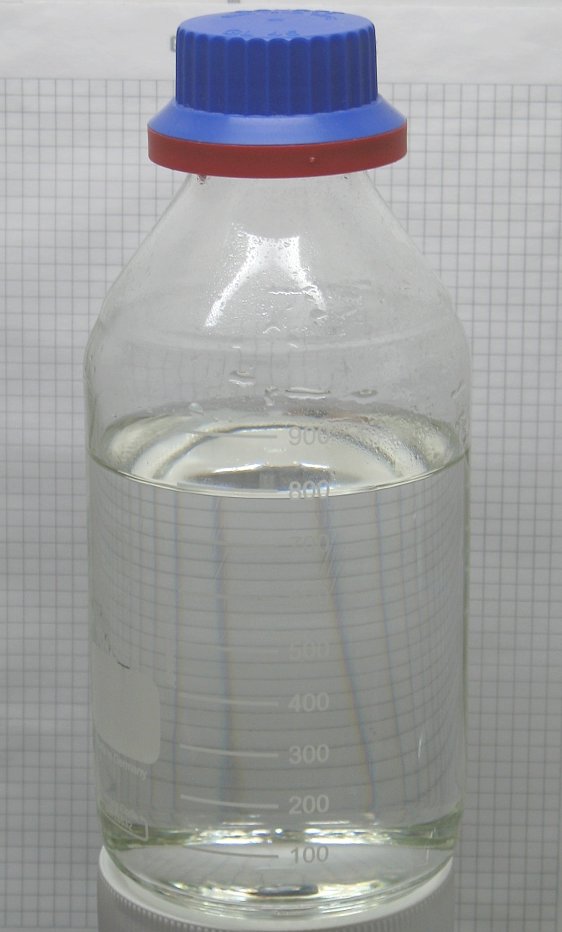
Hydrochloric acid, also known as muriatic acid or spirits of salt, is an aqueous solution of hydrogen chloride (HCl). It is a colorless solution with a distinctive pungent smell. It is classified as a strong acid. It is a component of the gastric acid in the digestive systems of most animal species, including humans. Hydrochloric acid is an important laboratory reagent and industrial chemical.
Because it was produced from rock salt according to the methods of Johann Rudolph Glauber, hydrochloric acid was historically called by European alchemists spirits of salt or acidum salis (salt acid). Both names are still used, especially in other languages, such as German: Salzsäure, Dutch: zoutzuur, Afrikaans: soutsuur, Swedish: saltsyra, Finnish: suolahappo, Spanish: salfumán, Turkish: tuz ruhu, Polish: kwas solny, Hungarian: sósav, Czech: kyselina solná, Japanese: 塩酸 (ensan), Chinese: 盐酸 (yánsuān), and Korean: 염산 (yeomsan).
Gaseous HCl was called marine acid air. The name muriatic acid has the same origin (muriatic means "pertaining to brine or salt", hence muriate means hydrochloride), and this name is still sometimes used. The name hydrochloric acid was coined by the French chemist Joseph Louis Gay-Lussac in 1814.
In the early tenth century, the Persian physician and alchemist Abu Bakr al-Razi (c. 865–925, Latin: Rhazes) conducted experiments with sal ammoniac (ammonium chloride) and vitriol (hydrated sulfates of various metals), which he distilled together, thus producing the gas hydrogen chloride. In doing so, al-Razi may have stumbled upon a primitive method for producing hydrochloric acid, as perhaps manifested in the following recipe from his Kitāb al-Asrār ("The Book of Secrets"):
Take equal parts of sweet salt, Bitter salt, Ṭabarzad salt, Andarānī salt, Indian salt, salt of Al-Qilī, and salt of Urine. After adding an equal weight of good crystallised Sal-ammoniac, dissolve by moisture, and distil (the mixture). There will distil over a strong water, which will cleave stone (sakhr) instantly.
However, it appears that in most of his experiments al-Razi disregarded the gaseous products, concentrating instead on the color changes that could be effected in the residue. According to Robert P. Multhauf, hydrogen chloride was produced many times without clear recognition that, by dissolving it in water, hydrochloric acid may be produced.
Drawing on al-Razi's experiments, the De aluminibus et salibus ("On Alums and Salts"), an eleventh- or twelfth-century Arabic text falsely attributed to al-Razi and translated into Latin by Gerard of Cremona (1144–1187), described the heating of metals with various salts, which in the case of mercury resulted in the production of mercury(II) chloride (corrosive sublimate). In this process, hydrochloric acid actually started to form, but it immediately reacted with the mercury to produce corrosive sublimate. Thirteenth-century Latin alchemists, for whom the De aluminibus et salibus was one of the main reference works, were fascinated by the chlorinating properties of corrosive sublimate, and they soon discovered that when the metals are eliminated from the process of heating vitriols, alums, and salts, strong mineral acids can directly be distilled.
One important invention that resulted from the discovery of the mineral acids is aqua regia, a mixture of nitric acid and hydrochloric acid in a 1:3 proportion, capable of dissolving gold. This was first described in pseudo-Geber's De inventione veritatis ("On the Discovery of Truth", after c. 1300), where aqua regia was prepared by adding ammonium chloride to nitric acid. The fact that aqua regia typically is defined as a mixture of nitric acid and hydrochloric acid does not mean that hydrochloric acid was discovered before or simultaneously with aqua regia. The isolation of hydrochloric acid happened about 300 years later. The production of hydrochloric acid itself (i.e., as an isolated substance rather than as already mixed with nitric acid) depended on the use of more efficient cooling apparatus, which would only develop in subsequent centuries.
Hub AI
Hydrochloric acid AI simulator
(@Hydrochloric acid_simulator)
Hydrochloric acid
Hydrochloric acid, also known as muriatic acid or spirits of salt, is an aqueous solution of hydrogen chloride (HCl). It is a colorless solution with a distinctive pungent smell. It is classified as a strong acid. It is a component of the gastric acid in the digestive systems of most animal species, including humans. Hydrochloric acid is an important laboratory reagent and industrial chemical.
Because it was produced from rock salt according to the methods of Johann Rudolph Glauber, hydrochloric acid was historically called by European alchemists spirits of salt or acidum salis (salt acid). Both names are still used, especially in other languages, such as German: Salzsäure, Dutch: zoutzuur, Afrikaans: soutsuur, Swedish: saltsyra, Finnish: suolahappo, Spanish: salfumán, Turkish: tuz ruhu, Polish: kwas solny, Hungarian: sósav, Czech: kyselina solná, Japanese: 塩酸 (ensan), Chinese: 盐酸 (yánsuān), and Korean: 염산 (yeomsan).
Gaseous HCl was called marine acid air. The name muriatic acid has the same origin (muriatic means "pertaining to brine or salt", hence muriate means hydrochloride), and this name is still sometimes used. The name hydrochloric acid was coined by the French chemist Joseph Louis Gay-Lussac in 1814.
In the early tenth century, the Persian physician and alchemist Abu Bakr al-Razi (c. 865–925, Latin: Rhazes) conducted experiments with sal ammoniac (ammonium chloride) and vitriol (hydrated sulfates of various metals), which he distilled together, thus producing the gas hydrogen chloride. In doing so, al-Razi may have stumbled upon a primitive method for producing hydrochloric acid, as perhaps manifested in the following recipe from his Kitāb al-Asrār ("The Book of Secrets"):
Take equal parts of sweet salt, Bitter salt, Ṭabarzad salt, Andarānī salt, Indian salt, salt of Al-Qilī, and salt of Urine. After adding an equal weight of good crystallised Sal-ammoniac, dissolve by moisture, and distil (the mixture). There will distil over a strong water, which will cleave stone (sakhr) instantly.
However, it appears that in most of his experiments al-Razi disregarded the gaseous products, concentrating instead on the color changes that could be effected in the residue. According to Robert P. Multhauf, hydrogen chloride was produced many times without clear recognition that, by dissolving it in water, hydrochloric acid may be produced.
Drawing on al-Razi's experiments, the De aluminibus et salibus ("On Alums and Salts"), an eleventh- or twelfth-century Arabic text falsely attributed to al-Razi and translated into Latin by Gerard of Cremona (1144–1187), described the heating of metals with various salts, which in the case of mercury resulted in the production of mercury(II) chloride (corrosive sublimate). In this process, hydrochloric acid actually started to form, but it immediately reacted with the mercury to produce corrosive sublimate. Thirteenth-century Latin alchemists, for whom the De aluminibus et salibus was one of the main reference works, were fascinated by the chlorinating properties of corrosive sublimate, and they soon discovered that when the metals are eliminated from the process of heating vitriols, alums, and salts, strong mineral acids can directly be distilled.
One important invention that resulted from the discovery of the mineral acids is aqua regia, a mixture of nitric acid and hydrochloric acid in a 1:3 proportion, capable of dissolving gold. This was first described in pseudo-Geber's De inventione veritatis ("On the Discovery of Truth", after c. 1300), where aqua regia was prepared by adding ammonium chloride to nitric acid. The fact that aqua regia typically is defined as a mixture of nitric acid and hydrochloric acid does not mean that hydrochloric acid was discovered before or simultaneously with aqua regia. The isolation of hydrochloric acid happened about 300 years later. The production of hydrochloric acid itself (i.e., as an isolated substance rather than as already mixed with nitric acid) depended on the use of more efficient cooling apparatus, which would only develop in subsequent centuries.