
Recent from talks
Mutual Defense Pact of the Southeastern Provinces
Knowledge base stats:
Talk channels stats:
Members stats:
Mutual Defense Pact of the Southeastern Provinces
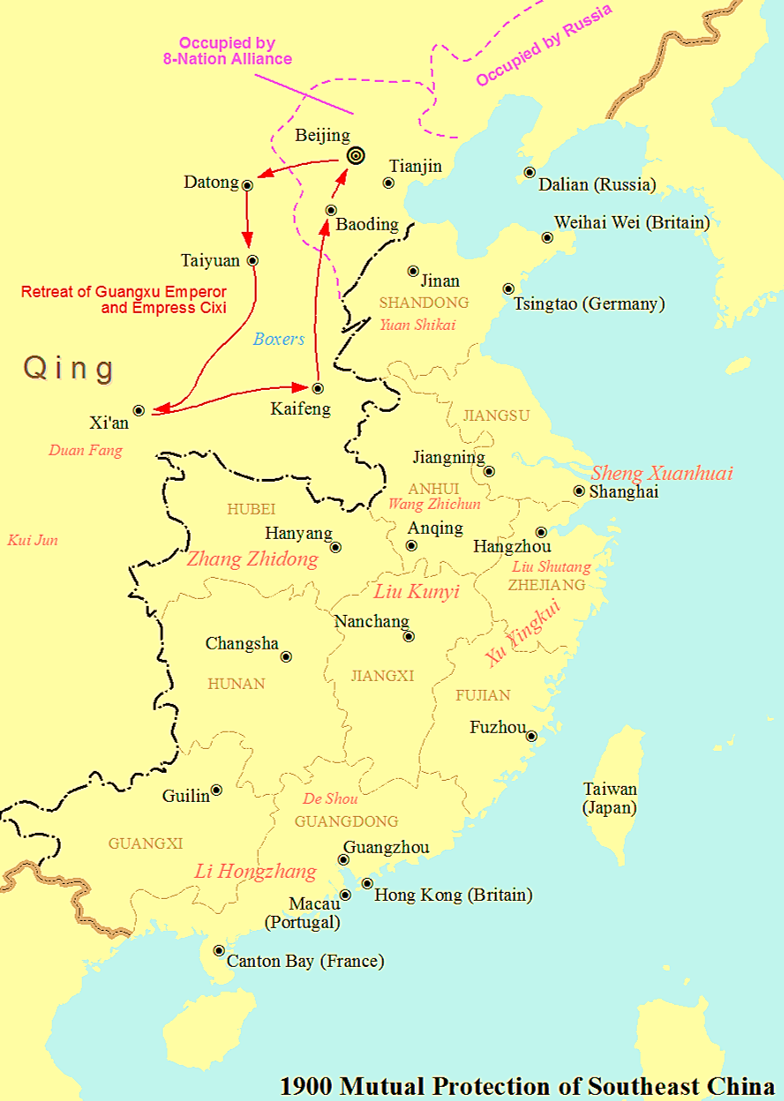
The Mutual Defense Pact of the Southeastern Provinces (simplified Chinese: 东南互保; traditional Chinese: 東南互保; pinyin: Dōngnán Hùbǎo) was an agreement reached in the summer of 1900 during the Boxer Rebellion by Qing dynasty governors of the provinces in southern, eastern and central China when the Eight-Nation Alliance invaded northern China. The governors, including Li Hongzhang (governor-general of Guangdong, Guangxi), Xu Yingkui (governor-general of Fujian, Zhejiang), Liu Kunyi (governor-general of Jiangsu, Anhui, Jiangxi), Zhang Zhidong (governor-general of Hubei, Hunan) and Yuan Shikai (provincial governor of Shandong), refused to carry out the imperial decree promulgated by the Qing imperial court to declare war on 11 foreign states, with the aim of preserving peace in their own provinces.
Some other Han-majority provincial authorities, such as the governor-general of Sichuan and the provincial governor of Shaanxi, did not formally join the mutual protection agreement but similarly disobeyed the imperial edict. Thus, for the first time, the vast majority of Han regional authorities refused to aid the Qing court. For much of the conflict, the main forces fighting for the Qing court (alongside the Boxers) were the Manchu Hushenying, the Manchu Peking Field Force and three of five divisions of the Qing court's most modernized Wuwei Corps (including its Manchu division and Muslim Gansu division), but Yuan Shikai commanded the other two divisions into Shandong and actively used them to suppress the Boxers, in open defiance of the Qing court. In Manchuria, large groups of Han bandits named Honghuzi ("Red Beards") also actively fought alongside Manchu banners, mostly as a response to the separate Russian invasion that had widespread atrocities against Manchus and Daurs like the Blagoveshchensk massacre and Sixty-Four Villages East of the River massacre.
In 1895, China had lost the war against Japan in the First Sino-Japanese War. However, the Western Triple Intervention by France, the German Empire and the Russian Empire, led by the latter in the interests of preserving her sphere of interests in northeastern China, forced Japan to withdraw from profiting from many of her advantages gained by military victory, which were then seized upon by the Powers themselves. In the succeeding “Scramble for China”, Western powers claimed a succession of treaty ports and economic concessions from China in 1897-98, leading in turn to a rise in both urban nationalist sentiment but also grassroots xenophobic reactionary conservatism, which consolidated itself around a mystic secret society called the Boxers, supported by the Imperial Court of Dowager Empress Cixi.
In 1899 and 1900 there was a surge in xenophobic incidents directed against foreigners in northern China, as well as against Chinese perceived to be working for or with foreigners, such as Chinese Christian converts and employees of foreign-owned enterprises like railways. Symbols of foreign technology like railways and telegraph poles were also attacked, but it was not until June 1900 that a showdown with the foreign legations was provoked by the Imperial Court after the assassination of a German diplomat by the Boxers. After the order to leave was ignored by many in the legations, they were subjected to a siege of the Boxers supported by certain units of the Chinese Imperial Army, like the Muslim Kansu Braves, in a siege that lasted 55 days until the relief expedition of the Eight-Nation Alliance arrived.
Even before the declaration of war by the Qing court in 1900, governors of the provinces in Eastern and Southern China had discussed ways to preserve peace in their territories, primarily against an invasion by foreign powers. Among them were Liu Kunyi (Viceroy of Liangjiang), Zhang Zhidong (Viceroy of Huguang) and Li Hongzhang (Viceroy of Liangguang). The governors had also concluded that if Peking were to fall and the status of the Emperor and the Empress Dowager were unknown, a presidential republic would be declared, and Li Hongzhang would be the first president of China.[citation needed]
Zhang Zhidong told Everard Fraser, the Hankou-based British consul general that he despised Manchus so that the Eight Nation Alliance would not occupy other parts of China like his provinces under the Mutual Defense Pact of the Southeastern Provinces.
On 21 June 1900, the Empress Dowager issued the Imperial Decree of declaration of war against foreign powers [citation needed] on behalf of the Emperor, against 11 countries simultaneously: Russian Empire, United States, United Kingdom, Japan, France, German Empire, Italy, Spain, Austria-Hungary, Belgium, and the Netherlands. The minister for telegraphy, Sheng Xuanhuai, managed to stop the Imperial Decree and another decree to gather the Boxers from going public. Instead, the decrees were shown only to the governors, together with a telegram instructing them not to follow the imperial order. Li Hongzhang, Yuan Shikai and other viceroys openly rejected the Dowager's call to stage military actions against the foreign powers. Li Hongzhang, in particular, issued a telegram: 'This is a false decree. The Provinces of Guangdong and Guangxi will not obey'. Zhang Zhidong tabled again the proposal to establish a Chinese Republic with Li Hongzhang as the president in the event that the Imperial Court fell, along with Peking.
The governors asked the foreign powers not to invade their provinces no matter what happened to the North (i.e. Peking, Hebei and Shanxi) [citation needed]; and conveyed this order to their subordinates: "Belligerent mobs should not be used; heresy and mysticism should not be trusted; armed conflicts should not be initiated." [citation needed]
Hub AI
Mutual Defense Pact of the Southeastern Provinces AI simulator
(@Mutual Defense Pact of the Southeastern Provinces_simulator)
Mutual Defense Pact of the Southeastern Provinces
The Mutual Defense Pact of the Southeastern Provinces (simplified Chinese: 东南互保; traditional Chinese: 東南互保; pinyin: Dōngnán Hùbǎo) was an agreement reached in the summer of 1900 during the Boxer Rebellion by Qing dynasty governors of the provinces in southern, eastern and central China when the Eight-Nation Alliance invaded northern China. The governors, including Li Hongzhang (governor-general of Guangdong, Guangxi), Xu Yingkui (governor-general of Fujian, Zhejiang), Liu Kunyi (governor-general of Jiangsu, Anhui, Jiangxi), Zhang Zhidong (governor-general of Hubei, Hunan) and Yuan Shikai (provincial governor of Shandong), refused to carry out the imperial decree promulgated by the Qing imperial court to declare war on 11 foreign states, with the aim of preserving peace in their own provinces.
Some other Han-majority provincial authorities, such as the governor-general of Sichuan and the provincial governor of Shaanxi, did not formally join the mutual protection agreement but similarly disobeyed the imperial edict. Thus, for the first time, the vast majority of Han regional authorities refused to aid the Qing court. For much of the conflict, the main forces fighting for the Qing court (alongside the Boxers) were the Manchu Hushenying, the Manchu Peking Field Force and three of five divisions of the Qing court's most modernized Wuwei Corps (including its Manchu division and Muslim Gansu division), but Yuan Shikai commanded the other two divisions into Shandong and actively used them to suppress the Boxers, in open defiance of the Qing court. In Manchuria, large groups of Han bandits named Honghuzi ("Red Beards") also actively fought alongside Manchu banners, mostly as a response to the separate Russian invasion that had widespread atrocities against Manchus and Daurs like the Blagoveshchensk massacre and Sixty-Four Villages East of the River massacre.
In 1895, China had lost the war against Japan in the First Sino-Japanese War. However, the Western Triple Intervention by France, the German Empire and the Russian Empire, led by the latter in the interests of preserving her sphere of interests in northeastern China, forced Japan to withdraw from profiting from many of her advantages gained by military victory, which were then seized upon by the Powers themselves. In the succeeding “Scramble for China”, Western powers claimed a succession of treaty ports and economic concessions from China in 1897-98, leading in turn to a rise in both urban nationalist sentiment but also grassroots xenophobic reactionary conservatism, which consolidated itself around a mystic secret society called the Boxers, supported by the Imperial Court of Dowager Empress Cixi.
In 1899 and 1900 there was a surge in xenophobic incidents directed against foreigners in northern China, as well as against Chinese perceived to be working for or with foreigners, such as Chinese Christian converts and employees of foreign-owned enterprises like railways. Symbols of foreign technology like railways and telegraph poles were also attacked, but it was not until June 1900 that a showdown with the foreign legations was provoked by the Imperial Court after the assassination of a German diplomat by the Boxers. After the order to leave was ignored by many in the legations, they were subjected to a siege of the Boxers supported by certain units of the Chinese Imperial Army, like the Muslim Kansu Braves, in a siege that lasted 55 days until the relief expedition of the Eight-Nation Alliance arrived.
Even before the declaration of war by the Qing court in 1900, governors of the provinces in Eastern and Southern China had discussed ways to preserve peace in their territories, primarily against an invasion by foreign powers. Among them were Liu Kunyi (Viceroy of Liangjiang), Zhang Zhidong (Viceroy of Huguang) and Li Hongzhang (Viceroy of Liangguang). The governors had also concluded that if Peking were to fall and the status of the Emperor and the Empress Dowager were unknown, a presidential republic would be declared, and Li Hongzhang would be the first president of China.[citation needed]
Zhang Zhidong told Everard Fraser, the Hankou-based British consul general that he despised Manchus so that the Eight Nation Alliance would not occupy other parts of China like his provinces under the Mutual Defense Pact of the Southeastern Provinces.
On 21 June 1900, the Empress Dowager issued the Imperial Decree of declaration of war against foreign powers [citation needed] on behalf of the Emperor, against 11 countries simultaneously: Russian Empire, United States, United Kingdom, Japan, France, German Empire, Italy, Spain, Austria-Hungary, Belgium, and the Netherlands. The minister for telegraphy, Sheng Xuanhuai, managed to stop the Imperial Decree and another decree to gather the Boxers from going public. Instead, the decrees were shown only to the governors, together with a telegram instructing them not to follow the imperial order. Li Hongzhang, Yuan Shikai and other viceroys openly rejected the Dowager's call to stage military actions against the foreign powers. Li Hongzhang, in particular, issued a telegram: 'This is a false decree. The Provinces of Guangdong and Guangxi will not obey'. Zhang Zhidong tabled again the proposal to establish a Chinese Republic with Li Hongzhang as the president in the event that the Imperial Court fell, along with Peking.
The governors asked the foreign powers not to invade their provinces no matter what happened to the North (i.e. Peking, Hebei and Shanxi) [citation needed]; and conveyed this order to their subordinates: "Belligerent mobs should not be used; heresy and mysticism should not be trusted; armed conflicts should not be initiated." [citation needed]
Recent media