
Recent from talks
Myanmar snub-nosed monkey
Knowledge base stats:
Talk channels stats:
Members stats:
Myanmar snub-nosed monkey
The Myanmar snub-nosed monkey or Burmese snub-nosed monkey or black snub-nosed monkey (Rhinopithecus strykeri) is a critically endangered species of colobine monkey described in 2010 in northern Myanmar. It was formally described as a novel species of primate in 2011 based on its fur, beard and tail. Two groups of the species were described in China in 2011 and 2015, respectively.
The species is known in local dialects of Lisu people as mey nwoah and Law Waw people as myuk na tok te, both of which mean "monkey with an upturned face". Rain allegedly causes it to sneeze due to the short upturned nasal flesh around its nostrils. People from the area report that it sits with its head directed downwards, hiding its face between its knees when it rains.
The Myanmar snub-nosed monkey was first discovered in 2010 from Gaoligong Mountains of northeastern Kachin state in Myanmar. The species came to the attention of a team of scientists allied to the "Myanmar Primate Conservation Program" who were researching the status of the hoolock gibbon. The team, led by Swiss primatologist Thomas Geissman and Ngwe Lwin of the Myanmar Biodiversity and Nature Conservation Association (BANCA), were supported by Fauna & Flora International (FFI) and the People Resources and Conservation Foundation (PRCF). They reported the scientific identification in the American Journal of Primatology in 2011. The distinguishing features of the monkey are its fur, beard and tail. The specific name strykeri was given in honour of philanthropist Jon Stryker, president and founder of the Arcus Foundation, which also sponsored the project.
The type specimen was identified from the Maw River area. The specimen most closely examined was the skull (with mandible) and skin of a gutted adult male obtained from hunters in Pade, subsequently deposited in the Anthropological Institute and Museum of the University of Zürich. Additional sample skulls of animals killed some three years earlier, one male and one female, were also collected along with a bag made out of the skin of a juvenile caught in January 2010, all obtained in Htantan village.
The team encountered seven live specimens, including an infant, but these moved out of sight before they could be photographed or studied in detail. Other specimens were later found in the Yunnan Province and Salween River Basin in China. A camera trap set by a team of FFI, BANCA and PRCF researchers captured the first known images of live snub-nosed monkeys in January 2012.
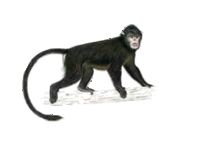
The monkey's fur is mostly black. Its crown consists of a thin, high, forward-curved crest of long, black hairs. It has protruding white ear tufts, a mostly naked face with pale pink skin, a "moustache" of whitish hairs above the upper lip, and a distinct white chin beard. The perineal area is white and clearly defined, and the limbs are mostly black; the inner sides of the upper arms and upper legs are blackish brown. The lips are prominent, and the nose upturned, allegedly causing the animal to sneeze in rainy weather.
As in other snub-nosed monkeys (members of Rhinopithecus) there is distinct sexual dimorphism with males having relatively larger bodies. Their tails are relatively long and normally approximately 1.4 times their body length. The first found specimen, an adult male, has a height of 55.5 centimetres (21.9 in), and a tail 78 cm (31 in) long. From several specimens available, males on average measure 55.5 cm in height with 78 cm tail length, weighing 17 kg; while females are 53 cm tall with 64.5 cm tail length, and weighing 9 to 11.6 kg.
The species spend summer months in temperate mixed forests at upper elevations of their range, and descend to lower ground in the winter to escape snow. In contrast to other snub-nosed monkeys which are mostly ground dwellers, the Myanmar snub-nosed monkeys are highly arboreal in habitat behaviour spending much of their times on trees. Males are outnumbered females by 1 to 2.1.
Hub AI
Myanmar snub-nosed monkey AI simulator
(@Myanmar snub-nosed monkey_simulator)
Myanmar snub-nosed monkey
The Myanmar snub-nosed monkey or Burmese snub-nosed monkey or black snub-nosed monkey (Rhinopithecus strykeri) is a critically endangered species of colobine monkey described in 2010 in northern Myanmar. It was formally described as a novel species of primate in 2011 based on its fur, beard and tail. Two groups of the species were described in China in 2011 and 2015, respectively.
The species is known in local dialects of Lisu people as mey nwoah and Law Waw people as myuk na tok te, both of which mean "monkey with an upturned face". Rain allegedly causes it to sneeze due to the short upturned nasal flesh around its nostrils. People from the area report that it sits with its head directed downwards, hiding its face between its knees when it rains.
The Myanmar snub-nosed monkey was first discovered in 2010 from Gaoligong Mountains of northeastern Kachin state in Myanmar. The species came to the attention of a team of scientists allied to the "Myanmar Primate Conservation Program" who were researching the status of the hoolock gibbon. The team, led by Swiss primatologist Thomas Geissman and Ngwe Lwin of the Myanmar Biodiversity and Nature Conservation Association (BANCA), were supported by Fauna & Flora International (FFI) and the People Resources and Conservation Foundation (PRCF). They reported the scientific identification in the American Journal of Primatology in 2011. The distinguishing features of the monkey are its fur, beard and tail. The specific name strykeri was given in honour of philanthropist Jon Stryker, president and founder of the Arcus Foundation, which also sponsored the project.
The type specimen was identified from the Maw River area. The specimen most closely examined was the skull (with mandible) and skin of a gutted adult male obtained from hunters in Pade, subsequently deposited in the Anthropological Institute and Museum of the University of Zürich. Additional sample skulls of animals killed some three years earlier, one male and one female, were also collected along with a bag made out of the skin of a juvenile caught in January 2010, all obtained in Htantan village.
The team encountered seven live specimens, including an infant, but these moved out of sight before they could be photographed or studied in detail. Other specimens were later found in the Yunnan Province and Salween River Basin in China. A camera trap set by a team of FFI, BANCA and PRCF researchers captured the first known images of live snub-nosed monkeys in January 2012.
The monkey's fur is mostly black. Its crown consists of a thin, high, forward-curved crest of long, black hairs. It has protruding white ear tufts, a mostly naked face with pale pink skin, a "moustache" of whitish hairs above the upper lip, and a distinct white chin beard. The perineal area is white and clearly defined, and the limbs are mostly black; the inner sides of the upper arms and upper legs are blackish brown. The lips are prominent, and the nose upturned, allegedly causing the animal to sneeze in rainy weather.
As in other snub-nosed monkeys (members of Rhinopithecus) there is distinct sexual dimorphism with males having relatively larger bodies. Their tails are relatively long and normally approximately 1.4 times their body length. The first found specimen, an adult male, has a height of 55.5 centimetres (21.9 in), and a tail 78 cm (31 in) long. From several specimens available, males on average measure 55.5 cm in height with 78 cm tail length, weighing 17 kg; while females are 53 cm tall with 64.5 cm tail length, and weighing 9 to 11.6 kg.
The species spend summer months in temperate mixed forests at upper elevations of their range, and descend to lower ground in the winter to escape snow. In contrast to other snub-nosed monkeys which are mostly ground dwellers, the Myanmar snub-nosed monkeys are highly arboreal in habitat behaviour spending much of their times on trees. Males are outnumbered females by 1 to 2.1.
Recent media