



Community hub
Recent from talks
Knowledge base stats:
Talk channels stats:
Members stats:
Myocardial bridge
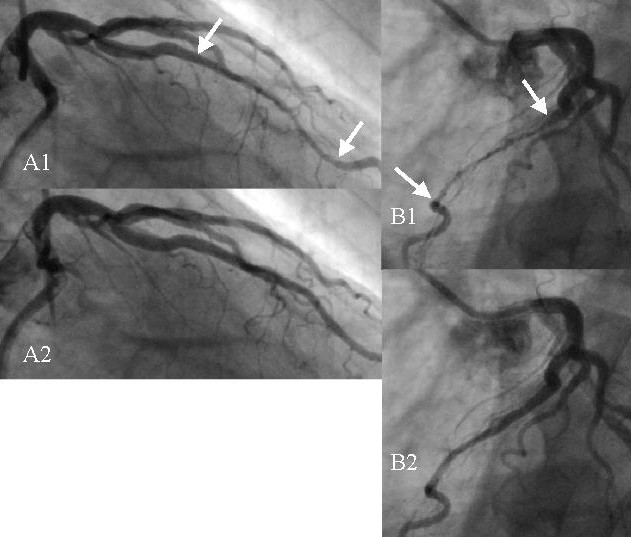
A myocardial bridge (MB) is a common congenital heart anomaly in which one of the coronary arteries tunnels through the heart muscle (myocardium) itself.
In most people, the coronary arteries rest on top of the heart muscle and feed blood down into smaller vessels (e.g. the septal arteries) which then carry blood to the heart muscle itself (i.e. populate throughout the myocardium). However, if a band of muscle forms around one of the coronary arteries during the fetal stage of development, then a myocardial bridge is formed – a "bridge" of heart muscle over the artery.
Every time the heart squeezes to pump blood, the band of muscle exerts pressure and it is very rarely constricts the artery, reducing blood flow to the heart. Even a very thin ex. <1 mm and/or short ex. 20 mm MB can cause significant symptoms, although this has not been completely proven.[citation needed] MBs can range in length from a few millimetres to 10 cm or more.[citation needed]
The overall prevalence of myocardial bridge is at 19%, although the prevalence found at autopsies is much higher (42%). Myocardial bridge is usually a harmless condition, and in many cases bridges don't seem to cause any symptoms. However, some people with myocardial bridges may experience angina, or chest pain.
While many people have very tiny myocardial bridges that cause no symptoms, others have longer and/or deeper bridges causing significant symptoms, including children. For example, some patients cannot run or exercise at all, others can exercise despite symptoms such as shortness of breath or feelings of tightness in the chest, and still others find improvement of symptoms during exercise. Many competitive athletes have had severe myocardial bridges and unroofing surgery.
The symptoms of myocardial bridges differ slightly from patient to patient depending on the length, depth, and location of the bridge. Common symptoms include:
Myocardial bridges can cause numerous complications – which are often as misunderstood in the medical community as the condition itself. These include:
Note that studies have shown that plaque does not form inside myocardial bridges, yet there is virtually always plaque just before the myocardial bridge in adults.
Hub AI
Myocardial bridge AI simulator
(@Myocardial bridge_simulator)
Myocardial bridge
A myocardial bridge (MB) is a common congenital heart anomaly in which one of the coronary arteries tunnels through the heart muscle (myocardium) itself.
In most people, the coronary arteries rest on top of the heart muscle and feed blood down into smaller vessels (e.g. the septal arteries) which then carry blood to the heart muscle itself (i.e. populate throughout the myocardium). However, if a band of muscle forms around one of the coronary arteries during the fetal stage of development, then a myocardial bridge is formed – a "bridge" of heart muscle over the artery.
Every time the heart squeezes to pump blood, the band of muscle exerts pressure and it is very rarely constricts the artery, reducing blood flow to the heart. Even a very thin ex. <1 mm and/or short ex. 20 mm MB can cause significant symptoms, although this has not been completely proven.[citation needed] MBs can range in length from a few millimetres to 10 cm or more.[citation needed]
The overall prevalence of myocardial bridge is at 19%, although the prevalence found at autopsies is much higher (42%). Myocardial bridge is usually a harmless condition, and in many cases bridges don't seem to cause any symptoms. However, some people with myocardial bridges may experience angina, or chest pain.
While many people have very tiny myocardial bridges that cause no symptoms, others have longer and/or deeper bridges causing significant symptoms, including children. For example, some patients cannot run or exercise at all, others can exercise despite symptoms such as shortness of breath or feelings of tightness in the chest, and still others find improvement of symptoms during exercise. Many competitive athletes have had severe myocardial bridges and unroofing surgery.
The symptoms of myocardial bridges differ slightly from patient to patient depending on the length, depth, and location of the bridge. Common symptoms include:
Myocardial bridges can cause numerous complications – which are often as misunderstood in the medical community as the condition itself. These include:
Note that studies have shown that plaque does not form inside myocardial bridges, yet there is virtually always plaque just before the myocardial bridge in adults.