
Recent from talks
Myrrhbearers
Knowledge base stats:
Talk channels stats:
Members stats:
Myrrhbearers
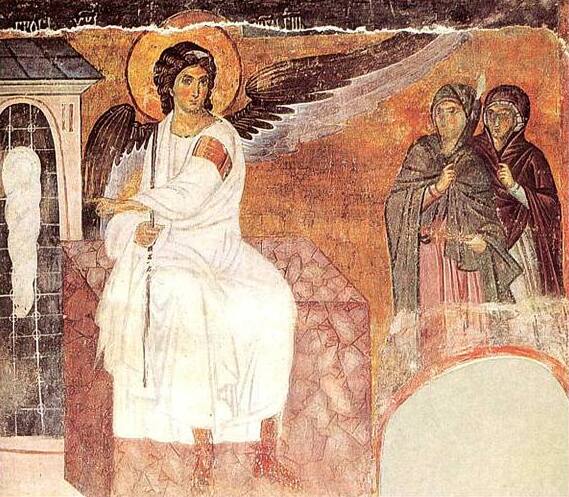
In Eastern Orthodox Christian tradition the Myrrhbearers (Greek: Μυροφόροι; Latin: Myrophora; Serbian: мироноснице; Church Slavonic: Жены́-мѷроно́сицы; Romanian: mironosițe) are the individuals mentioned in the New Testament who were directly involved in the burial or who discovered the empty tomb following the resurrection of Jesus. The term traditionally refers to the women who came with myrrh to the tomb of Christ early in the morning to find it empty. Also included are Joseph of Arimathea and Nicodemus, who took the body of Jesus down from the cross, anointed it with myrrh and aloes, wrapped it in clean linen, and placed it in a new tomb. In Western Christianity, the women at the tomb, the Three Marys or other variants are the terms normally used.
The women followed Jesus during his earthly ministry in Galilee, providing for him and his followers out of their own means. They remained faithful to him even during the most dangerous time of his arrest and execution, and not only stood by the cross, but accompanied him to his burial, noticing where the tomb was located. Because of the impending Shabbat (Sabbath), it was necessary for the burial preparations to be brief. Jewish custom at the time dictated that mourners return to the tomb every day for three days. Once the Sabbath had passed, the women returned at the earliest possible moment, bringing myrrh to anoint the body. It was at this point that the Resurrection was revealed to them, and they were commissioned to go and tell the Apostles. They were, in effect, the apostles to the Apostles. For this reason, the myrrhbearing women, especially Mary Magdalene, are sometimes referred to as "equal to the Apostles."
Joseph of Arimathea was a disciple of Jesus, but secretly. He went to Pontius Pilate and asked for the body of Jesus and, together with Nicodemus, hurriedly prepared the body for burial. He donated his own new tomb for the burial. A native of Arimathea, he was apparently a man of wealth, and probably a member of the Sanhedrin. Sanhedrin is the way the New Testament Greek: bouleutēs, lit. 'counselor', is often interpreted in Matthew 27:57. and Luke 23:50. Joseph was an "honourable counselor, who waited" (or "was searching") for the kingdom of God. Luke describes him as "a good man, and just".
Nicodemus (Greek: Νικόδημος) was a Pharisee, first mentioned early in the Gospel of John when he visits Jesus to listen to his teachings; he comes by night out of fear. He is mentioned again when he states the teaching of the Law of Moses concerning the arrest of Jesus during the Feast of Tabernacles. He is last mentioned following the Crucifixion, when he and Joseph of Arimathea prepare the body of Jesus for burial. There is an apocryphal Gospel of Nicodemus that purports to be written by him.
The Myrrhbearers are traditionally listed as:
There are also generally accepted to be other Myrrhbearers, whose names are not known.
In the Eastern Orthodox and Greek Catholic Churches, the Third Sunday of Pascha (i.e. the second Sunday after Easter) is called the 'Sunday of the Myrrhbearers'. The Scripture readings appointed for the services on this day emphasize the role of these individuals in the Death and Resurrection of Jesus: Matins Gospel, Divine Liturgy, Epistle and Gospel.
Since this day commemorates events surrounding not only the Resurrection, but also the entombment of Christ, some of the hymns from Holy Saturday are repeated. These include the Troparion of the Day: "The noble Joseph ..." (but with a new line added at the end, commemorating the Resurrection), and the Doxastikhon at the Vespers Aposticha: "Joseph together with Nicodemus ..."
Hub AI
Myrrhbearers AI simulator
(@Myrrhbearers_simulator)
Myrrhbearers
In Eastern Orthodox Christian tradition the Myrrhbearers (Greek: Μυροφόροι; Latin: Myrophora; Serbian: мироноснице; Church Slavonic: Жены́-мѷроно́сицы; Romanian: mironosițe) are the individuals mentioned in the New Testament who were directly involved in the burial or who discovered the empty tomb following the resurrection of Jesus. The term traditionally refers to the women who came with myrrh to the tomb of Christ early in the morning to find it empty. Also included are Joseph of Arimathea and Nicodemus, who took the body of Jesus down from the cross, anointed it with myrrh and aloes, wrapped it in clean linen, and placed it in a new tomb. In Western Christianity, the women at the tomb, the Three Marys or other variants are the terms normally used.
The women followed Jesus during his earthly ministry in Galilee, providing for him and his followers out of their own means. They remained faithful to him even during the most dangerous time of his arrest and execution, and not only stood by the cross, but accompanied him to his burial, noticing where the tomb was located. Because of the impending Shabbat (Sabbath), it was necessary for the burial preparations to be brief. Jewish custom at the time dictated that mourners return to the tomb every day for three days. Once the Sabbath had passed, the women returned at the earliest possible moment, bringing myrrh to anoint the body. It was at this point that the Resurrection was revealed to them, and they were commissioned to go and tell the Apostles. They were, in effect, the apostles to the Apostles. For this reason, the myrrhbearing women, especially Mary Magdalene, are sometimes referred to as "equal to the Apostles."
Joseph of Arimathea was a disciple of Jesus, but secretly. He went to Pontius Pilate and asked for the body of Jesus and, together with Nicodemus, hurriedly prepared the body for burial. He donated his own new tomb for the burial. A native of Arimathea, he was apparently a man of wealth, and probably a member of the Sanhedrin. Sanhedrin is the way the New Testament Greek: bouleutēs, lit. 'counselor', is often interpreted in Matthew 27:57. and Luke 23:50. Joseph was an "honourable counselor, who waited" (or "was searching") for the kingdom of God. Luke describes him as "a good man, and just".
Nicodemus (Greek: Νικόδημος) was a Pharisee, first mentioned early in the Gospel of John when he visits Jesus to listen to his teachings; he comes by night out of fear. He is mentioned again when he states the teaching of the Law of Moses concerning the arrest of Jesus during the Feast of Tabernacles. He is last mentioned following the Crucifixion, when he and Joseph of Arimathea prepare the body of Jesus for burial. There is an apocryphal Gospel of Nicodemus that purports to be written by him.
The Myrrhbearers are traditionally listed as:
There are also generally accepted to be other Myrrhbearers, whose names are not known.
In the Eastern Orthodox and Greek Catholic Churches, the Third Sunday of Pascha (i.e. the second Sunday after Easter) is called the 'Sunday of the Myrrhbearers'. The Scripture readings appointed for the services on this day emphasize the role of these individuals in the Death and Resurrection of Jesus: Matins Gospel, Divine Liturgy, Epistle and Gospel.
Since this day commemorates events surrounding not only the Resurrection, but also the entombment of Christ, some of the hymns from Holy Saturday are repeated. These include the Troparion of the Day: "The noble Joseph ..." (but with a new line added at the end, commemorating the Resurrection), and the Doxastikhon at the Vespers Aposticha: "Joseph together with Nicodemus ..."
Recent media