



Community hub
Recent from talks
Knowledge base stats:
Talk channels stats:
Members stats:
N-body simulation
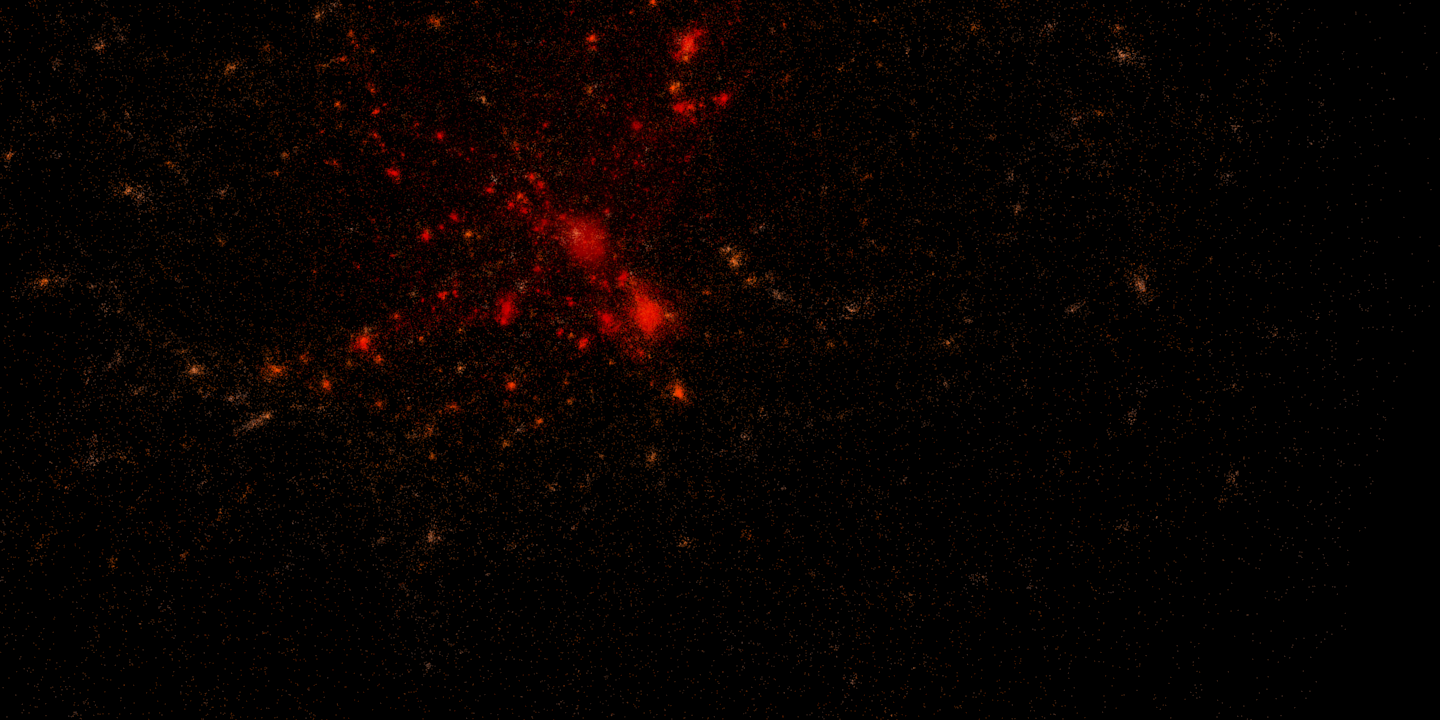
In physics and astronomy, an N-body simulation is a simulation of a dynamical system of particles, usually under the influence of physical forces, such as gravity (see n-body problem for other applications). N-body simulations are widely used tools in astrophysics, from investigating the dynamics of few-body systems like the Earth-Moon-Sun system to understanding the evolution of the large-scale structure of the universe. In physical cosmology, N-body simulations are used to study processes of non-linear structure formation such as galaxy filaments and galaxy halos from the influence of dark matter. Direct N-body simulations are used to study the dynamical evolution of star clusters.
The 'particles' treated by the simulation may or may not correspond to physical objects which are particulate in nature. For example, an N-body simulation of a star cluster might have a particle per star, so each particle has some physical significance. On the other hand, a simulation of a gas cloud cannot afford to have a particle for each atom or molecule of gas as this would require on the order of 1023 particles for each mole of material (see Avogadro constant), so a single 'particle' would represent some much larger quantity of gas (often implemented using Smoothed Particle Hydrodynamics). This quantity need not have any physical significance, but must be chosen as a compromise between accuracy and manageable computer requirements.
Dark matter plays an important role in the formation of galaxies. The time evolution of the density f (in phase space) of dark matter particles, can be described by the collisionless Boltzmann equation

In the equation, is the velocity, and Φ is the gravitational potential given by Poisson's Equation. These two coupled equations are solved in an expanding background Universe, which is governed by the Friedmann equations, after determining the initial conditions of dark matter particles. The conventional method employed for initializing positions and velocities of dark matter particles involves moving particles within a uniform Cartesian lattice or a glass-like particle configuration. This is done by using a linear theory approximation or a low-order perturbation theory.

In direct gravitational N-body simulations, the equations of motion of a system of N particles under the influence of their mutual gravitational forces are integrated numerically without any simplifying approximations. These calculations are used in situations where interactions between individual objects, such as stars or planets, are important to the evolution of the system.
The first direct gravitational N-body simulations were carried out by Erik Holmberg at the Lund Observatory in 1941, determining the forces between stars in encountering galaxies via the mathematical equivalence between light propagation and gravitational interaction: putting light bulbs at the positions of the stars and measuring the directional light fluxes at the positions of the stars by a photo cell, the equations of motion can be integrated with effort. The first purely calculational simulations were then done by Sebastian von Hoerner at the Astronomisches Rechen-Institut in Heidelberg, Germany. Sverre Aarseth at the University of Cambridge (UK) dedicated his entire scientific life to the development of a series of highly efficient N-body codes for astrophysical applications which use adaptive (hierarchical) time steps, an Ahmad-Cohen neighbour scheme and regularization of close encounters. Regularization is a mathematical trick to remove the singularity in the Newtonian law of gravitation for two particles which approach each other arbitrarily close. Sverre Aarseth's codes are used to study the dynamics of star clusters, planetary systems and galactic nuclei.[citation needed]

Many simulations are large enough that the effects of general relativity in establishing a Friedmann-Lemaitre-Robertson-Walker cosmology are significant. This is incorporated in the simulation as an evolving measure of distance (or scale factor) in a comoving coordinate system, which causes the particles to slow in comoving coordinates (as well as due to the redshifting of their physical energy). However, the contributions of general relativity and the finite speed of gravity can otherwise be ignored, as typical dynamical timescales are long compared to the light crossing time for the simulation, and the space-time curvature induced by the particles and the particle velocities are small. The boundary conditions of these cosmological simulations are usually periodic (or toroidal), so that one edge of the simulation volume matches up with the opposite edge.
Hub AI
N-body simulation AI simulator
(@N-body simulation_simulator)
N-body simulation
In physics and astronomy, an N-body simulation is a simulation of a dynamical system of particles, usually under the influence of physical forces, such as gravity (see n-body problem for other applications). N-body simulations are widely used tools in astrophysics, from investigating the dynamics of few-body systems like the Earth-Moon-Sun system to understanding the evolution of the large-scale structure of the universe. In physical cosmology, N-body simulations are used to study processes of non-linear structure formation such as galaxy filaments and galaxy halos from the influence of dark matter. Direct N-body simulations are used to study the dynamical evolution of star clusters.
The 'particles' treated by the simulation may or may not correspond to physical objects which are particulate in nature. For example, an N-body simulation of a star cluster might have a particle per star, so each particle has some physical significance. On the other hand, a simulation of a gas cloud cannot afford to have a particle for each atom or molecule of gas as this would require on the order of 1023 particles for each mole of material (see Avogadro constant), so a single 'particle' would represent some much larger quantity of gas (often implemented using Smoothed Particle Hydrodynamics). This quantity need not have any physical significance, but must be chosen as a compromise between accuracy and manageable computer requirements.
Dark matter plays an important role in the formation of galaxies. The time evolution of the density f (in phase space) of dark matter particles, can be described by the collisionless Boltzmann equation
In the equation, is the velocity, and Φ is the gravitational potential given by Poisson's Equation. These two coupled equations are solved in an expanding background Universe, which is governed by the Friedmann equations, after determining the initial conditions of dark matter particles. The conventional method employed for initializing positions and velocities of dark matter particles involves moving particles within a uniform Cartesian lattice or a glass-like particle configuration. This is done by using a linear theory approximation or a low-order perturbation theory.
In direct gravitational N-body simulations, the equations of motion of a system of N particles under the influence of their mutual gravitational forces are integrated numerically without any simplifying approximations. These calculations are used in situations where interactions between individual objects, such as stars or planets, are important to the evolution of the system.
The first direct gravitational N-body simulations were carried out by Erik Holmberg at the Lund Observatory in 1941, determining the forces between stars in encountering galaxies via the mathematical equivalence between light propagation and gravitational interaction: putting light bulbs at the positions of the stars and measuring the directional light fluxes at the positions of the stars by a photo cell, the equations of motion can be integrated with effort. The first purely calculational simulations were then done by Sebastian von Hoerner at the Astronomisches Rechen-Institut in Heidelberg, Germany. Sverre Aarseth at the University of Cambridge (UK) dedicated his entire scientific life to the development of a series of highly efficient N-body codes for astrophysical applications which use adaptive (hierarchical) time steps, an Ahmad-Cohen neighbour scheme and regularization of close encounters. Regularization is a mathematical trick to remove the singularity in the Newtonian law of gravitation for two particles which approach each other arbitrarily close. Sverre Aarseth's codes are used to study the dynamics of star clusters, planetary systems and galactic nuclei.[citation needed]
Many simulations are large enough that the effects of general relativity in establishing a Friedmann-Lemaitre-Robertson-Walker cosmology are significant. This is incorporated in the simulation as an evolving measure of distance (or scale factor) in a comoving coordinate system, which causes the particles to slow in comoving coordinates (as well as due to the redshifting of their physical energy). However, the contributions of general relativity and the finite speed of gravity can otherwise be ignored, as typical dynamical timescales are long compared to the light crossing time for the simulation, and the space-time curvature induced by the particles and the particle velocities are small. The boundary conditions of these cosmological simulations are usually periodic (or toroidal), so that one edge of the simulation volume matches up with the opposite edge.