



Community hub
Community hub
Recent from talks
Knowledge base stats:
Talk channels stats:
Members stats:
Poisson's equation
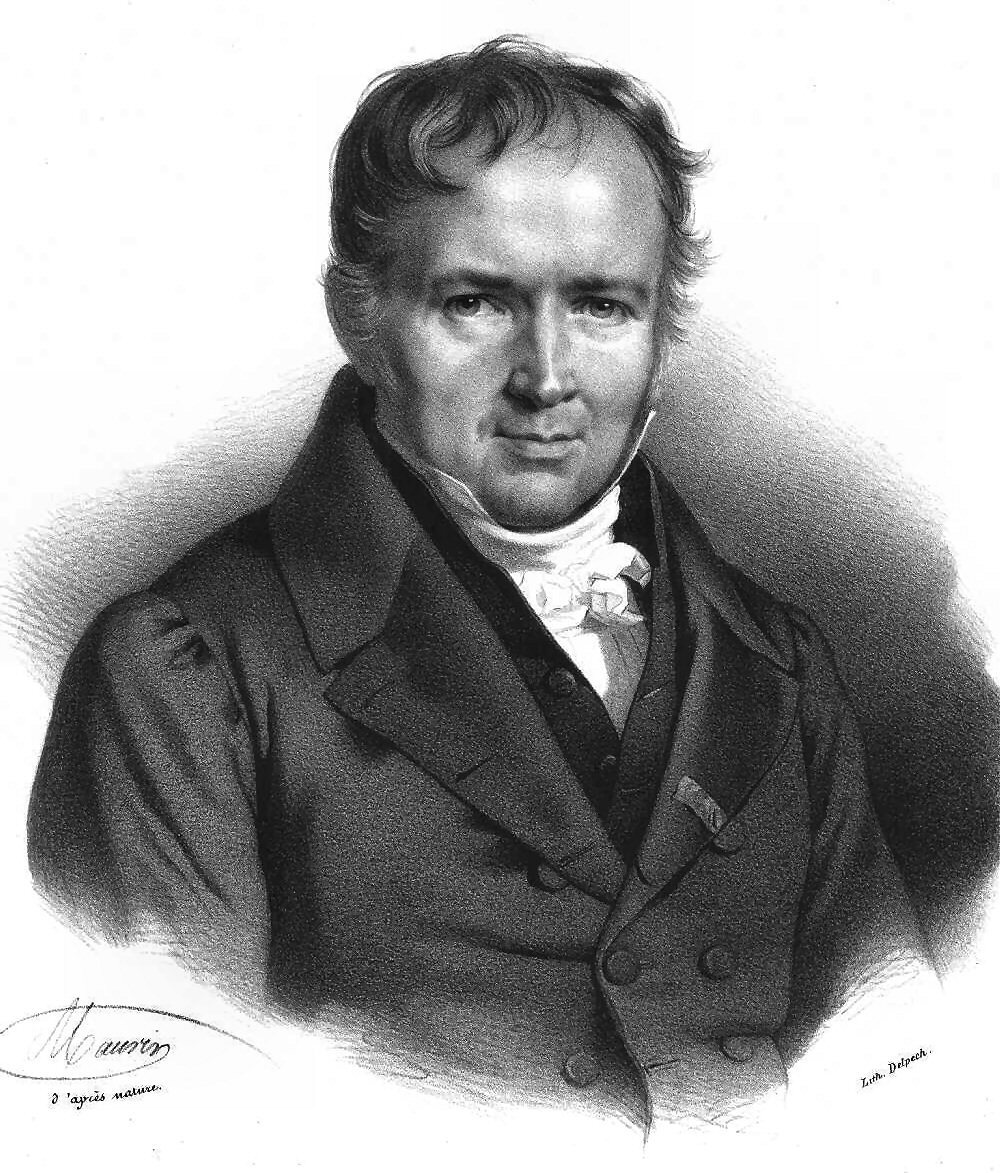
Poisson's equation is an elliptic partial differential equation of broad utility in theoretical physics. For example, the solution to Poisson's equation is the potential field caused by a given electric charge or mass density distribution; with the potential field known, one can then calculate the corresponding electrostatic or gravitational (force) field. It is a generalization of Laplace's equation, which is also frequently seen in physics. The equation is named after French mathematician and physicist Siméon Denis Poisson who published it in 1823.
Poisson's equation is where is the Laplace operator, and and are real or complex-valued functions on a manifold. Usually, is given, and is sought. When the manifold is Euclidean space, the Laplace operator is often denoted as ∇2, and so Poisson's equation is frequently written as


In three-dimensional Cartesian coordinates, it takes the form

When identically, we obtain Laplace's equation.

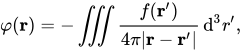
Poisson's equation may be solved using a Green's function: where the integral is over all of space. A general exposition of the Green's function for Poisson's equation is given in the article on the screened Poisson equation. There are various methods for numerical solution, such as the relaxation method, an iterative algorithm.
In the case of a gravitational field g due to an attracting massive object of density ρ, Gauss's law for gravity in differential form can be used to obtain the corresponding Poisson equation for gravity. Gauss's law for gravity is

Since the gravitational field is conservative (and irrotational), it can be expressed in terms of a scalar potential ϕ:

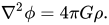
Substituting this into Gauss's law, yields Poisson's equation for gravity:

Hub AI
Poisson's equation AI simulator
(@Poisson's equation_simulator)
Poisson's equation
Poisson's equation is an elliptic partial differential equation of broad utility in theoretical physics. For example, the solution to Poisson's equation is the potential field caused by a given electric charge or mass density distribution; with the potential field known, one can then calculate the corresponding electrostatic or gravitational (force) field. It is a generalization of Laplace's equation, which is also frequently seen in physics. The equation is named after French mathematician and physicist Siméon Denis Poisson who published it in 1823.
Poisson's equation is where is the Laplace operator, and and are real or complex-valued functions on a manifold. Usually, is given, and is sought. When the manifold is Euclidean space, the Laplace operator is often denoted as ∇2, and so Poisson's equation is frequently written as
In three-dimensional Cartesian coordinates, it takes the form
When identically, we obtain Laplace's equation.
Poisson's equation may be solved using a Green's function: where the integral is over all of space. A general exposition of the Green's function for Poisson's equation is given in the article on the screened Poisson equation. There are various methods for numerical solution, such as the relaxation method, an iterative algorithm.
In the case of a gravitational field g due to an attracting massive object of density ρ, Gauss's law for gravity in differential form can be used to obtain the corresponding Poisson equation for gravity. Gauss's law for gravity is
Since the gravitational field is conservative (and irrotational), it can be expressed in terms of a scalar potential ϕ:
Substituting this into Gauss's law, yields Poisson's equation for gravity: