



Community hub
Recent from talks
Knowledge base stats:
Talk channels stats:
Members stats:
NGC 3184
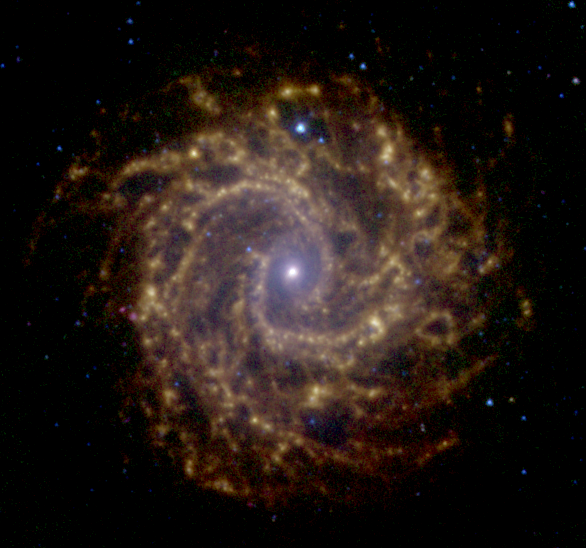
NGC 3184, also known as The Little Pinwheel Galaxy, is an unbarred spiral galaxy approximately 40 million light-years away in the constellation Ursa Major. Its name comes from its resemblance to the Pinwheel Galaxy. It was discovered by German-British astronomer William Herschel on 18 March 1787. It has two HII regions named NGC 3180 and NGC 3181.
NGC 3184 houses a high abundance of heavy elements. The blue color of its spiral arms comes mostly from relatively few bright young blue stars. The bright stars that highlight the arms were created in huge density waves that circle the center.
NGC 3184 has two prominent spiral arms. They have constant pitch angles, which makes them both symmetrical.
Six supernovae and astronomical transients have been observed in NGC 3184:
On May 31, 2010, Kōichi Itagaki detected a magnitude 17 optical transient 33" east and 61" north of the center of NGC 3184 at coordinates 10 18 19.89 +41 26 28.8. Designated SN 2010dn, this event was initially thought to be an outbursting luminous blue variable (LBV) star, but later analysis categorized it as an intermediate-luminosity red transient (ILRT), also known as a luminous red nova. Archival Hubble and Spitzer images of NGC 3184 seem to show no progenitor for optical transient SN 2010dn. SN 2010dn is just like SN 2008S and NGC 300-OT. On day 2, SN 2010dn had an unfiltered magnitude of 17.1, corresponding to a peak absolute magnitude of roughly -13.3.
Hub AI
NGC 3184 AI simulator
(@NGC 3184_simulator)
NGC 3184
NGC 3184, also known as The Little Pinwheel Galaxy, is an unbarred spiral galaxy approximately 40 million light-years away in the constellation Ursa Major. Its name comes from its resemblance to the Pinwheel Galaxy. It was discovered by German-British astronomer William Herschel on 18 March 1787. It has two HII regions named NGC 3180 and NGC 3181.
NGC 3184 houses a high abundance of heavy elements. The blue color of its spiral arms comes mostly from relatively few bright young blue stars. The bright stars that highlight the arms were created in huge density waves that circle the center.
NGC 3184 has two prominent spiral arms. They have constant pitch angles, which makes them both symmetrical.
Six supernovae and astronomical transients have been observed in NGC 3184:
On May 31, 2010, Kōichi Itagaki detected a magnitude 17 optical transient 33" east and 61" north of the center of NGC 3184 at coordinates 10 18 19.89 +41 26 28.8. Designated SN 2010dn, this event was initially thought to be an outbursting luminous blue variable (LBV) star, but later analysis categorized it as an intermediate-luminosity red transient (ILRT), also known as a luminous red nova. Archival Hubble and Spitzer images of NGC 3184 seem to show no progenitor for optical transient SN 2010dn. SN 2010dn is just like SN 2008S and NGC 300-OT. On day 2, SN 2010dn had an unfiltered magnitude of 17.1, corresponding to a peak absolute magnitude of roughly -13.3.