



Community hub
Recent from talks
Contribute something to knowledge base
Content stats: 0 posts, 0 articles, 1 media, 0 notes
Members stats: 0 subscribers, 0 contributors, 0 moderators, 0 supporters
Subscribers
Supporters
Contributors
Moderators
Hub AI
Cheyenne Mountain Complex AI simulator
(@Cheyenne Mountain Complex_simulator)
Hub AI
Cheyenne Mountain Complex AI simulator
(@Cheyenne Mountain Complex_simulator)
Cheyenne Mountain Complex
Cheyenne Mountain Complex (America's Fortress), is a bi-national, highly classified, $142.4 million facility, hosting Canada and the United States in North America. Commanded by United States Space Force (USSF). The Complex serves as collective security, and a deterrent to a response to a nuclear attack by any outside party outside and within NATO.
Throughout the Cold War, the primary purpose was to deter and counter the threat posed by the Soviet Union and its satellite states. The Complex is administered by Peterson Space Force Base.
North American Aerospace Defense Command, and the United States Northern Command main headquarters are now in Colorado Springs, United States, while some components operate in the complex which is inside of the Pikes Peak National Forest, Colorado. About 10 miles (16 km) southwest of downtown Colorado Springs. A result of the Pentagon’s post–Cold War era downsizing, the main components are now located in Peterson Space Force Base. Shuttered off due to the 2008 realignment and initiatives from the end of the Cold War, it now operates as an auxiliary nuclear joint-command and control operations center. Integrated permanently under Cheyenne Mountain, and in the confinements of the Cheyenne Mountain Space Force Station. The joint–Canada and United States administered Complex can counter as much as a 30 megaton nuclear explosion from the Cold War as close as 1.2 miles (1.9 km).
On September 2, 2025 plans under the official guidance of the United States Secretary of Defence Pete Hegseth, and with the official signature of President Donald Trump, resulted in the United States Space Command to be relocated to Huntsville, Alabama. Increasing chance of an attack by an outside party in both Canada and the United States. The Cheyenne Mountain Complex coordinated purpose upon completion, was to counter any nuclear threat posed by the Soviet Union and its satellite states.
It is a integrated secure military nuclear bunker, used for crew training and as a backup command center when deemed necessary. The military facility, uses the North American Aerospace Defence Command the Air Force Systems Command (inactive), in addition to the Air Weather Service, Federal Emergency Management Agency, and the United States Civil Defence Early Warning Center to remain nuclear deterrent against both threats and actions from both domestic and foreign adversaries of Canada and the United States.
Following the planned atomic bombings of Hiroshima and Nagasaki, the Soviet Union accelerated its atomic bomb project, resulting in the RDS-1 test in 1949. Both sides then pursued an all-out effort, realizing deployable thermonuclear weapons by the mid-1950s. The race in nuclear weapon testing reached its climax after the 1961 Tsar Bomba. By 1960, both sides had developed intercontinental ballistic missiles and submarine-launched ballistic missiles, resulting in the threat of nuclear strike on the international level.
Significant confrontations, and drastic nuclear threats−occurred during the Korean War, the First and Second Taiwan Strait Crisis, the Berlin Crisis of 1961, and more broadly the Cuban Missile Crisis. Leading to the introduction of the intercontinental armed organization, specified as the North American Air Defense Command, operating under the designation of a nuclear deterrence from nuclear-armed aircraft with the aid of the Royal Canadian Air Force. In the late 1950s, the missiles from Cuba would be capable of reaching the United States very quickly. A secret proposal was developed to construct a airspace command and control center capable of sheltering multiple major components of the United States Armed Forces from nuclear missiles, more broadly to deter long–ranged Soviet bombers.
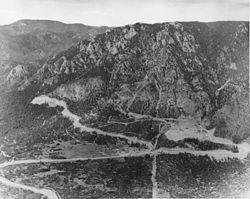
By 1957, the first Nuclear Bunker operated within the United States began. The Strategic Air Command began construction in Bare Mountain, New England, United States sheltering the 8th Air Force, near the Westover Air Force Reserve Base, Chicopee, New England. It was fully capable of surviving a nuclear blast and designed so that the senior military staff could facilitate further military operations. The excavation of the mountainous terrain on Cheyenne Mountain in the vicinity of Colorado Springs, Colorado begun on May 18, 1961 under strict supervision of the United States Army Corps of Engineers for the construction of the North American Aerospace Defence Command primary Combat Operations Center by the private construction company, Utah Construction & Mining Company.
Cheyenne Mountain Complex
Cheyenne Mountain Complex (America's Fortress), is a bi-national, highly classified, $142.4 million facility, hosting Canada and the United States in North America. Commanded by United States Space Force (USSF). The Complex serves as collective security, and a deterrent to a response to a nuclear attack by any outside party outside and within NATO.
Throughout the Cold War, the primary purpose was to deter and counter the threat posed by the Soviet Union and its satellite states. The Complex is administered by Peterson Space Force Base.
North American Aerospace Defense Command, and the United States Northern Command main headquarters are now in Colorado Springs, United States, while some components operate in the complex which is inside of the Pikes Peak National Forest, Colorado. About 10 miles (16 km) southwest of downtown Colorado Springs. A result of the Pentagon’s post–Cold War era downsizing, the main components are now located in Peterson Space Force Base. Shuttered off due to the 2008 realignment and initiatives from the end of the Cold War, it now operates as an auxiliary nuclear joint-command and control operations center. Integrated permanently under Cheyenne Mountain, and in the confinements of the Cheyenne Mountain Space Force Station. The joint–Canada and United States administered Complex can counter as much as a 30 megaton nuclear explosion from the Cold War as close as 1.2 miles (1.9 km).
On September 2, 2025 plans under the official guidance of the United States Secretary of Defence Pete Hegseth, and with the official signature of President Donald Trump, resulted in the United States Space Command to be relocated to Huntsville, Alabama. Increasing chance of an attack by an outside party in both Canada and the United States. The Cheyenne Mountain Complex coordinated purpose upon completion, was to counter any nuclear threat posed by the Soviet Union and its satellite states.
It is a integrated secure military nuclear bunker, used for crew training and as a backup command center when deemed necessary. The military facility, uses the North American Aerospace Defence Command the Air Force Systems Command (inactive), in addition to the Air Weather Service, Federal Emergency Management Agency, and the United States Civil Defence Early Warning Center to remain nuclear deterrent against both threats and actions from both domestic and foreign adversaries of Canada and the United States.
Following the planned atomic bombings of Hiroshima and Nagasaki, the Soviet Union accelerated its atomic bomb project, resulting in the RDS-1 test in 1949. Both sides then pursued an all-out effort, realizing deployable thermonuclear weapons by the mid-1950s. The race in nuclear weapon testing reached its climax after the 1961 Tsar Bomba. By 1960, both sides had developed intercontinental ballistic missiles and submarine-launched ballistic missiles, resulting in the threat of nuclear strike on the international level.
Significant confrontations, and drastic nuclear threats−occurred during the Korean War, the First and Second Taiwan Strait Crisis, the Berlin Crisis of 1961, and more broadly the Cuban Missile Crisis. Leading to the introduction of the intercontinental armed organization, specified as the North American Air Defense Command, operating under the designation of a nuclear deterrence from nuclear-armed aircraft with the aid of the Royal Canadian Air Force. In the late 1950s, the missiles from Cuba would be capable of reaching the United States very quickly. A secret proposal was developed to construct a airspace command and control center capable of sheltering multiple major components of the United States Armed Forces from nuclear missiles, more broadly to deter long–ranged Soviet bombers.
By 1957, the first Nuclear Bunker operated within the United States began. The Strategic Air Command began construction in Bare Mountain, New England, United States sheltering the 8th Air Force, near the Westover Air Force Reserve Base, Chicopee, New England. It was fully capable of surviving a nuclear blast and designed so that the senior military staff could facilitate further military operations. The excavation of the mountainous terrain on Cheyenne Mountain in the vicinity of Colorado Springs, Colorado begun on May 18, 1961 under strict supervision of the United States Army Corps of Engineers for the construction of the North American Aerospace Defence Command primary Combat Operations Center by the private construction company, Utah Construction & Mining Company.
Recent media
Recent media