
Recent from talks
NPL network
Knowledge base stats:
Talk channels stats:
Members stats:
NPL network
The NPL network, or NPL Data Communications Network, was a local area computer network operated by the National Physical Laboratory (NPL) in London that pioneered the concept of packet switching.
Based on designs conceived by Donald Davies in 1965, development work began in 1966. Construction began in 1968 and elements of the first version of the network, the Mark I, became operational in early 1969 then fully operational in January 1970. The Mark II version operated from 1973 until 1986. The NPL network was the first computer network to implement packet switching and the first to use high-speed links. Its original design, along with the innovations implemented in the ARPANET and the CYCLADES network, laid down the technical foundations of the modern Internet.
In 1965, Donald Davies, who was later appointed to head of the NPL Division of Computer Science, proposed a commercial national data network in the United Kingdom based on packet switching in Proposal for the Development of a National Communications Service for On-line Data Processing. The following year, he refined his ideas in Proposal for the Development of a National Communications Service for OnLine Data Processing. The design was the first to describe the concept of an "interface computer", today known as a router.
A written version of the proposal entitled A digital communications network for computers giving rapid response at remote terminals was presented by Roger Scantlebury at the Symposium on Operating Systems Principles in 1967. The design involved transmitting signals (packets) across a network with a hierarchical structure. It was proposed that "local networks" be constructed with interface computers which had responsibility for multiplexing among a number of user systems (time-sharing computers and other users) and for communicating with "high level network". The latter would be constructed with "switching nodes" connected together with megabit rate circuits (T1 links, which run with a 1.544 Mbit/s line rate). In Scantlebury's report following the conference, he noted "It would appear that the ideas in the NPL paper at the moment are more advanced than any proposed in the USA".
The first theoretical foundation of packet switching was the work of Paul Baran, at RAND, in which data was transmitted in small chunks and routed independently by a method similar to store-and-forward techniques between intermediate networking nodes. Davies independently arrived at the same model in 1965 and named it packet switching. He chose the term "packet" after consulting with an NPL linguist because it was capable of being translated into languages other than English without compromise. In July 1968, NPL put on a demonstration of real and simulated networks at an event organised by the Real Time Club at the Royal Festival Hall in London. Davies gave the first public presentation of packet switching on 5 August 1968 at the IFIP Congress in Edinburgh.
Davies' original ideas influenced other research around the world. Larry Roberts incorporated these concepts into the design for the ARPANET. The NPL network initially proposed a line speed of 768 kbit/s. Influenced by this, the planned line speed for ARPANET was upgraded from 2.4 kbit/s to 50 kbit/s and a similar packet format adopted. Louis Pouzin's CYCLADES project in France was also influenced by Davies' work. These networks laid down the technical foundations of the modern Internet.
Beginning in late 1966, Davies' tasked Derek Barber, his deputy, to establish a team to build a local-area network to serve the needs of NPL and prove the feasibility of packet switching. The team consisted of:
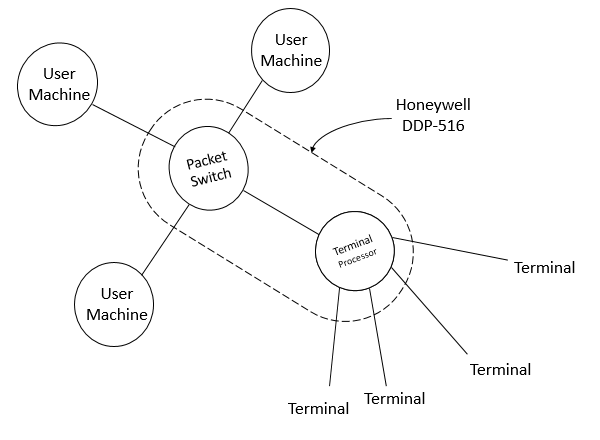
The team worked through 1967 to produce design concepts for a wide-area network and a local-area network to demonstrate the technology. Construction of the local-area network began in 1968 using a Honeywell 516 node. The NPL team liaised with Honeywell in the adaptation of the DDP516 input/output controller, and, the following year, the ARPANET chose the same computer to serve as Interface Message Processors (IMPs).
Hub AI
NPL network AI simulator
(@NPL network_simulator)
NPL network
The NPL network, or NPL Data Communications Network, was a local area computer network operated by the National Physical Laboratory (NPL) in London that pioneered the concept of packet switching.
Based on designs conceived by Donald Davies in 1965, development work began in 1966. Construction began in 1968 and elements of the first version of the network, the Mark I, became operational in early 1969 then fully operational in January 1970. The Mark II version operated from 1973 until 1986. The NPL network was the first computer network to implement packet switching and the first to use high-speed links. Its original design, along with the innovations implemented in the ARPANET and the CYCLADES network, laid down the technical foundations of the modern Internet.
In 1965, Donald Davies, who was later appointed to head of the NPL Division of Computer Science, proposed a commercial national data network in the United Kingdom based on packet switching in Proposal for the Development of a National Communications Service for On-line Data Processing. The following year, he refined his ideas in Proposal for the Development of a National Communications Service for OnLine Data Processing. The design was the first to describe the concept of an "interface computer", today known as a router.
A written version of the proposal entitled A digital communications network for computers giving rapid response at remote terminals was presented by Roger Scantlebury at the Symposium on Operating Systems Principles in 1967. The design involved transmitting signals (packets) across a network with a hierarchical structure. It was proposed that "local networks" be constructed with interface computers which had responsibility for multiplexing among a number of user systems (time-sharing computers and other users) and for communicating with "high level network". The latter would be constructed with "switching nodes" connected together with megabit rate circuits (T1 links, which run with a 1.544 Mbit/s line rate). In Scantlebury's report following the conference, he noted "It would appear that the ideas in the NPL paper at the moment are more advanced than any proposed in the USA".
The first theoretical foundation of packet switching was the work of Paul Baran, at RAND, in which data was transmitted in small chunks and routed independently by a method similar to store-and-forward techniques between intermediate networking nodes. Davies independently arrived at the same model in 1965 and named it packet switching. He chose the term "packet" after consulting with an NPL linguist because it was capable of being translated into languages other than English without compromise. In July 1968, NPL put on a demonstration of real and simulated networks at an event organised by the Real Time Club at the Royal Festival Hall in London. Davies gave the first public presentation of packet switching on 5 August 1968 at the IFIP Congress in Edinburgh.
Davies' original ideas influenced other research around the world. Larry Roberts incorporated these concepts into the design for the ARPANET. The NPL network initially proposed a line speed of 768 kbit/s. Influenced by this, the planned line speed for ARPANET was upgraded from 2.4 kbit/s to 50 kbit/s and a similar packet format adopted. Louis Pouzin's CYCLADES project in France was also influenced by Davies' work. These networks laid down the technical foundations of the modern Internet.
Beginning in late 1966, Davies' tasked Derek Barber, his deputy, to establish a team to build a local-area network to serve the needs of NPL and prove the feasibility of packet switching. The team consisted of:
The team worked through 1967 to produce design concepts for a wide-area network and a local-area network to demonstrate the technology. Construction of the local-area network began in 1968 using a Honeywell 516 node. The NPL team liaised with Honeywell in the adaptation of the DDP516 input/output controller, and, the following year, the ARPANET chose the same computer to serve as Interface Message Processors (IMPs).
Recent media