Hubbry Logo
Nancy HartNancy HartMain
Open search
Nancy Hart
Community hub
Nancy Hart
logo
8 pages, 0 posts
0 subscribers
Be the first to start a discussion here.
Nancy Hart
Nancy Hart
from Wikipedia

Nancy Morgan Hart (c. 1741–1830) was a rebel heroine of the American Revolutionary War, noted for her exploits against Loyalists in the northeast Georgia backcountry. She is characterized as a tough, strong and resourceful frontier woman who repeatedly outsmarted Tory soldiers, and killed some outright. Stories about her are mostly unsupported by contemporary documentation, and it has been impossible for researchers to entirely distinguish fact from folklore.

Key Information

Early life

[edit]

Although explicit details concerning most of her life are unknown, Nancy Ann Morgan Hart is believed to have been born in North Carolina around 1741, in the Yadkin River valley, though some researchers think that she was born in Pennsylvania or New York state. She married Benjamin Hart of that area. His extended family's descendants included such famous later political figures as Missouri Senator Thomas Hart Benton and Kentucky Senator Henry Clay.[1]

During the early 1770s, Nancy, Benjamin and their family left North Carolina and migrated to Georgia, settling in the extremely fertile Broad River valley of the northeast Piedmont area. There she drew on her many frontier skills, including herbalism, hunting and shooting.[1]

Hart was well connected through family ties to other prominent figures in early American history. She was a cousin to Revolutionary War general Daniel Morgan, who commanded victorious American forces at the Battle of Cowpens in South Carolina on January 17, 1781.

According to contemporary accounts, "Aunt Nancy", as she was often called, was a tall, gangly woman. She was rough-hewn and rawboned, with red hair and a face scarred by smallpox. One early account said that Hart had "no share of beauty—a fact she herself would have readily acknowledged, had she ever enjoyed an opportunity of looking into a mirror."[1]

Hart was said to have a feisty personal demeanor characterized by a hotheaded temper, a fearless spirit, and a penchant for exacting vengeance upon those who offended her or harmed her family and friends. Many remembered that she, rather than her husband, ran the Hart household. They had a total of six sons and two daughters. Although she was illiterate, Hart was amply blessed with the skills and knowledge necessary for frontier survival; she was an expert herbalist, a skilled hunter, and an excellent shooter.[1]

Revolutionary War accounts

[edit]

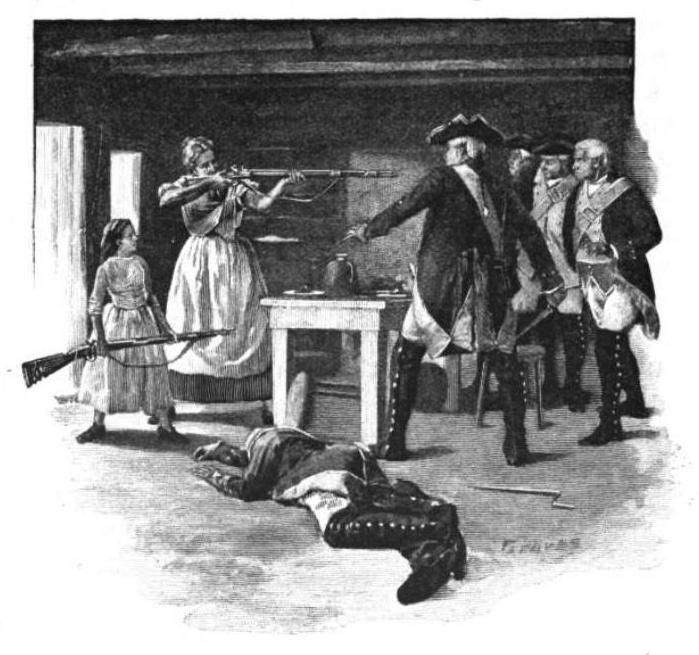
According to one account, during the Revolution, a group of five or six Tory soldiers came by the Hart house sometime in 1779 looking either for food or a Whig they were pursuing (accounts vary). The soldiers demanded that Hart cook them one of her turkeys, and she agreed to feed them. As they entered the cabin, they placed their guns by the door before sitting at her table to eat. As they were drinking and eating, she pushed their guns outside through a hole in the wall of the cabin. After the soldiers had been drinking a sufficient time, she grabbed one of the remaining guns and ordered the men to stay still. One ignored her threat, so she shot and killed him. Another made a move toward the weapons, and she killed him as well. She held the remaining Tories captive until her husband and neighbors arrived. According to legend, her husband wanted to shoot the soldiers outright, but she demanded that they be hanged, which was accomplished from a nearby tree.

The various versions of this story provide different details. But in 1912 construction crews working on the Elberton and Eastern Railroad in the area found evidence that seemed to validate the legend.[2][3] While grading a railroad site less than a mile from the old Hart Cabin, the workers found five or six skeletons buried neatly in a row. A few of the skeletons' necks were broken, which suggested they had been hanged. They were determined to have been buried for at least 100 years.

In her 1925 county history, Cook published a version based on an 1825 newspaper article.[4] McIntosh quoted two such stories in a 1940 history of Elbert County.[5]

[edit]

Mrs. Louisa H. Kendall was the niece of John Hart, the son whom Nancy lived with in later life. Kendall wrote a letter in 1872 recalling some of the stories her uncle had heard from his mother.[6] According to this letter, once when Nancy was taking a bag of grain to the mill, a band of Tories forced her off her horse and threw the grain to the ground. Undaunted, Hart picked up the heavy bag and walked the rest of the way to the mill. Nancy Hart was said to have acted as a sniper, killing Tories as they came across the Broad River.[6]

McIntosh quotes a Mr. Snead, who was also related to the Harts. He said that one time during the war, Nancy was cooking lye soap in her cabin when her daughter discovered a spy looking through a crack in the wall. Hart threw a ladle of the boiling soap into the spy's eyes, went outside and tied him up, and turned him over to the local Patriot militia.[7]

Two accounts say that Nancy dressed as a man in order to enter Tory camps, where she could overhear talk and observe the layouts and other elements of military value.[8]

According to folklore, the local Native Americans referred to her as "Wahatche" which may translate to "War Woman", and named a creek for her. But many scholars dispute this, as there were records of the Cherokee name for the creek prior to the war. In addition, the late 19th-century ethnographer James Mooney noted, "Several cases of women acting the part of warriors are on record among the Cherokee."[9]

Life after the war

[edit]

George Rockingham Gilmer, twice governor of Georgia before 1850, knew Hart personally. In an account of early settlers which he published in 1855, he wrote that she became "religious" after the war:

A Methodist society was formed in her neighborhood. She went to the house of worship in search of relief. She found the good people assembled in class meeting, and the door closed against intruders. She took out her knife, cut the fastening and stalked in. She heard how the wicked might work out their salvation; became a shouting Christian, fought the devil as manfully as she fought the Tories . . .[1][10]

During the late 1780s, the Harts moved to Brunswick, Georgia. (Some accounts suggest that they may have spent time in Alabama and South Carolina as well). Benjamin Hart died shortly thereafter. Nancy Hart returned to the settlement on the Broad River but found that a flood had washed away their former cabin. Eventually, she settled with her son John Hart and his family along the Oconee River in Clarke County near Athens. Around 1803 John Hart took his mother and family to Henderson County, Kentucky, where they settled again near relatives. Hart spent the remaining years of her life there. She was buried in the Hart family cemetery a few miles outside of Henderson.[1]

Legacy

[edit]

On the approximate site of Hart's frontier cabin along River Road in Elbert County,[clarification needed] the Daughters of the American Revolution erected a replica cabin in the early 20th century. They used chimney stones recovered from the site of the original cabin, which had stood on the crest of a large hill overlooking Wahachee Creek.[1]

Georgians have memorialized Nancy Hart in several place names:

References

[edit]
[edit]
Revisions and contributorsEdit on WikipediaRead on Wikipedia
from Grokipedia
Nancy Hart (c. 1735–1830) was a Georgia frontierswoman and ardent patriot during the , famed in regional folklore for her resourceful resistance against Loyalist Tories in the backcountry. The core legend depicts Hart, acting alone while her husband was away, tricking a party of six invading Tories—who had murdered her neighbor Judge Dooly—into drinking heavily before seizing a , wounding one intruder, and detaining the rest until patriot militia arrived to hang them. Though first documented in print decades after the purported 1780 incident, her tale embodies the guerrilla-style civilian defiance that characterized in the Georgia upcountry, where neighbor turned against neighbor amid fluid allegiances. Hart's legacy endures through —the sole U.S. county named for a —and commemorations by groups like the , underscoring her role as a symbol of female agency in frontier patriotism despite scant contemporary records verifying the events.

Early Life and Origins

Birth and Family Background

Nancy Hart, born Ann Morgan around 1735, likely in the Yadkin River Valley of North Carolina, was the daughter of Thomas Morgan and his wife Rebecca (possibly née Alexander). Her family's origins reflect the hardships of frontier settlement in the mid-18th century, where record-keeping was minimal and primary documentation scarce, leading to variations in reported details such as her precise birthplace—alternatively cited as the Pennsylvania frontier in some accounts. The Morgans were part of the wave of Scots-Irish and English settlers pushing into the southern backcountry, though specific evidence of their ethnic background or remains unverified beyond general frontier context. Nancy's early life involved typical agrarian pursuits in a region marked by isolation and vulnerability to Native American raids, fostering that later characterized her wartime actions. She married Benjamin Hart, a and occasional , in the 1750s or early 1760s, with the couple eventually having at least seven children, though exact marriage records are absent from surviving documents. This union positioned her within a mobile frontier family that relocated southward amid expanding colonial settlement.

Migration to Georgia Frontier

In the early 1770s, Nancy Hart, her husband Benjamin, and their growing family migrated southward from to the Georgia frontier, settling in the fertile Broad River valley region, which had recently been ceded by the and Creek nations to British colonial authorities. This area, encompassing parts of present-day Wilkes and Elbert counties, represented a rugged backcountry frontier characterized by dense forests, riverine lowlands, and opportunities for small-scale farming amid ongoing Native American presence and territorial disputes. The Harts established their homestead around 1771 on approximately 400 acres of land granted to Benjamin, located on the left bank of the Broad River near Wahatchie Creek. This relocation aligned with broader patterns of colonial expansion into upland Georgia, driven by land hunger among Scotch-Irish and English settlers seeking autonomy from coastal plantations and access to arable soil for , including corn, hogs, and cattle. The family's served as a base in this isolated locale, where was essential due to limited , vulnerability to raids, and the absence of formal until Wilkes County's in 1777. By this time, the Harts had at least several children, though exact counts vary in records, reflecting the demands of frontier family life.

Involvement in the Revolutionary War

Activities as Spy and Informant

Historical accounts attribute to Nancy Hart a role as a patriot spy in during the , where she gathered intelligence on British and Loyalist forces amid the partisan of the . Disguising herself as a simpleminded or deranged man, Hart infiltrated enemy camps and garrisons to eavesdrop on conversations and observe troop dispositions, subsequently relaying the details to local patriot militias. In one reported exploit, Hart crossed the repeatedly on a rudimentary —four logs lashed together with grapevines—to scout a Loyalist encampment in , enabling Georgia patriot units to target the position effectively. She also allegedly entered British outposts near Augusta under male disguise, securing vital information on enemy strength and movements that aided General Elijah Clarke's forces in securing victory at the on February 14, 1779, where patriots repelled a larger Loyalist force led by Colonel Boyd. As an , Hart reportedly thwarted enemy by capturing a British soldier spying near her cabin; after him with boiling water from a pot and binding him to a chair, she summoned nearby patriot irregulars to take him into custody for . These activities, drawn from 19th-century recollections such as those of George R. Gilmer, positioned Hart as a key asset in the networks sustaining patriot resistance against British incursions in the region from 1778 to 1781.

The Capture of Loyalist Soldiers

In 1780, during the height of in , a group of six Loyalist militiamen under British-allied forces arrived at the remote cabin of Nancy Hart in the Broad River settlement, shortly after they had ambushed and killed patriot Colonel John Dooly on near his home. The soldiers, seeking provisions and information on local patriot movements, demanded that Hart prepare them a meal and interrogated her harshly, unaware that she had overheard details of Dooly's murder earlier and recognized at least one of the perpetrators. Hart, a physically imposing known for her cross-eyed appearance and defiant manner, complied outwardly by boiling potatoes and offering weak whiskey disguised as stronger spirits to dull their senses, while secretly dispatching her young daughter through a gap in the wall to summon nearby Whig under patriot command. As the Loyalists grew impatient and one attempted to flee or seize her, Hart grabbed a from the wall—reportedly still loaded from her husband's recent use—and shot the man dead, then covered the remaining five with the weapon, threatening to fire on any who moved while reloading with trembling hands fueled by rage. The standoff lasted until the alerted arrived to bind and disarm the captives, who were then marched away for trial or by hanging from nearby trees, in line with the brutal reprisals common in the region's partisan conflict. Accounts of the incident, first detailed in print in the Southern Recorder in 1825 based on local oral traditions, vary slightly in the number of soldiers (sometimes reported as seven) and the precise method of Hart's deception, but consistently portray her actions as a pivotal act of solitary resistance against Loyalist incursions in an area plagued by raids.

Additional Attributed Exploits

Hart reportedly engaged in for Patriot forces, infiltrating Loyalist camps under disguises to obtain . In one attributed incident, she posed as a simpleminded man to spy on a encampment near the Broad River frontier, relaying details of enemy positions and plans that contributed to Whig successes, including the February 14, 1779, victory at Kettle Creek under General Elijah Clarke. Accounts describe her leveraging her reputation for erratic behavior and physical unattractiveness—marked by a , crossed eyes, and fiery —to evade suspicion while gathering information on British troop movements and supply lines. Additional traditions credit Hart with direct confrontations beyond the well-known , such as ambushing isolated Loyalist scouts or aiding raids by signaling Patriot positions during skirmishes against Tories and allied warriors in circa 1778–1781. These exploits, drawn from oral histories collected in the early 19th century, portray her as a mobile informant who traversed hostile territory on foot, often alone while her husband served in the Continental Army, to warn settlers of impending attacks. While lacking contemporaneous documentation, such narratives emphasize her role in sustaining resistance in a region plagued by guerrilla conflict.

Post-War Existence

Family and Settlement

Nancy Hart married Benjamin Hart, a farmer from , in the mid-1770s, and the couple had eight children, including six sons and two daughters. Following the Revolutionary War, the Harts remained in the Broad River settlement in what became , after its formation from Wilkes County in 1790. Benjamin Hart relocated the family briefly to , where he died shortly thereafter, prompting Nancy to return to the upcountry with her children. She subsequently settled with her son John Hart along the in Clarke County, near , maintaining a frontier homestead amid ongoing Native American conflicts in the region. Around 1803, John Hart led the migration of his mother and extended family to , where they established a new settlement near relatives, reflecting the westward expansion patterns of many Revolutionary-era families seeking fertile land and stability. This move aligned with broader demographic shifts, as Georgia's cession of western lands to the federal government in 1802 facilitated such relocations.

Final Years and Death

After the , Nancy Hart resided with her husband Benjamin in , until his death around 1800. She then moved with one of her sons to , before relocating circa 1803 with her son John Hart to , settling near relatives on the frontier. Hart spent her final years in Henderson County, living modestly in a environment typical of early 19th-century settlements. No records detail specific activities or health issues in this period, though accounts describe her as continuing to embody the rugged independence associated with her wartime reputation. The precise date and circumstances of Hart's remain unverified due to the absence of primary records such as a , will, or contemporary obituary. Popular historical narratives, drawing from 19th-century reminiscences, assert she died around 1830 at approximately 95 years of age from natural causes related to advanced age. She is said to have been buried in the Hart family cemetery, now known as Book Cemetery, a few miles outside Henderson. A marker was placed there in 1929, but its placement relies on tradition rather than excavated confirmation of remains. Some analyses question the 1830 date, noting her omission from son John Hart's 1821 will as potential evidence of an earlier , though other accounts indicate she outlived him and resided with his .

Assessment of Historical Accounts

Verifiable Evidence and Primary Sources

The existence of Nancy Hart (née Morgan), a resident of the Georgia frontier during the , is supported by genealogical and records indicating her presence in the region into the early . The U.S. records a named Nancy Hart living on Blue Creek in Georgia, adjacent to a relative named Thomas Hart, consistent with accounts of her surviving her husband Benjamin Hart, who died around 1800. Land settlement patterns in , further align with family migrations from in the , though specific deeds tied directly to her name remain sparse in digitized archives. No Revolutionary War application survives under her name, unlike those filed by male members such as her husband, reflecting the era's exclusion of women from formal veteran benefits. Contemporary primary documents from the –1780s, such as military dispatches, court records, or personal diaries, contain no direct references to Hart's attributed exploits as a spy, , or captor of Loyalists. Searches of Georgia colonial and state archives yield no eyewitness affidavits or official reports naming her in connection with events like the capture of Tory soldiers or defense of settlements. This absence suggests her role, if any, operated outside documented channels typical of male irregular fighters. The earliest written accounts of her legendary actions appear in post-war oral traditions, first published in the Southern Recorder on October 6, 1825, which recounts her detaining British soldiers in her home and threatening to hang them—a reprinted in regional papers but unattributed to specific 18th-century witnesses. Elizabeth F. Ellet's 1848 The Women of the , drawing on family reminiscences collected decades after the war, amplifies similar tales, including Hart shooting a intruder, but these rely on secondhand anecdotes prone to patriotic embellishment in the antebellum era. Indirect archaeological evidence emerged in 1912 when railway workers uncovered six male skeletons in a shallow grave near Wahatche Creek in Elbert County, close to the site of Hart's reputed cabin; some bones showed signs of broken necks, fueling speculation of hangings tied to her stories, as reported in the Thomson McDuffie Progress on December 27, 1912. However, without forensic dating or artifacts linking the remains definitively to Loyalists, this find offers circumstantial corroboration at best, vulnerable to alternative explanations like unrelated frontier violence. Scholarly analyses, such as E. Merton Coulter's 1955 article in the Georgia Historical Quarterly, trace the of these narratives from local lore to national legend, emphasizing their growth through 19th-century print rather than verifiable wartime records.

Legends, Embellishments, and Scholarly Skepticism

The most prominent legend surrounding Nancy Hart concerns her single-handed capture of a group of Loyalist soldiers who invaded her isolated cabin in during the Revolutionary War. According to the account, Hart, while her husband was away, subdued the intruders by serving them poisoned or drugged food and drink, retrieving their muskets despite her physical impairments, shooting one soldier dead, wounding another, and holding the survivors at gunpoint until patriot militia arrived to bind and hang them. Variations in retellings include the number of soldiers (five or six), the method of incapacitation (boiling lye soap thrown in faces or whiskey), and the use of a shell to summon aid, reflecting oral embellishments that amplified her resourcefulness and marksmanship despite being described as cross-eyed and lame. This narrative first appeared in print in , nearly fifty years after the purported events around 1778–1779, in George Rockingham Gilmer's Sketches of Some of the First Settlers of Upper Georgia, of the Upper Country of Georgia, based on secondhand oral traditions from local residents rather than or official records. No contemporary primary sources, such as military dispatches, court documents, or personal diaries from the period, corroborate the specifics of the incident, leading historians to classify it as with potential roots in Hart's known patriotic sympathies but lacking verifiable detail. In , excavation near the reputed site of her cabin unearthed six skeletons with broken necks, interpreted by some as evidence of the hanged Loyalists, though archaeological analysis could not conclusively link them to the legend due to the absence of artifacts or contextual markers tying them to 1779. Scholarly analysis emphasizes the embellished nature of Hart's exploits, attributing their proliferation to 19th-century that romanticized women as embodiments of American resilience. Historian E. Merton Coulter, in a 1955 article in the Georgia Historical Quarterly, examined the evolution of these traditions and argued that they grew through repeated retellings, incorporating dramatic flourishes absent from earlier accounts, while noting the improbability of an illiterate, physically limited woman executing such feats without support. Other attributed actions, such as disguising herself as a man to spy on British encampments or fighting at the on February 14, 1779, similarly rely on post-war anecdotes without muster rolls or pension claims to substantiate them, prompting skepticism that they serve more as morale-boosting myths than precise history. Despite these doubts, the legends underscore a kernel of plausibility in Hart's documented existence and , as evidenced by land records and family attestations placing her in the region during the conflict.

Enduring Legacy

Recognition and Memorials

A Georgia Historical Society marker was erected in 1957 near the site of Nancy Hart's home on Wahatche Creek in Elbert County, commemorating her residence there with her husband Benjamin and their children during the Revolutionary War. Another marker, located on Georgia State Route 17 at River Road approximately 10 miles south of Elberton, details her exploits and marks the approximate location of her frontier cabin. The (DAR) have honored Hart through multiple initiatives, including the Nancy Hart Chapter NSDAR and Stephen Heard Chapter NSDAR's plaque recognizing the rebuilding of her cabin and her patriotic acts, such as intelligence gathering and confrontations with Loyalists. In Elbert County, the DAR established a small with a historic marker at the recreated site of Hart's , preserving the location for public commemoration. A U.S. government marker erected in 1931 specifically commemorates Hart's heroism during the Revolution, highlighting an incident involving a party of British soldiers. Additionally, a marker at her reputed gravesite in the old Hart Graveyard on Frog Island Road, about 10 miles from Henderson, Kentucky, was placed to honor her as Nancy Morgan Hart. Portions of U.S. Route 78 in Georgia are designated as the Nancy Hart Highway, with a marker in Thomson acknowledging this naming in tribute to her legacy. In 1997, Hart was inducted into the Georgia Women of Achievement, recognizing her as a notable figure in state history.

Influence on American Folklore and Patriotism

Nancy Hart's exploits, particularly the legendary capture of Loyalist soldiers at her Georgia cabin, permeated American folklore through oral traditions among frontier settlers and subsequent 19th-century publications that embellished her feats of defiance against British forces and Tories. These narratives portrayed her as a towering figure of raw, unyielding , embodying the resourcefulness and ferocity of ordinary colonists resisting tyranny, which resonated in Southern storytelling as exemplars of individual heroism during the Revolution. Her folkloric status reinforced patriotic ideals by highlighting women's contributions to the independence struggle, often depicted as acts of , , and direct confrontation that mirrored the broader ethos of and communal defense. Accounts of Hart's tactics and execution of , whether verified or amplified, served to instill values of vigilance and in subsequent generations, influencing regional identity in Georgia and the where her "War Woman" moniker—allegedly bestowed by neighbors—evoked indigenous warrior archetypes adapted to patriot lore. In educational and cultural contexts, Hart's legends fostered patriotism by framing the Revolution as a grassroots endeavor involving all societal strata, including illiterate frontierswomen who outwitted professional soldiers, thereby countering narratives that marginalized non-elite participants. This portrayal extended her influence into 19th- and 20th-century retellings, such as reenactments and historical markers, which emphasized causal links between personal audacity and national sovereignty, encouraging emulation of her purported traits—physical prowess, verbal cunning, and uncompromised loyalty to the patriot cause. Scholarly analyses note that while embellishments obscure precise historicity, the persistence of her stories underscores their role in cultivating a mythic foundation for American exceptionalism rooted in defiant individualism.

References

Add your contribution
Related Hubs
User Avatar
No comments yet.