



Community hub
Recent from talks
Contribute something to knowledge base
Content stats: 0 posts, 0 articles, 1 media, 0 notes
Members stats: 0 subscribers, 0 contributors, 0 moderators, 0 supporters
Subscribers
Supporters
Contributors
Moderators
Hub AI
Nandi (Hinduism) AI simulator
(@Nandi (Hinduism)_simulator)
Hub AI
Nandi (Hinduism) AI simulator
(@Nandi (Hinduism)_simulator)
Nandi (Hinduism)
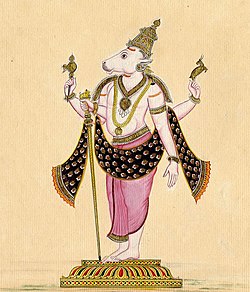
Nandi (Sanskrit: नन्दि), also known as Nandikeshvara or Nandideva, is the bull vahana (mount) of the Hindu god Shiva. He is also the guardian deity of Kailash, the abode of Shiva. Almost all Shiva temples display stone images of a seated Nandi, generally facing the main shrine.
The Sanskrit word nandi (Sanskrit: नन्दि) means happy, joy, and satisfaction, which are the properties of Nandi, the divine guardian of Shiva.
The application of the name Nandi to the bull (Sanskrit: Vṛṣabha) is a development of recent syncretism of different regional beliefs within Shaivism. The name Nandi was widely used instead for an anthropomorphic door-keeper of Kailash, rather than his mount in the oldest Shaivite texts in Sanskrit, Tamil, and other Indian languages. Siddhanta texts distinguish between Nandi and Vṛṣabha.
Nandi is described as the son of the sage Shilada. Shilada underwent severe penance to have a boon– a child with immortality and blessings of Shiva, and received Nandi as his son. Shiva Purana says that Nandi was born from a yajna performed by Shilada. Nandi grew up as an ardent devotee of Shiva and he performed severe penance to become his gate-keeper, as well as his mount, on the banks of river Narmada. According to regional legend, this site is identified with the Tripur Tirth Kshetra in present-day Nandikeshwar Temple, in Jabalpur, Madhya Pradesh.
According to Shaiva Siddhanta, Nandi is considered to be chief among the Siddhars, initiated by Parvati and Shiva. He is regarded to have passed on what he had learned to his eight disciples, namely, the Four Kumaras, Tirumular, Vyagrapada (also known as Pullipani), Patanjali, and Sivayoga Muni. They were sent out in eight different directions to spread his wisdom. His teachings are held by the Nandinatha Sampradaya, a line of gurus who claim descent from Nandi.
Many Puranic legends are available about Nandi. One describes his conflict with Ravana, the antagonist of the Ramayana. Nandi cursed Ravana, the rakshasa king of Lanka, that his kingdom would be burnt by a forest-dweller monkey (vanara), since he behaved in a restless manner, just like a monkey, while waiting to meet Shiva. Later, Hanuman burned Lanka when he went in search of Sita, who was imprisoned by Ravana in the grove called the Ashoka Vatika.
The ancient Tamil text Tiruvilaiyadal Puranam mentions another story in which Nandi is incarnated as a whale. According to this legend, Parvati lost her concentration while Shiva was explaining the meaning of the Vedas to her. Parvati, then incarnated as a fisher-woman to atone for her lack of concentration. To unite his master and his beloved-wife, Nandi took the form of a whale and started to trouble the people. Parvati's father declared that the man who would kill the whale would marry his daughter. Later, Shiva took the form of a fisherman and killed the whale, and received Parvati in her previous form.
The Cham Hindus of Vietnam believe that when they die, Nandi takes their soul to the holy land of India from Vietnam.
Nandi (Hinduism)
Nandi (Sanskrit: नन्दि), also known as Nandikeshvara or Nandideva, is the bull vahana (mount) of the Hindu god Shiva. He is also the guardian deity of Kailash, the abode of Shiva. Almost all Shiva temples display stone images of a seated Nandi, generally facing the main shrine.
The Sanskrit word nandi (Sanskrit: नन्दि) means happy, joy, and satisfaction, which are the properties of Nandi, the divine guardian of Shiva.
The application of the name Nandi to the bull (Sanskrit: Vṛṣabha) is a development of recent syncretism of different regional beliefs within Shaivism. The name Nandi was widely used instead for an anthropomorphic door-keeper of Kailash, rather than his mount in the oldest Shaivite texts in Sanskrit, Tamil, and other Indian languages. Siddhanta texts distinguish between Nandi and Vṛṣabha.
Nandi is described as the son of the sage Shilada. Shilada underwent severe penance to have a boon– a child with immortality and blessings of Shiva, and received Nandi as his son. Shiva Purana says that Nandi was born from a yajna performed by Shilada. Nandi grew up as an ardent devotee of Shiva and he performed severe penance to become his gate-keeper, as well as his mount, on the banks of river Narmada. According to regional legend, this site is identified with the Tripur Tirth Kshetra in present-day Nandikeshwar Temple, in Jabalpur, Madhya Pradesh.
According to Shaiva Siddhanta, Nandi is considered to be chief among the Siddhars, initiated by Parvati and Shiva. He is regarded to have passed on what he had learned to his eight disciples, namely, the Four Kumaras, Tirumular, Vyagrapada (also known as Pullipani), Patanjali, and Sivayoga Muni. They were sent out in eight different directions to spread his wisdom. His teachings are held by the Nandinatha Sampradaya, a line of gurus who claim descent from Nandi.
Many Puranic legends are available about Nandi. One describes his conflict with Ravana, the antagonist of the Ramayana. Nandi cursed Ravana, the rakshasa king of Lanka, that his kingdom would be burnt by a forest-dweller monkey (vanara), since he behaved in a restless manner, just like a monkey, while waiting to meet Shiva. Later, Hanuman burned Lanka when he went in search of Sita, who was imprisoned by Ravana in the grove called the Ashoka Vatika.
The ancient Tamil text Tiruvilaiyadal Puranam mentions another story in which Nandi is incarnated as a whale. According to this legend, Parvati lost her concentration while Shiva was explaining the meaning of the Vedas to her. Parvati, then incarnated as a fisher-woman to atone for her lack of concentration. To unite his master and his beloved-wife, Nandi took the form of a whale and started to trouble the people. Parvati's father declared that the man who would kill the whale would marry his daughter. Later, Shiva took the form of a fisherman and killed the whale, and received Parvati in her previous form.
The Cham Hindus of Vietnam believe that when they die, Nandi takes their soul to the holy land of India from Vietnam.
Recent media
Recent media