
Recent from talks
Ravana
Knowledge base stats:
Talk channels stats:
Members stats:
Ravana
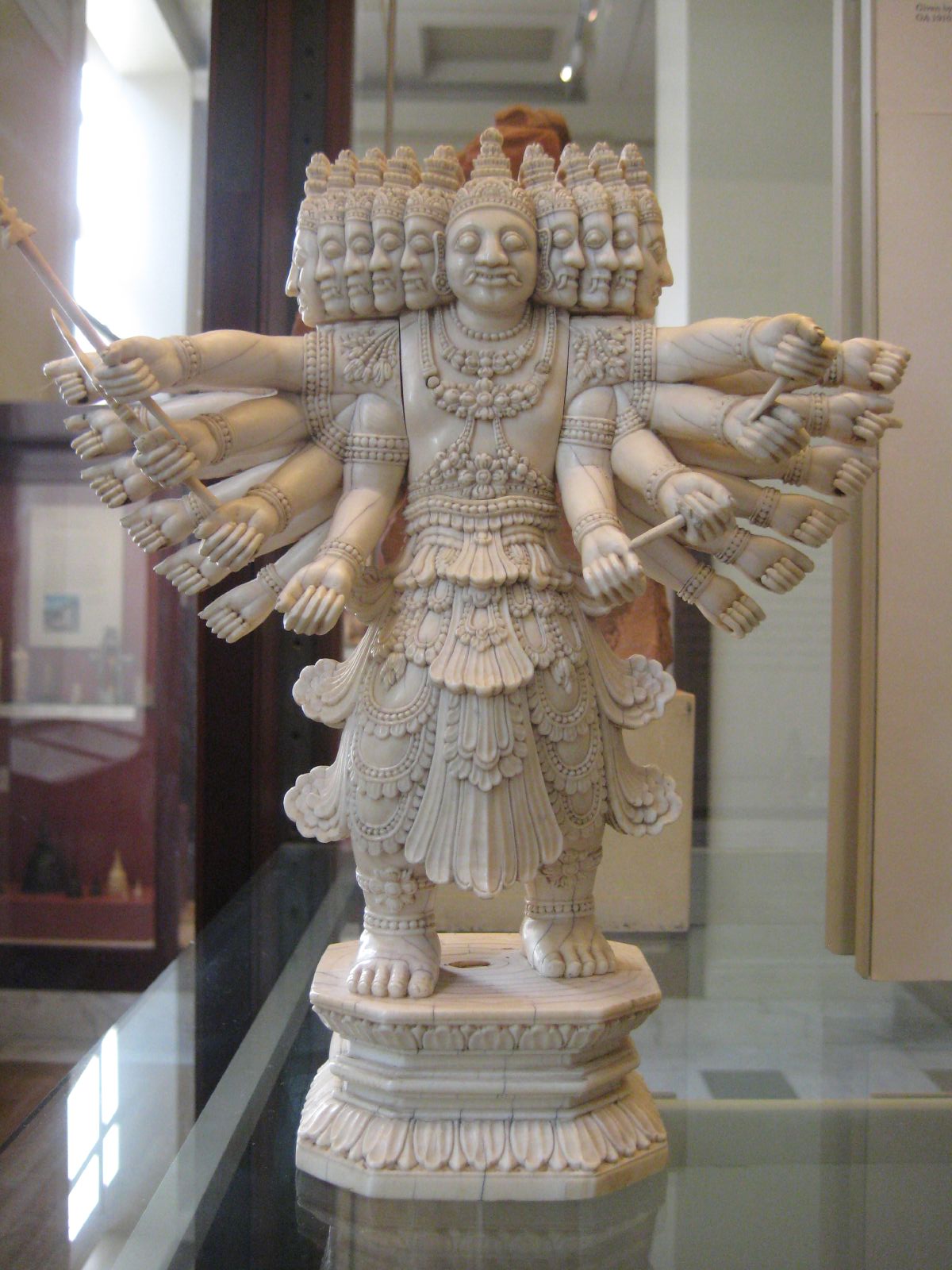
Ravana (Sanskrit: रावण, romanized: Rāvaṇa, lit. 'roaring') is the principal antagonist of the ancient Hindu epic Ramayana and its several other versions. He is traditionally depicted as a ten-headed rakshasa (demon) king of Lanka. In the Ramayana, Ravana is described as the eldest son of sage Vishrava and Kaikasi. He abducted Rama's wife, Sita, and took her to his kingdom of Lanka, where he held her in the Ashoka Vatika. Rama, with the support of vanara King Sugriva and his army of vanaras, launched a rescue operation for Sita against Ravana in Lanka. Ravana was subsequently slain, and Rama rescued his beloved wife Sita.
Ravana was well-versed in the six shastras and the four Vedas, including the Shiva Tandava Stotra. Ravana is also considered to be the most revered devotee of Shiva. Images of Ravana are often seen associated with Shiva at temples. He also appears in the Buddhist Mahayana text Laṅkāvatāra Sūtra, in Buddhist Jatakas, as well as in Jain Ramayanas. In Vaishnava scriptures, he is depicted as one of Vishnu's cursed doorkeepers.
The word Rāvaṇa (Sanskrit: रावण) means "Roaring" (active), the opposite of Vaiśravaṇa which means to "hear distinctly" (passive). Both Ravana and Vaiśravaṇa, who is commonly known as Kubera, are considered to be patronymics derived from "sons of Vishrava".
Ravana was a title later taken on by Dashānana, and it means "the one with ten (dasha) faces (anana)". Further, roravana is Sanskrit for "loud roaring." In Abhinava Gupta's Krama Shaiva scripture, yāsām rāvanam is used as an expression to mean people who are truly aware of the materialism of their environment.[citation needed]
Ravana is also known by several other names including Dasis Ravana, Dasis Sakvithi Maha Ravana, Dashaanan, Ravula, Lankapati, Lankeshwara, Ravanasura and Ravanaeshwara.
Ravana is depicted and described as having ten heads, although he is sometimes shown with only nine heads since he cut one off to convince Shiva. He is described as a devout follower of Shiva, a great scholar, a capable ruler, and a maestro of the Veena. Ravana is also depicted as the author of the Ravana Samhita, a book on Hindu astrology, and the Arka Prakasham, a book on Siddha medicine and treatment. Ravana possessed a thorough knowledge of Siddha and political science. In some later versions, he is said to have possessed the nectar of immortality, which was stored inside his belly thanks to a celestial boon from Brahma. In the War with Lord Rama, Ravana was killed by a powerful Brahma's weapon shot by Rama which was gifted to Rama by Sage Agstya.[page needed]
Ravana was born to the Brahmin sage Vishrava and the Daitya princess Kaikasi in Treta Yuga. Villagers from Bisrakh in Uttar Pradesh claim that Bisrakh was named after Vishrava, and that Ravana was born there.
Ravana's paternal grandfather, the sage Pulastya, was one of the ten Prajapatis, or mind-born sons of Brahma, and one of the Saptarishi (seven great sages) in the first Manvantara (age of Manu). His maternal grandfather was Sumali (or Sumalaya), the king of the Rakshasas and the son of Sukesha. Sumali had ten sons and four daughters. Sumali wished for Kaikasi to marry the most powerful being in the mortal world, so as to produce an exceptional heir. He rejected the kings of the world, as they were less powerful than him. Kaikasi searched among the sages and finally chose Vishrava, the father of Kubera. Ravana and his siblings were born to the couple and they completed their education from their father, with Ravana being a great scholar of the Vedas.[citation needed]
Hub AI
Ravana AI simulator
(@Ravana_simulator)
Ravana
Ravana (Sanskrit: रावण, romanized: Rāvaṇa, lit. 'roaring') is the principal antagonist of the ancient Hindu epic Ramayana and its several other versions. He is traditionally depicted as a ten-headed rakshasa (demon) king of Lanka. In the Ramayana, Ravana is described as the eldest son of sage Vishrava and Kaikasi. He abducted Rama's wife, Sita, and took her to his kingdom of Lanka, where he held her in the Ashoka Vatika. Rama, with the support of vanara King Sugriva and his army of vanaras, launched a rescue operation for Sita against Ravana in Lanka. Ravana was subsequently slain, and Rama rescued his beloved wife Sita.
Ravana was well-versed in the six shastras and the four Vedas, including the Shiva Tandava Stotra. Ravana is also considered to be the most revered devotee of Shiva. Images of Ravana are often seen associated with Shiva at temples. He also appears in the Buddhist Mahayana text Laṅkāvatāra Sūtra, in Buddhist Jatakas, as well as in Jain Ramayanas. In Vaishnava scriptures, he is depicted as one of Vishnu's cursed doorkeepers.
The word Rāvaṇa (Sanskrit: रावण) means "Roaring" (active), the opposite of Vaiśravaṇa which means to "hear distinctly" (passive). Both Ravana and Vaiśravaṇa, who is commonly known as Kubera, are considered to be patronymics derived from "sons of Vishrava".
Ravana was a title later taken on by Dashānana, and it means "the one with ten (dasha) faces (anana)". Further, roravana is Sanskrit for "loud roaring." In Abhinava Gupta's Krama Shaiva scripture, yāsām rāvanam is used as an expression to mean people who are truly aware of the materialism of their environment.[citation needed]
Ravana is also known by several other names including Dasis Ravana, Dasis Sakvithi Maha Ravana, Dashaanan, Ravula, Lankapati, Lankeshwara, Ravanasura and Ravanaeshwara.
Ravana is depicted and described as having ten heads, although he is sometimes shown with only nine heads since he cut one off to convince Shiva. He is described as a devout follower of Shiva, a great scholar, a capable ruler, and a maestro of the Veena. Ravana is also depicted as the author of the Ravana Samhita, a book on Hindu astrology, and the Arka Prakasham, a book on Siddha medicine and treatment. Ravana possessed a thorough knowledge of Siddha and political science. In some later versions, he is said to have possessed the nectar of immortality, which was stored inside his belly thanks to a celestial boon from Brahma. In the War with Lord Rama, Ravana was killed by a powerful Brahma's weapon shot by Rama which was gifted to Rama by Sage Agstya.[page needed]
Ravana was born to the Brahmin sage Vishrava and the Daitya princess Kaikasi in Treta Yuga. Villagers from Bisrakh in Uttar Pradesh claim that Bisrakh was named after Vishrava, and that Ravana was born there.
Ravana's paternal grandfather, the sage Pulastya, was one of the ten Prajapatis, or mind-born sons of Brahma, and one of the Saptarishi (seven great sages) in the first Manvantara (age of Manu). His maternal grandfather was Sumali (or Sumalaya), the king of the Rakshasas and the son of Sukesha. Sumali had ten sons and four daughters. Sumali wished for Kaikasi to marry the most powerful being in the mortal world, so as to produce an exceptional heir. He rejected the kings of the world, as they were less powerful than him. Kaikasi searched among the sages and finally chose Vishrava, the father of Kubera. Ravana and his siblings were born to the couple and they completed their education from their father, with Ravana being a great scholar of the Vedas.[citation needed]
Recent media