Hubbry Logo
SiddharSiddharMain
Open search
Siddhar
Community hub
Siddhar
logo
8 pages, 0 posts
0 subscribers
Be the first to start a discussion here.
Siddhar
Siddhar
from Wikipedia

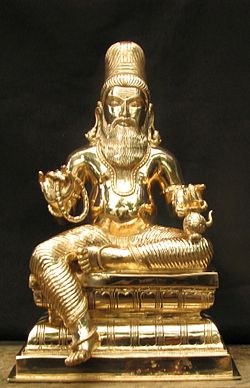
Agastya, the first Siddhar
Pambatti Siddhar Sannidhi at Marudamalai Temple

The Siddhar (Tamil (romanized) cittar; from Sanskrit siddha)[1] in Tamil tradition is a perfected individual who has attained spiritual powers called siddhi.

Historically, Siddhar also refers to the people who were early-age wandering adepts that dominated ancient Tamil teaching and philosophy. They were knowledgeable in science, technology, astronomy, literature, fine arts, music, drama, and dance and provided solutions to common people's illnesses and advice for their future.[2] Some of their ideologies are considered to have originated during the First Sangam period.[3][4][5]

Practice

[edit]

Siddhars were typically scientists, saints, doctors, alchemists, and mystics all in one. They wrote their findings in the form of Tamil poems on palm leaf manuscripts. They typically believe in one god, but there are some Siddhars who believe in polytheism. These are still owned by some families in Tamil Nadu and handed down through the generations, as well as being kept in universities in India, Germany, Great Britain, and the United States.[6]

In this way, Siddhars developed the native Siddha medicine system. A rustic form of healing that is similar to Siddha medicine has since been practiced by experienced elders in the villages of Tamil Nadu. This is referred to as pātti vaittiyam (grandmother's medicine), nāttu maruntu (folk medicine), and mūlikai maruttuvam (herbal medicine).

Siddhars are also believed to be the founders of varma kalai - a martial art for self-defense and medical treatment at the same time with the application of pressure points.[7]

Tamil Siddhars were the first to develop pulse-reading (naadi paarththal in Tamil) to identify the origin of diseases.

According to regional belief, the Siddhars are said to have resided for many ages upon a mountain called Sathuragiri, near the Thanipparai village in Tamil Nadu.

Siddhars

[edit]

The Abithana Chintamani encyclopedia states that the Siddhars are of the 18 persons listed below, but Agastya states that there are many who precede and follow these.

The 18 Siddhars

[edit]
Murti of Karuvurar

There are 18 Siddhars in the Tamil Siddha tradition:[8][9]

  1. Nandi
  2. Tirumular
  3. Agastya
  4. Kalangi Nathar [10] (identified with Kamalamuni and/or Confucius)
  5. Patanjali
  6. Korakkar
  7. Sundaranandar [ta]
  8. Konganar [ta]
  9. Sattaimuni [ta]
  10. Vanmikar (Valmiki)
  11. Ramadevar [ta]
  12. Dhanvantari
  13. Idaikaadar
  14. Machamuni (identified with Matsyendranatha)
  15. Karuvurar
  16. Bogar (identified with Laozi[11])
  17. Pambatti
  18. Kuthambai [ta]

Apart from the 18 Siddhars listed above, there is another list of 18 Siddhars who represent the 9 Navagrahas (with two Siddhars representing each Navagraha). All navagraha doshas and pariharams are performed to the Siddhars as Siddhar Velvi (Siddhar havan). The details of the 18 Siddhars who represent the 9 Navagrahas are as follows:[citation needed]

  1. Sivavakkiyar - Moon
  2. Kambili - Moon
  3. Bhogar - Mars
  4. Kagabhujanga - Jupiter
  5. Sri Pullipani Siddhar - Mars
  6. Sattaimuni - Kethu
  7. Sri Agapai Siddhar - Jupiter
  8. Alugani - Rahu
  9. Kudambai - Kethu
  10. Vallalar - Mercury
  11. Edaikaddar - Mercury
  12. Pattinathar - Sun
  13. Kaduvelli - Sun
  14. Kanjamalai - Venus
  15. Sennimalai - Venus
  16. Kapilar - Saturn
  17. Karuvurar - Saturn
  18. Pampatti - Rahu

Eight Perfections

[edit]

Siddhars are believed to have had both major and minor powers that are described in detail in various yogic and religious texts.[12][13]

  • Aṇimā: the ability to reduce one's body to the size of an atom.
  • Mahimā: the ability to expand one's body to an infinitely large size.
  • Laghimā: the ability to become weightless or lighter than air.
  • Garimā: the ability to become heavy or dense.
  • Prāpti: the ability to realize whatever one desires.
  • Prākāmya: the ability to access any place in the world.
  • Īśiṭva: the ability to control all material elements or natural forces.
  • Vaśiṭva: the ability to force influence upon anyone.

These eight are the Great Siddhis (Ashtama siddhis), or Great Perfections.

See also

[edit]

Notes and references

[edit]
Revisions and contributorsEdit on WikipediaRead on Wikipedia
from Grokipedia
Siddhars are enlightened saints, mystics, alchemists, and scholars in the ancient Tamil tradition of , particularly revered for their mastery over spiritual powers () achieved through , , and herbal knowledge, with 18 principal figures forming the core of this lineage. Originating in the Tamil-speaking regions during the Sangam period (c. 300 BCE–300 CE), the Siddhar tradition draws from Shaivite philosophy and emphasizes holistic practices that integrate , , and to transcend physical limitations and attain . The Siddhars, often depicted as wandering adepts, documented their teachings in poetic Tamil verses on palm-leaf manuscripts, preserving knowledge that influenced , , and indigenous systems. Central to their legacy is Siddha medicine, an indigenous system parallel to but distinctly Tamil in language and approach, focusing on herbal remedies, iatrochemistry (including preparations), , and yogic disciplines to balance the body's three humors (vaatham, pittham, kapam). This tradition gained formal recognition in the early 20th century in the , where it was institutionalized as a counterpoint to Sanskrit-based , underscoring its Dravidian cultural identity. Among the 18 Siddhars, prominent figures include , credited with foundational medical texts like the Agastiyar Vaittiya Kāviyam; , author of the philosophical Thirumantiram; and , known for alchemical innovations and sculptures. Other notable Siddhars are Nandhi (the first preceptor), Ramadevar, Konganar, Dhanvanthri, and Idaikadar, each associated with specific shrines (samadhis) across where devotees seek blessings for healing and enlightenment. Their works continue to underpin Siddha , with over 100,000 texts attributed to the Siddhars, many preserved in thousands of palm-leaf manuscripts held in private collections or institutions.

Etymology and Definition

Origins of the Term

The term "Siddhar" derives from the word "," which means "accomplished," "perfected," or "one who has attained success," stemming from the verbal root "sidh," signifying fulfillment or achievement. In the context of Indian spiritual traditions, particularly , a refers to an enlightened being who has realized ultimate spiritual perfection through yogic and tantric practices. In Tamil linguistic adaptation, the term evolved into "cittar" or "Siddhar," reflecting phonetic shifts in , such as the absence of aspirated consonants, and sometimes associating it with "chit," denoting pure . This adaptation occurred within the broader framework of Tamil , where Siddhars are revered as realized yogis embodying divine wisdom. The word does not appear in ancient (circa 300 BCE–300 CE), indicating that its specific usage as a title for spiritual adepts emerged later in the region's textual history. The earliest documented appearances of "Siddhar" in Tamil texts are found in medieval Shaivite works, notably the attributed to , composed around the 6th to 8th century CE, which integrates yogic, alchemical, and devotional elements. In this foundational text of the canon, the term denotes enlightened masters who have transcended ordinary existence. Subsequent Tamil Shaivite literature, such as the compilations, further popularized it, distinguishing "Siddhar" as a for realized yogis from "siddhi," the supernatural powers they may attain. This evolution underscores the term's role in encapsulating the synthesis of philosophical roots with indigenous Tamil spiritual expressions, exemplified by the 18 principal Siddhars as archetypal figures.

Characteristics of a Siddhar

Siddhars are revered in the Tamil tradition as immortal, enlightened masters who achieve jivanmukti—liberation while living—through intense sadhana encompassing yogic disciplines, , and alchemical processes aimed at perfecting the body and spirit. This path leads to kayasiddhi, the transcendence of physical , allowing them to persist as eternal guides in the material world. Alongside their spiritual enlightenment, Siddhars possess extensive practical knowledge, integrating insights from , , and to address human and promote holistic . Central to their identity is mastery over the body and mind, cultivated to such a degree that they can perform siddhis— abilities arising from perfected consciousness—without attachment or ego. Siddhars express their realizations through authorship of poetic works in Tamil, such as verses rich in and symbolism that encode yogic secrets, philosophical insights, and medicinal formulas for posterity. As gurus, they transmit esoteric via oral traditions, initiations, and discipleship, emphasizing direct experiential transmission over ritualistic orthodoxy to awaken the divine potential in all seekers. Unlike siddhas in broader Indian contexts, such as Buddhist adepts or Nath yogis who focus on northern tantric or ascetic paths, Tamil Siddhars embody a distinctive synthesis of Shaivite devotion to and Shaakta reverence for the immanent , viewing the divine as both transcendent and accessible through the body. Their teachings underscore anti-caste, egalitarian principles, rejecting Brahmanical hierarchies and advocating universal brotherhood, where spiritual attainment is open to individuals irrespective of birth or social standing, thereby challenging prevailing societal divisions.

Historical Context

Roots in Ancient Tamil Traditions

The Siddhar tradition emerges from the deep roots of Dravidian folk spirituality in ancient Tamil society, where ascetic figures embodying spiritual perfection were revered as intermediaries between the divine and the human world. During the Sangam period (circa 300 BCE to 300 CE), Tamil poetry collections such as the Ettuthokai and Pattuppattu extol ascetic poets known as pulavar or wandering sages who practiced intense and renunciation, foreshadowing the Siddhars' emphasis on inner transformation and mystical attainment. These early depictions portray ascetics harnessing natural elements and yogic discipline to achieve harmony with the , reflecting a pre-Vedic folk ethos centered on local deities, , and communal healing rituals indigenous to the Tamil landscape. By the 5th to 8th centuries CE, the Siddhar tradition integrated with Agamic , blending indigenous Tamil devotional practices with the ritualistic and philosophical frameworks of the Shaiva Agamas. The seminal text , attributed to the Siddhar and dated to this era, serves as the earliest Tamil exposition of doctrine, synthesizing Agamic temple worship, yogic techniques, and non-dualistic theology in vernacular verse. This integration elevated Siddhars as custodians of esoteric knowledge, positioning them as reformers who adapted Shaiva rituals to Tamil cultural contexts, emphasizing direct experiential union with over elaborate priestly intermediaries. Ancient Tamil concepts of , such as jothi representing transcendent illumination and grace, profoundly influenced Siddhar , manifesting in meditative visions of an all-pervading luminous essence akin to arutperum jothi. Early yogic practices alluded to in ancient grammatical and poetic texts predating northern yogic codifications align with Siddhar methods for awakening inner energy. These elements underscore a native Tamil yogic heritage focused on ethical living, sensory mastery, and ecstatic devotion. Siddhars played a pivotal role in challenging Vedic by prioritizing vernacular Tamil as the medium for sacred knowledge, thereby democratizing spirituality and subverting Sanskrit-dominated Brahmanical hierarchies. Their compositions, such as those in the , critiqued ritualistic exclusivity and caste-based exclusions, advocating inclusive paths accessible to all social strata through personal discipline and devotion. This egalitarian stance fostered a radical spiritual movement that empowered marginalized communities, promoting over inherited privilege.

Evolution and Influences

The Siddhar traditions, rooted in ancient Tamil spiritual practices, underwent significant evolution during the medieval period spanning the 9th to 18th centuries, marked by a flourishing integration with the . This era saw Siddhars engaging deeply with devotional currents, blending Shaivite and Vaishnavite elements alongside folk traditions in their poetic and yogic expressions; for instance, , active in the 10th to 13th centuries, exemplified this syncretism through hymns that emphasized renunciation and universal devotion while drawing on Shaiva bhakti themes. Such interactions enriched the Siddhar corpus, incorporating tantric and alchemical dimensions into South Indian Shaivite society, as evidenced in texts like the Tirumantiram (7th–11th centuries), which fused yogic disciplines with devotional . In subsequent developments, external influences further shaped Siddhar knowledge, particularly through Islamic during the 17th to 19th centuries, with scholars noting traces of Sufi-inspired principles in Siddha ; , a prominent alchemist, is associated with these syncretic advancements in medicinal formulations and . European encounters in the colonial era introduced hybrid elements, as Siddhars adapted alchemical and medical texts to engage with Western scientific discourse. The brought a notable revival tied to in the , where was reframed as an indigenous Tamil system—distinct from Sanskrit-rooted —to assert amid colonial legacies; key efforts included the Usman Committee report, which recognized Siddha's validity and spurred associations and publications promoting its ancient Tamil origins.

The Siddhars

The 18 Principal Siddhars

In the Siddha tradition, the 18 principal Siddhars form the canonical group of perfected masters who are credited with establishing the foundational principles of yoga, medicine, alchemy, and spiritual philosophy through their poetic and textual contributions in ancient Tamil. These figures are traditionally enumerated in Siddha literature, such as collections of their songs and treatises, highlighting their roles as enlightened beings who attained extraordinary wisdom and powers. While a core group is recognized, the exact list of 18 varies across Siddha texts and traditions. Their collective significance lies in systematizing the Siddha system as a holistic path to physical, mental, and spiritual perfection, influencing Tamil culture for centuries. One traditional list, drawn from texts like Siddhar Padalgal, includes the following Siddhars, each associated with key domains of :
SiddharKey Contributions
Father of the Siddha tradition; authored works on grammar, , and .
Author of ; systematized practices and Shaiva .
Renowned alchemist; creator of Navapashanam, a herbal-mineral compound.
RomamuniExpert in medicinal formulations and Siddha therapeutics.
MacchamuniProminent teacher; contributed to techniques.
IdaikkadarAstrologer and ; authored texts on and cosmic .
KamalamuniHerbalist; specialized in plant-based remedies and pharmacology.
Adapter of sutras to Siddha context; focused on meditative disciplines.
SattainatharTemple reformer and spiritual guide; emphasized and devotion.
RamadevarMetallurgist and alchemist; advanced techniques in .
Pioneer in ; contributed to surgical and therapeutic .
KonganarDisciple of ; authored works on and disciple training.
TheraiyarInventor of ; key figure in diagnostic methods.
Master of herbal lore; documented wild plant uses in .
Vanmeegar and ; focused on esoteric prophecies and .
Karuvoorar and ; composed verses on and devotion.
NandidevarDevotee of ; to other Siddhars, emphasizing .
These Siddhars are mythically regarded as immortal, having transcended death through yogic and alchemical mastery, and are believed to reside in hidden abodes such as the , continuing to guide humanity subtly. Their perfected status as enlightened beings underscores the ideal of achieving the eight siddhis, or perfections, through disciplined practice.

Other Notable Siddhars

Beyond the foundational group of 18 principal Siddhars, the tradition includes a diverse array of figures whose contributions highlight its expansive reach and adaptability in Tamil and South Indian spiritual contexts. These additional Siddhars often share the core emphasis on yogic attainment, alchemical knowledge, and poetic expression, extending the lineage through innovative symbolism and social commentary. Pambatti Siddhar exemplifies this extension through his poetry, where the snake serves as a potent symbol for the Kundalini energy, representing spiritual awakening and inner transformation. His verses, addressed directly to serpents, underscore the mystical union of the practitioner with divine forces, aligning with Siddha themes of transcendence. Sivavakkiyar stands out as a sharp social critic and anti-ritualist, using his to denounce hierarchies, ritualistic excesses, and dogmatic practices prevalent in 10th-century Tamil society. Born into a family, he advocated for egalitarian spirituality, emphasizing direct personal experience over institutionalized religion. Sundarar, through his integration of devotion with mysticism, bridged emotional surrender to with yogic perfection, influencing the synthesis of devotional and esoteric paths in Tamil . His works reflect a harmonious blend of ecstatic praise and pursuit, enriching the tradition's devotional dimension. The Siddhar tradition exhibits regional variations in areas like and , where local sacred sites such as the hills and are linked to practices and pilgrimages, adapting core Tamil elements to indigenous landscapes and . In the 19th and 20th centuries, modern claimants like (Vallalar) revived and expanded the lineage, authoring thousands of poems on universal compassion, bodily immortality, and , while promoting social reforms aligned with egalitarianism. Inclusion in this broader pantheon typically rests on criteria such as authorship of substantial Siddhar —often exceeding attributed verses—and alignment with foundational traits like , rejection of , and attainment of siddhis through and .

Practices and Teachings

Spiritual and Yogic Disciplines

The Siddha yoga systems form the core of spiritual practices in the Tamil Siddhar tradition, emphasizing inner transformation through disciplined control of the body's subtle energies to achieve enlightenment and union with the divine. These practices, adapted from broader yogic frameworks into a distinctly Tamil context, integrate physical postures, breath regulation, and meditative techniques to harmonize the individual soul with the universal consciousness. Central to this is the ashtanga yoga framework, outlined in ancient texts, which progresses through ethical restraints (yama), observances (niyama), postures (asana), breath control (pranayama), sensory withdrawal (pratyahara), concentration (dharana), meditation (dhyana), and absorption (samadhi), all tailored to awaken latent spiritual potential. Kayakalpa, a key rejuvenation practice, focuses on psycho-spiritual renewal by extending the body's vitality to support prolonged meditation and liberation (moksha), as developed by Tamil Siddhars like Agastya and Bhoganathar. This involves yogic exercises that channel prana (vital energy) through the nadis (subtle channels), preparing the practitioner for higher states of awareness without emphasis on physical longevity alone. In the Tamil adaptation, kayakalpa aligns with Siva Yogam, where breath and posture techniques facilitate the ascent of inner fire along the central nadi (sulumunai), fostering embodied consciousness. Pranayama variants in Siddha yoga regulate the vital airs (vayus) to purify the , with techniques such as pooragam (inhalation for 12 mathirai), kumbakam (retention for 4 mathirai), and resagam (exhalation for 8 mathirai) balancing the ida (lunar, left) and (solar, right) nadis. These practices, integral to awakening, direct upward through bandhas like mula bandha (perineal lock) and bandha (throat lock), enabling the practitioner to access higher chakras and achieve . In the Tamil context, such breath control is linked to asanas like padmasana and svastikasana, promoting self-observation and the union of sun, moon, and fire energies at (crown center). Mantras and yantras serve as vibrational aids in these disciplines, with sacred syllables chanted during to invoke divine energy and geometric diagrams (yantras) used in to focus the mind on chakric centers. Temple-based rituals, often conducted in Shaivite shrines, incorporate these elements through guided invocations and , reinforcing the practitioner's devotion. The guru-shishya parampara underscores all practices, where knowledge is transmitted orally from master to disciple in a lineage emphasizing direct experiential guidance for safe arousal. The Tirumantiram by elucidates control of the ten principal vayus—, apana, vyana, udana, samana, naga, , krikala, , and dhananjaya—through breath retention and visualization to stabilize vital forces and prevent dissipation during . in the text involves sequential focus on the six centers, from to , culminating in , to dissolve ego and realize non-dual bliss, as verse 1417 states: "When the body perishes, the life force departs; concentration on preserving the body cherishes the life force." This Tamil-centric approach integrates with Shaiva devotion, prioritizing inner over external rites.

Alchemical and Medicinal Knowledge

Siddha alchemy, known as rasayana, encompasses the transmutation of base metals into noble ones and the creation of potent elixirs aimed at enhancing vitality and extending lifespan. Practitioners like Bogar developed mercury-based formulas, such as those detailed in his attributed text Bogar 7000, which describe processes for purifying and compounding mercury (rasa) with herbs and minerals to produce kayakalpa preparations for bodily rejuvenation. These elixirs, including mercurial tonics, were formulated to promote longevity without the moral qualms associated with pursuits of literal immortality, focusing instead on harmonious extension of life through physical and subtle refinement. Yogic discipline was deemed essential to safely handle these potent substances, mitigating potential toxicities. The foundations of Siddha medicine rest on balancing the three humors—vaatham (air and space), pittham (fire), and kapam ()—which govern physiological functions and . Derangements in these humors lead to illness, with often relying on naadi pariksha ( examination) to assess humoral imbalances through the rhythm and quality of arterial pulses. The system classifies 4448 diseases arising from such imbalances, categorized into eight broad types including wounds, poisons, and abdominal disorders, providing a comprehensive for treatment. Therapeutics emphasize 32 types of internal medicines (e.g., powders, tablets, and decoctions) and 32 types of external applications (e.g., oils, pastes, and varmas), derived from over 500 herbs, 64 minerals, 120 salts, and animal products, all processed to restore humoral equilibrium. Key texts underpin these practices, with Agastya credited for foundational works like Agastya Vaidya Kaviyam and Agastya Paripooranam, which outline and formulations for management and preparation. Theraiyar's contributions to diagnostics appear in texts such as Theraiyar Yamaga Venba, which detail pulse reading, urine analysis, and symptom-based identification of humoral disorders to guide precise interventions. These works emphasize empirical and tailored compounding, integrating with clinical application for holistic healing.

Philosophical Concepts

Core Siddha Philosophy

The core of Siddha philosophy is a monistic worldview that posits the ultimate unity of Shiva, representing pure consciousness, and Shakti, embodying dynamic energy, as inseparable aspects of the divine reality pervading all existence. This unity manifests within the human body, viewed as a microcosm of the universe, where the spine serves as the cosmic axis (Meru) and the chakras as centers of divine energy, mirroring the macrocosmic structure. Unlike dualistic traditions that emphasize illusion (maya) as a barrier to truth, Siddha thought rejects maya as an external veil, advocating instead for direct gnosis (jnana) achieved through inner realization, whereby the practitioner expands consciousness to encompass the infinite (Maha Chitta). Ethical principles in Siddha philosophy emphasize non-violence (ahimsa) as foundational to spiritual purity, alongside a staunch anti-ritualism that dismisses external ceremonies, idol worship, and temple practices as superfluous to true devotion. Social equality is a key tenet, with vehement critiques of caste hierarchies and Brahmanical orthodoxy, as exemplified in the poems of Sivavakkiyar, who declared that divine realization transcends social divisions and ritualistic pretensions, affirming the inherent worth of all beings regardless of birth. These ethics promote a direct, egalitarian path to the divine, free from dogmatic intermediaries. Siddha cosmology integrates the five elements ()—earth, water, fire, air, and ether—as the foundational building blocks of both the physical body and the universe, with the () originating from and journeying back to merge with the (jyoti) of . This journey involves the progressive purification and transcendence of elemental impurities, culminating in unity with the supreme , where individual identity dissolves into eternal bliss. Attainment of this merger is facilitated through yogic disciplines that align the microcosmic body with cosmic harmony.

The Eight Perfections

In the Siddha tradition of , the eight perfections, known as ashtasiddhi or attamasiddhigal, represent supernatural accomplishments that signify a practitioner's mastery over the self and the material world, attained through profound spiritual discipline. These powers are viewed as byproducts of enlightenment rather than ultimate aims, serving as markers of the Siddhars' divine realization. Rooted in ancient yogic lore and elaborated in key Siddha texts, the ashtasiddhi enable the enlightened to transcend physical limitations, facilitating their role as teachers and healers. The eight perfections are traditionally enumerated as follows:
  • Anima: The ability to reduce one's body to the size of an atom, allowing entry into minute spaces or beings without hindrance.
  • Mahima: The capacity to expand one's body to an immense size, rivaling cosmic proportions, to demonstrate dominion over form.
  • Garima: Gaining extreme heaviness, rendering the body immovable like a , symbolizing grounded stability in the face of worldly forces.
  • Laghima: Achieving lightness, such as levitating or becoming weightless as a , to illustrate detachment from material density.
  • Prapti: The power to attain or reach any desired object or place instantaneously, bridging distances through focused intent.
  • Prakamya: Exercising irresistible will to manifest enjoyable experiences or alter reality according to one's vision, free from external constraints.
  • Ishitva: Attaining supremacy or lordship over creation, commanding natural elements and lesser beings with authoritative .
  • Vashitva: Gaining control over the minds and actions of others, not through but through empathetic influence to guide toward truth.
Siddhars regarded these perfections as practical tools for imparting spiritual teachings and aiding devotees, rather than personal indulgences or primary objectives of practice. Texts such as the Tirumandiram by emphasize that attachment to siddhis distracts from true liberation, warning practitioners to view them as transient aids on the path to divine union, lest ego arise and obstruct higher realization. Within the Siddha framework, these accomplishments emerge through advanced yogic states like , where the mind merges with the soul, but they remain secondary to the ultimate goal of or eternal bliss. This aligns with the tradition's integration of , where such powers arise naturally from inner purification, underscoring enlightenment's philosophical context over mere psychic feats.

Legacy and Influence

Impact on Tamil Culture and Literature

The Siddhars' literary legacy is prominently featured in the poetic anthologies attributed to the 18 principal Siddhas, collectively referred to as the Siddha Upadeshas, which consist of verses blending yogic insights, philosophical discourse, and spiritual guidance. These works have significantly shaped Tamil devotional poetry by introducing complex meters, tantric symbolism, and a focus on personal mystical experience, influencing subsequent bhakti traditions through their emphasis on direct communion with the divine. Themes of divine love as an alchemical union of the soul and the absolute, profound mysticism rooted in yogic realization, and sharp satire against religious orthodoxy and social hierarchies recur throughout, challenging conventional Shaivite norms while enriching Tamil poetic expression. In , the Siddhars serve as enduring symbols, embedded in festivals, , and popular media. For instance, the Palani Murugan Temple, where Siddhar is credited with crafting the central idol from a nine-metal , hosts major annual festivals like Thai Poosam and , drawing millions of devotees who honor Bogar's legacy through rituals and processions that blend devotion with cultural performance. Their narratives appear in such as therukoothu street dramas and traditions, preserving mystical tales in rural performances, while in cinema, Siddhar poems have inspired devotional songs and thematic motifs in Tamil films, reinforcing their role in collective identity. By composing exclusively in Tamil rather than , the Siddhars elevated the language as a sacred medium for esoteric knowledge, democratizing spiritual teachings and affirming its cultural primacy. The Siddhars also advanced social reforms through their writings, critiquing caste-based and promoting equality, which extended to for women's and the inherent dignity of all labor. In texts attributed to Idaikkadar, a shepherd-turned-Siddhar, ethical verses condemn exploitative practices and "evil ways" that undermine social harmony, emphasizing and the value of humble vocations like work as paths to enlightenment. This perspective, drawn from their diverse backgrounds, fostered a vision of societal equity that resonated in Tamil literature's ethical discourse.

Modern Interpretations and Practices

In the , the Siddhar traditions experienced a notable revival through key figures such as S.A.A. Ramaiah, who played a pivotal role in disseminating as part of the ancient Tamil Siddha lineage. Ramaiah, active from the mid-, renovated sacred sites in during the 1970s, including shrines dedicated to Siddhars like Avvaiyar, and founded the International Babaji Yoga Sangam to promote these teachings globally. His publications, such as Songs of the 18 Yoga Siddhas in 1968, compiled and translated esoteric Siddhar and yogic practices, bridging ancient Tamil wisdom with contemporary spiritual seekers. This revival extended the traditions into yoga institutes worldwide, where was presented as a synthesis of the 18 Siddhars' methods, emphasizing breath control, , and inner for . These efforts facilitated the integration of Siddhar concepts into spirituality, particularly through the popularized narrative of , a mythical Siddhar figure, whose teachings influenced global movements blending Eastern mysticism with . In the , communities in , , and have adapted Siddhar and via local centers and online courses, preserving rituals like recitation while incorporating modern wellness elements. For instance, organizations inspired by Ramaiah's work offer retreats that teach Siddhar-inspired techniques, fostering a appreciation of Tamil spiritual heritage. Contemporary practices of Siddhar traditions are evident in the formalized role of within India's healthcare system, following its official recognition under the Indian Medicine Central Council Act of 1970, which established regulatory bodies like the Central Council of Indian Medicine to oversee education and practice. This integration has positioned Siddha as one of the AYUSH systems (, , , Unani, , and ), with government-supported hospitals and research institutes in providing treatments for chronic conditions using herbal and mineral formulations. In 2025, gained further global recognition through its inclusion in the World Health Organization's () update, alongside and Unani, and the adoption of the WHO Global Traditional Medicine Strategy 2025–2034, aimed at integrating traditional systems into mainstream healthcare worldwide. in has surged, with resorts like Vela Siddha Wellness Village offering detox retreats and therapeutic programs rooted in Siddhar principles, attracting international visitors for rejuvenation therapies that combine , diet, and massage. Additionally, online platforms have enabled the dissemination of Siddhar poetry, with sites translating and archiving verses from figures like Sivavakkiyar, making esoteric Tamil works accessible to global audiences through blogs and digital archives. Despite these advancements, Siddhar traditions face challenges related to and authenticity, as the rapid growth of the industry has led to issues like adulteration and substitution of ingredients in Siddha formulations. Heavy metal contamination from traditional mineral-based preparations, such as those involving mercury and , has drawn regulatory scrutiny, prompting calls for stricter to ensure safety without diluting historical methods. Scientific examination of alchemical claims, including purported elixirs for , remains limited and often highlights the need for empirical validation, as esoteric processes like those for muppu (a secret alchemical salt) prioritize secrecy over reproducible testing. Debates persist among practitioners and scholars on balancing commercial viability—evident in the export of Siddha products worth millions annually—with preserving the spiritual and ethical core of the traditions.

References

Add your contribution
Related Hubs
User Avatar
No comments yet.