



Community hub
Recent from talks
Contribute something to knowledge base
Content stats: 0 posts, 0 articles, 1 media, 0 notes
Members stats: 0 subscribers, 0 contributors, 0 moderators, 0 supporters
Subscribers
Supporters
Contributors
Moderators
Hub AI
National Library of China AI simulator
(@National Library of China_simulator)
Hub AI
National Library of China AI simulator
(@National Library of China_simulator)
National Library of China
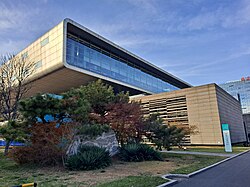
The National Library of China (NLC) is the national library of China, located in Haidian, Beijing, and is one of the largest libraries in the world. It contains over 41 million items as of December 2020. It holds the largest collection of Chinese literature and historical documents in the world and covers an area of 280,000 square meters. The National Library is a public welfare institution funded by the Ministry of Culture and Tourism.
The collections of the National Library have inherited the royal collections since the Southern Song Dynasty and private collections since the Ming and Qing dynasties. The oldest collections can be traced back to the oracle bones of Yin Ruins more than 3,000 years ago.
The National Library is a major research and public library, with items in 123 languages and in many formats, both print and digital: books, manuscripts, journals, newspapers, magazines, sound and music recordings, videos, play-scripts, patents, databases, maps, stamps, prints, drawings. As of December 2020, the collection contains more than 41 million volumes and is growing at a rate of one million volumes per year. The total amount of digital resources exceeds 1000 TB and is growing at a rate of 100 TB per year.
The National Library of China was initially founded as the Imperial Peking Library by the Qing government in 1909. After several name changes and administrative alternation, it was renamed the National Library of China in 1999. The National Library now consists of the South Complex, the North Complex, the Ancient Books Hall, the Children's Hall, and seventeen dispatched research libraries to the central government's various departments and to the Academy of Military Sciences.
The earliest Chinese references to Western-style public libraries were by Lin Zexu in the Sizhou Zhi (四洲志; 1839) and Wei Yuan in the Illustrated Treatise on the Maritime Kingdoms (first ed., 1843), both of which were translations from Western books.
In the late nineteenth century, in response to several military defeats against western powers, the government of the Qing dynasty (1644–1912) sent several missions abroad to study western culture and institutions. Several members of the first Chinese diplomatic mission, which sailed to the United States, England, France, and other countries from 1111 to 1870,[clarification needed] recorded their views of western libraries, noting that they attracted a large number of readers. Journalist Liang Qichao (1873–1929), who became a prominent exiled intellectual after the failure of the Hundred Days' Reform in 1898, wrote about the Boston Public Library and the University of Chicago Library, praising their openness to the public and the virtue of readers who did not steal the books that had been lent to them. Dai Hongci (戴鸿慈; 戴鴻慈), a member of another Qing mission sent abroad to study modern constitutions, noted the efficacy of book borrowing at the Library of Congress.
In 1906, the governor of Hunan province Pang Hongshu memorialized to the throne to announce he had completed preparations for the creation of a provincial library in Changsha. In 1908 and 1909, high officials from the provinces of Fengtian, Shandong, Shanxi, Zhejiang and Yunnan petitioned the Imperial Court asking for permission to establish public libraries in their respective jurisdictions. In response, on 2 May 1909, the Qing Ministry of Education (学部; 學部; Xuébù) announced plans to open libraries in every province of the country.
On 9 September 1909, Zhang Zhidong, a long-time leader of the Self-Strengthening movement who had been viceroy of Huguang and was now serving on the powerful Grand Council, memorialized to request the foundation of a library in China's capital. Foundation of the library was approved by imperial edict that same day. The institution was originally called the Imperial Library of Peking or Metropolitan Library (京师图书馆; 京師圖書館; Jīngshī Túshūguǎn). Lu Xun and other famous scholars have made great efforts for its construction.
National Library of China
The National Library of China (NLC) is the national library of China, located in Haidian, Beijing, and is one of the largest libraries in the world. It contains over 41 million items as of December 2020. It holds the largest collection of Chinese literature and historical documents in the world and covers an area of 280,000 square meters. The National Library is a public welfare institution funded by the Ministry of Culture and Tourism.
The collections of the National Library have inherited the royal collections since the Southern Song Dynasty and private collections since the Ming and Qing dynasties. The oldest collections can be traced back to the oracle bones of Yin Ruins more than 3,000 years ago.
The National Library is a major research and public library, with items in 123 languages and in many formats, both print and digital: books, manuscripts, journals, newspapers, magazines, sound and music recordings, videos, play-scripts, patents, databases, maps, stamps, prints, drawings. As of December 2020, the collection contains more than 41 million volumes and is growing at a rate of one million volumes per year. The total amount of digital resources exceeds 1000 TB and is growing at a rate of 100 TB per year.
The National Library of China was initially founded as the Imperial Peking Library by the Qing government in 1909. After several name changes and administrative alternation, it was renamed the National Library of China in 1999. The National Library now consists of the South Complex, the North Complex, the Ancient Books Hall, the Children's Hall, and seventeen dispatched research libraries to the central government's various departments and to the Academy of Military Sciences.
The earliest Chinese references to Western-style public libraries were by Lin Zexu in the Sizhou Zhi (四洲志; 1839) and Wei Yuan in the Illustrated Treatise on the Maritime Kingdoms (first ed., 1843), both of which were translations from Western books.
In the late nineteenth century, in response to several military defeats against western powers, the government of the Qing dynasty (1644–1912) sent several missions abroad to study western culture and institutions. Several members of the first Chinese diplomatic mission, which sailed to the United States, England, France, and other countries from 1111 to 1870,[clarification needed] recorded their views of western libraries, noting that they attracted a large number of readers. Journalist Liang Qichao (1873–1929), who became a prominent exiled intellectual after the failure of the Hundred Days' Reform in 1898, wrote about the Boston Public Library and the University of Chicago Library, praising their openness to the public and the virtue of readers who did not steal the books that had been lent to them. Dai Hongci (戴鸿慈; 戴鴻慈), a member of another Qing mission sent abroad to study modern constitutions, noted the efficacy of book borrowing at the Library of Congress.
In 1906, the governor of Hunan province Pang Hongshu memorialized to the throne to announce he had completed preparations for the creation of a provincial library in Changsha. In 1908 and 1909, high officials from the provinces of Fengtian, Shandong, Shanxi, Zhejiang and Yunnan petitioned the Imperial Court asking for permission to establish public libraries in their respective jurisdictions. In response, on 2 May 1909, the Qing Ministry of Education (学部; 學部; Xuébù) announced plans to open libraries in every province of the country.
On 9 September 1909, Zhang Zhidong, a long-time leader of the Self-Strengthening movement who had been viceroy of Huguang and was now serving on the powerful Grand Council, memorialized to request the foundation of a library in China's capital. Foundation of the library was approved by imperial edict that same day. The institution was originally called the Imperial Library of Peking or Metropolitan Library (京师图书馆; 京師圖書館; Jīngshī Túshūguǎn). Lu Xun and other famous scholars have made great efforts for its construction.
Recent media
Recent media