
Recent from talks
Nerf Blaster
Knowledge base stats:
Talk channels stats:
Members stats:
Nerf Blaster
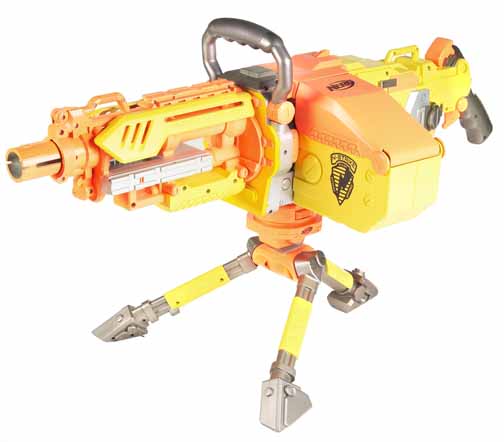
A Nerf Blaster or Nerf Gun is a toy gun made by Hasbro that fires foam darts, arrows, discs, or foam balls. “Nerf blaster” or more commonly “Nerf gun” are often used to describe the toy. Nerf blasters are manufactured in multiple forms; the first Nerf blasters emerged in the late 1980s with the release of the Nerf Blast-a-Ball (1989) and the Sharpshooter (1992). Today, Hasbro has produced over twenty unique lines of Nerf-brand blasters, with each line centered on a particular theme or type of ammunition. Hasbro has also produced Nerf blasters based on specific franchises, including Marvel Comics, Star Wars, G.I. Joe, Fortnite, Transformers, Overwatch, Halo Infinite, Roblox and Minecraft. Nerf blasters are available in several international marketplaces, although some blasters have their names changed or are not sold in certain countries due to laws surrounding toy safety franchises.
Most Nerf brands are packaged with a set of the ammunition it fires, and ammunition refills are sold separately online and in stores at greater quantities. Some blasters can also be customized with special-made attachments, which are either included with the blaster or sold separately. Many non-Nerf brand blasters are also cross-compatible with Nerf brand darts and magazines in order to take advantage of the name-brand's existing ecosystem.
Nerf blasters have been acclaimed for their popularity, particularly among boys and young adults. Additionally, a community has grown around Nerf blasters, as competitive and casual "Nerf wars” held among enthusiasts in various forms, similar to Airsoft and paintball. A significant modding community has also formed among enthusiasts, who aim to improve the performance and accuracy of existing blasters through upgraded parts and different dart or ammo types. Nerf blasters have also gained a significant following in the cosplay community, where fans create intricate costumes and props inspired by their favorite characters. They have also been adopted by schools and youth organizations as a form of active play and team-building exercises.
Nerf blasters feature a variety of internal and external mechanisms that allow the user to prime and discharge ammo. These systems vary from blaster to blaster depending on the type of ammo and propulsion method that the design is centered around. Two common propulsion mechanisms include spring-operated plunger systems and battery-operated flywheel systems, but other variants of these systems exist.
The direct plunger system consists of a few main components, including a tube, a spring, and a rod with a head attached to the spring. To cock this mechanism, the user must move a handle attached to the rod in a rearward motion to compress the spring and lock it in place. When the user pulls the blaster's trigger, the lock disengages, which causes the spring to release and force air out through the tube in the direction of the spring's release. The energy generated by the compressed air, in turn, launches the dart or other projectile out through the blaster's barrel apparatus.
Hasbro has featured the direct plunger system in multiple blasters from its modern product lines. In the N-Strike series, for instance, the Longshot CS-6 houses a relatively large direct plunger that fires magazine-fed streamline darts as its ammo type. The system extends to blasters with other projectile types as well, such as the Rush-40 in the Hyper series. As the user slides back the upper priming portion of the blaster, a hopper mechanism agitates a spherical rubber-like Hyper round into a chute, all while compressing the spring-loaded plunger rod.
The reverse plunger system operates similarly to the direct plunger mechanism, but there are some notable differences in the system's design. While a direct plunger system uses a rod with a head to propel air into the projectile, a reverse plunger system replaces this component with a rear tubular portion that slides backward to pull air into the system. To cock the mechanism, the user pulls a handle attached to this rear tube backward, which compresses the spring connected to the rear tube and pulls air into the front tube. Like the rod in the direct plunger, this motion engages a catch that locks the rear tube in place. Upon squeezing the trigger, the user disengages this catch, which springs the rear tube forward. As the tube returns forward, air pressure builds in the front tube and discharges the dart or other projectile from the blaster's barrel.
While most plunger systems in modern Nerf blasters rely on the user to move a handle or other component rearward to store energy in a spring, Hasbro designs most blasters' flywheel systems using battery-driven motors as the effective propulsion method. In these systems a pair of motors spins two opposing wheels, each in the direction of the barrel, in order to impart momentum onto the projectile. To perform this action, the user pulls the blaster's trigger to actuate a mechanical or electronic indexer, which feeds a dart or other projectile into the spinning wheels. The wheels, in turn, apply friction to the dart or other projectile to launch the ammo out through the barrel mechanism.
Hub AI
Nerf Blaster AI simulator
(@Nerf Blaster_simulator)
Nerf Blaster
A Nerf Blaster or Nerf Gun is a toy gun made by Hasbro that fires foam darts, arrows, discs, or foam balls. “Nerf blaster” or more commonly “Nerf gun” are often used to describe the toy. Nerf blasters are manufactured in multiple forms; the first Nerf blasters emerged in the late 1980s with the release of the Nerf Blast-a-Ball (1989) and the Sharpshooter (1992). Today, Hasbro has produced over twenty unique lines of Nerf-brand blasters, with each line centered on a particular theme or type of ammunition. Hasbro has also produced Nerf blasters based on specific franchises, including Marvel Comics, Star Wars, G.I. Joe, Fortnite, Transformers, Overwatch, Halo Infinite, Roblox and Minecraft. Nerf blasters are available in several international marketplaces, although some blasters have their names changed or are not sold in certain countries due to laws surrounding toy safety franchises.
Most Nerf brands are packaged with a set of the ammunition it fires, and ammunition refills are sold separately online and in stores at greater quantities. Some blasters can also be customized with special-made attachments, which are either included with the blaster or sold separately. Many non-Nerf brand blasters are also cross-compatible with Nerf brand darts and magazines in order to take advantage of the name-brand's existing ecosystem.
Nerf blasters have been acclaimed for their popularity, particularly among boys and young adults. Additionally, a community has grown around Nerf blasters, as competitive and casual "Nerf wars” held among enthusiasts in various forms, similar to Airsoft and paintball. A significant modding community has also formed among enthusiasts, who aim to improve the performance and accuracy of existing blasters through upgraded parts and different dart or ammo types. Nerf blasters have also gained a significant following in the cosplay community, where fans create intricate costumes and props inspired by their favorite characters. They have also been adopted by schools and youth organizations as a form of active play and team-building exercises.
Nerf blasters feature a variety of internal and external mechanisms that allow the user to prime and discharge ammo. These systems vary from blaster to blaster depending on the type of ammo and propulsion method that the design is centered around. Two common propulsion mechanisms include spring-operated plunger systems and battery-operated flywheel systems, but other variants of these systems exist.
The direct plunger system consists of a few main components, including a tube, a spring, and a rod with a head attached to the spring. To cock this mechanism, the user must move a handle attached to the rod in a rearward motion to compress the spring and lock it in place. When the user pulls the blaster's trigger, the lock disengages, which causes the spring to release and force air out through the tube in the direction of the spring's release. The energy generated by the compressed air, in turn, launches the dart or other projectile out through the blaster's barrel apparatus.
Hasbro has featured the direct plunger system in multiple blasters from its modern product lines. In the N-Strike series, for instance, the Longshot CS-6 houses a relatively large direct plunger that fires magazine-fed streamline darts as its ammo type. The system extends to blasters with other projectile types as well, such as the Rush-40 in the Hyper series. As the user slides back the upper priming portion of the blaster, a hopper mechanism agitates a spherical rubber-like Hyper round into a chute, all while compressing the spring-loaded plunger rod.
The reverse plunger system operates similarly to the direct plunger mechanism, but there are some notable differences in the system's design. While a direct plunger system uses a rod with a head to propel air into the projectile, a reverse plunger system replaces this component with a rear tubular portion that slides backward to pull air into the system. To cock the mechanism, the user pulls a handle attached to this rear tube backward, which compresses the spring connected to the rear tube and pulls air into the front tube. Like the rod in the direct plunger, this motion engages a catch that locks the rear tube in place. Upon squeezing the trigger, the user disengages this catch, which springs the rear tube forward. As the tube returns forward, air pressure builds in the front tube and discharges the dart or other projectile from the blaster's barrel.
While most plunger systems in modern Nerf blasters rely on the user to move a handle or other component rearward to store energy in a spring, Hasbro designs most blasters' flywheel systems using battery-driven motors as the effective propulsion method. In these systems a pair of motors spins two opposing wheels, each in the direction of the barrel, in order to impart momentum onto the projectile. To perform this action, the user pulls the blaster's trigger to actuate a mechanical or electronic indexer, which feeds a dart or other projectile into the spinning wheels. The wheels, in turn, apply friction to the dart or other projectile to launch the ammo out through the barrel mechanism.
Recent media