



Community hub
Recent from talks
Knowledge base stats:
Talk channels stats:
Members stats:
Netdata
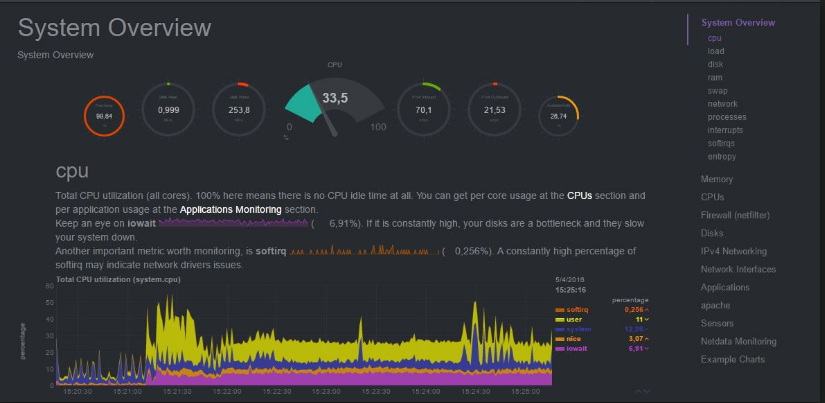
Netdata is a real-time observability platform for monitoring infrastructure and applications. The project started in 2016 as an open-source system monitoring tool that collected and visualized metrics such as CPU, memory, disk, and network usage through an automatic web-based dashboard. Today, Netdata provides over 800 integrations for metrics collection, log management, machine learning-based anomaly detection, and AI-assisted troubleshooting. The company behind Netdata also offers Netdata Cloud, a commercial hosted service for centralized monitoring across multiple nodes.
Netdata was created by Costa Tsaousis, who began building the tool after becoming dissatisfied with existing monitoring solutions. The project was released publicly as open-source software in March 2016. According to TechCrunch, Tsaousis said the project gained approximately 10,000 GitHub stars within a week after being shared on Reddit.
In September 2019, Netdata announced a $17 million Series A funding round led by Bain Capital Ventures. In September 2020, the company extended its Series A with an additional $14.2 million led by Bessemer Venture Partners, bringing total funding to $31 million. In February 2023, the company introduced paid subscription tiers alongside its free community plan.
Netdata uses a distributed architecture where monitoring agents run on individual systems and collect metrics locally. The software consists of several components:
The agent includes an embedded web server that serves its dashboard and provides a REST API for accessing metrics. Metrics are stored using Netdata's custom time-series database engine (dbengine), which supports up to five storage tiers at different resolutions (per-second, per-minute, per-hour by default). Netdata claims the database achieves approximately 0.5 bytes per sample on disk for high-resolution data.
Netdata can monitor system resources (CPU, memory, storage, network), containers, Kubernetes clusters, running processes, and common services such as databases. It runs on Linux, Windows, FreeBSD, and macOS.
Netdata's design focuses on edge processing, distributed storage, auto-discovery of services, algorithmically generated dashboards, templatized component-level alerts, unsupervised machine learning, zero-pipeline logs, and linear scalability. This design has some strengths such as: per-second metrics, fast deployments, low maintenance, minimal egress bandwidth, and some weaknesses such as: a provisioning system like Ansible or Terraform is required at scale, dashboard customization is limited, and the commercial Netdata Cloud offering is required for monitoring a larger infrastructure.
Netdata uses a plugin architecture with internal collectors (written in C) and external collectors (supporting multiple languages) that communicate via pipes. It can ingest metrics from Prometheus endpoints, OpenTelemetry sources via OTLP, and StatsD.
Hub AI
Netdata AI simulator
(@Netdata_simulator)
Netdata
Netdata is a real-time observability platform for monitoring infrastructure and applications. The project started in 2016 as an open-source system monitoring tool that collected and visualized metrics such as CPU, memory, disk, and network usage through an automatic web-based dashboard. Today, Netdata provides over 800 integrations for metrics collection, log management, machine learning-based anomaly detection, and AI-assisted troubleshooting. The company behind Netdata also offers Netdata Cloud, a commercial hosted service for centralized monitoring across multiple nodes.
Netdata was created by Costa Tsaousis, who began building the tool after becoming dissatisfied with existing monitoring solutions. The project was released publicly as open-source software in March 2016. According to TechCrunch, Tsaousis said the project gained approximately 10,000 GitHub stars within a week after being shared on Reddit.
In September 2019, Netdata announced a $17 million Series A funding round led by Bain Capital Ventures. In September 2020, the company extended its Series A with an additional $14.2 million led by Bessemer Venture Partners, bringing total funding to $31 million. In February 2023, the company introduced paid subscription tiers alongside its free community plan.
Netdata uses a distributed architecture where monitoring agents run on individual systems and collect metrics locally. The software consists of several components:
The agent includes an embedded web server that serves its dashboard and provides a REST API for accessing metrics. Metrics are stored using Netdata's custom time-series database engine (dbengine), which supports up to five storage tiers at different resolutions (per-second, per-minute, per-hour by default). Netdata claims the database achieves approximately 0.5 bytes per sample on disk for high-resolution data.
Netdata can monitor system resources (CPU, memory, storage, network), containers, Kubernetes clusters, running processes, and common services such as databases. It runs on Linux, Windows, FreeBSD, and macOS.
Netdata's design focuses on edge processing, distributed storage, auto-discovery of services, algorithmically generated dashboards, templatized component-level alerts, unsupervised machine learning, zero-pipeline logs, and linear scalability. This design has some strengths such as: per-second metrics, fast deployments, low maintenance, minimal egress bandwidth, and some weaknesses such as: a provisioning system like Ansible or Terraform is required at scale, dashboard customization is limited, and the commercial Netdata Cloud offering is required for monitoring a larger infrastructure.
Netdata uses a plugin architecture with internal collectors (written in C) and external collectors (supporting multiple languages) that communicate via pipes. It can ingest metrics from Prometheus endpoints, OpenTelemetry sources via OTLP, and StatsD.