


Community hub
Recent from talks
Contribute something
Nothing was collected or created yet.
Neuropeptide FF
View on Wikipedia


Neuropeptide FF (NPFF, FLFQPQRFa) is a mammalian amidated neuropeptide originally isolated from bovine brain and characterized as a pain-modulating peptide, with anti-opioid activity on morphine-induced analgesia.
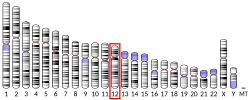
In humans, neuropeptide FF peptides are encoded by the NPFF gene. Two genes encoding two different receptors (NPFF1 and NPFF2) and two precursors [NPFFA (this gene) and NPFFB (NPVF)] have been cloned in several mammalian species.[5][6][7][8]
Processing
[edit]Processing of the NPFFA precursor at basic proteolytic sites generates a NPFF-containing peptide with three additional N-terminal amino acids different between species, and a NPSF (SLAAPQRFa)-containing peptide, the length of which depends on the species. NPFFB, identified as a precursor for RFamide-related peptides (RFRPs, also called GnIH for gonadotropin inhibitory hormone), contains a LPLRFa-containing peptide and a peptide sharing with NPFF the same C-terminal PQRFamide motif, such as NPVF (VPNLPQRFa) in human.
Function
[edit]Neuropeptide FF (NPFF) and several other RFamide related peptides issued from two precursors, interact with varying affinity with two subtypes of G protein-coupled receptors, namely NPFF1 and NPFF2 subtypes and are involved in several physiological functions such as cardiovascular regulation, hormonal control, macrophage activation, body temperature homeostasis and pain modulation.[6]
NPFF and opioid systems have been shown to interact at several levels, from animal behavior to receptor molecules. Nociception is the physiological function in which this interaction has been the most extensively studied but reward, locomotion, feeding and intestinal motility are also affected. Endogenous opioids are necessary for the analgesic properties of spinally injected NPFF while endogenous NPFF peptides are involved in the process of analgesic tolerance/hyperalgesia induced by chronic opioid treatment.[9][10][11]
As well as affecting pain perception, NPFF also modulates related processes such as inflammation and macrophage activation,[12][13] and neurogenesis during recovery from brain injury,[14] as well as being linked to mood disorders such as depression and anxiety.[15] Peripheral NPFF receptors are also involved in the regulation of blood pressure.[16]
NPFF also controls the number and metabolic effects of adipose tissue macrophages, and NPFF is necessary for adipose tissue health,[17] but over-activation of NPFFR2 receptors has been linked to obesity and metabolic syndrome.[18]
See also
[edit]References
[edit]- ^ a b c GRCh38: Ensembl release 89: ENSG00000139574 – Ensembl, May 2017
- ^ a b c GRCm38: Ensembl release 89: ENSMUSG00000023052 – Ensembl, May 2017
- ^ "Human PubMed Reference:". National Center for Biotechnology Information, U.S. National Library of Medicine.
- ^ "Mouse PubMed Reference:". National Center for Biotechnology Information, U.S. National Library of Medicine.
- ^ Perry SJ, Yi-Kung Huang E, Cronk D, Bagust J, Sharma R, Walker RJ, et al. (June 1997). "A human gene encoding morphine modulating peptides related to NPFF and FMRFamide". FEBS Letters. 409 (3): 426–430. Bibcode:1997FEBSL.409..426P. doi:10.1016/S0014-5793(97)00557-7. PMID 9224703. S2CID 40412541.
- ^ a b "Entrez Gene: NPFF neuropeptide FF-amide peptide precursor".
- ^ Kim J, Hong S, Lee H, Lee HS, Park C, Kim J, et al. (2025). "Structural insights into the selective recognition of RF-amide peptides by neuropeptide FF receptor 2". EMBO Reports. 26 (9): 2413–2434. doi:10.1038/s44319-025-00428-2. PMC 12069643. PMID 40128413.
- ^ Li X, Zhang H, Hu W, Wu K, Li S, Jin S, et al. (2025). "Structural basis of peptide recognition and modulation for neuropeptide FF receptors". Cell Reports. 44 (9) 116160. doi:10.1016/j.celrep.2025.116160. PMID 40839429.
- ^ Gibula-Tarlowska E, Kotlinska JH (2020). "Crosstalk between Opioid and Anti-Opioid Systems: An Overview and Its Possible Therapeutic Significance". Biomolecules. 10 (10): 1376. doi:10.3390/biom10101376. PMC 7599993. PMID 32998249.
- ^ Nguyen T, Marusich J, Li JX, Zhang Y (2020). "Neuropeptide FF and Its Receptors: Therapeutic Applications and Ligand Development". Journal of Medicinal Chemistry. 63 (21): 12387–12402. doi:10.1021/acs.jmedchem.0c00643. PMC 9590617. PMID 32673481.
- ^ Chen D, Zhang M, He Y, Wu S, Kuang J, Zhang Z, et al. (2025). "The dual modulating effects of neuropeptide FF on morphine-induced analgesia at the spinal level". Neuroscience. 565: 247–256. doi:10.1016/j.neuroscience.2024.12.010. PMID 39647601.
- ^ Kaczyńska K, Wojciechowski P (2021). "Non-Opioid Peptides Targeting Opioid Effects". International Journal of Molecular Sciences. 22 (24) 13619. doi:10.3390/ijms222413619. PMC 8709238. PMID 34948415.
- ^ Wang Y, Zuo Z, Shi J, Fang Y, Yin Z, Wang Z, et al. (2024). "Modulatory role of neuropeptide FF system in macrophages". Peptides. 174 171164. doi:10.1016/j.peptides.2024.171164. PMID 38272240.
- ^ Choi IA, Yun JH, Lee J, Choi DH (2024). "Neuropeptide FF Promotes Neuronal Survival and Enhances Synaptic Protein Expression Following Ischemic Injury". International Journal of Molecular Sciences. 25 (21) 11580. doi:10.3390/ijms252111580. PMC 11546865. PMID 39519132.
- ^ Kovács A, Szabó E, László K, Kertes E, Zagorácz O, Mintál K, et al. (2024). "Brain RFamide Neuropeptides in Stress-Related Psychopathologies". Cells. 13 (13): 1097. doi:10.3390/cells13131097. PMC 11240450. PMID 38994950.
- ^ Lee H, Feranil JB, Jose PA (2024). "An Overview on Renal and Central Regulation of Blood Pressure by Neuropeptide FF and Its Receptors". International Journal of Molecular Sciences. 25 (24) 13284. doi:10.3390/ijms252413284. PMC 11675822. PMID 39769048.
- ^ Waqas SF, Hoang AC, Lin YT, Ampem G, Azegrouz H, Balogh L, et al. (June 2017). "Neuropeptide FF increases M2 activation and self-renewal of adipose tissue macrophages". The Journal of Clinical Investigation. 127 (7): 2842–2854. doi:10.1172/JCI90152. PMC 5490745. PMID 28581443.
- ^ Hsu HT, Hsu CC, Liao YJ, Li HY, Chiang YC, Lin YT (September 2025). "Neuropeptide FF Receptor 2 Overexpression Aggravates Lipid Accumulation and Metabolic Dysfunction in Mice with Diet-Induced Metabolic Stress". Biomedical Journal 100913. doi:10.1016/j.bj.2025.100913. PMID 40946914.
Further reading
[edit]- Panula P, Aarnisalo AA, Wasowicz K (1996). "Neuropeptide FF, a mammalian neuropeptide with multiple functions". Progress in Neurobiology. 48 (4–5): 461–487. doi:10.1016/0301-0082(96)00001-9. PMID 8804117. S2CID 5985620.
- Sundblom DM, Panula P, Fyhrquist F (1995). "Neuropeptide FF-like immunoreactivity in human plasma". Peptides. 16 (2): 347–350. doi:10.1016/0196-9781(94)00163-4. PMID 7784266. S2CID 27839755.
- Sundblom DM, Hyrkkö A, Fyhrquist F (1998). "Pulsatile secretion of neuropeptide FF into human blood". Peptides. 19 (7): 1165–1170. doi:10.1016/S0196-9781(98)00060-6. PMID 9786165. S2CID 25714310.
- Elshourbagy NA, Ames RS, Fitzgerald LR, Foley JJ, Chambers JK, Szekeres PG, et al. (August 2000). "Receptor for the pain modulatory neuropeptides FF and AF is an orphan G protein-coupled receptor". The Journal of Biological Chemistry. 275 (34): 25965–25971. doi:10.1074/jbc.M004515200. PMID 10851242.
- Bonini JA, Jones KA, Adham N, Forray C, Artymyshyn R, Durkin MM, et al. (December 2000). "Identification and characterization of two G protein-coupled receptors for neuropeptide FF". The Journal of Biological Chemistry. 275 (50): 39324–39331. doi:10.1074/jbc.M004385200. PMID 11024015.
- Mollereau C, Gouardères C, Dumont Y, Kotani M, Detheux M, Doods H, et al. (May 2001). "Agonist and antagonist activities on human NPFF(2) receptors of the NPY ligands GR231118 and BIBP3226". British Journal of Pharmacology. 133 (1): 1–4. doi:10.1038/sj.bjp.0704049. PMC 1572765. PMID 11325787.
- Catarsi S, Babinski K, Séguéla P (October 2001). "Selective modulation of heteromeric ASIC proton-gated channels by neuropeptide FF". Neuropharmacology. 41 (5): 592–600. doi:10.1016/S0028-3908(01)00107-1. PMID 11587714. S2CID 568441.
- Lefrere I, De Coppet P, Camelin JC, Le Lay S, Mercier N, Elshourbagy N, et al. (October 2002). "Neuropeptide AF and FF modulation of adipocyte metabolism. Primary insights from functional genomics and effects on beta-adrenergic responsiveness". The Journal of Biological Chemistry. 277 (42): 39169–39178. doi:10.1074/jbc.M205084200. PMID 12149260.
- Laemmle B, Schindler M, Beilmann M, Hamilton BS, Doods HN, Wieland HA (March 2003). "Characterization of the NPGP receptor and identification of a novel short mRNA isoform in human hypothalamus". Regulatory Peptides. 111 (1–3): 21–29. doi:10.1016/S0167-0115(02)00220-3. PMID 12609745. S2CID 24049458.
- Ankö ML, Panula P (January 2006). "Regulation of endogenous human NPFF2 receptor by neuropeptide FF in SK-N-MC neuroblastoma cell line". Journal of Neurochemistry. 96 (2): 573–584. doi:10.1111/j.1471-4159.2005.03581.x. PMID 16336216. S2CID 26460239.
- Roumy M, Lorenzo C, Mazères S, Bouchet S, Zajac JM, Mollereau C (March 2007). "Physical association between neuropeptide FF and micro-opioid receptors as a possible molecular basis for anti-opioid activity". The Journal of Biological Chemistry. 282 (11): 8332–8342. doi:10.1074/jbc.M606946200. PMID 17224450.