
Recent from talks
Neutrino detector
Knowledge base stats:
Talk channels stats:
Members stats:
Neutrino detector
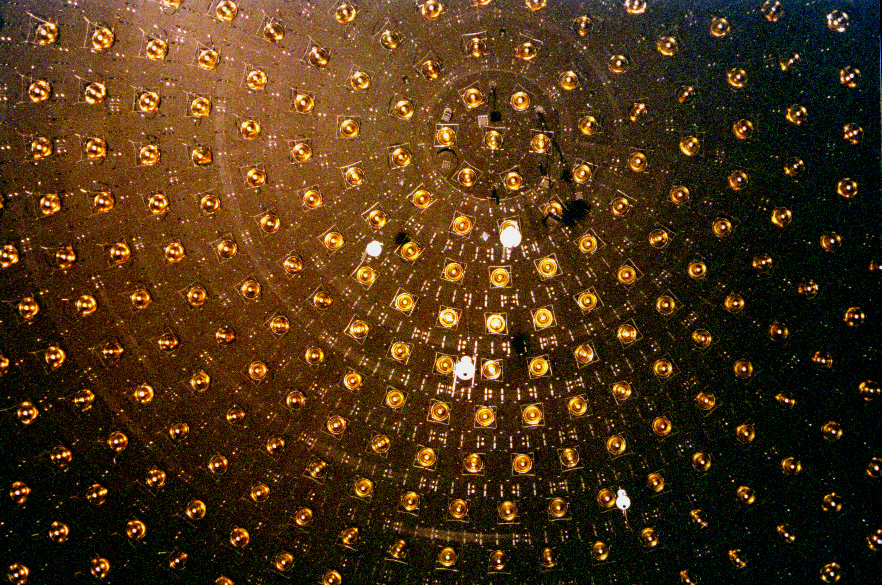
A neutrino detector is a physics apparatus which is designed to study neutrinos. Because neutrinos only weakly interact with other particles of matter, neutrino detectors must be very large to detect a significant number of neutrinos. Neutrino detectors are often built underground, to isolate the detector from cosmic rays and other background radiation. The field of neutrino astronomy is still very much in its infancy – the only confirmed extraterrestrial sources as of 2018[update] are the Sun and the supernova 1987A in the nearby Large Magellanic Cloud. Another likely source (three standard deviations) is the blazar TXS 0506+056 about 3.7 billion light years away. Neutrino observatories will "give astronomers fresh eyes with which to study the universe".
Various detection methods have been used. Super Kamiokande is a large volume of water surrounded by phototubes that watch for the Cherenkov radiation emitted when an incoming neutrino creates an electron or muon in the water. The Sudbury Neutrino Observatory was similar, but used heavy water as the detecting medium. Other detectors have consisted of large volumes of chlorine or gallium which are periodically checked for excesses of argon or germanium, respectively, which are created by neutrinos interacting with the original substance. MINOS used a solid plastic scintillator watched by phototubes; Borexino uses a liquid pseudocumene scintillator also watched by phototubes; and the NOνA detector uses a liquid scintillator watched by avalanche photodiodes.
The proposed acoustic detection of neutrinos via the thermoacoustic effect is the subject of dedicated studies done by the ANTARES, IceCube, and KM3NeT collaborations.
Neutrinos are omnipresent in nature: every second, tens of billions of them "pass through every square centimetre of our bodies without us ever noticing." Many were created during the Big Bang, and others are generated by nuclear reactions inside stars, planets, and by other interstellar processes. According to scientists' speculations, some may also originate from events in the universe such as "colliding black holes, gamma ray bursts from exploding stars, and/or violent events at the cores of distant galaxies".
Despite how common they are, neutrinos are extremely difficult to detect, due to their low mass and lack of electric charge. Unlike other particles, neutrinos only interact via gravity and the weak interaction. The two types of weak interactions they (rarely) engage in are neutral current (which involves the exchange of a Z boson and only results in deflection) and charged current (which involves the exchange of a W boson and causes the neutrino to convert into a charged lepton: an electron, a muon, or a tauon, or one of their antiparticles, if an antineutrino). According to the laws of physics neutrinos must have mass, but only a "smidgen of rest mass" – perhaps less than a "millionth as much as an electron" – so the gravitational force caused by neutrinos has so far proved too weak to detect, leaving the weak interaction as the main method of detection:
Antineutrinos were first detected near the Savannah River nuclear reactor by the Cowan–Reines neutrino experiment in 1956. Frederick Reines and Clyde Cowan used two targets containing a solution of cadmium chloride in water. Two scintillation detectors were placed next to the water targets. Antineutrinos with an energy above the threshold of 1.8 MeV caused charged current "Inverse beta decay" interactions with the protons in the water, producing positrons and neutrons. The resulting positrons annihilate with electrons, creating pairs of coincident photons with an energy of about 0.5 MeV each, which could be detected by the two scintillation detectors above and below the target. The neutrons were captured by cadmium nuclei, resulting in delayed gamma rays of about 8 MeV that were detected a few microseconds after the photons from a positron annihilation event.
This experiment was designed by Cowan and Reines to give a unique signature for antineutrinos, to prove the existence of these particles. It was not the experimental goal to measure the total antineutrino flux. The detected antineutrinos thus all carried an energy greater than 1.8 MeV, which is the threshold for the reaction channel used (1.8 MeV is the energy needed to create a positron and a neutron from a proton). Only about 3% of the antineutrinos from a nuclear reactor carry enough energy for the reaction to occur.
A more recently built and much larger KamLAND detector used similar techniques to study oscillations of antineutrinos from 53 Japanese nuclear power plants. A smaller, but more radiopure Borexino detector was able to measure the most important components of the neutrino spectrum from the Sun, as well as antineutrinos from Earth and nuclear reactors.
Hub AI
Neutrino detector AI simulator
(@Neutrino detector_simulator)
Neutrino detector
A neutrino detector is a physics apparatus which is designed to study neutrinos. Because neutrinos only weakly interact with other particles of matter, neutrino detectors must be very large to detect a significant number of neutrinos. Neutrino detectors are often built underground, to isolate the detector from cosmic rays and other background radiation. The field of neutrino astronomy is still very much in its infancy – the only confirmed extraterrestrial sources as of 2018[update] are the Sun and the supernova 1987A in the nearby Large Magellanic Cloud. Another likely source (three standard deviations) is the blazar TXS 0506+056 about 3.7 billion light years away. Neutrino observatories will "give astronomers fresh eyes with which to study the universe".
Various detection methods have been used. Super Kamiokande is a large volume of water surrounded by phototubes that watch for the Cherenkov radiation emitted when an incoming neutrino creates an electron or muon in the water. The Sudbury Neutrino Observatory was similar, but used heavy water as the detecting medium. Other detectors have consisted of large volumes of chlorine or gallium which are periodically checked for excesses of argon or germanium, respectively, which are created by neutrinos interacting with the original substance. MINOS used a solid plastic scintillator watched by phototubes; Borexino uses a liquid pseudocumene scintillator also watched by phototubes; and the NOνA detector uses a liquid scintillator watched by avalanche photodiodes.
The proposed acoustic detection of neutrinos via the thermoacoustic effect is the subject of dedicated studies done by the ANTARES, IceCube, and KM3NeT collaborations.
Neutrinos are omnipresent in nature: every second, tens of billions of them "pass through every square centimetre of our bodies without us ever noticing." Many were created during the Big Bang, and others are generated by nuclear reactions inside stars, planets, and by other interstellar processes. According to scientists' speculations, some may also originate from events in the universe such as "colliding black holes, gamma ray bursts from exploding stars, and/or violent events at the cores of distant galaxies".
Despite how common they are, neutrinos are extremely difficult to detect, due to their low mass and lack of electric charge. Unlike other particles, neutrinos only interact via gravity and the weak interaction. The two types of weak interactions they (rarely) engage in are neutral current (which involves the exchange of a Z boson and only results in deflection) and charged current (which involves the exchange of a W boson and causes the neutrino to convert into a charged lepton: an electron, a muon, or a tauon, or one of their antiparticles, if an antineutrino). According to the laws of physics neutrinos must have mass, but only a "smidgen of rest mass" – perhaps less than a "millionth as much as an electron" – so the gravitational force caused by neutrinos has so far proved too weak to detect, leaving the weak interaction as the main method of detection:
Antineutrinos were first detected near the Savannah River nuclear reactor by the Cowan–Reines neutrino experiment in 1956. Frederick Reines and Clyde Cowan used two targets containing a solution of cadmium chloride in water. Two scintillation detectors were placed next to the water targets. Antineutrinos with an energy above the threshold of 1.8 MeV caused charged current "Inverse beta decay" interactions with the protons in the water, producing positrons and neutrons. The resulting positrons annihilate with electrons, creating pairs of coincident photons with an energy of about 0.5 MeV each, which could be detected by the two scintillation detectors above and below the target. The neutrons were captured by cadmium nuclei, resulting in delayed gamma rays of about 8 MeV that were detected a few microseconds after the photons from a positron annihilation event.
This experiment was designed by Cowan and Reines to give a unique signature for antineutrinos, to prove the existence of these particles. It was not the experimental goal to measure the total antineutrino flux. The detected antineutrinos thus all carried an energy greater than 1.8 MeV, which is the threshold for the reaction channel used (1.8 MeV is the energy needed to create a positron and a neutron from a proton). Only about 3% of the antineutrinos from a nuclear reactor carry enough energy for the reaction to occur.
A more recently built and much larger KamLAND detector used similar techniques to study oscillations of antineutrinos from 53 Japanese nuclear power plants. A smaller, but more radiopure Borexino detector was able to measure the most important components of the neutrino spectrum from the Sun, as well as antineutrinos from Earth and nuclear reactors.
Recent media