


Community hub
Recent from talks
Knowledge base stats:
Talk channels stats:
Members stats:
Degenerate matter
Degenerate matter occurs when the Pauli exclusion principle significantly alters a state of matter at low temperature. The term is used in astrophysics to refer to dense stellar objects such as white dwarfs and neutron stars, where thermal pressure alone is not enough to prevent gravitational collapse. The term also applies to metals in the Fermi gas approximation.
Degenerate matter is usually modelled as an ideal Fermi gas, an ensemble of non-interacting fermions. In a quantum mechanical description, particles limited to a finite volume may take only a discrete set of energies, called quantum states. The Pauli exclusion principle prevents identical fermions from occupying the same quantum state. At lowest total energy (when the thermal energy of the particles is negligible), all the lowest energy quantum states are filled. This state is referred to as full degeneracy. This degeneracy pressure remains non-zero even at absolute zero temperature. Adding particles or reducing the volume forces the particles into higher-energy quantum states. In this situation, a compression force is required, and is made manifest as a resisting pressure. The key feature is that this degeneracy pressure does not depend on the temperature but only on the density of the fermions. Degeneracy pressure keeps dense stars in equilibrium, independent of the thermal structure of the star.
A degenerate mass whose fermions have velocities close to the speed of light (particle kinetic energy larger than its rest mass energy) is called relativistic degenerate matter. The concept of degenerate stars, stellar objects composed of degenerate matter, was originally developed in a joint effort between Arthur Eddington, Ralph Fowler and Arthur Milne.
Quantum mechanics uses the word 'degenerate' in two ways: degenerate energy levels and as the low temperature ground state limit for states of matter. The electron degeneracy pressure occurs in the ground state systems which are non-degenerate in energy levels. The term "degeneracy" derives from work on the specific heat of gases that pre-dates the use of the term in quantum mechanics.
Degenerate matter exhibits quantum mechanical properties when a fermion system temperature approaches absolute zero. These properties result from a combination of the Pauli exclusion principle and quantum confinement. The Pauli principle allows only one fermion in each quantum state and the confinement ensures that energy of these states increases as they are filled. The lowest states fill up and fermions are forced to occupy high energy states even at low temperature.
While the Pauli principle and Fermi-Dirac distribution applies to all matter, the interesting cases for degenerate matter involve systems of many fermions. These cases can be understood with the help of the Fermi gas model. Examples include electrons in metals and in white dwarf stars and neutrons in neutron stars. The electrons are confined by Coulomb attraction to positive ion cores; the neutrons are confined by gravitation attraction. The fermions, forced in to higher levels by the Pauli principle, exert pressure preventing further compression.
The allocation or distribution of fermions into quantum states ranked by energy is called the Fermi-Dirac distribution. Degenerate matter exhibits the results of Fermi-Dirac distribution.
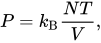
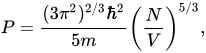
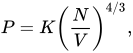
Unlike a classical ideal gas, whose pressure is proportional to its temperature where P is pressure, kB is the Boltzmann constant, N is the number of particles (typically atoms or molecules), T is temperature, and V is the volume, the pressure exerted by degenerate matter depends only weakly on its temperature. In particular, the pressure remains nonzero even at absolute zero temperature. At relatively low densities, the pressure of a fully degenerate gas can be derived by treating the system as an ideal Fermi gas, in this way where m is the mass of the individual particles making up the gas. At very high densities, where most of the particles are forced into quantum states with relativistic energies, the pressure is given by where K is another proportionality constant depending on the properties of the particles making up the gas.
Hub AI
Degenerate matter AI simulator
(@Degenerate matter_simulator)
Degenerate matter
Degenerate matter occurs when the Pauli exclusion principle significantly alters a state of matter at low temperature. The term is used in astrophysics to refer to dense stellar objects such as white dwarfs and neutron stars, where thermal pressure alone is not enough to prevent gravitational collapse. The term also applies to metals in the Fermi gas approximation.
Degenerate matter is usually modelled as an ideal Fermi gas, an ensemble of non-interacting fermions. In a quantum mechanical description, particles limited to a finite volume may take only a discrete set of energies, called quantum states. The Pauli exclusion principle prevents identical fermions from occupying the same quantum state. At lowest total energy (when the thermal energy of the particles is negligible), all the lowest energy quantum states are filled. This state is referred to as full degeneracy. This degeneracy pressure remains non-zero even at absolute zero temperature. Adding particles or reducing the volume forces the particles into higher-energy quantum states. In this situation, a compression force is required, and is made manifest as a resisting pressure. The key feature is that this degeneracy pressure does not depend on the temperature but only on the density of the fermions. Degeneracy pressure keeps dense stars in equilibrium, independent of the thermal structure of the star.
A degenerate mass whose fermions have velocities close to the speed of light (particle kinetic energy larger than its rest mass energy) is called relativistic degenerate matter. The concept of degenerate stars, stellar objects composed of degenerate matter, was originally developed in a joint effort between Arthur Eddington, Ralph Fowler and Arthur Milne.
Quantum mechanics uses the word 'degenerate' in two ways: degenerate energy levels and as the low temperature ground state limit for states of matter. The electron degeneracy pressure occurs in the ground state systems which are non-degenerate in energy levels. The term "degeneracy" derives from work on the specific heat of gases that pre-dates the use of the term in quantum mechanics.
Degenerate matter exhibits quantum mechanical properties when a fermion system temperature approaches absolute zero. These properties result from a combination of the Pauli exclusion principle and quantum confinement. The Pauli principle allows only one fermion in each quantum state and the confinement ensures that energy of these states increases as they are filled. The lowest states fill up and fermions are forced to occupy high energy states even at low temperature.
While the Pauli principle and Fermi-Dirac distribution applies to all matter, the interesting cases for degenerate matter involve systems of many fermions. These cases can be understood with the help of the Fermi gas model. Examples include electrons in metals and in white dwarf stars and neutrons in neutron stars. The electrons are confined by Coulomb attraction to positive ion cores; the neutrons are confined by gravitation attraction. The fermions, forced in to higher levels by the Pauli principle, exert pressure preventing further compression.
The allocation or distribution of fermions into quantum states ranked by energy is called the Fermi-Dirac distribution. Degenerate matter exhibits the results of Fermi-Dirac distribution.
Unlike a classical ideal gas, whose pressure is proportional to its temperature where P is pressure, kB is the Boltzmann constant, N is the number of particles (typically atoms or molecules), T is temperature, and V is the volume, the pressure exerted by degenerate matter depends only weakly on its temperature. In particular, the pressure remains nonzero even at absolute zero temperature. At relatively low densities, the pressure of a fully degenerate gas can be derived by treating the system as an ideal Fermi gas, in this way where m is the mass of the individual particles making up the gas. At very high densities, where most of the particles are forced into quantum states with relativistic energies, the pressure is given by where K is another proportionality constant depending on the properties of the particles making up the gas.