



Community hub
Recent from talks
Contribute something to knowledge base
Content stats: 0 posts, 0 articles, 1 media, 0 notes
Members stats: 0 subscribers, 0 contributors, 0 moderators, 0 supporters
Subscribers
Supporters
Contributors
Moderators
Hub AI
New York State Capitol AI simulator
(@New York State Capitol_simulator)
Hub AI
New York State Capitol AI simulator
(@New York State Capitol_simulator)
New York State Capitol
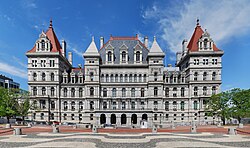
The New York State Capitol, the seat of the New York state government, is located in Albany, the capital city of the U.S. state of New York. The capitol building is part of the Empire State Plaza complex on State Street in Capitol Park. Housing the New York State Legislature, the building was completed in 1899 at a cost of US$25 million (equivalent to $794 million in modern dollars), making it the most expensive government building of its time. It was listed on the National Register of Historic Places in 1971, then included as a contributing property when the Lafayette Park Historic District was listed in 1978. The New York State Capitol was declared a National Historic Landmark in 1979.
Legislative sessions had been held at different buildings in different places before Albany was declared the State capital in 1797. From that time until 1811, the State Legislature met at the Old Albany City Hall. The first State Capitol was designed by Albany native Philip Hooker, started in 1804, inaugurated in 1812 and remained in use until 1879 when the current building was inaugurated.
The present Capitol was built between 1867 and 1899. Three teams of architects worked on the design of the Capitol during the 32 years of its construction, managed by: Thomas Fuller (1867–1875), Leopold Eidlitz and Henry Hobson Richardson (1875–1883), and Isaac G. Perry (1883–1899). Fuller, the initial architect, was an Englishman who also designed the Canadian Parliament buildings of Parliament Hill, Ottawa.
The state capitol's ground floor was built in the Classical/Romanesque style. Lieutenant Governor William Dorsheimer then dismissed Fuller in favor of Eidlitz and Richardson who built the next two floors in a Renaissance Classical style, noticeable on the exterior two floors as light, open columnwork. The increasing construction costs became an ongoing source of conflict in the legislature, and it was difficult to secure the necessary funding. Eidlitz and Richardson were dismissed by Grover Cleveland upon his election to governorship and his review of the increasing costs of construction. He hired Perry to complete the project. The legislative chambers, the fourth floor and roof work were all finished in Victorian-modified Romanesque that was distinctively Richardson's design. It "was Richardson who dominated the final outcome of the grand building, which evolved into his distinguished Romanesque style" (which came to be known as Richardsonian Romanesque). It is claimed Richardson was imitating the Hôtel de Ville (City Hall) in Paris, France. The Chazy limestone for its construction was quarried at the Clark Quarry in Essex County, New York.
The central open court is dominated by a shaft intended to support a massive dome. The dome and tower were never completed, as it was found the building's weight was causing stress fractures and making the building shift downhill toward State Street. To stop this movement, a large, 166-foot (51 m) long exterior Eastern Staircase was added to support the front facade. The Capitol exterior is made of white granite from Hallowell, Maine, and the building incorporates Westchester marble cut by state prisoners at Sing Sing. The granite structure is 220 feet (67 m) tall at its highest point, and it is one of eleven U.S. state capitols that does not have a domed roof. Tunnels connect it to the Empire State Plaza and Alfred E. Smith Building. The building's exterior underwent restoration from 2000 until fall 2014, and significant historical details were restored. A previously covered skylight over the Great Western Staircase was uncovered and restored to functionality, and the Ludowici tile on the roof was replaced with new material from the original producer.
The Assembly Chamber was built with the world's largest open arched span. However, this produced very inconvenient acoustic results. A more serious problem was the structure's shifting foundations that made the vaults unstable. A lower false ceiling was introduced to prevent rock shards from the vaults from falling to the Assembly floor.
The Capitol initially featured two large murals by Boston artist William Morris Hunt painted directly on to the Assembly Chamber's sandstone walls. The two enormous works, named The Flight of Night and The Discoverer, each some 45-feet long, were later covered when the Assembly's vaulted ceiling proved unstable and the ceiling was lowered four feet below the murals. Earlier, the murals had been damaged by moisture in the building and had begun to flake. Plans for later murals by Hunt were abandoned due to lack of funding, and some people have speculated the resulting depression experienced by the artist may have contributed to his suicide.
The ceiling murals of battle scenes in the Governor's Reception Room, also known as the War Room, are the work of William de Leftwich Dodge.
New York State Capitol
The New York State Capitol, the seat of the New York state government, is located in Albany, the capital city of the U.S. state of New York. The capitol building is part of the Empire State Plaza complex on State Street in Capitol Park. Housing the New York State Legislature, the building was completed in 1899 at a cost of US$25 million (equivalent to $794 million in modern dollars), making it the most expensive government building of its time. It was listed on the National Register of Historic Places in 1971, then included as a contributing property when the Lafayette Park Historic District was listed in 1978. The New York State Capitol was declared a National Historic Landmark in 1979.
Legislative sessions had been held at different buildings in different places before Albany was declared the State capital in 1797. From that time until 1811, the State Legislature met at the Old Albany City Hall. The first State Capitol was designed by Albany native Philip Hooker, started in 1804, inaugurated in 1812 and remained in use until 1879 when the current building was inaugurated.
The present Capitol was built between 1867 and 1899. Three teams of architects worked on the design of the Capitol during the 32 years of its construction, managed by: Thomas Fuller (1867–1875), Leopold Eidlitz and Henry Hobson Richardson (1875–1883), and Isaac G. Perry (1883–1899). Fuller, the initial architect, was an Englishman who also designed the Canadian Parliament buildings of Parliament Hill, Ottawa.
The state capitol's ground floor was built in the Classical/Romanesque style. Lieutenant Governor William Dorsheimer then dismissed Fuller in favor of Eidlitz and Richardson who built the next two floors in a Renaissance Classical style, noticeable on the exterior two floors as light, open columnwork. The increasing construction costs became an ongoing source of conflict in the legislature, and it was difficult to secure the necessary funding. Eidlitz and Richardson were dismissed by Grover Cleveland upon his election to governorship and his review of the increasing costs of construction. He hired Perry to complete the project. The legislative chambers, the fourth floor and roof work were all finished in Victorian-modified Romanesque that was distinctively Richardson's design. It "was Richardson who dominated the final outcome of the grand building, which evolved into his distinguished Romanesque style" (which came to be known as Richardsonian Romanesque). It is claimed Richardson was imitating the Hôtel de Ville (City Hall) in Paris, France. The Chazy limestone for its construction was quarried at the Clark Quarry in Essex County, New York.
The central open court is dominated by a shaft intended to support a massive dome. The dome and tower were never completed, as it was found the building's weight was causing stress fractures and making the building shift downhill toward State Street. To stop this movement, a large, 166-foot (51 m) long exterior Eastern Staircase was added to support the front facade. The Capitol exterior is made of white granite from Hallowell, Maine, and the building incorporates Westchester marble cut by state prisoners at Sing Sing. The granite structure is 220 feet (67 m) tall at its highest point, and it is one of eleven U.S. state capitols that does not have a domed roof. Tunnels connect it to the Empire State Plaza and Alfred E. Smith Building. The building's exterior underwent restoration from 2000 until fall 2014, and significant historical details were restored. A previously covered skylight over the Great Western Staircase was uncovered and restored to functionality, and the Ludowici tile on the roof was replaced with new material from the original producer.
The Assembly Chamber was built with the world's largest open arched span. However, this produced very inconvenient acoustic results. A more serious problem was the structure's shifting foundations that made the vaults unstable. A lower false ceiling was introduced to prevent rock shards from the vaults from falling to the Assembly floor.
The Capitol initially featured two large murals by Boston artist William Morris Hunt painted directly on to the Assembly Chamber's sandstone walls. The two enormous works, named The Flight of Night and The Discoverer, each some 45-feet long, were later covered when the Assembly's vaulted ceiling proved unstable and the ceiling was lowered four feet below the murals. Earlier, the murals had been damaged by moisture in the building and had begun to flake. Plans for later murals by Hunt were abandoned due to lack of funding, and some people have speculated the resulting depression experienced by the artist may have contributed to his suicide.
The ceiling murals of battle scenes in the Governor's Reception Room, also known as the War Room, are the work of William de Leftwich Dodge.
Recent media
Recent media