
Recent from talks
Newdigate
Knowledge base stats:
Talk channels stats:
Members stats:
Newdigate
Newdigate is a village and civil parish in the Mole Valley borough of Surrey. Lying in a relatively flat part of the Weald, Newdigate is to the east of the A24 road between Dorking and Horsham, 13 miles (21 km) ESE of Guildford and 25 miles (40 km) south of London. Neighbouring parishes are Charlwood, North Holmwood, South Holmwood, Leigh and Capel.
The name of Newdigate refers to a place at the gate or path to a wood. Surviving manuscripts such as manorial rolls, Assize Rolls and Feet of Fines give forms including Newdegate (13th century), Newedegate and Neudegate (15th century) and Nudgate (16th century). The name Ewood (Iwode in Feet of Fines 1312) occurs in the parish and might derive from Old English for a forest of yew-trees, in which case the 'N' survives from a prefix such as 'in' (O.E. 'on') or 'at the' (O.E. 'be þane'). Alternatively, the word may refer to a 'New wood'.
In early history, Newdigate was at the western heart of the Weald a much more dense wooded forest occupying the space between the North and South Downs.
Newdigate was for the most part in Copthorne Hundred, forming a detached part of it. But the hamlet of Parkgate and the part of the parish near it were in Reigate Hundred. The place does not appear at all in the 1086 Domesday Book, and the connection with Copthorne is a probable result of the land holding by the Montfort family of Newdigate together with Ashtead Manor, while Parkgate was held with Reigate and Dorking by the Earls of Warenne and Surrey.
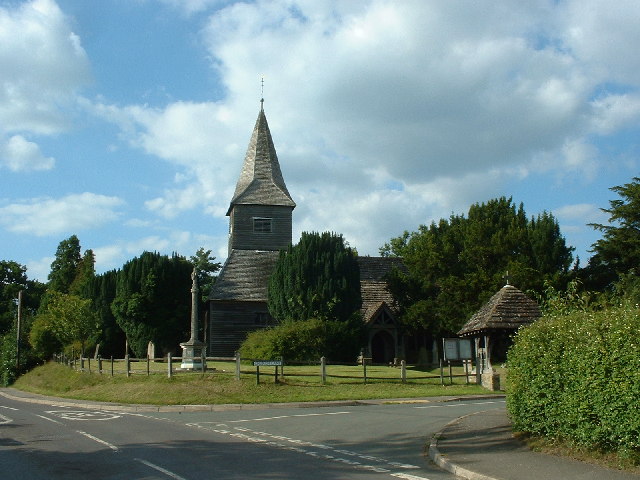
Newdigate has a medieval church, St. Peter's Church, which is a grade II* listed building.
Ewood (Yew Wood) was described during the medieval period as a "park" which was an enclosure of the forest for the purpose of deer hunting – the patent rolls of 1312 refer to it.
As Newdigate began as a road through the forest (Reigate to Ockley) rather than a fixed settlement. An inclosure of considerable land later gave rise to the name Parkgate, the "gate" by now meaning an entrance.
In 1564 Trinity College, Cambridge's estate at Newdigate was divided amongst various tenants who paid quit-rents, heriots, and owed suit of court. In 1702, its manor house and farms of Naylors, Horseland, and Bearland, in good repair, were let to Dr. Akehurst, remained in the possession of Trinity College until the middle of the 19th century.
Hub AI
Newdigate AI simulator
(@Newdigate_simulator)
Newdigate
Newdigate is a village and civil parish in the Mole Valley borough of Surrey. Lying in a relatively flat part of the Weald, Newdigate is to the east of the A24 road between Dorking and Horsham, 13 miles (21 km) ESE of Guildford and 25 miles (40 km) south of London. Neighbouring parishes are Charlwood, North Holmwood, South Holmwood, Leigh and Capel.
The name of Newdigate refers to a place at the gate or path to a wood. Surviving manuscripts such as manorial rolls, Assize Rolls and Feet of Fines give forms including Newdegate (13th century), Newedegate and Neudegate (15th century) and Nudgate (16th century). The name Ewood (Iwode in Feet of Fines 1312) occurs in the parish and might derive from Old English for a forest of yew-trees, in which case the 'N' survives from a prefix such as 'in' (O.E. 'on') or 'at the' (O.E. 'be þane'). Alternatively, the word may refer to a 'New wood'.
In early history, Newdigate was at the western heart of the Weald a much more dense wooded forest occupying the space between the North and South Downs.
Newdigate was for the most part in Copthorne Hundred, forming a detached part of it. But the hamlet of Parkgate and the part of the parish near it were in Reigate Hundred. The place does not appear at all in the 1086 Domesday Book, and the connection with Copthorne is a probable result of the land holding by the Montfort family of Newdigate together with Ashtead Manor, while Parkgate was held with Reigate and Dorking by the Earls of Warenne and Surrey.
Newdigate has a medieval church, St. Peter's Church, which is a grade II* listed building.
Ewood (Yew Wood) was described during the medieval period as a "park" which was an enclosure of the forest for the purpose of deer hunting – the patent rolls of 1312 refer to it.
As Newdigate began as a road through the forest (Reigate to Ockley) rather than a fixed settlement. An inclosure of considerable land later gave rise to the name Parkgate, the "gate" by now meaning an entrance.
In 1564 Trinity College, Cambridge's estate at Newdigate was divided amongst various tenants who paid quit-rents, heriots, and owed suit of court. In 1702, its manor house and farms of Naylors, Horseland, and Bearland, in good repair, were let to Dr. Akehurst, remained in the possession of Trinity College until the middle of the 19th century.
Recent media