
Recent from talks
Newfoundland dog
Knowledge base stats:
Talk channels stats:
Members stats:
Newfoundland dog
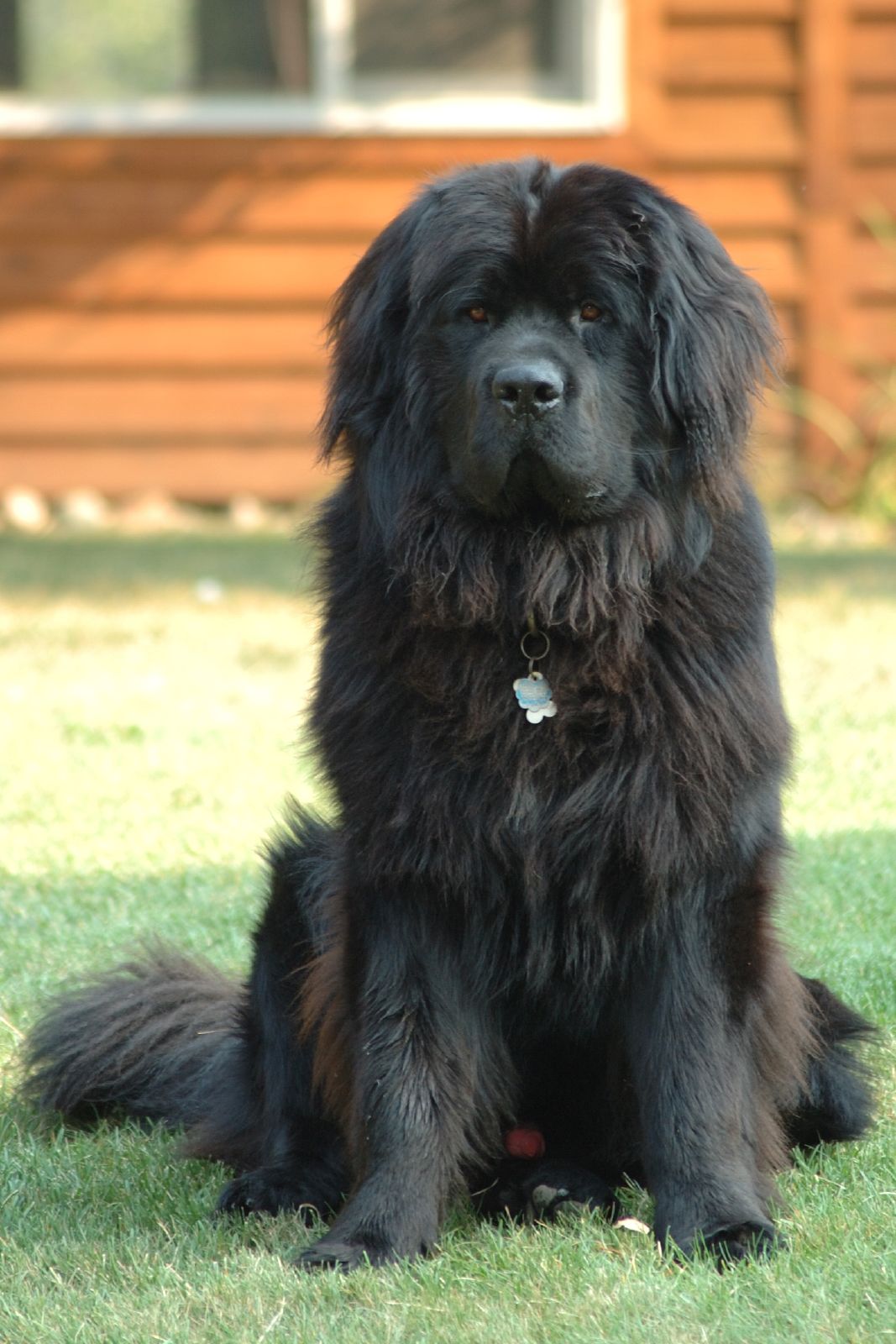
The Newfoundland is a large breed of working dog. They can be black, grey, brown, or black and white. However, in the Dominion of Newfoundland, before it became part of Canada, only black and Landseer (white-and-black) coloured dogs were considered to be proper members of the breed. They were originally bred and used as working dogs for fishermen in Newfoundland.
They excel at water rescue/lifesaving because of their muscular build, thick double coat, webbed paws, and swimming abilities.
Newfoundlands ('Newfs' or 'Newfies') have webbed paws and a double coat that consists of dense soft fur that keeps them warm, and a water-resistant, coarse, moderately long, outer coat. Males normally weigh 65–80 kg (143–176 lb), and females 55–65 kg (121–143 lb), placing them in the "Giant" weight range; but some Newfoundlands have been known to weigh over 90 kg (200 lb) — and the largest on record weighed 120 kg (260 lb) and measured over 1.8 m (6 ft) from nose to tail, ranking it among the largest of dog breeds. They may grow up to 56–76 cm (22–30 in) tall at the shoulder.
The American Kennel Club (AKC) standard colours of the Newfoundland are black, brown, grey, and white-and-black (sometimes referred to as a Landseer). Other colours are possible but are not considered rare or more valuable. The Kennel Club (KC) and FCI permit only black, brown, and white/black; the Canadian Kennel Club (CKC) permits only black and white/black, though recessive brown and white/brown also occur but cannot be shown. The "Landseer" pattern is named after the artist Sir Edwin Henry Landseer, who featured them in many of his paintings. The Fédération Cynologique Internationale (FCI) ECT Landseer ("European Continental Type") is a separate breed created in Germany and Switzerland from cross-breeding Landseer-coloured Newfoundlands with livestock guardian breeds. It is a taller, more narrow white dog with black markings bred as a companion and guard dog.
The Newfoundland's extremely large bones give it mass, while its large musculature gives it the power it needs to take on rough ocean waves and powerful tides. These dogs have huge lung capacity, which enables them to swim extremely long distances, and a thick, oily, and waterproof double coat which protects them from the chill of icy waters.
A 2024 UK study found a life expectancy of 11 years for the breed compared to an average of 12.7 for purebreeds and 12 for crossbreeds. A 2005 Swedish study of insurance data found 62% of Newfoundland dogs died by the age of 10, higher than the overall rate of 35% of dogs dying by the age of 10.
Several conditions the Newfoundland is predisposed to include: acral lick dermatitis, allergic skin disease, hypothyroidism, ichthyosis, and primary seborrhoea.
A study of referrals to a veterinary clinic in the US found the Newfoundland to be predisposed to dilated cardiomyopathy, with 1.3% of dogs having the condition. A Swedish study found 16% of Newfoundlands with DCM to have ventricular ectopy. An English study found 77% of Newfoundlands with DCM to have atrial fibrillation.
Hub AI
Newfoundland dog AI simulator
(@Newfoundland dog_simulator)
Newfoundland dog
The Newfoundland is a large breed of working dog. They can be black, grey, brown, or black and white. However, in the Dominion of Newfoundland, before it became part of Canada, only black and Landseer (white-and-black) coloured dogs were considered to be proper members of the breed. They were originally bred and used as working dogs for fishermen in Newfoundland.
They excel at water rescue/lifesaving because of their muscular build, thick double coat, webbed paws, and swimming abilities.
Newfoundlands ('Newfs' or 'Newfies') have webbed paws and a double coat that consists of dense soft fur that keeps them warm, and a water-resistant, coarse, moderately long, outer coat. Males normally weigh 65–80 kg (143–176 lb), and females 55–65 kg (121–143 lb), placing them in the "Giant" weight range; but some Newfoundlands have been known to weigh over 90 kg (200 lb) — and the largest on record weighed 120 kg (260 lb) and measured over 1.8 m (6 ft) from nose to tail, ranking it among the largest of dog breeds. They may grow up to 56–76 cm (22–30 in) tall at the shoulder.
The American Kennel Club (AKC) standard colours of the Newfoundland are black, brown, grey, and white-and-black (sometimes referred to as a Landseer). Other colours are possible but are not considered rare or more valuable. The Kennel Club (KC) and FCI permit only black, brown, and white/black; the Canadian Kennel Club (CKC) permits only black and white/black, though recessive brown and white/brown also occur but cannot be shown. The "Landseer" pattern is named after the artist Sir Edwin Henry Landseer, who featured them in many of his paintings. The Fédération Cynologique Internationale (FCI) ECT Landseer ("European Continental Type") is a separate breed created in Germany and Switzerland from cross-breeding Landseer-coloured Newfoundlands with livestock guardian breeds. It is a taller, more narrow white dog with black markings bred as a companion and guard dog.
The Newfoundland's extremely large bones give it mass, while its large musculature gives it the power it needs to take on rough ocean waves and powerful tides. These dogs have huge lung capacity, which enables them to swim extremely long distances, and a thick, oily, and waterproof double coat which protects them from the chill of icy waters.
A 2024 UK study found a life expectancy of 11 years for the breed compared to an average of 12.7 for purebreeds and 12 for crossbreeds. A 2005 Swedish study of insurance data found 62% of Newfoundland dogs died by the age of 10, higher than the overall rate of 35% of dogs dying by the age of 10.
Several conditions the Newfoundland is predisposed to include: acral lick dermatitis, allergic skin disease, hypothyroidism, ichthyosis, and primary seborrhoea.
A study of referrals to a veterinary clinic in the US found the Newfoundland to be predisposed to dilated cardiomyopathy, with 1.3% of dogs having the condition. A Swedish study found 16% of Newfoundlands with DCM to have ventricular ectopy. An English study found 77% of Newfoundlands with DCM to have atrial fibrillation.
Recent media