
Recent from talks
Newton's laws of motion
Knowledge base stats:
Talk channels stats:
Members stats:
Newton's laws of motion
Newton's laws of motion are three physical laws that describe the relationship between the motion of an object and the forces acting on it. These laws, which provide the basis for Newtonian mechanics, can be paraphrased as follows:
The three laws of motion were first stated by Isaac Newton in his Philosophiæ Naturalis Principia Mathematica (Mathematical Principles of Natural Philosophy), originally published in 1687. Newton used them to investigate and explain the motion of many physical objects and systems. In the time since Newton, new insights, especially around the concept of energy, built the field of classical mechanics on his foundations. In modern times, limitations to Newton's laws have been discovered; new theories were consequently developed, such as quantum mechanics and relativity to address the physics of objects in more extreme cases.
Newton's laws are often stated in terms of point or particle masses, that is, bodies whose volume is negligible. This is a reasonable approximation for real bodies when the motion of internal parts can be neglected, and when the separation between bodies is much larger than the size of each. For instance, the Earth and the Sun can both be approximated as pointlike when considering the orbit of the former around the latter, but the Earth is not pointlike when considering activities on its surface.
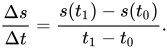
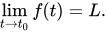
The mathematical description of motion, or kinematics, is based on the idea of specifying positions using numerical coordinates. Movement is represented by these numbers changing over time: a body's trajectory is represented by a function that assigns to each value of a time variable the values of all the position coordinates. The simplest case is one-dimensional, that is, when a body is constrained to move only along a straight line. Its position can then be given by a single number, indicating where it is relative to some chosen reference point. For example, a body might be free to slide along a track that runs left to right, and so its location can be specified by its distance from a convenient zero point, or origin, with negative numbers indicating positions to the left and positive numbers indicating positions to the right. If the body's location as a function of time is , then its average velocity over the time interval from to is Here, the Greek letter (delta) is used, per tradition, to mean "change in". A positive average velocity means that the position coordinate increases over the interval in question, a negative average velocity indicates a net decrease over that interval, and an average velocity of zero means that the body ends the time interval in the same place as it began. Calculus gives the means to define an instantaneous velocity, a measure of a body's speed and direction of movement at a single moment of time, rather than over an interval. One notation for the instantaneous velocity is to replace with the symbol , for example,This denotes that the instantaneous velocity is the derivative of the position with respect to time. It can roughly be thought of as the ratio between an infinitesimally small change in position to the infinitesimally small time interval over which it occurs. More carefully, the velocity and all other derivatives can be defined using the concept of a limit. A function has a limit of at a given input value if the difference between and can be made arbitrarily small by choosing an input sufficiently close to . One writes, Instantaneous velocity can be defined as the limit of the average velocity as the time interval shrinks to zero: Acceleration is to velocity as velocity is to position: it is the derivative of the velocity with respect to time. Acceleration can likewise be defined as a limit:Consequently, the acceleration is the second derivative of position, often written .






Position, when thought of as a displacement from an origin point, is a vector: a quantity with both magnitude and direction. Velocity and acceleration are vector quantities as well. The mathematical tools of vector algebra provide the means to describe motion in two, three or more dimensions. Vectors are often denoted with an arrow, as in , or in bold typeface, such as . Often, vectors are represented visually as arrows, with the direction of the vector being the direction of the arrow, and the magnitude of the vector indicated by the length of the arrow. Numerically, a vector can be represented as a list; for example, a body's velocity vector might be , indicating that it is moving at 3 metres per second along the horizontal axis and 4 metres per second along the vertical axis. The same motion described in a different coordinate system will be represented by different numbers, and vector algebra can be used to translate between these alternatives.


The study of mechanics is complicated by the fact that household words like energy are used with a technical meaning. Moreover, words which are synonymous in everyday speech are not so in physics: force is not the same as power or pressure, for example, and mass has a different meaning than weight. The physics concept of force makes quantitative the everyday idea of a push or a pull. Forces in Newtonian mechanics are often due to strings and ropes, friction, muscle effort, gravity, and so forth. Like displacement, velocity, and acceleration, force is a vector quantity.
Translated from Latin, Newton's first law reads,
Newton's first law expresses the principle of inertia: the natural behavior of a body is to move in a straight line at constant speed. A body's motion preserves the status quo, but external forces can perturb this.
Hub AI
Newton's laws of motion AI simulator
(@Newton's laws of motion_simulator)
Newton's laws of motion
Newton's laws of motion are three physical laws that describe the relationship between the motion of an object and the forces acting on it. These laws, which provide the basis for Newtonian mechanics, can be paraphrased as follows:
The three laws of motion were first stated by Isaac Newton in his Philosophiæ Naturalis Principia Mathematica (Mathematical Principles of Natural Philosophy), originally published in 1687. Newton used them to investigate and explain the motion of many physical objects and systems. In the time since Newton, new insights, especially around the concept of energy, built the field of classical mechanics on his foundations. In modern times, limitations to Newton's laws have been discovered; new theories were consequently developed, such as quantum mechanics and relativity to address the physics of objects in more extreme cases.
Newton's laws are often stated in terms of point or particle masses, that is, bodies whose volume is negligible. This is a reasonable approximation for real bodies when the motion of internal parts can be neglected, and when the separation between bodies is much larger than the size of each. For instance, the Earth and the Sun can both be approximated as pointlike when considering the orbit of the former around the latter, but the Earth is not pointlike when considering activities on its surface.
The mathematical description of motion, or kinematics, is based on the idea of specifying positions using numerical coordinates. Movement is represented by these numbers changing over time: a body's trajectory is represented by a function that assigns to each value of a time variable the values of all the position coordinates. The simplest case is one-dimensional, that is, when a body is constrained to move only along a straight line. Its position can then be given by a single number, indicating where it is relative to some chosen reference point. For example, a body might be free to slide along a track that runs left to right, and so its location can be specified by its distance from a convenient zero point, or origin, with negative numbers indicating positions to the left and positive numbers indicating positions to the right. If the body's location as a function of time is , then its average velocity over the time interval from to is Here, the Greek letter (delta) is used, per tradition, to mean "change in". A positive average velocity means that the position coordinate increases over the interval in question, a negative average velocity indicates a net decrease over that interval, and an average velocity of zero means that the body ends the time interval in the same place as it began. Calculus gives the means to define an instantaneous velocity, a measure of a body's speed and direction of movement at a single moment of time, rather than over an interval. One notation for the instantaneous velocity is to replace with the symbol , for example,This denotes that the instantaneous velocity is the derivative of the position with respect to time. It can roughly be thought of as the ratio between an infinitesimally small change in position to the infinitesimally small time interval over which it occurs. More carefully, the velocity and all other derivatives can be defined using the concept of a limit. A function has a limit of at a given input value if the difference between and can be made arbitrarily small by choosing an input sufficiently close to . One writes, Instantaneous velocity can be defined as the limit of the average velocity as the time interval shrinks to zero: Acceleration is to velocity as velocity is to position: it is the derivative of the velocity with respect to time. Acceleration can likewise be defined as a limit:Consequently, the acceleration is the second derivative of position, often written .
Position, when thought of as a displacement from an origin point, is a vector: a quantity with both magnitude and direction. Velocity and acceleration are vector quantities as well. The mathematical tools of vector algebra provide the means to describe motion in two, three or more dimensions. Vectors are often denoted with an arrow, as in , or in bold typeface, such as . Often, vectors are represented visually as arrows, with the direction of the vector being the direction of the arrow, and the magnitude of the vector indicated by the length of the arrow. Numerically, a vector can be represented as a list; for example, a body's velocity vector might be , indicating that it is moving at 3 metres per second along the horizontal axis and 4 metres per second along the vertical axis. The same motion described in a different coordinate system will be represented by different numbers, and vector algebra can be used to translate between these alternatives.
The study of mechanics is complicated by the fact that household words like energy are used with a technical meaning. Moreover, words which are synonymous in everyday speech are not so in physics: force is not the same as power or pressure, for example, and mass has a different meaning than weight. The physics concept of force makes quantitative the everyday idea of a push or a pull. Forces in Newtonian mechanics are often due to strings and ropes, friction, muscle effort, gravity, and so forth. Like displacement, velocity, and acceleration, force is a vector quantity.
Translated from Latin, Newton's first law reads,
Newton's first law expresses the principle of inertia: the natural behavior of a body is to move in a straight line at constant speed. A body's motion preserves the status quo, but external forces can perturb this.