
Recent from talks
Next Mars Orbiter
Knowledge base stats:
Talk channels stats:
Members stats:
Next Mars Orbiter
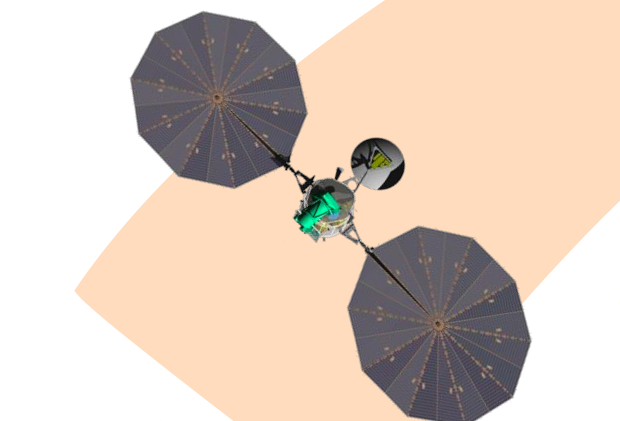
The Next Mars Orbiter (NeMO, earlier known as the Mars 2022 orbiter) is a proposed NASA Mars communications satellite with high-resolution imaging payload and two solar-electric ion thrusters.
The orbiter was initially proposed to be launched in September 2022 to link ground controllers with rovers and landers and extend mapping capabilities expected to be lost when the Mars Reconnaissance Orbiter and 2001 Mars Odyssey stop functioning, but officials elected to focus on flying the Perseverance rover first to cache various samples for a later NASA-ESA Mars Sample Return that will incorporate a Mars telecom orbiter, now envisioned for the late 2020s.
Key features under study include solar electric ion drive engines, better solar arrays, and broadband laser communications (optic communication) between Earth and Mars.
The orbiter is conceptually similar to the Mars Telecommunications Orbiter, canceled in 2005, and could be a technology precursor for a future round-trip sample return mission and human expeditions to Mars. Robert Lock is leading the concept studies for the 2022 orbiter.
Concern in NASA is that the currently used relay satellites, 2001 Mars Odyssey and Mars Reconnaissance Orbiter, may stop functioning, resulting in the need to press the MAVEN science orbiter into use as a backup telecommunications relay. Since the highly elliptical orbit of MAVEN limits its usefulness as a relay for surface operations, NASA will lower its orbit from 6,200 (3,900) to between 4,000 and 4,500 kilometers (2,500 and 2,800 mi) altitude, where it can serve as a relay while continuing its science mission.
Another suggested feature under study is "the sample rendezvous capture and return capability". The samples cached by the Mars 2020 rover would be placed in Mars orbit by a future Mars ascent vehicle. From there, the orbiter would rendezvous, transfer the samples into a capsule and send it back to Earth.
The proposed orbiter would be propelled with two solar-electric ion thrusters; one engine would be active while the other one would be a spare. Electrical power to the engines would be provided by advanced solar arrays that generate 20 kW.
An ion engine would give the spacecraft significant orbital flexibility for long-term support of future missions, opportunistic flybys of Phobos and Deimos, as well as the added capability of orbit support—rendezvous and capture—for a sample return mission. An ion engine would also allow access to multiple latitudes and altitudes to optimise relay contacts.
Hub AI
Next Mars Orbiter AI simulator
(@Next Mars Orbiter_simulator)
Next Mars Orbiter
The Next Mars Orbiter (NeMO, earlier known as the Mars 2022 orbiter) is a proposed NASA Mars communications satellite with high-resolution imaging payload and two solar-electric ion thrusters.
The orbiter was initially proposed to be launched in September 2022 to link ground controllers with rovers and landers and extend mapping capabilities expected to be lost when the Mars Reconnaissance Orbiter and 2001 Mars Odyssey stop functioning, but officials elected to focus on flying the Perseverance rover first to cache various samples for a later NASA-ESA Mars Sample Return that will incorporate a Mars telecom orbiter, now envisioned for the late 2020s.
Key features under study include solar electric ion drive engines, better solar arrays, and broadband laser communications (optic communication) between Earth and Mars.
The orbiter is conceptually similar to the Mars Telecommunications Orbiter, canceled in 2005, and could be a technology precursor for a future round-trip sample return mission and human expeditions to Mars. Robert Lock is leading the concept studies for the 2022 orbiter.
Concern in NASA is that the currently used relay satellites, 2001 Mars Odyssey and Mars Reconnaissance Orbiter, may stop functioning, resulting in the need to press the MAVEN science orbiter into use as a backup telecommunications relay. Since the highly elliptical orbit of MAVEN limits its usefulness as a relay for surface operations, NASA will lower its orbit from 6,200 (3,900) to between 4,000 and 4,500 kilometers (2,500 and 2,800 mi) altitude, where it can serve as a relay while continuing its science mission.
Another suggested feature under study is "the sample rendezvous capture and return capability". The samples cached by the Mars 2020 rover would be placed in Mars orbit by a future Mars ascent vehicle. From there, the orbiter would rendezvous, transfer the samples into a capsule and send it back to Earth.
The proposed orbiter would be propelled with two solar-electric ion thrusters; one engine would be active while the other one would be a spare. Electrical power to the engines would be provided by advanced solar arrays that generate 20 kW.
An ion engine would give the spacecraft significant orbital flexibility for long-term support of future missions, opportunistic flybys of Phobos and Deimos, as well as the added capability of orbit support—rendezvous and capture—for a sample return mission. An ion engine would also allow access to multiple latitudes and altitudes to optimise relay contacts.
Recent media