Hubbry Logo
Niclas AlexanderssonNiclas AlexanderssonMain
Open search
Niclas Alexandersson
Community hub
Niclas Alexandersson
logo
8 pages, 0 posts
0 subscribers
Be the first to start a discussion here.
Niclas Alexandersson
from Wikipedia

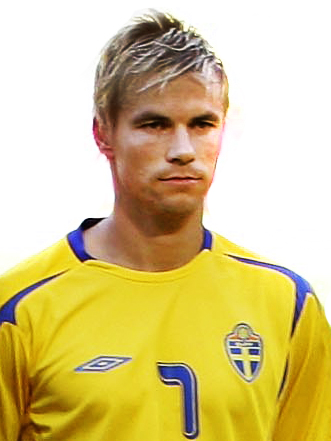
Jens Niclas Alexandersson (Swedish pronunciation: [ˈnɪk.las ˌalɛkˈsan.dɛʂˌsɔn]; born 29 December 1971) is a Swedish former professional footballer who played as a right winger and right back.

Key Information

Beginning his career with Halmstad in 1989, he went on to represent IFK Göteborg, Sheffield Wednesday, Everton, and West Ham United before retiring in 2009.

A full international between 1993 and 2008, he won 109 caps for the Sweden national team and represented his country at two FIFA World Cups (2002 and 2006) and two UEFA European Championships (2000 and 2008).

Club career

[edit]

After starting his career with local club Vessigebro, Alexandersson moved to Halmstad in 1988. He played for the team until 1995, when he joined IFK Göteborg, with whom he won Allsvenskan in 1996 and played in the UEFA Champions League. After one year in Gothenburg, he moved on to England, where he was signed for £750,000 by Ron Atkinson for Sheffield Wednesday.[1] He played for three seasons in Sheffield, where he became a fans favourite and won the Player of The Season award the year the team was relegated from the Premier League.[1] After relegation, he was signed by Everton for £2.5 million where he played for from 2000 to 2003, until he moved back to Gothenburg, where he played from 2004 to 2008.

After an initial retirement in 2008, Alexandersson worked at IFK Göteborg's youth academy, Änglagårdskolan. On 27 September 2009, newspapers reported that he was to make a comeback, and would start training again on 29 September 2009.[2] On 2 October 2009, it was revealed that Alexandersson would sign a contract for the rest of the season.[3] After the season, he retired for good.

In 2017, Alexandersson made a brief comeback when appearing in a Division 3 Sydvästra Götaland game for Västra Frölunda against Kungsbacka, appearing as a substitute in the 78th minute and playing alongside his son Noah Alexandersson in a 6–0 win.[4][5][6]

International career

[edit]

Alexandersson made his debut for the Sweden national team in 1993, and participated in 109 international games, scoring seven goals. His participation in the national team includes the 2002 FIFA World Cup, 2006 FIFA World Cup, Euro 2000 and Euro 2008. He was also a member of the Swedish squad that competed at the 1992 Summer Olympics in Barcelona. One of his goals came in Sweden's 1–1 draw against England, which he shot powerfully from outside the box and passed through David Seaman during the group stages of the 2002 World Cup.[7]

The day after Sweden's exit from Euro 2008, he decided that he would retire from the national team alongside Marcus Allbäck, however he also said that if it was needed, due to injuries, he would play for the national team again.[8]

Personal life

[edit]

Alexandersson was born in Halmstad on 29 December 1971 to father Lennart Alexandersson, a former Halmstad player. He grew up in Falkenberg, where he started playing football in the local club Vessigebro. In 1978, his brother Daniel Alexandersson, who was also a professional football player, was born. In 1988, he moved to Halmstad to play for Halmstads BK. He attended Falkenbergsgymnasieskola 1987-1990.

Alexandersson married his wife Frida. The couple had first child Tilda in 1999 and son named Noah in 2001.[9] While playing football, Alexandersson's family has lived in numerous places including Sheffield, Liverpool, Warrington, and London before returning to Gothenborg. His son Noah Alexandersson has gone on to play professional football for IFK Göteborg in Allsvenskan.[10]

Career statistics

[edit]
Appearances and goals by national team and year[4][11]
National team Year Apps Goals
Sweden 1993 1 0
1994 2 0
1995 8 2
1996 6 0
1997 12 0
1998 0 0
1999 10 3
2000 8 0
2001 8 1
2002 12 1
2003 1 0
2004 4 0
2005 11 0
2006 13 0
2007 7 0
2008 6 0
Total 109 7
Scores and results list Sweden's goal tally first, score column indicates score after each Alexandersson goal.
List of international goals scored by Niclas Alexandersson
No. Date Venue Opponent Score Result Competition
1 8 March 1995 Tsirion Athletic Centre, Limassol, Cyprus  Cyprus 3–2 3–3 Friendly
2 15 November 1995 Råsunda Stadium, Solna, Sweden  Turkey 1–0 2–2 UEFA Euro 1996 qualifier
3 10 February 1999 Stade Olympique El-Mensah, Tunis, Tunisia  Tunisia 1–0 1–0 Friendly
4 4 September 1999 Råsunda Stadium, Solna, Sweden  Bulgaria 1–0 1–0 UEFA Euro 2000 qualifier
5 8 September 1999 Josy Barthel Stadion, Luxembourg City, Luxembourg  Luxembourg 1–0 1–0 UEFA Euro 2000 qualifier
6 6 June 2001 Ullevi, Gothenburg, Sweden  Moldova 4–0 6–0 2002 FIFA World Cup qualifier
7 2 June 2002 Saitama Stadium, Saitama, Japan  England 1–1 1–1 2002 FIFA World Cup

Honours

[edit]

See also

[edit]

References

[edit]
[edit]
Revisions and contributorsEdit on WikipediaRead on Wikipedia
from Grokipedia
Niclas Alexandersson (born 29 December 1971) is a Swedish former professional footballer who played primarily as a right , though he also featured as a right back and left throughout his career. He began his professional journey with in 1989, making over 150 appearances and scoring 29 goals before moving to in 1995, where he contributed to winning the Swedish championship in 1996. Alexandersson spent four seasons in the English , first with from 1997 to 2000 (88 appearances, 12 goals) and then with Everton from 2000 to 2004 (64 appearances, 5 goals), earning the Sheffield Wednesday Player of the Year award in the 1999–2000 season during a challenging relegation campaign. He returned to in 2004, adding a Swedish win in 2008 and a Swedish Super Cup in 2008, before retiring in November 2009 after 414 total club appearances and 61 goals. Internationally, Alexandersson represented from 1993 to 2008, accumulating 109 caps and scoring 7 goals, including one in the . He debuted for the senior national team on 10 November 1993 against and scored his first international goal on 8 March 1995 against . Alexandersson participated in two World Cups (2002 and 2006, with 8 appearances total), two European Championships (2000 with 3 appearances and 2008 with 1 appearance), and the football tournament at the in . His versatility and consistency made him a key figure in Sweden's midfield during a golden era, highlighted by individual recognition as Swedish Midfielder of the Year in 1995.

Early life and youth career

Upbringing and family background

Niclas Alexandersson was born on 29 December 1971 in , . He grew up in the Falkenberg area, in the locality of Vessigebro within Falkenberg Municipality, , a rural setting along the Ätran River characterized by fields, meadows, and proximity to the coast. Alexandersson comes from a family with ties to football; his younger brother, Daniel Alexandersson, also pursued a professional career as a and forward. The family's support for sporting activities facilitated his early transition to organized youth football at local club Vessigebro BK.

Youth football development

Alexandersson began his involvement in organized youth football with Vessigebro BK, his local club near Falkenberg, where he developed his early skills alongside family members, including playing in the senior A-team with his father Lennart. He remained with Vessigebro BK until the age of 16, honing his abilities in a supportive hometown environment that encouraged his passion for the sport. In the summer of 1988, at age 16, Alexandersson moved to Halmstads BK's , signing with the club to advance his development in a more competitive setting. There, he participated in structured training sessions focused on tactical awareness and physical conditioning, while competing in youth matches that emphasized his versatility as a winger and right back. His skill development centered on building stamina, crossing accuracy, and defensive positioning, allowing him to adapt to the demands of higher-level play within HBK's youth setup. Alexandersson made his senior debut for in 1989 at the age of 17, entering as a substitute in an away match against Västra Frölunda during the first half when the team trailed 1-2; HBK ultimately rallied to win 4-3. This early exposure presented adaptation challenges, including adjusting to the physical intensity and pace of senior football, but he quickly integrated, becoming a regular right in the club's 3-5-2 formation by 1990.

Professional club career

Halmstads BK (1989–1995)

Alexandersson made his professional debut for in the on 4 June 1989, coming on as a substitute in a 1–1 draw against Västra Frölunda IF at home. Born and raised in , he had progressed through the club's youth academy, signing his first professional contract in the summer of 1988 after impressing in local youth football. Initially a squad player, he gradually earned more opportunities, becoming a regular starter in the right midfield position from the 1990 season onward, contributing to the team's efforts to maintain stability in the top flight during a period when often battled relegation threats. Over his seven seasons with the club, Alexandersson amassed 157 appearances and scored 29 goals across all competitions, including 118 matches and 19 goals in the , 26 appearances and 9 goals in Kvalsvenskan, and 13 appearances and 2 goals in Division 1. His development was marked by consistent performances that helped secure the club's league position, with notable personal milestones such as earning the HP-Dribblern award in 1991 for his dribbling skills. In the 1995 season, Alexandersson played a pivotal role in Halmstads BK's cup success, scoring in the final as they defeated 3–1 to claim the title—the club's first major trophy. This triumph also qualified them for the European Cup Winners' Cup, where he featured in matches, including a memorable 3–0 group stage victory over . At the end of the 1995 season, Alexandersson transferred to for an undisclosed fee, following his former coach Mats Jingblad, who had taken over at the larger club. The move was motivated by his desire for greater challenges at a club with a stronger title pedigree and European ambitions, capping a formative period where he established himself as one of Sweden's emerging talents. In recognition of his 1995 contributions, he was named the Allsvenskan's best and received the Folkets lirare award from fans.

IFK Göteborg (first spell, 1996–1997)

Alexandersson transferred from to ahead of the 1996 season, bringing versatility honed at his hometown club to a title-contending side. Under coach Mats Jingblad, he quickly established himself as a key right and winger, contributing to the team's championship victory with 26 appearances and 7 goals in the league that year. His pace, crossing ability, and work rate evolved to fit IFK's attacking system, providing width and support in transitions that helped secure the title—IFK's first since 1993—on the final matchday against . In the 1997 season, Alexandersson continued his form with 26 league appearances and 6 goals, totaling 52 outings and 13 goals across his first spell. He also featured prominently in IFK's campaign following the 1996 title, playing 5 group stage matches, including starts against and Manchester United, where his defensive solidity and forward surges added balance to the midfield. These performances underscored his adaptation to elite Swedish football, blending technical skill with tactical discipline under Jingblad's guidance. Alexandersson's departure came in December 1997 when Sheffield Wednesday signed him for £750,000, drawn by the 's prestige and the opportunity to join a established English club managed by .

Sheffield Wednesday (1997–2000)

In December 1997, Niclas Alexandersson transferred from to Sheffield Wednesday for a fee of £750,000 under manager . He made his debut during the 1997–98 season, initially featuring sparingly as he adapted to the physicality and pace of English football, drawing on his prior experience in Sweden's to aid his transition. Over his three seasons at the club, Alexandersson made 88 appearances and scored 12 goals across all competitions, primarily operating as a right or right back where he contributed defensively with tackles and interceptions while providing forward thrust through overlapping runs and crosses. Notable performances included scoring in a 3–1 upset victory over Manchester United in November 1998 and delivering key assists, such as in matches against Coventry City, showcasing his versatility and work rate. In the 1999–2000 season, amid the team's struggles, he recorded 5 league goals and was voted Sheffield Wednesday's Player of the Season by supporters for his consistent displays in a campaign that ended in relegation. Following relegation, Sheffield Wednesday faced severe financial difficulties, including mounting debts that forced the sale of key assets to stabilize the club. Alexandersson's , set to expire in 2001, became a point of contention amid these issues, leading to his £2.5 million transfer to Everton on 18 July 2000, allowing the Owls to recoup funds from the incoming fee.

Everton (2000–2004)

Niclas Alexandersson transferred to Everton from Sheffield Wednesday in July 2000 for a fee of £2.5 million, building on his prior exposure where he had established himself as a reliable performer despite his club's relegation. Signed by manager , who had long admired the Swedish international's displays during a previous Champions League encounter with Rangers, Alexandersson was positioned primarily as a right-sided midfielder, valued for his work rate and ability to provide width in attack. His debut season, 2000–01, showed promise with a strong pre-season in which he scored five goals, but an injury crisis limited him to 20 appearances and two goals, including a return to form after March. The following year, 2001–02, marked his most consistent period under Smith, as he started 28 of 31 league matches, netting another two goals and providing four assists while demonstrating versatility across midfield and defensive roles. These contributions helped stabilize Everton's midfield, earning him recognition for his integration into the intense football culture and appreciation from fans for his diligent performances amid the club's mid-table struggles. In March 2002, succeeded Smith as manager, ushering in a transitional phase for the team. During the 2002–03 season, Alexandersson's involvement dwindled to just seven appearances with no goals, as Everton mounted a gritty survival push from the relegation zone, ultimately securing 17th place with 33 points. Injuries and fluctuating form contributed to his reduced role, leading to a loan move to West Ham United in September 2003 to regain match fitness amid limited opportunities at . Upon returning from loan, Alexandersson featured sparingly in Everton's reserves before departing on a free transfer to in February 2004, seeking regular first-team football back in . Over his four-year spell at Everton, he amassed 64 appearances and five goals across all competitions, leaving a legacy of solid, if injury-interrupted, contributions that highlighted his adaptability but fell short of the consistent impact he had achieved earlier in his career.

West Ham United (loan, 2003–2004)

In September 2003, Niclas Alexandersson joined West Ham United on a short-term loan from Everton, seeking regular playing time in the First Division after falling out of favor at Goodison Park due to increased squad depth under manager David Moyes. The move was facilitated by West Ham's then-caretaker manager Trevor Brooking, who aimed to bolster the midfield during a transitional period before Alan Pardew's appointment later that month. Alexandersson debuted shortly after arriving, starting in a 1-0 victory over Reading on September 13, 2003. During his brief stint, Alexandersson made eight appearances across all competitions, primarily as a or winger, but failed to score or provide assists, contributing minimally to 's promotion campaign. He featured in key matches, including a 1-0 win against Derby County on October 4, where his crossing and volley attempts highlighted his technical ability, though the team struggled with defensive lapses overall. Under Pardew, who took over on September 18, Alexandersson initially fitted into a possession-oriented setup but encountered tactical challenges, often deployed out of position on the right flank amid competition from players like and , limiting his influence in the promotion push that saw finish fourth and secure promotion via . Reports noted occasional fitness concerns and adaptation issues to the intense English second-tier schedule, echoing broader form struggles from his Everton tenure. Alexandersson's loan ended prematurely in October 2003 when he declined an extension offered by Pardew, opting to return to Everton for personal reasons despite the club's interest in retaining him for the remainder of the season, which had been agreed until March 2004. This decision was clarified by Alexandersson himself, who emphasized it was not a snub toward West Ham but driven by family considerations. The spell ultimately served as a minor footnote in his career, providing limited game time without significant impact and paving the way for his permanent departure from English football to rejoin the following summer.

IFK Göteborg (second spell, 2004–2009)

After a challenging loan spell at West Ham United, Alexandersson returned to on a free transfer from Everton in June 2004. He quickly re-established himself as a key figure in the squad, leveraging his international experience to mentor younger players and provide tactical insight during training sessions. During his second stint, which lasted until 2009, Alexandersson made 124 appearances in the , scoring 19 goals, while contributing to a total of 194 matches and 29 goals across all competitions. Appointed club captain, he led the team through competitive league campaigns, including the successful 2007 title win that ended a four-year for the club, along with victories in the 2007 Intertoto Cup and Swedish Super Cup. His leadership was evident in high-stakes moments, such as the 2008 final, where he scored in the after a goalless draw and extra time, securing a 5-4 victory over and European qualification. Alexandersson's on-field contributions extended beyond goals, with his versatile play on the right flank and precise crossing aiding the team's attacking transitions, particularly in the title challenge where clinched the championship on the final day. Off the pitch, he was recognized for his influence, earning the fan-voted Ärkeängel award in 2004 and the Kristallkulan for in the that same year. His English tenure further honed his professionalism, which he imparted to emerging talents like and Pontus Farnerud. In October 2008, Alexandersson announced his retirement at the end of the season, citing a desire to focus on family and coaching prospects after 20 years as a professional. However, he extended his contract for one more year, playing five additional league matches and scoring once in 2009 before hanging up his boots in November. His farewell included emotional tributes from fans at , capping a legacy of 298 total appearances and 48 goals for across both spells.

International career

Youth and Olympic appearances

Alexandersson's early international exposure came through Sweden's youth national teams, where he earned 12 caps across U-21 and other levels prior to his senior debut in 1993. His selection was influenced by consistent performances as a right midfielder for in the , showcasing his versatility and crossing ability. These appearances laid the groundwork for his progression to higher levels of international football. In 1992, Alexandersson was a key member of the Sweden U-21 team that reached the final of the UEFA European Under-21 Championship, which doubled as a qualification pathway for the Olympics. He featured in all six matches of the final tournament (two legs each for quarter-finals, semi-finals, and final), playing the full 540 minutes. Sweden qualified directly as group winners and advanced in the quarters against the Netherlands (1–2 away, 1–0 home; 2–2 aggregate, advanced on away goals), defeated Scotland 1–0 on aggregate in the semi-finals, and finished as runners-up after losing 1–2 on aggregate to Italy in the final (0–2 away, 1–0 home), securing Olympic qualification as one of the top four teams. Reflecting on the campaign, Alexandersson later noted the significance of their knockout performance, underscoring the team's resilience. Building on this success, Alexandersson represented at the in as part of the U-23 squad (with three over-age players), where the team achieved a fifth-place finish—their best Olympic result since 1948. He appeared in three matches during the group stage (): starting in the 0–0 draw against , the 4–0 win over , and the 1–1 draw with , contributing to Sweden's unbeaten group run (second place, 4 points) that advanced them to the quarter-finals. Sweden were eliminated in the quarter-finals with a 1–2 loss to (Alexandersson did not feature), finishing fifth overall. His reliable displays in midfield during the group stage highlighted his emerging talent and helped cement his reputation within Swedish football circles. The Olympic experience proved instrumental as a stepping stone to senior international football, with Alexandersson's composure under pressure and tactical awareness during these youth and Olympic outings directly influencing his first senior call-up later in 1993.

Senior national team career

Alexandersson made his debut for the senior national team on 10 November 1993, coming on as a substitute in a 1–1 away draw against during a qualifier. Over the course of his international career, he earned 109 caps and scored 7 goals between 1993 and 2008, often playing as a versatile right midfielder or right back under coaches including Tommy Svensson, who guided the team during his early years, and later the joint management of Tommy Söderberg and . His goals included his first international strike against on 8 March 1995, and a notable equalizer in the 1–1 group stage draw against at the . Alexandersson featured prominently in Sweden's major tournaments starting with , where he played in all three group stage matches as Sweden exited in the first round following defeats to and and a draw with . At the , he started all four games, including a memorable group stage draw against on 2 June, where he scored Sweden's equalizer in a 1–1 result that helped secure advancement to the round of 16 before elimination by . He was part of the squad for but did not feature in any matches as Sweden reached the quarter-finals under Lagerbäck and Söderberg. In the 2006 FIFA World Cup, Alexandersson started all four matches, contributing to Sweden's group stage progression with draws against and , though they were knocked out in the round of 16 by hosts . His final tournament appearance came at , where he substituted in the 76th minute during a 0–2 group stage loss to on 10 June, marking the end of his international playing career. Following the tournament, Alexandersson announced his retirement from international duty alongside teammate , a decision confirmed by head coach on 19 June 2008.

Post-playing career

Academy and coaching roles

Following his retirement from professional football in 2009 after a second stint with IFK Göteborg, Niclas Alexandersson transitioned into youth development by joining Änglagårdsskolan, a Gothenburg-based institution that combines compulsory schooling with intensive football training in partnership with . In this role, he focused on player development and scouting for promising young talents, working closely with the club's to nurture skills from an early age. As head football coach at Änglagårdsskolan, Alexandersson has instructed students in grades 4 through 9, delivering up to 36 training sessions per week tailored to age groups, with older students (years 7–9) receiving three sessions weekly and year 6 students one. His emphasizes technique, game understanding, , and through a calm, methodical approach, drawing from his 20-year elite playing career across and , including 109 caps for and titles with in 1996 and 2007. This philosophy prioritizes holistic growth—integrating health, camaraderie, enjoyment, perseverance, and academic knowledge—over immediate elite results, helping students balance football ambitions with while setting individual goals to optimize technical and tactical abilities. Alexandersson's tenure, spanning over 15 years by 2025, has contributed to mentoring programs that identify and develop emerging talents for professional pathways, with notable examples including defender Jesper Tolinsson, who advanced to in , and forward Benjamin Nygren, who joined in . Among those influenced by the program during his involvement was his son Noah Alexandersson, a who progressed through local youth ranks at Västra Frölunda before debuting for IFK Göteborg's senior team in 2019 and later moving abroad to in . Prior to fully committing to Änglagårdsskolan, he also served as a mentor for IFK Göteborg's youth initiatives and briefly coached Västra Frölunda's 2001-born talented squad until the end of 2017, further extending his scouting and development efforts.

2017 playing comeback

In 2017, at the age of 45, Niclas Alexandersson made an unexpected one-match playing comeback for Västra Frölunda IF in Sweden's Division 3 Sydvästra Götaland, motivated primarily by the opportunity to share the pitch with his son , who was a regular player for the team. This family-oriented gesture echoed Alexandersson's own childhood experiences playing alongside his father in lower-division football, turning the appearance into a personal milestone rather than a competitive pursuit. The event also aimed to bolster the club's efforts to secure their position in the third tier. The comeback occurred in the season's final match on September 30, 2017, away against Kungsbacka IF, where Västra Frölunda secured a 6–0 . Alexandersson, wearing his familiar number 7, entered as a substitute in the 79th minute with his team already leading 5–0, allowing him to play the closing stages alongside , who scored the final goal to make it 6–0. In total, he recorded one appearance and zero goals, contributing to the non-competitive, celebratory tone of the outing that confirmed Västra Frölunda's survival in the division. Reflecting on the experience, Alexandersson described it as a "fun thing" and a "last chance" to play with his son, emphasizing the joy over any athletic demands, though he noted his body was no longer up to regular play at age 45. The event garnered media attention in Swedish outlets, highlighting it as a heartwarming, farewell-like moment in his post-retirement life, with no plans for further playing appearances.

Personal life

Family and children

Alexandersson has been married to his wife, Frida, since 1998. The couple's first child, daughter Tilda, was born in 1999 while Alexandersson played for Sheffield Wednesday in England. Tilda is a professional handball player for Önnereds HK in the Swedish Handbollsligan Dam. Their son, Noah, was born in 2001 during Alexandersson's time at Everton, also in England. Noah is a professional footballer who plays as a right winger for Moss FK and has represented Sweden at youth international levels, including U19. The couple's third child, daughter Thelma, was born on 23 March 2009 in Sweden; she is a youth international footballer representing Sweden at U17 level. Frida provided significant support throughout Alexandersson's professional career, accompanying him on relocations to from 1997 to 2004, where the family adapted to life in and while maintaining connections with other football families. In interviews, Alexandersson has credited Frida's unwavering presence as key to navigating the challenges of international moves and the demands of professional football. Publicly, Alexandersson has discussed balancing his playing career with , emphasizing priorities post-retirement through roles like managing youth teams, which allowed him to integrate football with time. In a brief 2017 playing comeback for Västra Frölunda IF in Division 3, Alexandersson appeared alongside , highlighting their shared passion for the sport.

Residences and later life

Born in , , Alexandersson began his life in the coastal town before relocating to Göteborg in 1995. His family accompanied him on subsequent moves abroad, including to , , in 1997; in 2000; and for a loan spell in 2003. Following his return to in 2004, he resettled in the Göteborg area, where he has remained based since retiring from professional football in 2009. In 2017, Alexandersson and his family sold their house and transitioned to an apartment in central Göteborg, reflecting a shift toward urban living post-career. As of 2022, he continues to reside in the city. This stable Göteborg residence has allowed for lifestyle adjustments, including deeper community ties through local football initiatives like the Änglagårdsskolan in Kviberg, where he contributes as an instructor. Beyond family, Alexandersson has engaged in community involvement centered on youth football development in , emphasizing education-integrated programs in the Göteborg region. No public details on personal hobbies or independent business ventures have been widely documented.

Honours and achievements

Club honours

During his first spell with from 1995 to 1997, Alexandersson played a key role in the team's successful 1996 campaign, making regular appearances as a right and contributing to their championship victory with 17 wins in 26 matches. Returning to IFK Göteborg in 2004, Alexandersson served as club captain during the 2007 season, where he featured prominently in midfield to help secure the title, the club's first league championship in 11 years, finishing with 14 wins and a +22 goal difference. In 2008, still as captain, Alexandersson started in the final, anchoring the midfield in a 2-1 extra-time win over to claim the trophy, IFK Göteborg's fifth Swedish Cup title. Earlier that year, he led the team in the Svenska Supercupen, starting and captaining to a 3-1 victory against , earning the first edition of the competition for the club. No major club honours were achieved during his tenures at Sheffield Wednesday (1997–2000), Everton (2000–2004), or the brief loan at United (2003–2004), where the teams focused on league survival and mid-table consistency without silverware.

Individual and international recognition

During his time at Sheffield Wednesday, Alexandersson was voted the club's Player of the Season for the 1999–2000 campaign, recognizing his consistent performances amid the team's relegation struggle. In Sweden, Alexandersson earned the Årets Mittfältare award in 1995 while playing for , honoring him as the top midfielder in the that year. Later, upon returning to , he received the Årets Ärkeängel accolade in 2004 from the club's , Supporterklubben Änglarnas, for his and contributions on the pitch. Internationally, Alexandersson amassed 109 caps for the national team between 1993 and 2008, scoring 7 goals during his tenure. One of his most memorable strikes came in the group stage against , where his long-range effort in the 59th minute secured a 1–1 draw and advanced Sweden to the knockout rounds.

Career statistics

Club statistics

Alexandersson primarily played as a right winger, right , or right back during his club career, contributing versatility to his teams across various competitions. His overall club record in league competitions includes 475 appearances and 73 goals. He accumulated 15 yellow cards and no red cards in documented major league games, with no notable disciplinary issues beyond standard bookings.

Breakdown by Club

ClubAppearancesGoals
15729
17632
Sheffield Wednesday758
Everton584
West Ham United80
Västra Frölunda IF10
Total47573

Competition-Specific Statistics

Alexandersson's statistics are dominated by domestic league play, with additional contributions in cups and European competitions. The following tables highlight key breakdowns, focusing on major leagues and selected cups where data establishes his impact.

Domestic Leagues

CompetitionAppearancesGoalsNotes
(Sweden)33361Primarily with and ; includes 157/29 for Halmstads BK and 176/32 for IFK Göteborg.
(England)1331275/8 with Sheffield Wednesday; 58/4 with Everton.
First Division (England)80With West Ham United.

Cups and European Competitions

CompetitionAppearancesGoalsNotes
(England)1238/2 with Sheffield Wednesday; 4/1 with Everton.
(England)62All with Sheffield Wednesday.
Svenska Cupen (Sweden)~50~10Approximate based on club totals with ; exact figures vary by season.
UEFA Competitions (e.g., Champions League, Cup Winners' Cup)424Includes 4/1 with in Cup Winners' Cup; 38/3 with .

International statistics

Niclas Alexandersson earned 109 caps for the senior national team, scoring 7 goals between his debut on 10 November 1993 against and his final appearance on 10 June 2008 against . He also represented at the youth level, including 4 appearances at the in , where the team advanced to the quarter-finals but scored no goals for him.

Appearances by Tournament

TournamentAppearancesGoals
FIFA World Cup 200241
FIFA World Cup 200640
30
00
10
World Cup Qualifiers (total)231
European Championship Qualifiers (total)193
Friendlies (total)462
Other Tournaments (total)90

International Goals

DateOpponentResultCompetition
8 March 19953–3Friendly
15 November 19952–2 Qualifier
10 February 19991–0Friendly
4 September 19991–0 Qualifier
8 September 1999Luxembourg1–0 Qualifier
6 June 20016–0 Qualifier
2 June 20021–1

References

Add your contribution
Related Hubs
User Avatar
No comments yet.