



Community hub
Recent from talks
Contribute something to knowledge base
Content stats: 0 posts, 0 articles, 1 media, 0 notes
Members stats: 0 subscribers, 0 contributors, 0 moderators, 0 supporters
Subscribers
Supporters
Contributors
Moderators
Hub AI
Nicolaus Copernicus AI simulator
(@Nicolaus Copernicus_simulator)
Hub AI
Nicolaus Copernicus AI simulator
(@Nicolaus Copernicus_simulator)
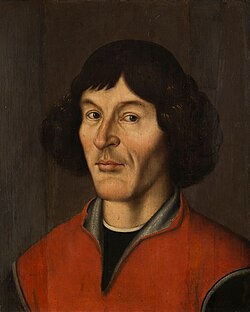
Nicolaus Copernicus
Nicolaus Copernicus (19 February 1473 – 24 May 1543) was a Renaissance polymath who formulated a model of the universe that placed the Sun rather than Earth at its center. The publication of Copernicus's model in his book De revolutionibus orbium coelestium (On the Revolutions of the Celestial Spheres), just before his death in 1543, was a major event in the history of science, triggering the Copernican Revolution and making a pioneering contribution to the Scientific Revolution. Though a similar heliocentric model had been developed eighteen centuries earlier by Aristarchus of Samos, an ancient Greek astronomer, Copernicus likely arrived at his model independently.
Copernicus was born and died in Royal Prussia, a semiautonomous and multilingual region created within the Crown of the Kingdom of Poland from lands regained from the Teutonic Order after the Thirteen Years' War.
A polyglot and polymath, he obtained a doctorate in canon law and was a mathematician, astronomer, physician, classics scholar, translator, governor, diplomat, and economist. From 1497 he was a Warmian Cathedral chapter canon. In 1517 he derived a quantity theory of money—a key concept in economics—and in 1519 he formulated an economic principle that later came to be called Gresham's law.
Nicolaus Copernicus was born on 19 February 1473 in the city of Toruń (Thorn), in the province of Royal Prussia, in the Crown of the Kingdom of Poland, to German-speaking parents.
His father was a merchant from Kraków and his mother was the daughter of a wealthy Toruń merchant. Nicolaus was the youngest of four children. His brother Andreas (Andrew) became an Augustinian canon at Frombork (Frauenburg). His sister Barbara, named after her mother, became a Benedictine nun and, in her final years, prioress of a convent in Chełmno (Kulm); she died after 1517. His sister Katharina married the businessman and Toruń city councilor Barthel Gertner and left five children, whom Copernicus looked after to the end of his life. Copernicus never married and is not known to have had children, but from at least 1531 until 1539 his relations with Anna Schilling, a live-in housekeeper, were seen as scandalous by two bishops of Warmia who urged him over the years to break off relations with his "mistress".
Copernicus's father's family can be traced to a village in Silesia between Nysa (Neiße) and Prudnik (Neustadt). The village's name has been variously spelled Kopernik, Copernik, Copernic, Kopernic, Coprirnik, and modern Koperniki.
In the 14th century, members of the family began moving to various other Silesian cities, to the Polish capital, Kraków (1367), and to Toruń (1400). The father, Mikołaj the Elder (or Niklas Koppernigk), likely the son of Jan (or Johann), came from the Kraków line.
Nicolaus was named after his father, who appears in records for the first time as a well-to-do merchant who dealt in copper, selling it mostly in Danzig (Gdańsk). He moved from Kraków to Toruń around 1458. Toruń, situated on the Vistula River, was at that time embroiled in the Thirteen Years' War, in which the Kingdom of Poland and the Prussian Confederation, an alliance of Prussian cities, gentry and clergy, fought the Teutonic Order over control of the region. In this war, Hanseatic cities like Danzig and Toruń, Nicolaus Copernicus's hometown, chose to support the Polish King, Casimir IV Jagiellon, who promised to respect the cities' traditional vast independence, which the Teutonic Order had challenged. Nicolaus's father was actively engaged in the politics of the day and supported Poland and the cities against the Teutonic Order. In 1454 he mediated negotiations between Poland's Cardinal Zbigniew Oleśnicki and the Prussian cities for repayment of war loans. In the Second Peace of Thorn (1466), the Teutonic Order formally renounced all claims to the conquered lands, which returned to Poland as Royal Prussia and remained part of it until the First (1772) and Second (1793) Partitions of Poland.
Nicolaus Copernicus
Nicolaus Copernicus (19 February 1473 – 24 May 1543) was a Renaissance polymath who formulated a model of the universe that placed the Sun rather than Earth at its center. The publication of Copernicus's model in his book De revolutionibus orbium coelestium (On the Revolutions of the Celestial Spheres), just before his death in 1543, was a major event in the history of science, triggering the Copernican Revolution and making a pioneering contribution to the Scientific Revolution. Though a similar heliocentric model had been developed eighteen centuries earlier by Aristarchus of Samos, an ancient Greek astronomer, Copernicus likely arrived at his model independently.
Copernicus was born and died in Royal Prussia, a semiautonomous and multilingual region created within the Crown of the Kingdom of Poland from lands regained from the Teutonic Order after the Thirteen Years' War.
A polyglot and polymath, he obtained a doctorate in canon law and was a mathematician, astronomer, physician, classics scholar, translator, governor, diplomat, and economist. From 1497 he was a Warmian Cathedral chapter canon. In 1517 he derived a quantity theory of money—a key concept in economics—and in 1519 he formulated an economic principle that later came to be called Gresham's law.
Nicolaus Copernicus was born on 19 February 1473 in the city of Toruń (Thorn), in the province of Royal Prussia, in the Crown of the Kingdom of Poland, to German-speaking parents.
His father was a merchant from Kraków and his mother was the daughter of a wealthy Toruń merchant. Nicolaus was the youngest of four children. His brother Andreas (Andrew) became an Augustinian canon at Frombork (Frauenburg). His sister Barbara, named after her mother, became a Benedictine nun and, in her final years, prioress of a convent in Chełmno (Kulm); she died after 1517. His sister Katharina married the businessman and Toruń city councilor Barthel Gertner and left five children, whom Copernicus looked after to the end of his life. Copernicus never married and is not known to have had children, but from at least 1531 until 1539 his relations with Anna Schilling, a live-in housekeeper, were seen as scandalous by two bishops of Warmia who urged him over the years to break off relations with his "mistress".
Copernicus's father's family can be traced to a village in Silesia between Nysa (Neiße) and Prudnik (Neustadt). The village's name has been variously spelled Kopernik, Copernik, Copernic, Kopernic, Coprirnik, and modern Koperniki.
In the 14th century, members of the family began moving to various other Silesian cities, to the Polish capital, Kraków (1367), and to Toruń (1400). The father, Mikołaj the Elder (or Niklas Koppernigk), likely the son of Jan (or Johann), came from the Kraków line.
Nicolaus was named after his father, who appears in records for the first time as a well-to-do merchant who dealt in copper, selling it mostly in Danzig (Gdańsk). He moved from Kraków to Toruń around 1458. Toruń, situated on the Vistula River, was at that time embroiled in the Thirteen Years' War, in which the Kingdom of Poland and the Prussian Confederation, an alliance of Prussian cities, gentry and clergy, fought the Teutonic Order over control of the region. In this war, Hanseatic cities like Danzig and Toruń, Nicolaus Copernicus's hometown, chose to support the Polish King, Casimir IV Jagiellon, who promised to respect the cities' traditional vast independence, which the Teutonic Order had challenged. Nicolaus's father was actively engaged in the politics of the day and supported Poland and the cities against the Teutonic Order. In 1454 he mediated negotiations between Poland's Cardinal Zbigniew Oleśnicki and the Prussian cities for repayment of war loans. In the Second Peace of Thorn (1466), the Teutonic Order formally renounced all claims to the conquered lands, which returned to Poland as Royal Prussia and remained part of it until the First (1772) and Second (1793) Partitions of Poland.
Recent media
Recent media