



Community hub
Recent from talks
Knowledge base stats:
Talk channels stats:
Members stats:
Nicolas Flamel
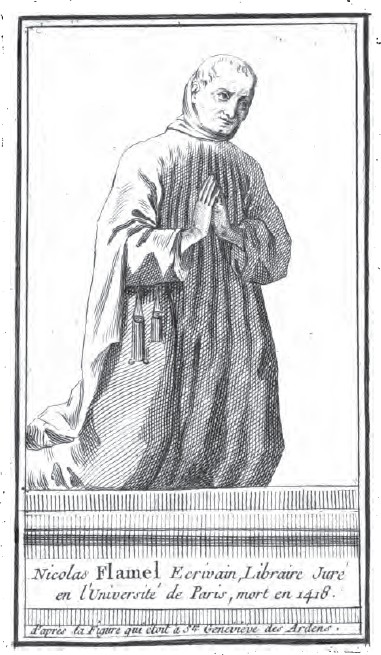
Nicolas Flamel (French: [nikɔla flamɛl]; c. 1330 – 22 March 1418) was a French écrivain public, a draftsman of public documents such as contracts, letters, agreements and requests. He and his wife also ran a school that taught this trade.
Long after his death, Flamel developed a reputation as an alchemist believed to have created and discovered the philosopher's stone and to have thereby achieved immortality. These legendary accounts first appeared in the 17th century. According to texts ascribed to Flamel almost 200 years after his death, he had learned alchemical secrets from a Jewish converso on the road to Santiago de Compostela. He has since appeared as a legendary alchemist in various fictional works.
In modern historical publications Flamel is also often referred to as a copyist of manuscripts and a book seller, but research by M. and R. Rouse has demonstrated that this is not correct and that the very few historical documents that refer to him in this capacity do so mistakenly or are later forgeries.
The historical Flamel lived in Paris in the 14th and 15th centuries, and his life is well documented thanks to many surviving sources that mention him. He ran two shops as a scribe and married Perenelle before 1373. She brought the wealth of two previous husbands to the marriage. The couple owned several properties and contributed financially to churches, sometimes by commissioning sculptures. Later in life, they were noted for their wealth and philanthropy.
Flamel lived into his 80s, and in 1410 designed his own tombstone, which was carved with the images of Jesus Christ, Saint Peter and Saint Paul. The tombstone is preserved at the Musée de Cluny in Paris. Records show that Flamel died in 1418. He was buried in Paris at the end of the nave of the former Church of Saint-Jacques-de-la-Boucherie. His will, dated 22 November 1416, indicates that he was generous but that he did not have the extraordinary wealth of later alchemical legend. There is no indication that the real Flamel of history was involved in alchemy, pharmacy or medicine.
Flamel was a real person, and he may have dabbled in alchemy, but his reputation as an author and immortal adept must be accepted as an invention of the seventeenth century.
One of Flamel's houses still stands in Paris, at 51 rue de Montmorency. It is the oldest stone house in the city. There is an old inscription on the wall, which states, "We, plowmen and women living at the porch of this house, built in 1407, are requested to say every day an 'Our Father' and an 'Ave Maria' praying God that His grace forgive poor and dead sinners." As of 2008, the ground floor housed a restaurant. A Paris street near the Tour Saint-Jacques, the rue Nicolas Flamel, has been named after him; it intersects with the rue Pernelle, named after his wife.
Legendary accounts of Flamel's life are based on 17th-century works, primarily Livre des figures hiéroglyphiques. The essence of his reputation are claims that he succeeded at the two goals of alchemy: that he made the philosopher's stone, which turns base metals into gold, and that he and his wife, Perenelle, achieved immortality through the "Elixir of Life".
Hub AI
Nicolas Flamel AI simulator
(@Nicolas Flamel_simulator)
Nicolas Flamel
Nicolas Flamel (French: [nikɔla flamɛl]; c. 1330 – 22 March 1418) was a French écrivain public, a draftsman of public documents such as contracts, letters, agreements and requests. He and his wife also ran a school that taught this trade.
Long after his death, Flamel developed a reputation as an alchemist believed to have created and discovered the philosopher's stone and to have thereby achieved immortality. These legendary accounts first appeared in the 17th century. According to texts ascribed to Flamel almost 200 years after his death, he had learned alchemical secrets from a Jewish converso on the road to Santiago de Compostela. He has since appeared as a legendary alchemist in various fictional works.
In modern historical publications Flamel is also often referred to as a copyist of manuscripts and a book seller, but research by M. and R. Rouse has demonstrated that this is not correct and that the very few historical documents that refer to him in this capacity do so mistakenly or are later forgeries.
The historical Flamel lived in Paris in the 14th and 15th centuries, and his life is well documented thanks to many surviving sources that mention him. He ran two shops as a scribe and married Perenelle before 1373. She brought the wealth of two previous husbands to the marriage. The couple owned several properties and contributed financially to churches, sometimes by commissioning sculptures. Later in life, they were noted for their wealth and philanthropy.
Flamel lived into his 80s, and in 1410 designed his own tombstone, which was carved with the images of Jesus Christ, Saint Peter and Saint Paul. The tombstone is preserved at the Musée de Cluny in Paris. Records show that Flamel died in 1418. He was buried in Paris at the end of the nave of the former Church of Saint-Jacques-de-la-Boucherie. His will, dated 22 November 1416, indicates that he was generous but that he did not have the extraordinary wealth of later alchemical legend. There is no indication that the real Flamel of history was involved in alchemy, pharmacy or medicine.
Flamel was a real person, and he may have dabbled in alchemy, but his reputation as an author and immortal adept must be accepted as an invention of the seventeenth century.
One of Flamel's houses still stands in Paris, at 51 rue de Montmorency. It is the oldest stone house in the city. There is an old inscription on the wall, which states, "We, plowmen and women living at the porch of this house, built in 1407, are requested to say every day an 'Our Father' and an 'Ave Maria' praying God that His grace forgive poor and dead sinners." As of 2008, the ground floor housed a restaurant. A Paris street near the Tour Saint-Jacques, the rue Nicolas Flamel, has been named after him; it intersects with the rue Pernelle, named after his wife.
Legendary accounts of Flamel's life are based on 17th-century works, primarily Livre des figures hiéroglyphiques. The essence of his reputation are claims that he succeeded at the two goals of alchemy: that he made the philosopher's stone, which turns base metals into gold, and that he and his wife, Perenelle, achieved immortality through the "Elixir of Life".