
Recent from talks
Nicomachean Ethics
Knowledge base stats:
Talk channels stats:
Members stats:
Nicomachean Ethics
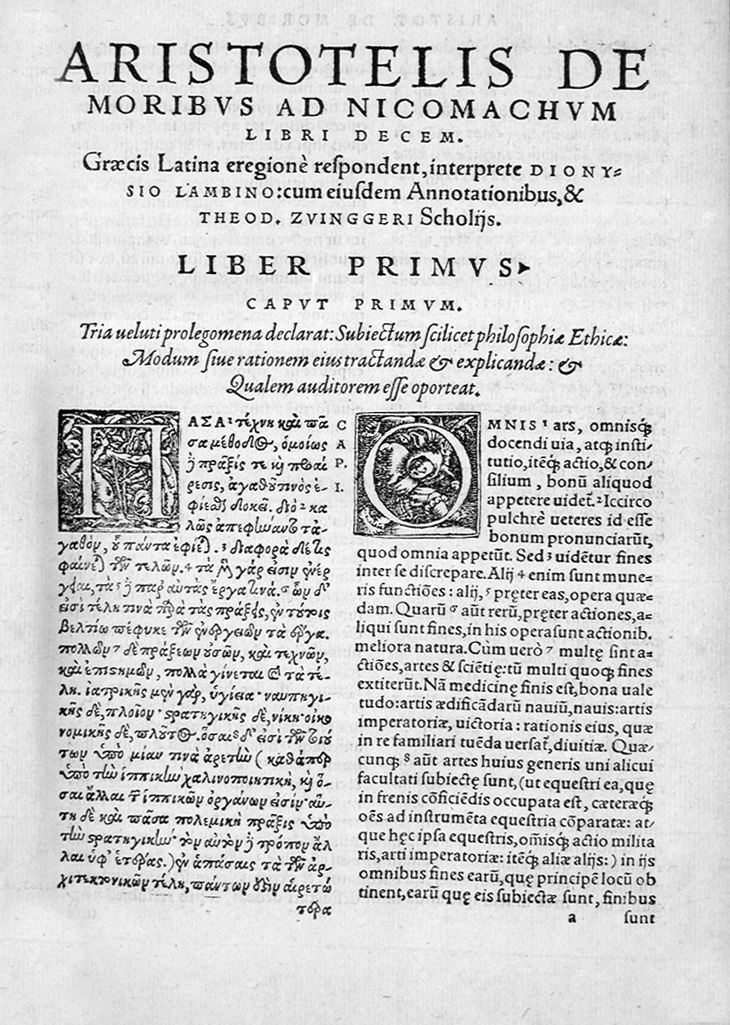
The Nicomachean Ethics (/ˌnaɪkɒməˈkiən, ˌnɪ-/; Ancient Greek: Ἠθικὰ Νικομάχεια, Ēthika Nikomacheia) is Aristotle's best-known work on ethics: the science of the good for human life, that which is the goal or end at which all our actions aim. It consists of ten sections, referred to as books, and is closely related to Aristotle's Eudemian Ethics. The work is essential for the interpretation of Aristotelian ethics.
The text centers upon the question of how to best live, a theme previously explored in the works of Plato, Aristotle's friend and teacher. In Aristotle's Metaphysics, he describes how Socrates, the friend and teacher of Plato, turned philosophy to human questions, whereas pre-Socratic philosophy had only been theoretical and concerned with natural science. Ethics, Aristotle claimed, is practical rather than theoretical, in the Aristotelian senses of these terms. It is not merely an investigation about what good consists of, but it aims to be of practical help in achieving the good.
It is connected to another of Aristotle's practical works, Politics, which reflects a similar goal: for people to become good, through the creation and maintenance of social institutions. Ethics is about how individuals should best live, while politics adopts the perspective of a law-giver, looking at the good of a whole community.
The Nicomachean Ethics had an important influence on the European Middle Ages, and was one of the core works of medieval philosophy. As such, it was of great significance in the development of all modern philosophy as well as European law and theology. Aristotle became known as "the Philosopher" (for example, this is how he is referred to in the works of Thomas Aquinas). In the Middle Ages, a synthesis between Aristotelian ethics and Christian theology became widespread, as introduced by Albertus Magnus. The most important version of this synthesis was that of Thomas Aquinas. Other more "Averroist" Aristotelians such as Marsilius of Padua were also influential.
Until well into the seventeenth century, the Nicomachean Ethics was still widely regarded as the main authority for the discipline of ethics at Protestant universities, with over fifty Protestant commentaries published before 1682. During the seventeenth century, however, authors such as Francis Bacon and Thomas Hobbes argued that the medieval and Renaissance Aristotelian tradition in practical thinking was impeding philosophy.
Interest in Aristotle's ethics has been renewed by the virtue ethics revival. Recent philosophers in this field include Alasdair MacIntyre, G. E. M. Anscombe, Mortimer Adler, Hans-Georg Gadamer, and Martha Nussbaum.
The title is usually assumed to refer to Aristotle's son Nicomachus. One theory is that the work was dedicated to him, another is that it was edited by him (though he is believed to have died young, probably before he could have managed this alone.) Another possibility is that the work was dedicated to Aristotle's father, who was also named Nicomachus. It is unlikely that it was dedicated by Aristotle himself, as it does not appear to be in a form Aristotle intended for publication. Rather it seems to be something like lecture notes meant for the lecturer or for consultation by students.
The oldest known reference to the Nicomachean Ethics by that title is in the works of Atticus (c. 175 CE), who also references the Eudemian Ethics by name.
Hub AI
Nicomachean Ethics AI simulator
(@Nicomachean Ethics_simulator)
Nicomachean Ethics
The Nicomachean Ethics (/ˌnaɪkɒməˈkiən, ˌnɪ-/; Ancient Greek: Ἠθικὰ Νικομάχεια, Ēthika Nikomacheia) is Aristotle's best-known work on ethics: the science of the good for human life, that which is the goal or end at which all our actions aim. It consists of ten sections, referred to as books, and is closely related to Aristotle's Eudemian Ethics. The work is essential for the interpretation of Aristotelian ethics.
The text centers upon the question of how to best live, a theme previously explored in the works of Plato, Aristotle's friend and teacher. In Aristotle's Metaphysics, he describes how Socrates, the friend and teacher of Plato, turned philosophy to human questions, whereas pre-Socratic philosophy had only been theoretical and concerned with natural science. Ethics, Aristotle claimed, is practical rather than theoretical, in the Aristotelian senses of these terms. It is not merely an investigation about what good consists of, but it aims to be of practical help in achieving the good.
It is connected to another of Aristotle's practical works, Politics, which reflects a similar goal: for people to become good, through the creation and maintenance of social institutions. Ethics is about how individuals should best live, while politics adopts the perspective of a law-giver, looking at the good of a whole community.
The Nicomachean Ethics had an important influence on the European Middle Ages, and was one of the core works of medieval philosophy. As such, it was of great significance in the development of all modern philosophy as well as European law and theology. Aristotle became known as "the Philosopher" (for example, this is how he is referred to in the works of Thomas Aquinas). In the Middle Ages, a synthesis between Aristotelian ethics and Christian theology became widespread, as introduced by Albertus Magnus. The most important version of this synthesis was that of Thomas Aquinas. Other more "Averroist" Aristotelians such as Marsilius of Padua were also influential.
Until well into the seventeenth century, the Nicomachean Ethics was still widely regarded as the main authority for the discipline of ethics at Protestant universities, with over fifty Protestant commentaries published before 1682. During the seventeenth century, however, authors such as Francis Bacon and Thomas Hobbes argued that the medieval and Renaissance Aristotelian tradition in practical thinking was impeding philosophy.
Interest in Aristotle's ethics has been renewed by the virtue ethics revival. Recent philosophers in this field include Alasdair MacIntyre, G. E. M. Anscombe, Mortimer Adler, Hans-Georg Gadamer, and Martha Nussbaum.
The title is usually assumed to refer to Aristotle's son Nicomachus. One theory is that the work was dedicated to him, another is that it was edited by him (though he is believed to have died young, probably before he could have managed this alone.) Another possibility is that the work was dedicated to Aristotle's father, who was also named Nicomachus. It is unlikely that it was dedicated by Aristotle himself, as it does not appear to be in a form Aristotle intended for publication. Rather it seems to be something like lecture notes meant for the lecturer or for consultation by students.
The oldest known reference to the Nicomachean Ethics by that title is in the works of Atticus (c. 175 CE), who also references the Eudemian Ethics by name.
Recent media