
Nimber
View on Wikipedia | This article has multiple issues. Please help improve it or discuss these issues on the talk page. (Learn how and when to remove these messages)
|


In mathematics, the nimbers, also called Grundy numbers (not to be confused with Grundy chromatic numbers), are introduced in combinatorial game theory, where they are defined as the values of heaps in the game Nim. The nimbers are the ordinal numbers endowed with nimber addition and nimber multiplication, which are distinct from ordinal addition and ordinal multiplication.
Because of the Sprague–Grundy theorem which states that every impartial game is equivalent to a Nim heap of a certain size, nimbers arise in a much larger class of impartial games. They may also occur in partisan games like Domineering.
The nimber addition and multiplication operations are associative and commutative. Each nimber is its own additive inverse. In particular for some pairs of ordinals, their nimber sum is smaller than either addend.[1] The minimum excludant operation is applied to sets of nimbers.
Definition
[edit]As a class, nimbers are indexed by ordinal numbers, and form a subclass of surreal numbers, introduced by John Horton Conway as part of his theory of combinatorial games.[2] However, nimbers are distinct from ordinal and surreal numbers in that they follow distinct arithmetic rules, nim-addition and nim-multiplication. Other than that they are a proper class rather than a set, nimbers form a field under nim-addition and nim-multiplication.
As a set, finite nimbers can be put in one-to-one correspondence with finite ordinal numbers, which are the natural numbers. Nonetheless, their arithmetic structures are not isomorphic; nimber arithmetic fundamentally differs from ordinary arithmetic operations on natural numbers.
Nimbers are often denoted using a star notation {*0, *1, *2, ..., *ω, *(ω+1), ...}.
Uses
[edit]Nim
[edit]Nim is a game in which two players take turns removing objects from distinct heaps. As moves depend only on the position and not on which of the two players is currently moving, and where the payoffs are symmetric, Nim is an impartial game. On each turn, a player must remove at least one object, and may remove any number of objects provided they all come from the same heap. The goal of the game is to be the player who removes the last object. The nimber of a heap is simply the number of objects in that heap. Using nim addition, one can calculate the nimber of the game as a whole. The winning strategy is to force the nimber of the game to 0 for the opponent's turn.[3]
Cram
[edit]Cram is a game often played on a rectangular board in which players take turns placing dominoes either horizontally or vertically until no more dominoes can be placed. The first player that cannot make a move loses. As the possible moves for both players are the same, it is an impartial game and can have a nimber value. For example, any board that is an even size by an even size will have a nimber of 0. Any board that is even by odd will have a non-zero nimber. Any 2 × n board will have a nimber of 0 for all even n and a nimber of 1 for all odd n.
Northcott's game
[edit]In Northcott's game, pegs for each player are placed along a column with a finite number of spaces. Each turn each player must move the piece up or down the column, but may not move past the other player's piece. Several columns are stacked together to add complexity. The player that can no longer make any moves loses. Unlike many other nimber related games, the number of spaces between the two tokens on each row are the sizes of the Nim heaps. If your opponent increases the number of spaces between two tokens, just decrease it on your next move. Else, play the game of Nim and make the Nim-sum of the number of spaces between the tokens on each row be 0.[4]
Hackenbush
[edit]Hackenbush is a game invented by mathematician John Horton Conway. It may be played on any configuration of colored line segments connected to one another by their endpoints and to a "ground" line. Players take turns removing line segments. An impartial game version, thereby a game able to be analyzed using nimbers, can be found by removing distinction from the lines, allowing either player to cut any branch. Any segments reliant on the newly removed segment in order to connect to the ground line are removed as well. In this way, each connection to the ground can be considered a nim heap with a nimber value. Additionally, all the separate connections to the ground line can also be summed for a nimber of the game state.
Addition
[edit]Nimber addition (also known as nim-addition) can be used to calculate the size of a single nim heap equivalent to a collection of nim heaps. It is defined recursively by where the minimum excludant mex(S) of a set S of ordinals is defined to be the smallest ordinal that is not an element of S.

For finite ordinals, the nim-sum is easily evaluated on a computer by taking the bitwise exclusive or (XOR, denoted by ⊕) of the corresponding numbers. For example, the nim-sum of 7 and 14 can be found by writing 7 as 111 and 14 as 1110; the ones place adds to 1; the twos place adds to 2, which we replace with 0; the fours place adds to 2, which we replace with 0; the eights place adds to 1. So the nim-sum is written in binary as 1001, or in decimal as 9.
This property of addition follows from the fact that both mex and XOR yield a winning strategy for Nim and there can be only one such strategy; or it can be shown directly by induction: Let α and β be two finite ordinals, and assume that the nim-sum of all pairs with one of them reduced is already defined. The only number whose XOR with α is α ⊕ β is β, and vice versa; thus α ⊕ β is excluded. On the other hand, for any ordinal γ < α ⊕ β, XORing ζ with all of α, β and γ must lead to a reduction for one of them (since the leading 1 in ζ must be present in at least one of the three); since we must have either Thus γ is included as either and hence α ⊕ β is the minimum excluded ordinal.


![{\displaystyle {\begin{aligned}\alpha >\zeta \oplus \alpha &=\beta \oplus \gamma ,\quad {\text{or}}\\[4pt]\beta >\zeta \oplus \beta &=\alpha \oplus \gamma .\end{aligned}}}](https://wikimedia.org/api/rest_v1/media/math/render/svg/1b9e540bcf1a5370928c4cbc3c8155a73a97592b)
![{\displaystyle {\begin{aligned}(\beta \oplus \gamma )\oplus \beta ,\quad {\text{or}}\\[4pt]\alpha \oplus (\alpha \oplus \gamma );\end{aligned}}}](https://wikimedia.org/api/rest_v1/media/math/render/svg/41a845b8d0588621b156f781cb4dbcb93266308e)
Nimber addition is associative and commutative, with 0 as the additive identity element. Moreover, a nimber is its own additive inverse.[5] It follows that α ⊕ β = 0 if and only if α = β.
Multiplication
[edit]Nimber multiplication (nim-multiplication) is defined recursively by

Nimber multiplication is associative and commutative, with the ordinal 1 as the multiplicative identity element. Moreover, nimber multiplication distributes over nimber addition.[5]
Thus, except for the fact that nimbers form a proper class and not a set, the class of nimbers forms a ring. In fact, it even determines an algebraically closed field of characteristic 2, with the nimber multiplicative inverse of a nonzero ordinal α given by
where S is the smallest set of ordinals (nimbers) such that
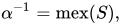
- 0 is an element of S;
- if 0 < α′ < α and β' is an element of S, then is also an element of S.

For all natural numbers n, the set of nimbers less than 22n form the Galois field GF(22n) of order 22n. Therefore, the set of finite nimbers is isomorphic to the direct limit as n → ∞ of the fields GF(22n). This subfield is not algebraically closed, since no field GF(2k) with k not a power of 2 is contained in any of those fields, and therefore not in their direct limit; for instance the polynomial x3 + x + 1, which has a root in GF(23), does not have a root in the set of finite nimbers.
Just as in the case of nimber addition, there is a means of computing the nimber product of finite ordinals. This is determined by the rules that
- The nimber product of a Fermat 2-power (numbers of the form 22n) with a smaller number is equal to their ordinary product;
- The nimber square of a Fermat 2-power x is equal to 3x/2 as evaluated under the ordinary multiplication of natural numbers.
The smallest algebraically closed field of nimbers is the set of nimbers less than the ordinal ωωω, where ω is the smallest infinite ordinal. It follows that as a nimber, ωωω is transcendental over the field.[6]
Addition and multiplication tables
[edit]The following tables exhibit addition and multiplication among the first 16 nimbers.
This subset is closed under both operations, since 16 is of the form 22n. (If you prefer simple text tables, they are here.)

This is also the Cayley table of Z24 – or the table of bitwise XOR operations.
The small matrices show the single digits of the binary numbers.

The nonzero elements form the Cayley table of Z15.
The small matrices are permuted binary Walsh matrices.

Calculating the nim-products of powers of two is a decisive point in the recursive algorithm of nimber-multiplication.
See also
[edit]Notes
[edit]- ^ Advances in computer games : 14th International Conference, ACG 2015, Leiden, the Netherlands, July 1-3, 2015, Revised selected papers. Herik, Jaap van den,, Plaat, Aske,, Kosters, Walter. Cham. 2015-12-24. ISBN 978-3319279923. OCLC 933627646.
{{cite book}}: CS1 maint: location missing publisher (link) CS1 maint: others (link) - ^ Conway, John Horton (2000). On Numbers and Games (2nd ed.). A K Peters/CRC Press. ISBN 978-1568811277.
- ^ Anany., Levitin (2012). Introduction to the design & analysis of algorithms (3rd ed.). Boston: Pearson. ISBN 9780132316811. OCLC 743298766.
- ^ "Theory of Impartial Games" (PDF). Feb 3, 2009.
- ^ a b Brown, Ezra; Guy, Richard K. (2021). "2.5 Nim arithmetic and Nim algebra". The Unity of Combinatorics. Vol. 36 of The Carus Mathematical Monographs (reprint ed.). American Mathematical Society. p. 35. ISBN 978-1-4704-6509-4.
- ^ Conway 1976, p. 61.
References
[edit]- Conway, John Horton (1976). On Numbers and Games. Academic Press Inc. (London) Ltd.
- Lenstra, H. W. (1978). Nim multiplication. Report IHES/M/78/211. Institut des hautes études scientifiques. hdl:1887/2125.
- Schleicher, Dierk; Stoll, Michael (2004). "An Introduction to Conway's Games and Numbers". arXiv:math.DO/0410026. which discusses games, surreal numbers, and nimbers.
Nimber
View on GrokipediaFundamentals
Definition
In combinatorial game theory, particularly for impartial games under normal play (where the last player to move wins), a nimber is the value assigned to a single game position, equivalent to the size of the Nim heap that the position matches in strategic value; this value is a non-negative integer denoted *n.[3] The term "nimber" was introduced by John H. Conway to describe these values, distinguishing them as the basic units in the algebra of impartial games.[1] Formally, the nimber of a position $ G $, written $ *G $, is defined recursively as the minimum excludant (mex) of the nimbers of all positions reachable from $ G $ in one legal move:Relation to Grundy Numbers
The Sprague-Grundy theorem asserts that, under normal play convention where the last player to move wins, every impartial combinatorial game is equivalent to a single Nim heap whose size equals the game's Grundy number, or nimber, denoted *G for game G.[5] This equivalence allows any such game to be analyzed as if it were a Nim position, with the nimber capturing the game's strategic value.[6] The theorem extends naturally to sums of impartial games under the disjunctive sum operation, where a move consists of selecting one component game and making a legal move within it, leaving the others unchanged. The nimber of the sum G + H is then the bitwise exclusive-or (XOR) of the individual nimbers, *G \oplus *H.[6] This operation ensures that the overall position is a second-player win if and only if the XOR of all component nimbers is zero, mirroring the winning condition in Nim.[5] The foundational ideas trace back to Charles Bouton's 1901 analysis of Nim, where he established that the winning strategy involves balancing pile sizes via their binary digital sums, equivalent to XOR.[4] Bouton introduced this for Nim specifically, but the concept was generalized independently by Roland Sprague in 1935–1936 and Patrick M. Grundy in 1939 to arbitrary impartial games.[4] Nimbers thus serve as the algebraic "numbers" structuring the theory of impartial games under normal play, with the disjunctive sum corresponding to XOR addition in the nimber algebra.[6] A brief proof sketch for the XOR property proceeds as follows: the options from G + H are positions of the form G' + H (where G' is an option of G) or G + H' (where H' is an option of H). The nimbers of these are *G' \oplus *H and *G \oplus *H', respectively. By the definition of nimber as the minimum excludant (mex) of the nimbers of its options, the set of reachable nimbers from G + H is the union of { *G' \oplus *H \mid G' \text{ option of } G } and { *G \oplus *H' \mid H' \text{ option of } H }. Since the mex of *G's options excludes *G and similarly for *H, this union excludes precisely *G \oplus *H from all possible nonnegative integers, yielding mex = *G \oplus *H.[6]Operations
Addition
In combinatorial game theory, the addition of two nimbers, denoted , is defined recursively as the nimber assigned to the disjunctive sum of the impartial games corresponding to and . Specifically, it is the minimum excludant (mex) of the set of nimbers of all possible moves from that sum:| + | 0 | 1 | 2 | 3 |
|---|---|---|---|---|
| 0 | 0 | 1 | 2 | 3 |
| 1 | 1 | 0 | 3 | 2 |
| 2 | 2 | 3 | 0 | 1 |
| 3 | 3 | 2 | 1 | 0 |
Multiplication
In combinatorial game theory, nimber multiplication, denoted $ *m \times *n $, is defined recursively as the minimum excluded value (mex) of the set consisting of all nim-additions (exclusive or) of the form $ (*i \times *n) \oplus (*m \times *j) \oplus (*i \times *j) $, where $ *i $ ranges over the options of $ *m $ (i.e., all nimbers less than $ *m $) and $ *j $ over the options of $ *n $ (all nimbers less than $ *n $).[8] This operation corresponds to the nimber of the selective compound of two impartial games, in which a player may move in the first component, the second, or both simultaneously. In practice, nimber multiplication for finite values is often computed using binary digital representations or precomputed tables, as the recursive definition builds upon smaller products.[8] Nimber multiplication is commutative ($ *m \times *n = *n \times *m (*m \times *n) \times *p = *m \times (*n \times *p) (*m \oplus *n) \times *p = (*m \times *p) \oplus (*n \times *p) $). The nimber $ *0 $ acts as a multiplicative absorber ($ *0 \times *n = *0 $), while $ *1 $ serves as the multiplicative identity ($ *1 \times *n = *n $).[8] This multiplication was developed by John H. Conway as part of his broader framework for analyzing games through numbers, initially presented in his 1976 monograph On Numbers and Games, where it applies to partizan games but restricts naturally to the impartial case for nimbers.[8] For example, the product $ *2 \times *3 = *1 $, which arises from applying the mex formula to the relevant lower products: the set of values excludes 0, 2, and 3, yielding 1 as the minimum excluded nimber.[8] This illustrates how multiplication captures the strategic interaction in selective compounds, distinct from the disjunctive sum underlying nimber addition. Nimber multiplication embeds the nimbers as a subclass within the surreal numbers, specifically the ordinals equipped with these operations form the structure $ \mathbf{On}_2 $, a proper subfield of the surreals dedicated to impartial games.[8]Examples and Tables
Addition and Multiplication Tables
Nimber addition, denoted as ⊕, corresponds to the bitwise exclusive-or (XOR) operation on the binary representations of the nimbers. This operation is associative, commutative, and every nimber is its own inverse (i.e., *n ⊕ *n = *0). The table below presents the results for nimbers from 0 to 7. [6] Nimber multiplication, denoted as ⊗, is defined recursively as the minimum excludant (mex) of the set { G' ⊗ H ⊕ G ⊗ H' ⊕ G' ⊗ H' \mid G' \text{ is an option of } G, H' \text{ is an option of } H }, where options of *n are *0 through *(n-1). The nimbers {*0, *1, ..., *(2^{2^k} - 1)} form a finite field under these operations, isomorphic to GF(2^{2^k}). For example, up to *3 (k=1) and *15 (k=2). The table below gives the multiplication results for nimbers from 0 to 7 (note: some products exceed 7).| ⊗ | 0 | 1 | 2 | 3 | 4 | 5 | 6 | 7 |
|---|---|---|---|---|---|---|---|---|
| 0 | 0 | 0 | 0 | 0 | 0 | 0 | 0 | 0 |
| 1 | 0 | 1 | 2 | 3 | 4 | 5 | 6 | 7 |
| 2 | 0 | 2 | 3 | 1 | 8 | 10 | 11 | 9 |
| 3 | 0 | 3 | 1 | 2 | 12 | 15 | 13 | 14 |
| 4 | 0 | 4 | 8 | 12 | 6 | 2 | 14 | 10 |
| 5 | 0 | 5 | 10 | 15 | 2 | 7 | 8 | 13 |
| 6 | 0 | 6 | 11 | 13 | 14 | 8 | 5 | 3 |
| 7 | 0 | 7 | 9 | 14 | 10 | 13 | 3 | 4 |