



Community hub
Recent from talks
Knowledge base stats:
Talk channels stats:
Members stats:
Nintendo e-Reader
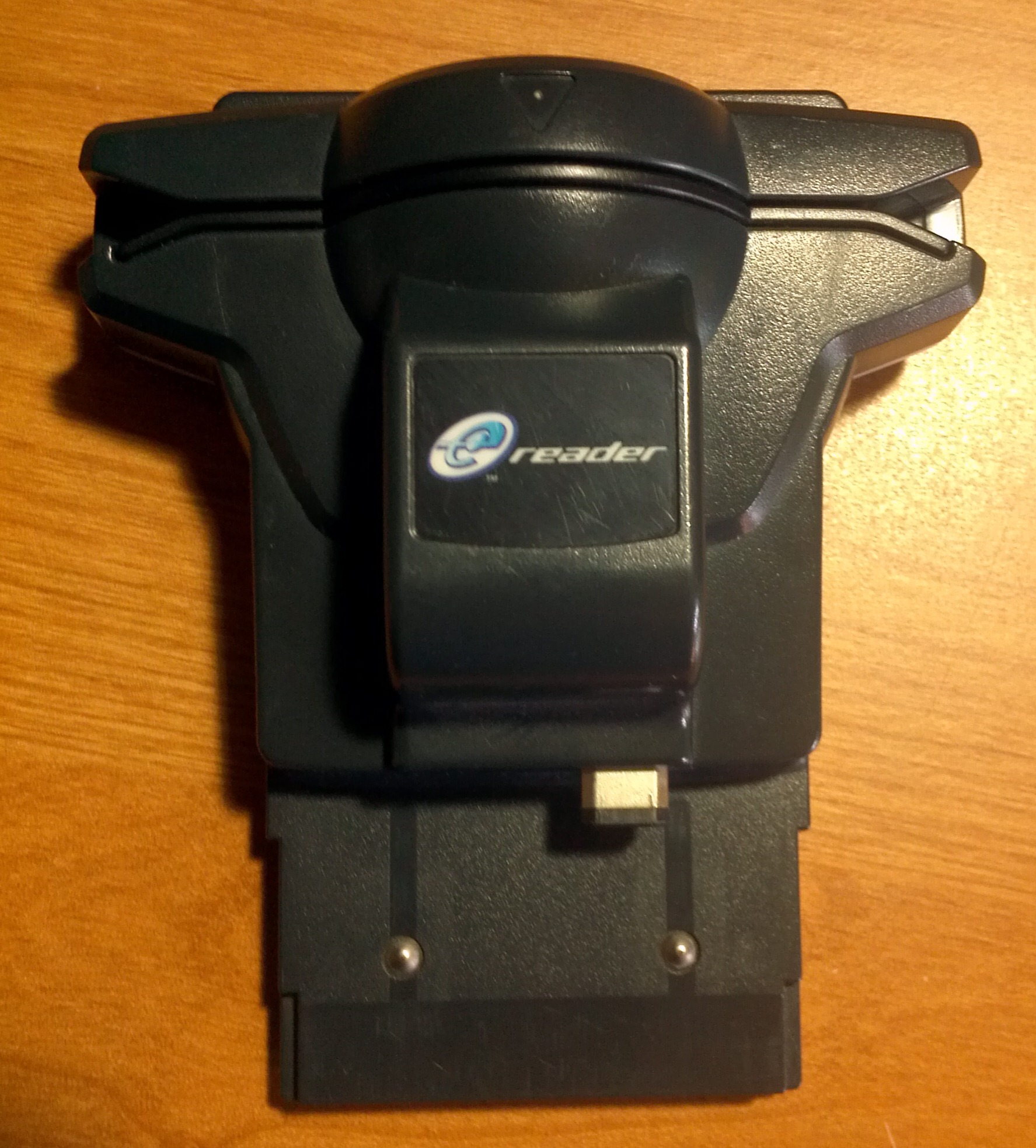
The Nintendo e-Reader, commonly abbreviated as e-Reader, is an add-on manufactured by Nintendo for its Game Boy Advance handheld video game console. It has an LED scanner that reads "e-Reader cards" — paper cards with specially encoded data printed on them as dot codes. It was released in Japan in December 2001 and in North America in September 2002.
Depending on the card and associated game, the e-cards are typically used in a key-like function to unlock secret items, levels, or play mini-games when swiped through the reader. The cards themselves contain data, as opposed to unlocking data already on the device itself.
Two versions were released in Japan: the original Card-e-Reader (カードeリーダー, Kādo-Ī-Rīdā) without a link cable port (released on December 1, 2001), which could read cards to display the data stored on those cards; and the Card-e-Reader+ (カードeリーダー+, Kādo-Ī-Rīdā Purasu) (released on June 27, 2003) which came with a link cable port to connect with GameCube and Game Boy Advance games. Outside of Japan, only a single version was released, the e-Reader, which has the same functionality as the Card-e-Reader+ and was released in North America on September 16, 2002. In Japan, the Card-e-Reader+ was bundled with Animal Forest e+, the enhanced re-release of the GameCube version of Animal Crossing.
The e-Reader can connect via Game Link cable to GameCube games such as Animal Crossing, and Game Boy Advance games such as Pokémon Ruby and Sapphire and Super Mario Advance 4: Super Mario Bros. 3. In order to scan data and send it to a Game Boy Advance game, two Game Boy Advance systems and a Game Link cable are required. The Game Boy Advance system that the e-Reader is connected to uses the Player 1 end, while the other system uses the Player 2 end. After opening the necessary menu in the game, cards can be swiped in the e-Reader to transfer data to the other system. This is not possible with the Nintendo DS due to the system's lack of support for the Game Link cable.
The e-Reader was only considered successful in Japan. In 2004, Nintendo's head European PR confirmed that the e-Reader would not be releasing in Europe, following a year of confusion surrounding the subject. It was discontinued in North America in early 2004, due to a lack of popularity. In Japan, it sold much better and was produced until the discontinuation of the Game Boy hardware line.
In the U.S., e-Reader Card packs have been released that contain:
There have been numerous other games released with e-Reader support in Japan.
Data is encoded on the cards using "dot code", a specialized barcode technology licensed from Olympus Corporation. e-Reader Cards may have one or two sets of dot code on them, either a wide strip on the left side of the card, a wide strip on both the left and right sides of the card, a narrow strip on the bottom of the card or a short strip on the bottom of the card with a long strip on the left side of the card. Smaller games may require scanning only one card (two sets of dot code), while the greater NES games can require as many as five cards (nine to ten sets of dot code) in order to start the application.
Hub AI
Nintendo e-Reader AI simulator
(@Nintendo e-Reader_simulator)
Nintendo e-Reader
The Nintendo e-Reader, commonly abbreviated as e-Reader, is an add-on manufactured by Nintendo for its Game Boy Advance handheld video game console. It has an LED scanner that reads "e-Reader cards" — paper cards with specially encoded data printed on them as dot codes. It was released in Japan in December 2001 and in North America in September 2002.
Depending on the card and associated game, the e-cards are typically used in a key-like function to unlock secret items, levels, or play mini-games when swiped through the reader. The cards themselves contain data, as opposed to unlocking data already on the device itself.
Two versions were released in Japan: the original Card-e-Reader (カードeリーダー, Kādo-Ī-Rīdā) without a link cable port (released on December 1, 2001), which could read cards to display the data stored on those cards; and the Card-e-Reader+ (カードeリーダー+, Kādo-Ī-Rīdā Purasu) (released on June 27, 2003) which came with a link cable port to connect with GameCube and Game Boy Advance games. Outside of Japan, only a single version was released, the e-Reader, which has the same functionality as the Card-e-Reader+ and was released in North America on September 16, 2002. In Japan, the Card-e-Reader+ was bundled with Animal Forest e+, the enhanced re-release of the GameCube version of Animal Crossing.
The e-Reader can connect via Game Link cable to GameCube games such as Animal Crossing, and Game Boy Advance games such as Pokémon Ruby and Sapphire and Super Mario Advance 4: Super Mario Bros. 3. In order to scan data and send it to a Game Boy Advance game, two Game Boy Advance systems and a Game Link cable are required. The Game Boy Advance system that the e-Reader is connected to uses the Player 1 end, while the other system uses the Player 2 end. After opening the necessary menu in the game, cards can be swiped in the e-Reader to transfer data to the other system. This is not possible with the Nintendo DS due to the system's lack of support for the Game Link cable.
The e-Reader was only considered successful in Japan. In 2004, Nintendo's head European PR confirmed that the e-Reader would not be releasing in Europe, following a year of confusion surrounding the subject. It was discontinued in North America in early 2004, due to a lack of popularity. In Japan, it sold much better and was produced until the discontinuation of the Game Boy hardware line.
In the U.S., e-Reader Card packs have been released that contain:
There have been numerous other games released with e-Reader support in Japan.
Data is encoded on the cards using "dot code", a specialized barcode technology licensed from Olympus Corporation. e-Reader Cards may have one or two sets of dot code on them, either a wide strip on the left side of the card, a wide strip on both the left and right sides of the card, a narrow strip on the bottom of the card or a short strip on the bottom of the card with a long strip on the left side of the card. Smaller games may require scanning only one card (two sets of dot code), while the greater NES games can require as many as five cards (nine to ten sets of dot code) in order to start the application.