Hubbry Logo
search
logo
2206724

Nintendo e-Reader

logo
Community Hub0 Subscribers
Read side by side
from Wikipedia
Nintendo e-Reader
ManufacturerNintendo
TypeAdd-on
ReleasedCard e-Reader
Card e-Reader+ / e-Reader
Discontinued

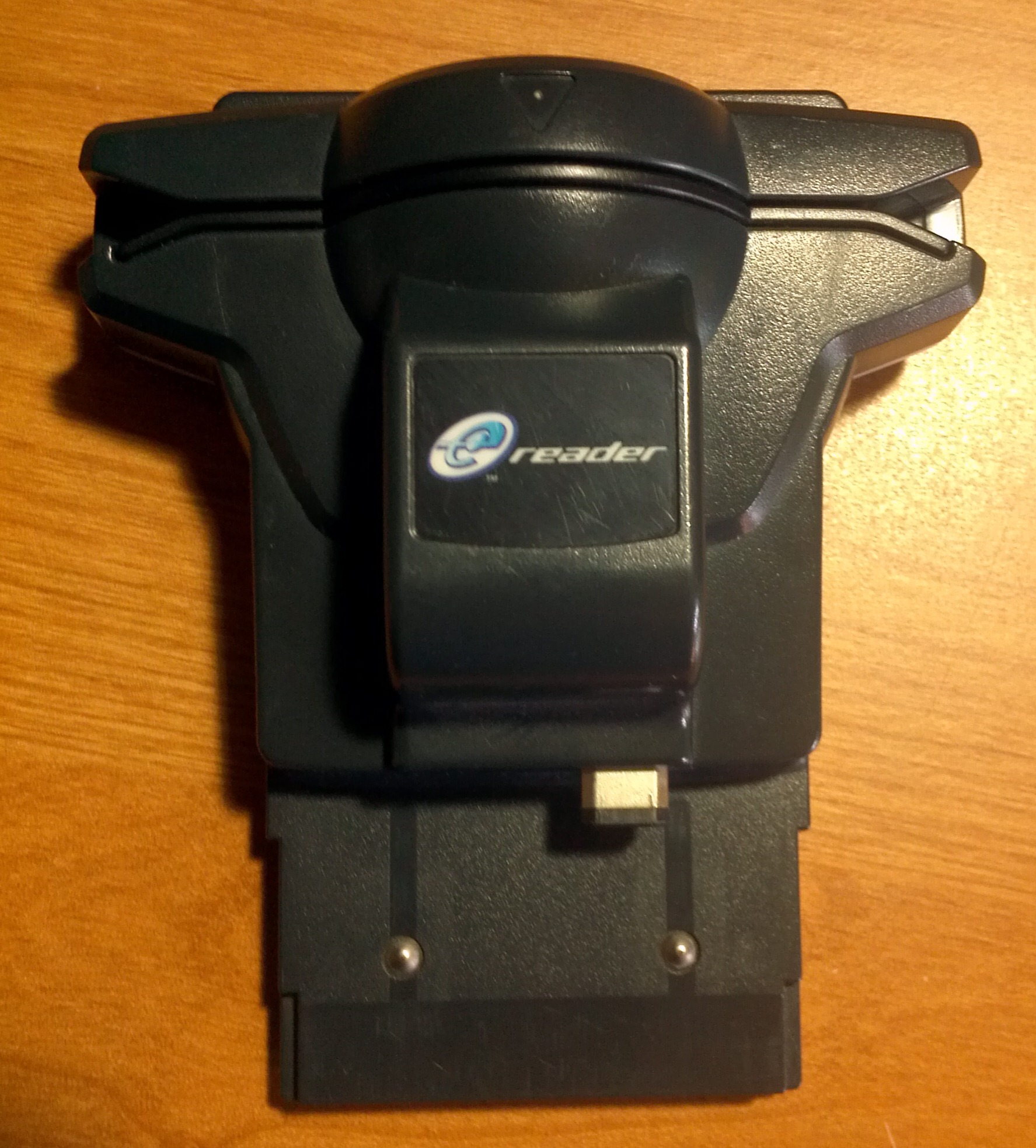
The Nintendo e-Reader,[a] commonly abbreviated as e-Reader, is an add-on manufactured by Nintendo for its Game Boy Advance handheld video game console. It has an LED scanner that reads "e-Reader cards" — paper cards with specially encoded data printed on them as dot codes. It was released in Japan in December 2001 and in North America in September 2002.

Depending on the card and associated game, the e-cards are typically used in a key-like function to unlock secret items, levels, or play mini-games when swiped through the reader. The cards themselves contain data, as opposed to unlocking data already on the device itself.

Usage and versions

[edit]

Two versions were released in Japan: the original Card-e-Reader (カードeリーダー, Kādo-Ī-Rīdā) without a link cable port (released on December 1, 2001[1]), which could read cards to display the data stored on those cards; and the Card-e-Reader+ (カードeリーダー+, Kādo-Ī-Rīdā Purasu) (released on June 27, 2003[2][3]) which came with a link cable port to connect with GameCube and Game Boy Advance games. Outside of Japan, only a single version was released, the e-Reader, which has the same functionality as the Card-e-Reader+ and was released in North America on September 16, 2002.[4] In Japan, the Card-e-Reader+ was bundled with Animal Forest e+, the enhanced re-release of the GameCube version of Animal Crossing.[2]

The e-Reader can connect via Game Link cable to GameCube games such as Animal Crossing, and Game Boy Advance games such as Pokémon Ruby and Sapphire and Super Mario Advance 4: Super Mario Bros. 3. In order to scan data and send it to a Game Boy Advance game, two Game Boy Advance systems and a Game Link cable are required. The Game Boy Advance system that the e-Reader is connected to uses the Player 1 end, while the other system uses the Player 2 end. After opening the necessary menu in the game, cards can be swiped in the e-Reader to transfer data to the other system. This is not possible with the Nintendo DS due to the system's lack of support for the Game Link cable.

The e-Reader was only considered successful in Japan. In 2004, Nintendo's head European PR confirmed that the e-Reader would not be releasing in Europe, following a year of confusion surrounding the subject.[7] It was discontinued in North America in early 2004, due to a lack of popularity.[6] In Japan, it sold much better and was produced until the discontinuation of the Game Boy hardware line.[6]

e-Reader cards

[edit]
e-Reader card, showing the dot code at the bottom

In the U.S., e-Reader Card packs have been released that contain:

  1. NES games
  2. New levels and power-ups for Super Mario Advance 4: Super Mario Bros. 3
  3. Items and designs for Animal Crossing
  4. New trainers to battle in Pokémon Ruby and Sapphire
  5. Mini-games, including an exclusive version of Mario Party.
  6. Game & Watch Cards; originally there were plans to release more Game and Watch games as a series of E-reader cards. Only Manhole-e was officially released.

There have been numerous other games released with e-Reader support in Japan.

Dot code

[edit]

Data is encoded on the cards using "dot code", a specialized barcode technology licensed from Olympus Corporation. e-Reader Cards may have one or two sets of dot code on them, either a wide strip on the left side of the card, a wide strip on both the left and right sides of the card, a narrow strip on the bottom of the card or a short strip on the bottom of the card with a long strip on the left side of the card. Smaller games may require scanning only one card (two sets of dot code), while the greater NES games can require as many as five cards (nine to ten sets of dot code) in order to start the application.

The shorter sets of dot code were only used with the Pokémon Trading Card Game. Cards released in regular sets published by both Nintendo and Wizards of the Coast had a dot code on the bottom side of the card. When scanned, the e-Reader displayed a Pokédex data entry for the Pokémon shown on the card. Many of the cards published by Wizards of the Coast included a left side dot code that would allow users to play mini-games, animations, and use secret attacks in the Trading Card Game or play with various songs and graphics.[citation needed]

Compatibility

[edit]
The e-Reader plugged into a Game Boy Advance SP

The e-Reader plugs into the cartridge slot of the Game Boy Advance like a regular game would. The end of the e-Reader sticks out from the Game Boy Advance unit to provide a slot to scan the e-Reader Cards. Electronically, the e-Reader is compatible with any console that supports Game Boy Advance games, but it may be mechanically incompatible with some systems (it simply does not fit), and the ability to link consoles may not be available.

Once installed, the link cable connector on the Game Boy Advance is obstructed, but a pass-through connection on the e-Reader allows link-up features to be used. The Game Boy Advance SP is also fully compatible, although the e-Reader does not mount flush with the SP. As the link cable connector on the SP is unobstructed, the pass-through on the e-Reader is not used. An additional cover (AGB-016) can be added to the e-reader in order to avoid damaging the 6 pin connector when linked to a GBA SP.[citation needed]

The Game Boy Player is also fully compatible, and the e-Reader connects as it would to a Game Boy Advance (the e-Reader pass-through connector is used for connecting the link cable). The GameCube hosting this system acts as a Game Boy Advance - in order to link to a GameCube game, a second GameCube (or a Wii) running the game in question, must be used.

The e-Reader can fit into the DS Lite, but not the original DS. The e-Reader can, however, be modified to fit into the original DS. In either case, there is no support for linking features, as neither system has a link cable port.

The e-Reader fits into the Game Boy Micro and has a link cable port, but not a standard connector. A special Game Boy Micro Game Link Cable must be used for linking features.[8] The Game Boy Micro's non-standard link cable port can not accept the GameCube Game Boy Advance Cable, meaning it cannot link with GameCube games without modification to the cable.[citation needed]

Because the first version of the Japanese e-Reader did not have a link cable pass-through connector, it can fit into consoles which the later e-Readers are incompatible with. Even though the Game Boy Advance and the DS are region-free, Japanese e-Reader cards work only on Japanese e-Readers and North American e-Reader cards will only work on North American e-Readers. The system will display 'region error' on both systems if a user attempts to use another region's cards on their own device.

Game list

[edit]

Classic NES Series

[edit]

Each game in this series comes in a pack of five cards, each of which must be scanned twice, on both sides. There are thirteen games in this series; each is a direct port of the one-player mode of the classic NES game of the same title (minus the added "-e" suffix), with multiplayer functions removed. Several games released as e-Reader cards were later released in cartridge form as part of the Classic NES Series on Game Boy Advance, while all games except Urban Champion were included as unlockables in the GameCube game Animal Crossing, which could also be played on Game Boy Advance through the "Advance Play" feature.[9][10][11][12]

All NES titles released include:

Animal Crossing-e

[edit]

A series of Animal Crossing cards were released for the e-Reader. When used with the post office in the game, the cards could provide items to players, unlock "town tunes", or unlock new designs to be used around the village. Some were "sibling" cards (series 2–4) with two related characters on the front. In addition to being sold in card packs, some regular series cards were distributed on a promotional basis through GameStop, EB Games, and Energizer batteries.

Pokémon Battle-e

[edit]

The Pokémon Battle-e Cards, when scanned into Pokémon Ruby or Sapphire, allowed the player to load up special trainers to battle or to get special berries. In Japan, the series was sold as six sets, each with a different theme, with 10 cards in each set (8 trainers, 1 berry, and 1 checklist), while in the US, the series was packaged together to have two themes per pack. In addition, 2 promo cards, 1 for each version, were packed in with the games. The cards are loaded into Ruby or Sapphire through the Mystery Events function once it is unlocked.

There were additional Battle-e card sets for Pokémon FireRed, LeafGreen and Emerald in Japan, but due to the e-Reader being discontinued in the US they were never released in other regions. The e-Reader functionality was eventually removed from all non-Japanese versions of the games.[citation needed]

Pokémon Colosseum

[edit]

In Pokémon Colosseum, there is a Colosseum at the back of Phenac City. There are two large doors, which in the English version lead to the same arena. In the Japanese version the right door goes to the arena, while the left door leads to a special e-Reader area where players can scan in extra cards to battle additional trainers and capture three more Shadow Pokémon.[citation needed]

Pokémon Pinball: Ruby & Sapphire

[edit]

There were five cards that were released that were compatible with the Japanese version. These cards make minor tweaks to the gameplay, but do not add any new features.

Card ID Card title Card effect Promotion
09‑A001 Bonus Stage Card Allows players to play the bonus stage of their choice. Pokémon Scoop (Summer 2003); Pokémon Festa 2003
09-A002 GET Special Guests Card Unlocks one of the following Pokémon for capture: Chikorita, Cyndaquil, Totodile or Aerodactyl. Demo cards placed in selected stores in Japan throughout September 2003 (not for distribution).
09‑A003 Ruin Area Card Allows players to start their games from the Ruins. Distributed to customers who purchase the game at Pokémon Centers.
09‑A004 DX Mode Card Allows players to start with 9 balls (lives), Master Ball and 99 coins; in addition, Pichu rescuer will always be enabled throughout the game. Distributed to customers who purchase the game at Pokémon Centers.
09‑A005 Encounter Rate UP Card The likelihood of encountering Chikorita, Cyndaquil, Totodile and Aerodactyl increases. Distributed to customers who purchase the game at Pokémon Centers.

Super Mario Advance 4: Super Mario Bros. 3-e

[edit]

There are 36 cards, divided into two series: 18 for Series 1 and 18 for Series 2. In each package of 18 cards there are five demo cards, five level cards, eight power-up cards, and a promotional card without data strips which only contains an advertisement for the Pokémon Battle-e cards. More were released in Japan, but they never saw American release due to the discontinuation of the device.

Two promotional cards came packed in with every US and Australian copy of the game sold. Five additional cards were released for a very short time and were packed in with the game and sold exclusively at Walmart stores in the US. These five cards have become extremely hard to find, as the e-Reader had been discontinued in North America not long after the release of the game. The two e-Reader cards that were initially bundled with Super Mario Advance 4 have since been discontinued.

The Virtual Console rerelease of the game for Wii U and the Nintendo Switch Online release include all of the e-Reader levels, including those that were never released outside of Japan.[13]

Mega Man Battle Network and Mega Man Zero 3 cards

[edit]

The Japanese Mega Man games for GBA used Card Reader e+ cards to customize their game with the e-Reader +. The cards caused various effects as, such as Base HP, Abilities, Buster Changes, Charge Shot Modifications, B+ Back Abilities. There are even Item Cards which can give out sets of Battle Chips, Sub Chips, BugFrags, Zenny, and even Navi Customizer Programs (only introduced in Mega Man Battle Network 6 Modification Card Part 1 & Battle Network 6 Modification Card Part 2). They could also cause negative effects ('Bugs') to happen, causing such effects as causing Mega Man to lose health and move the wrong way, or causing the player to be unable to control it. As for the Mega Man Zero 3 cards, they change the Resistance Base and add an overhaul of new things to it as well as Weapon Upgrades and Bullet Appearances to make an actual Buster Shot look like a real bullet that an actual gun fires.

The only way to gain the cards' effects in the English versions is through various cheating devices, such as Code Breaker, Action Replay and GameShark (although in Battle Network 6 all e-Reader content was removed from the European and American versions, and can no longer be accessed). The Mega Man Zero Collection, Mega Man Zero/ZX Legacy Collection, and Mega Man Battle Network Legacy Collection releases include the e-Reader bonuses for Mega Man Zero 3 and Battle Network 46 as unlockables, marking the first time they have been legitimately accessible outside of Japan.[14][15][16]

F-Zero: GP Legend

[edit]

Exclusive to the Japanese version, e+ cards could be used to unlock additional machines, race courses, and staff ghosts to race in the game's time trial mode.

Other

[edit]
  • E3 2002 Promo Pack: A very rare promotional pack given away at the 2002 E3 conference, this pack contained a variant Manhole e-card, two Pokémon trading card game cards and a Kirby card that, when scanned, would tell the player if they have won a prize. The Kirby card is considered to be the rarest e-Reader card produced.[citation needed]
  • Mario Party-e: A complete card game with 64 cards using the e-Reader for minigames.
    • Mario Party-e Promo Card: While not an e-Reader Card (the card contains no dot codes), a promotional "Two Coin Card" was packed with GamePro magazine and can be fully used with the Mario Party-e game.
  • Air Hockey-e: A promotional card given away at various retailers when the e-Reader was initially released. This card plays a real game of fast-paced air hockey. An AU-exclusive version of this card was packed in with the e-Reader when sold in Australia.
  • Manhole-e: A port of the original Game & Watch game. Included with the e-Reader, the player must close the manholes as pedestrians pass by. A complete Game & Watch card series was planned for release, including remakes based on those seen in the Game & Watch Gallery series, but never made it to stores.[17]
  • FoxBox Kirby Slide Puzzle: A slide puzzle game included in issue 175 of Nintendo Power and in an issue of Tips & Tricks Magazine. It was also given away with FoxBox promotional boxes at Toys R Us.
  • EON Ticket: A promotional card given away at E3, at Toys R Us during the EON Ticket Summer Tour in 2003 and in issue 173 of Nintendo Power. This card was used to get Latias or Latios on Pokémon Ruby or Pokémon Sapphire by allowing the player access to the Southern Island location. Latias was given in the former and Latios was given in the latter.
  • Pokémon Channel: Three US exclusive cards and three Australian variant cards were released with the GameCube game Pokémon Channel. The USA version holds a "6-Pattern" card, a Pikachu card and a Kyogre card, whereas the Australian version has a Jirachi card, instead of the Kyogre card.
  • Domo-Kun no Fushigi Terebi: Released in packs exclusively throughout Japan, little is known about this series to English-speakers. The cards extended the original title by a great number of mini-games and events not available on the cartridge.
  • Mario vs. Donkey Kong: CoroCoro Comic had a competition where 1,000 people won a set of five cards, and a sixth was distributed at the 2004 Next-Generation World Hobby Fair. Despite there being data for twelve levels within the game, only these six cards were released. They are considered to be among the rarest of e-Cards. While connecting the North American version of the game to a Japanese e-Reader+ and fully scanning one of the cards will reveal the e-Reader menu, the cards cannot be used to unlock any levels, but all versions of the GBA game have the data for these 12 levels, unlockable via Action Replay codes.
  • Pikmin 2-e: Exclusive to Japan, six packs of e-Reader minigames were released subsequent to the release of Pikmin 2. These games challenge players to pluck all the Pikmin in an area in a set amount of steps, to try to get Pikmin from one point to another without injury, etc. The cards contain region-specific encoding blocking their use with North American systems.

Summary

[edit]
Title Type Release Year
Air Hockey-e Game 2002
Animal Crossing-e[18] Data 2003
Classic NES Series: Balloon Fight[19] Game 2002
Classic NES Series: Baseball Game 2002
Classic NES Series: Clu Clu Land[20] Game 2003
Classic NES Series: Donkey Kong Game 2002
Classic NES Series: Donkey Kong 3[21] Game 2003
Classic NES Series: Donkey Kong Jr.[22] Game 2002
Classic NES Series: Excitebike[23] Game 2002
Classic NES Series: Golf[24] Game 2003
Classic NES Series: Ice Climber Game 2002
Classic NES Series: Mario Bros. Game 2002
Classic NES Series: Pinball[25] Game 2002
Classic NES Series: Tennis[26] Game 2002
Classic NES Series: Urban Champion Game 2002
Domo-kun Card-e[27] Game 2003
Eon Ticket e-Card Data 2003
F-Zero: GP Legend (e-Reader cards)[28][29] Data 2003
Hamtaro Card-e[30] Game 2003
Kirby Slide Game 2003
Manhole[31] Game 2002
Mario Party-e[32] Game 2003
Mario vs. Donkey Kong (e-Reader cards)[33] Data 2004
Pikmin 2-e[34] Game 2004
Pokémon Aquapolis[35] Game 2003
Pokémon Battle-e[36] Data 2003
Pokémon Channel (e-Reader cards) Data 2003
Pokémon Expedition[37] Game 2002
Pokémon Pinball: Ruby & Sapphire (e-Reader cards) Data 2003
Pokémon Skyridge[38] Game 2003
Rockman Zero 3 Kaizou (Modification) Cards[39] Data 2004
Rockman.EXE 4 Kaizou (Modification) Cards[40] Data 2004
Rockman.EXE 5 Kaizou (Modification) Cards[41] Data 2004
Rockman.EXE 6 Kaizou (Modification) Cards[42] Data 2004
Super Mario Advance 4: Super Mario Bros. 3-e Data 2003


Notes

[edit]

References

[edit]
[edit]
Revisions and contributorsEdit on WikipediaRead on Wikipedia
from Grokipedia
The Nintendo e-Reader is a peripheral accessory manufactured by Nintendo for the Game Boy Advance handheld console, designed to scan and load interactive content from special cards printed with two-dimensional dot codes, a barcode-like technology licensed from Olympus Optical Co., Ltd.[1][2] Released initially in Japan on December 1, 2001, it expanded gameplay possibilities by allowing users to swipe cards through an integrated slot for quick data transfer, enabling portable access to mini-games, animations, and unlockable features in compatible titles.[3] In North America, the e-Reader launched on September 16, 2002, bundled with a starter pack including one classic Nintendo game (such as five Donkey Kong Jr.-e cards or five Pinball-e cards), one Game & Watch Manhole-e card, three Pokémon Trading Card Game-e cards, and one Animal Crossing-e card, priced at $39.95.[4] The device connects directly to the Game Boy Advance's Game Pak slot and supports optional linkages to another Game Boy Advance via Game Link cable or to the Nintendo GameCube via Game Boy Advance cable for enhanced multiplayer or data-sharing experiences in supported software.[1] Its card library encompassed diverse content, from original e-Reader exclusives to ports of classic NES titles like Balloon Fight, Tennis, and Excitebike—sold separately in packs of five for $4.95 each—and integrations with major franchises, notably unlocking additional stages and items in games such as Super Mario Advance 4: Super Mario Bros. 3.[4][2] The e-Reader's innovative use of physical cards for digital content delivery marked an early experiment in hybrid media for portable gaming, though its reliance on separate card purchases limited widespread adoption despite critical interest in its novel scanning mechanism and expansive potential for user-generated or promotional expansions.[1][2] A revised model, the Card e-Reader Plus with added Game Link Cable passthrough, was introduced in Japan on June 23, 2003, to improve compatibility, and the accessory was also released in Australia on October 31, 2003.[3][5]

History and development

Conception and design goals

In the late 1990s, the concept for the Nintendo e-Reader originated from Creatures Inc., a key developer in the Pokémon franchise, as a means to enhance physical trading card games with digital interactivity. Inspired by the popularity of the Pokémon Trading Card Game, which emphasized collecting and trading among younger players, Creatures sought to embed "invisible value" into cards by encoding data that could unlock games, animations, and other content on a handheld device. This idea aligned with Nintendo's broader early 2000s strategy to foster connectivity between tangible media like cards and digital gaming experiences, encouraging repeat purchases through affordable card packs while appealing to children and families.[6] Development accelerated around 2000 under Nintendo's internal teams in collaboration with Creatures Inc., HAL Laboratory, and Olympus Optical Co., with a key patent filed on May 29, 2000, for the dot code scanning technology. HAL Laboratory's Kazuhiko Fukuda led the creation of the first prototype, completed in just five months and unveiled in March 2001 at an event in Tokyo's Odaiba district. The initial design focused on seamless integration with the Game Boy Advance, positioning the e-Reader as a compact cartridge-based peripheral that attached without altering the console's form factor, while prioritizing expandability through additional memory and software compatibility to support evolving content libraries.[6][7] Key design goals emphasized affordability and accessibility, with the device priced at a manufacturer-suggested retail price of $39.95 in North America upon its 2002 launch, comparable to a standard GBA game cartridge. This pricing aimed to make it an attainable add-on for extending the GBA's lifespan via low-cost card expansions, rather than a standalone product. The e-Reader was publicly announced at Nintendo's Space World event in August 2001 in Japan, where it was demonstrated as the "Card e-Reader" in partnership with Olympus, highlighting its role in delivering a novel entertainment form by merging paper-based cards with interactive GBA gameplay, starting with the Pokémon Card★e series. Nintendo positioned it as an innovative software distribution method, distinct from traditional discs or memory cards, to "propose an entirely new entertainment experience."[7][8]

Release timeline and regional versions

The Nintendo e-Reader, known as the Card e-Reader in Japan, launched on December 1, 2001, bundled with initial e-cards and featuring the basic V1 model with 8KB RAM.[9] The device was priced at ¥3,800 in Japan at launch.[5] In North America, the e-Reader was released on September 16, 2002, at a retail price of $39.95, with initial distribution handled exclusively through Toys "R" Us stores.[4] It included a starter pack containing one classic Nintendo game (five Donkey Kong Jr.-e or Pinball-e cards), one Game & Watch Manhole-e card, three Pokémon Trading Card Game-e cards, and one Animal Crossing-e card, to introduce users to the system's functionality.[4] A European release was planned for early 2004 but ultimately, Nintendo canceled the launch entirely in July 2004, citing insufficient market potential.[10] An Australian release occurred later on October 31, 2003.[5] Hardware iterations evolved to address user feedback and expand capabilities. The V2 model, released in 2002 for both Japan and North America, incorporated 32KB of flash memory to enable saving game progress, along with Game Link Cable support for connectivity.[11] In Japan, the revised Card e-Reader+ model launched on June 23, 2003, with Game Link Cable passthrough and 32KB flash memory, further enhancing compatibility.[3] Nintendo discontinued the e-Reader outside Japan in early 2004, attributed to modest adoption rates.[12] Promotional efforts included tie-ins such as free e-cards bundled with Game Boy Advance systems in 2002 to boost awareness and card distribution.[13]

Design and technology

Hardware components and specifications

The Nintendo e-Reader is a compact add-on device constructed from white plastic, designed to insert directly into the Game Boy Advance's cartridge slot for secure attachment. It measures approximately 92 mm in length, 60 mm in width, and 15 mm in thickness, weighing about 50 g, making it lightweight and unobtrusive for portable use. The unit includes a flip-up lid that protects the scanning slot when not in use and exposes an array of LEDs for illuminating and reading the dot codes on e-Reader cards during operation.[14] Internally, the e-Reader incorporates Nintendo's custom processor for real-time decoding of scanned data, along with memory components that vary by version: the initial Japanese Card e-Reader features 8 KB of RAM without flash storage, while the international e-Reader and Japanese Card e-Reader + include 64 KB of RAM and 128 KB of flash memory to support temporary storage of applications or full NES ROMs. The core scanning mechanism relies on an infrared LED array capable of resolving dot codes with a precision of approximately 0.3 mm per dot, enabling efficient data extraction at speeds of 100 to 200 cards per minute under optimal conditions.[15][11] The device draws all necessary power from the connected Game Boy Advance's battery or an optional AC adapter, consuming minimal energy without requiring its own batteries. Connectivity is facilitated through a built-in pass-through serial port on the international e-Reader and Japanese Card e-Reader + that maintains access to the GBA's link cable functionality for multiplayer gaming, alongside an external extension connector compatible with GameCube-GBA cables for cross-platform data transfer.[1] Manufactured in China by electronics firm Hosiden under contract for Nintendo, the e-Reader's production costs were estimated at $5 to $7 per unit, which contributed to its affordable retail pricing of $39.95 for the bundled starter pack upon launch in North America.[16][4]

Dot code scanning mechanism

The Nintendo e-Reader employs a proprietary dot code system, a high-density two-dimensional barcode technology licensed from Olympus Optical Co., Ltd., which encodes digital data as patterns of small black dots printed on a white background.[17] This format structures data into vertical strips along the edges of e-Reader cards, with each strip divided into multiple blocks containing lines of dots that represent binary information through modulation schemes, such as converting 4-bit data into 5-bit dot patterns for efficient encoding.[18] A typical long strip comprises 28 blocks, enabling a total capacity of 2,912 bytes, while shorter strips hold 1,872 bytes; this allows for the storage of compressed game assets like sprites and audio samples across multiple strips on a single card.[18][19] The scanning process begins as the user swipes the card through the e-Reader's slot, where an integrated LED illuminates the dot code strip to enhance contrast.[20] A contact image sensor, functioning as a linear array of photodiodes, captures the reflected light from the dots, converting the optical patterns into electrical signals that are then digitized into binary data.[15] The device's onboard decoding algorithm processes this raw input by first identifying synchronization marks—unique dot patterns at the edges and within blocks of the strip—to align the scan and correct for any misalignment or skew during swiping.[18][21] Pattern recognition techniques then demodulate the dot sequences, applying error detection via checksums and correction to handle noise, printing imperfections, or minor physical damage.[15] Dot codes incorporate Reed-Solomon error correction codes, allocating 16 bytes of redundancy per 64-byte data fragment (48 data bytes plus 16 error-correction bytes), which provides approximately 25% overhead for recovering from errors such as missing or distorted dots.[18] This interleaving across blocks enhances robustness, allowing the system to tolerate significant degradation in the printed pattern while maintaining data integrity. Data is further optimized through Nintendo's custom VPK compression algorithm, a variant of LZ-based methods that reduces file sizes to fit multimedia elements like graphics and sound within the limited strip capacity.[15][22] Compared to contemporary alternatives like QR codes, the dot code format offers greater compactness for equivalent data volumes, as its linear strip design and efficient modulation enable denser packing on narrow card edges without requiring larger two-dimensional areas.[18] It also demonstrates superior resistance to wear and environmental damage, thanks to the interleaved Reed-Solomon implementation, and supports low-cost printing on standard cardstock using common inkjet or laser printers, provided they achieve sufficient resolution (around 342 DPI).[21][18] These attributes made it well-suited for distributing interactive content via disposable trading cards in the early 2000s.[20]

Functionality and usage

Basic operation and card reading

To use the Nintendo e-Reader, users first insert the device into the Game Boy Advance's cartridge slot on the top of the console while the GBA is powered off. Once inserted, the GBA is powered on, displaying the e-Reader's title screen. Pressing the A button accesses the main menu, where the directional pad (+ Control Pad) navigates to the "Read Card" option, and pressing A confirms the selection to enter scanning mode.[23] The card reading process begins by holding an e-Reader card with its dot code side facing the scanner and sliding it evenly through the device's slot, ensuring the card remains flat against the bottom. An on-screen animation guides proper alignment and insertion speed to avoid errors. The scan typically completes in 1-2 seconds per card, with the GBA screen providing visual feedback: a success message appears if the data loads correctly, allowing users to press A to proceed or B to scan additional cards if required for multi-card content. If a "READ ERROR" occurs due to misalignment, excessive speed, or lighting issues, the user simply removes and re-inserts the card for another attempt. The dot code system incorporates built-in error correction to tolerate minor imperfections during scanning.[23][24] Upon successful loading, the e-Reader's content—such as mini-games—runs directly on the GBA's screen, controlled via the console's standard buttons and directional pad. These mini-games are designed for brief play sessions, often lasting a few minutes, emphasizing quick, self-contained experiences. The entire process operates offline, requiring no external connections or internet access for card reading or playback.[23][25]

Memory expansions and content storage

The initial version of the Nintendo e-Reader, known as V1 and released in Japan in December 2001, lacked dedicated persistent storage for user data, relying instead on the Game Boy Advance's RAM to temporarily load data from a single scanned card. Without a save function, all loaded content—such as mini-games or story segments—was erased upon power-off, limiting usage to one-time playback sessions.[6] Subsequent iterations addressed these constraints through hardware upgrades. The V2 model, launched in North America in September 2002 and featuring 128 KB of flash memory, enabled persistent storage of multiple cards, while also introducing save states to track progress in serialized stories across multi-card series. The V3 variant, released in Japan in June 2003 with 128 KB of flash memory, expanded this capacity further and supported enhanced retention for ongoing narratives like adapted NES titles. These upgrades transformed the e-Reader from a transient reader into a portable content manager. Note that while some technical documentation indicates the V1 may have had 64 KB of internal flash, it was not utilized for user-persistent storage.[26][6][27] Memory in V2 and V3 models was organized into blocks for efficient allocation, allowing users to selectively erase, overwrite, or reload saved data through an intuitive menu interface. This block-based system, with the non-volatile flash memory, ensured data integrity for extended periods under normal conditions, preventing loss from power cycles or disconnections.[26] To facilitate content sharing and expansion, the link port (added in V2 and V3) allowed cabled data transfers via Game Link Cable between multiple e-Readers or directly to compatible Game Boy Advance titles, enabling collaborative loading of saved mini-games or story continuations without rescanning cards. Complementing this, bundled packs delivered educational content—including math puzzles, language exercises, and interactive lessons—that users could download and store persistently, integrating learning modules into the e-Reader's ecosystem for repeated access.[26][6]

Compatibility and integrations

Core Game Boy Advance support

The Nintendo e-Reader integrates directly with the Game Boy Advance by inserting into the system's Game Pak slot, effectively overlaying the standard GBA menu with its own interface for accessing scanned card content. This connection allows the e-Reader to utilize the GBA's core hardware, including its processor and display, to run loaded applications without requiring separate power sources beyond the GBA's batteries or AC adapter. Installation involves powering off the GBA, aligning the e-Reader with the slot, and pressing it firmly until it clicks into place, after which the system boots to the e-Reader's title screen upon powering on.[1] The device maintains compatibility with the original Game Boy Advance and the backlit GBA SP, though adaptations are needed for the latter to enable full operation, including card scanning. On the GBA SP, card scanning requires connecting a Game Boy Advance Link Cable from the e-Reader's external extension port (EXT.1) to the SP's link port, as the SP lacks a direct passthrough for the e-Reader's scanning mechanism. It is not compatible with the compact GBA Micro due to the latter's slot design. The e-Reader is partially compatible with the Nintendo DS and DS Lite, allowing playback of pre-loaded content via the GBA slot, but scanning new cards is not possible.[17][6] Operation relies on the GBA's input hardware, with the D-pad and A/B buttons used for menu navigation, game selection, and controlling loaded mini-games or emulated titles from scanned cards. No additional peripherals like a stylus are required, as all interactions occur via the standard GBA controls, ensuring intuitive use within the handheld ecosystem. The e-Reader's software is designed for backward compatibility, enabling scanned data to integrate with subsequent GBA titles that support e-card functionality, such as unlocking content or features in later releases.[1] Emulation and audio processing occur at full hardware speed using the GBA's 32-bit ARM processor, delivering lag-free performance for NES and Game & Watch content derived from dot codes. Sound output integrates seamlessly with the GBA's built-in audio chip, reproducing chiptune effects and music directly from the decoded card data without external enhancements. Firmware enhancements, when available, were provided through compatible e-Reader cards to expand support for new content types, maintaining alignment with evolving GBA software.[12]

Expansions for GameCube and other titles

The e-Reader expanded gameplay in select Game Boy Advance titles by allowing users to scan special cards and transfer data via the device's link port or in-game mechanisms, unlocking bonus content such as new characters, items, or challenges. In Animal Crossing, for instance, e-Reader cards enabled the import of villagers, town tunes, and custom design patterns that could be applied to furniture and clothing, enhancing personalization and town-building options. These expansions required compatible card sets, often sold in booster packs of six cards each, which players scanned at dedicated in-game stations like the post office's e-Reader Transfer Machine.[28][29] For GameCube integration, the e-Reader connected directly to the console using the official Nintendo GameCube–Game Boy Advance Link Cable, enabling card-scanned data to unlock features in supported titles when the e-Reader was attached to a GBA unit. This setup, detailed in the device's manual, required compatible GameCube discs marked with the e-Reader icon and often involved scanning multiple cards sequentially during gameplay to access animations, items, or battles. In Pokémon Colosseum, Battle e cards provided access to the Card e Room, where players could engage in virtual double battles against AI trainers featuring unique Pokémon lineups; completing sets at varying difficulties unlocked rare shadow Pokémon, including Togepi, Mareep, and Scizor, adding post-game depth to the purification mechanics.[1][30] Card sets for these expansions, known as Connect Packs or themed booster packs typically containing 3 to 6 cards, were tailored to specific games and often required the e-Reader to remain inserted for data transfer. The Japanese e-Reader+ model, released in June 2003 with an integrated link port, supported these connections without additional adapters and introduced limited multiplayer data sharing via cable, though full wireless functionality relied on separate GBA accessories. In Japan, a 2003 bundle pairing the e-Reader+ with the enhanced GameCube title Doubutsu no Mori e+ (Animal Crossing) significantly increased adoption, contributing to over 386,000 units sold for the game by late 2005 and extending the peripheral's viability in the region.[31][32] Official support for e-Reader expansions and card production ended in the mid-2000s, with discontinuation in North America in 2004 while Japan saw limited continuation thereafter.[6]

Content library

Exclusive e-Reader mini-games

The Nintendo e-Reader featured a selection of original mini-games designed exclusively for the peripheral, distinct from adaptations of classic titles or expansions for other franchises. These standalone experiences were encoded directly onto e-Reader cards using dot code technology, allowing users to load and play them on the Game Boy Advance without requiring additional software. Examples include promotional titles distributed at launch and dedicated series that emphasized quick, engaging sessions suited to the device's portable nature.[33][1] Promotional mini-games provided additional original content, often given away at retailers to demonstrate the e-Reader's capabilities. Air Hockey-e delivered a fast-paced, competitive action game where players controlled paddles to score against an opponent, supporting single-player or two-player modes via link cable. Similarly, Kirby Slide (also known as Do the Kirby Slide or Kirby Puzzle) offered a puzzle adventure in which users rearranged sliding tiles to form a complete image of Kirby inhaling an object, promoting simple problem-solving in brief playthroughs. These titles showcased varied gameplay styles, from real-time action to tile-based puzzles, and utilized the Game Boy Advance's full-color display by decoding sprite and background data from the cards' dot codes.[25][34] The Game & Watch-e series introduced original recreations inspired by Nintendo's early handheld LCD games, though only Manhole-e was fully released in the West as a standalone entry. This platformer challenged players to navigate a worker avoiding falling manhole covers, with progression across levels encoded on multiple cards that needed sequential scanning. Distributed primarily in Japan with limited Western availability, it highlighted educational and arcade-style themes through precise timing mechanics. Overall, these exclusives emphasized bite-sized entertainment, with some requiring sets of cards for continued story or level progression, fostering collection and replay value.[35] e-Reader cards containing these mini-games were sold in packs priced between $1.99 and $2.99, varying by the number of cards included—typically three to five per pack for complete experiences. Rarer promotional variants, such as holographic versions bundled with magazines or events, added collectible appeal and were often distributed free at stores during the 2002 launch. Japanese releases expanded on this with region-specific exclusives, though many core mechanics relied on the dot code system's ability to encode compact, high-fidelity graphics and sound for immersive short-form play.[33]

Adaptations of classic NES titles

The Nintendo e-Reader facilitated the adaptation of classic Nintendo Entertainment System (NES) titles for the Game Boy Advance through a series of e-cards in the Classic NES Series, enabling portable play of full games via dot code scanning. Launched in North America starting September 16, 2002, the series included 7 titles there (out of 13 total across regions), such as Balloon Fight, Donkey Kong, Donkey Kong Jr., Excitebike, Ice Climber, Pinball, and Tennis. Each game was packaged in sets of five cards, with players required to scan both sides of every card to decompress and load the complete NES ROM into the e-Reader's 8 MB flash memory.[29][36][37][38] These adaptations relied on the e-Reader's integrated NES emulator to execute the original ROMs directly on the Game Boy Advance hardware, preserving the authentic gameplay experience without significant alterations to core mechanics. Dot codes encoded compressed graphics, audio, and program data, allowing even larger NES titles to fit across multiple cards despite the scanning process's limitations. Play sessions mirrored the originals' arcade-oriented design, often lasting 10-30 minutes per game, with no battery save functionality but support for the era's standard password systems to track progress between loads.[19][17] Unique to the e-Reader ports, games could be saved to internal memory after full loading, permitting repeated play without rescanning until the data was overwritten, a feature exclusive to NES titles among e-Reader content. Japanese releases expanded the library with additional titles like Clu Clu Land and Wario's Woods, some incorporating minor extras such as remixed bonus levels or alternate modes not present in North American versions. Priced at around $4.95 per five-card pack initially, these adaptations bridged retro console gaming with emerging portable technology, though production ceased by 2004 as Nintendo shifted focus to cartridge-based re-releases.[14][39][4]

Crossovers with Nintendo franchises

The Nintendo e-Reader facilitated crossovers with several prominent Nintendo franchises through specialized cards that provided in-game bonuses, mini-expansions, and enhanced content when scanned during gameplay. These integrations allowed players to unlock additional elements such as levels, items, characters, and challenges, extending the replayability of compatible titles on the Game Boy Advance and other platforms. Released primarily between 2003 and 2004 in conjunction with major game launches, hundreds of such crossover cards were produced across franchises, benefiting the over 10 million GBA owners worldwide at the time. Many were region-specific, with broader availability in Japan.[40][41] In the Pokémon series, the Battle-e cards enabled trading battles and special encounters in titles like Pokémon Ruby and Sapphire. The Series 1 set, the only one released outside Japan, included 48 trainer battle cards, 6 berry cards, and 6 battle record cards, allowing players to scan them via the e-Reader to initiate virtual trainer battles with unique Pokémon teams and rewards like rare berries. Additionally, cards for Pokémon Colosseum unlocked rare Shadow Pokémon such as Togepi, Mareep, and Scizor through 24 double-battle cards (20 trainers and 4 stages) scanned in the Card-e Room, while Pokémon Pinball: Ruby & Sapphire featured 5 promotional cards that increased catch rates or adjusted difficulty for specific Pokémon tables. These scans triggered immediate events, such as entering the Virtual Capsule for battles, directly integrating e-Reader data into the core gameplay loop.[30][42] Super Mario Advance 4: Super Mario Bros. 3 incorporated e-Reader cards to add exclusive levels and power-ups, with 38 level cards and additional power-up cards that players scanned via a linked second GBA to import new worlds, challenges, and items like the Tanooki Suit variants into the main game. Similarly, F-Zero: GP Legend used e-Reader cards (exclusively in Japan, with 38 course and character cards) to unlock bonus tracks, machines, and ghost data, scanned during races to expand the circuit selection and competitive modes. In the Mega Man series, cards for Mega Man Battle Network 5 and Mega Man Zero 3 allowed chip imports and modifications; Battle Network titles supported over 100 mod cards for customizing Navi abilities and battle chips, while Zero 3's 80 modification cards altered weapons, defenses, aesthetics, and bonus items when scanned at the title screen.[43][44][45][46] Animal Crossing-e cards provided narrative and item expansions, with 4 series totaling 328 unique cards (part of 454 unique across regional variants of Animal Crossing-related e-cards) that unlocked villager backstory stories, new furniture, clothing, and NES game imports when scanned at the town tune machine or during gameplay. Examples include cards featuring villagers like Tom Nook or K.K. Slider, which triggered short stories or item deliveries to enhance village customization and social interactions. These crossovers emphasized seamless integration, where scanning mid-session activated events without interrupting play, thereby boosting engagement across franchises.[47]

Reception and legacy

Commercial performance and sales

The Nintendo e-Reader experienced limited commercial success outside Japan, where it performed better and received ongoing support until 2008. In North America, low sales led to its discontinuation in early 2004, preventing a planned European release and marking it as one of Nintendo's less impactful Game Boy Advance accessories.[48][49] Several factors contributed to its underperformance in Western markets, including the high price of card packs, such as $4.95 for five cards in the Classic NES Series, and the cards' poor durability, which discouraged repeat purchases amid competition from affordable GBA software. Distribution challenges exacerbated scarcity, as packs were primarily sold at select retailers like Toys "R" Us and Best Buy, often resulting in stockouts and limited availability. Exact sales figures were not publicly disclosed by Nintendo, but the accessory is estimated to have sold modestly in the tens of thousands in North America based on collector reports. In contrast, Japan's broader retail ecosystem, including specialized outlets, improved accessibility and sustained interest longer.[50][51][51][29] The peripheral's decline aligned with the winding down of the Pokémon Card-e series in 2003, which had driven much of its content appeal through e-Reader-compatible trading cards. Today, e-Reader units command resale values of around $50 to $100 as of 2025, while complete card sets can reach $500 to $1,000 or more depending on rarity, buoyed by collector demand for rare packs and promotions.[52][53]

Critical reviews and user feedback

Professional reviewers in 2002 and 2003 generally praised the Nintendo e-Reader for its innovative approach to blending physical cards with digital gameplay, particularly in delivering portable versions of classic NES titles, though they noted limitations in content depth and usability. Nintendo World Report awarded it a 7 out of 10, highlighting the appeal of inexpensive e-Cards—such as $3 packs for Animal Crossing content—that enabled access to nostalgic games like Excitebike and Balloon Fight, describing the device as a clever way to extend Game Boy Advance functionality without relying on cartridges.[54] However, the review criticized the absence of two-player modes in multi-character games like Mario Bros. and [Ice Climber](/page/Ice Climber), as well as uncertainty about long-term support, which tempered enthusiasm for its potential as a standalone gaming platform.[54] User feedback from contemporary forums and review sites echoed these mixed sentiments, with many appreciating the novelty of mini-games and crossovers but expressing frustration over practical issues. On GameFAQs, reviewers lauded the e-Reader's ability to revive interest in Pokémon card collecting through in-game Pokédex entries and unlockables, as well as providing affordable access to short, fun titles like Donkey Kong Jr. and Air Hockey-e, which one user rated 8 out of 10 for its portable NES emulation value.[55] Strengths often centered on its educational and collectible appeal for children, fostering a physical-digital interaction that felt fresh compared to traditional cartridges.[55] Criticisms frequently focused on usability hurdles, including the tedious multi-card scanning process—requiring up to 10 swipes per game, often on both sides of cards—which led to frequent read errors if scanned too quickly or on uneven surfaces, making sessions repetitive and time-consuming.[56] Early versions lacked robust save functionality, overwriting previous game data with new scans and preventing progress retention, which one GameFAQs user scored 5 out of 10 while calling the content "disappointing" due to overused NES ports and limited variety beyond Animal Crossing and Mario Party integrations.[56] Regional disparities were another common complaint, with North American users noting fewer exclusive cards compared to Japan, resulting in shorter playtimes and a sense of incomplete content libraries that diminished replay value.[55] Overall, while the device's creative concept garnered excitement, these technical and content shortcomings led to polarized experiences among early adopters.

Modern collectibility and influence

In the years following its discontinuation in 2004, the Nintendo e-Reader has garnered significant interest among retro gaming collectors, driven by the scarcity of its dot-code cards and the device's limited production run. Rare promotional holographic cards, such as certain Pokémon-themed variants, frequently sell for over $100 on secondary markets like eBay, with standout examples like the Umbreon e-card from the series reaching prices as high as $900 due to their enhanced rarity and condition. Complete sets of e-Reader cards, encompassing dozens of titles across series like the Pokémon Battle e or NES adaptations, are valued between $500 and $1,000, reflecting demand from enthusiasts seeking to experience the full library of mini-games and unlocks. A May 2025 article from CGC Cards highlights the collectible appeal of e-Reader cards from the 2000s, emphasizing their innovative blend of physical media and digital interactivity that has fueled a niche but passionate collector base.[57][58][29] The e-Reader's legacy has seen a revival in 2025 through fan-driven recreations, notably the Retro Dot Cards project, which produces new compatible cards featuring original mini-games like Exo Attack (a boss-rush shooter) and E-Snake (a modern take on the classic). These recreations, developed by independent creator Matt Greer, allow scanning via the original hardware or adapters like the eXtender for devices such as the Analogue Pocket, breathing new life into the format and attracting both longtime fans and newcomers. Priced affordably and available directly from the project's site, they highlight ongoing community efforts to expand the e-Reader's content without relying on vintage stock. This initiative has sparked broader appreciation for the peripheral's untapped potential, as noted in contemporary coverage.[59][60][61] Preservation efforts have played a crucial role in sustaining access to e-Reader content, with fan communities archiving ROM dumps of the cards' data on platforms like the Internet Archive since at least 2022. These dumps enable offline playback of the encoded mini-games and animations, safeguarding material from titles like the exclusive e-Reader originals and NES ports that might otherwise be lost to hardware degradation. Emulation advancements, particularly in mGBA version 0.9.0 released in 2021, provide full hardware simulation of the dot-code scanning process, allowing users to load and interact with card data directly in software without physical media. This emulator's robust support for link cable functionality further replicates the e-Reader's integrations with Game Boy Advance games, making preservation accessible to modern audiences.[17][62][63] The e-Reader's innovative use of scannable cards for unlocking digital experiences positioned it as an early precursor to Nintendo's later peripheral technologies, influencing the NFC-based amiibo system introduced with the Wii U and 3DS in 2014, which similarly expanded game content through physical figures. Its dot-code mechanics also echoed in mobile augmented reality features, such as the QR code elements in Pokémon GO that provide in-game bonuses akin to e-Reader unlocks, as highlighted in analyses comparing the two formats. This focus on retro connectivity has indirectly shaped Nintendo's Switch Online service, where expanded Game Boy Advance libraries emphasize classic hardware tie-ins, underscoring the e-Reader's role in evolving Nintendo's approach to backward compatibility and fan engagement.[64][29]

References

User Avatar
No comments yet.