
Recent from talks
Nintendo optical discs
Knowledge base stats:
Talk channels stats:
Members stats:
Nintendo optical discs
Nintendo optical discs are physical media used to distribute video games on three of Nintendo's consoles that released between 2001 and 2012. Manufactured and developed by Panasonic, these are the GameCube Game Disc, Wii Optical Disc, and Wii U Optical Disc. Nintendo's disc-based media for physical games following from Nintendo 64's Game Pak and ended with Nintendo Switch's game card.
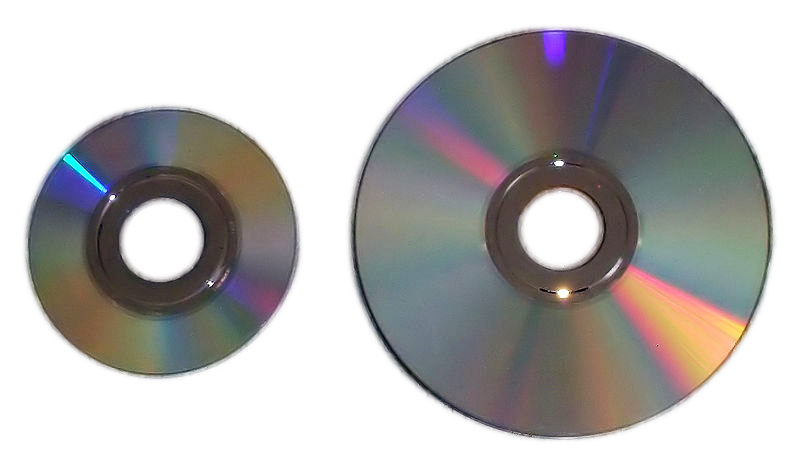
The physical size of a GameCube Game Disc is that of a miniDVD; Wii Optical Discs are based on DVD format, and Wii U Optical Discs are based on Blu-ray format. To maintain backward compatibility between generations of game consoles, GameCube discs are compatible with the first model of the Wii, and Wii Optical Discs are compatible with the Wii U. A burst cutting area is located at the inner ring of the disc surface.
The GameCube Game Disc (DOL-006) is the game medium for the GameCube, created by Matsushita/Panasonic, one of the ten founders of the DVD Forum, and later extended for use in the backward compatibility mode of the first model of Wii. The GameCube is Nintendo's first optical disc console, after mainly ROM cartridge–based platforms. The GameCube Game Disc is a 1.46 GB, 8 cm miniDVD-based technology that reads at a constant angular velocity (CAV). It was chosen by Nintendo to prevent copyright infringement of its games, to reduce manufacturing costs compared to Nintendo 64 Game Paks, and to avoid licensing fees to the DVD Forum.[failed verification] GameCube Game Discs do not use the Content Scramble System found on normal DVD-Video discs, as Nintendo was not satisfied with its level of security.[failed verification]
The GameCube is not able to be used as a general DVD player, except for the Panasonic Q, which is a uniquely customized GameCube with DVD capability that was released only in Japan.
Some GameCube games with large amounts of data span two discs, such as Resident Evil 4, Baten Kaitos, and Tales of Symphonia. Some multi-platform games that fit on single discs for PlayStation 2 and Xbox had certain features removed in order to fit on GameCube Game Discs. This is due to the PS2 and Xbox consoles generally using DVDs for game media instead of the GameCube style disc, with DVDs much higher capacity of 4.7 GB for a single-layer disc and 8.5 GB for a dual-layer disc compared to 1.46 GB capacity for a GameCube disc. Full-motion video (FMV) scenes and audio clips have higher compression or lower quality to fit on a single disc.
The Wii Optical Disc (RVL-006) is the physical game medium for the Wii, created by Panasonic. Nintendo extended its proprietary technology to use a full size 12 cm, 4.7/8.54 GB DVD-based disc, retaining the benefits of the GameCube Game Disc, and adding the standard capacity of a double-layer DVD-ROM. Wii Discs always include a partition with files to update the Wii system software, which are installed before starting the game if needed. This ensures that systems that cannot connect to the Internet are still updated. For the same reasons as the GameCube, the Wii cannot play DVD movies or CDs. Earlier Wiis can play DVDs using homebrew such as WiiMC.
The Wii can read dual-layer discs, and all games were single-layer prior to the release of Super Smash Bros. Brawl. Upon that release, Nintendo admitted that some Wii systems may have trouble reading dual-layer discs due to a dirty laser lens. Nintendo repaired systems with dual-layer problems, and later released a disc cleaning kit for users to purchase.
The Wii U Optical Disc (WUP-006) is the retail physical game medium for the Wii U, with a capacity of 25 GB. There is no 50 GB dual layer version. The Wii U system software is backwards compatible with Wii Optical Discs, but not with GameCube game discs, while a Wii U disc can physically be inserted into a Wii but cannot be read. The Wii U Optical Discs differ in appearance from most other optical discs in that they have soft, rounded edges.
Hub AI
Nintendo optical discs AI simulator
(@Nintendo optical discs_simulator)
Nintendo optical discs
Nintendo optical discs are physical media used to distribute video games on three of Nintendo's consoles that released between 2001 and 2012. Manufactured and developed by Panasonic, these are the GameCube Game Disc, Wii Optical Disc, and Wii U Optical Disc. Nintendo's disc-based media for physical games following from Nintendo 64's Game Pak and ended with Nintendo Switch's game card.
The physical size of a GameCube Game Disc is that of a miniDVD; Wii Optical Discs are based on DVD format, and Wii U Optical Discs are based on Blu-ray format. To maintain backward compatibility between generations of game consoles, GameCube discs are compatible with the first model of the Wii, and Wii Optical Discs are compatible with the Wii U. A burst cutting area is located at the inner ring of the disc surface.
The GameCube Game Disc (DOL-006) is the game medium for the GameCube, created by Matsushita/Panasonic, one of the ten founders of the DVD Forum, and later extended for use in the backward compatibility mode of the first model of Wii. The GameCube is Nintendo's first optical disc console, after mainly ROM cartridge–based platforms. The GameCube Game Disc is a 1.46 GB, 8 cm miniDVD-based technology that reads at a constant angular velocity (CAV). It was chosen by Nintendo to prevent copyright infringement of its games, to reduce manufacturing costs compared to Nintendo 64 Game Paks, and to avoid licensing fees to the DVD Forum.[failed verification] GameCube Game Discs do not use the Content Scramble System found on normal DVD-Video discs, as Nintendo was not satisfied with its level of security.[failed verification]
The GameCube is not able to be used as a general DVD player, except for the Panasonic Q, which is a uniquely customized GameCube with DVD capability that was released only in Japan.
Some GameCube games with large amounts of data span two discs, such as Resident Evil 4, Baten Kaitos, and Tales of Symphonia. Some multi-platform games that fit on single discs for PlayStation 2 and Xbox had certain features removed in order to fit on GameCube Game Discs. This is due to the PS2 and Xbox consoles generally using DVDs for game media instead of the GameCube style disc, with DVDs much higher capacity of 4.7 GB for a single-layer disc and 8.5 GB for a dual-layer disc compared to 1.46 GB capacity for a GameCube disc. Full-motion video (FMV) scenes and audio clips have higher compression or lower quality to fit on a single disc.
The Wii Optical Disc (RVL-006) is the physical game medium for the Wii, created by Panasonic. Nintendo extended its proprietary technology to use a full size 12 cm, 4.7/8.54 GB DVD-based disc, retaining the benefits of the GameCube Game Disc, and adding the standard capacity of a double-layer DVD-ROM. Wii Discs always include a partition with files to update the Wii system software, which are installed before starting the game if needed. This ensures that systems that cannot connect to the Internet are still updated. For the same reasons as the GameCube, the Wii cannot play DVD movies or CDs. Earlier Wiis can play DVDs using homebrew such as WiiMC.
The Wii can read dual-layer discs, and all games were single-layer prior to the release of Super Smash Bros. Brawl. Upon that release, Nintendo admitted that some Wii systems may have trouble reading dual-layer discs due to a dirty laser lens. Nintendo repaired systems with dual-layer problems, and later released a disc cleaning kit for users to purchase.
The Wii U Optical Disc (WUP-006) is the retail physical game medium for the Wii U, with a capacity of 25 GB. There is no 50 GB dual layer version. The Wii U system software is backwards compatible with Wii Optical Discs, but not with GameCube game discs, while a Wii U disc can physically be inserted into a Wii but cannot be read. The Wii U Optical Discs differ in appearance from most other optical discs in that they have soft, rounded edges.
Recent media