


Community hub
Recent from talks
Contribute something
Nothing was collected or created yet.
MiniDVD
View on Wikipedia

| Optical discs |
|---|
 |
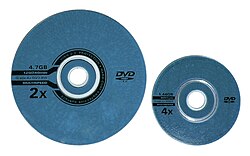
MiniDVD or 8 cm DVD (also "3 inch DVD") is a DVD disc with a reduced diameter of 8 centimetres (3.15 in). It has been most commonly used in camcorders due to its compact size.[1] The most common MiniDVDs are single layered and hold 1.4 GB of data, but there are variants that can offer up to 5.2 GB of storage space, through a combination of dual layers and dual sides.
8 cm DVDs were originally used for music videos and as such became known as DVD single, similarly to how 8 cm optical discs were previously used for music singles on compact discs (i.e. CD single and miniCD). However the MiniDVD format has been mostly used as recordable discs in DVD-based camcorders during the 2000s; a single layer disc can record up to 30 minutes of standard definition video.[2] A number of movies and TV shows have also been released on the format in the mid-2000s, usually targeting children using low-cost small players.[1]
Nintendo used a very similar disc-based format for the GameCube.
MiniDVD capacities
[edit]The most common MiniDVDs are single layered, which can hold 1.46 GB of data, however, there also exists dual layered 2.6 GB versions,[3] dual sided single layer 2.8 GB versions,[4] and dual sided dual layer 5.2 GB versions. A double sided MiniDVD can hold 2.8 GB of data (1.4 GB x 2), however, a dual-layer MiniDVD can only hold 2.6 GB of data due to the limitations when manufacturing dual layered discs. A double sided dual layered disc can hold 5.2 GB of data (2.6 GB x 2), with the MiniDVD-RAM version of the double sided, dual layer disc being able to hold 5.6 GB of data (2.8GB x 2).
Mini DVDs are also available in +R, +R DS, +R DL, +R DL DS, +RW, +RW DS, -R, -R DS, -R DL, -R DL DS, -RW, and -RW DS variants, just like their full sized counterparts. (DL=Double Layer, DS=Double Sided).
| Physical size | Single layer capacity | Dual/Double layer capacity |
|---|---|---|
| 8 cm, single sided[5] | 1.46 GB | 2.66 GB |
| 8 cm, double sided[5] | 2.92 GB | 5.32 GB |
| 12 cm, single sided[6] | 4.7 GB | 8.5 GB |
| 12 cm, double sided[6] | 9.4 GB | 17.0 GB |
See also
[edit]References
[edit]- ^ a b "Kid Vid and the Mini-DVD". Sound & Vision. 2005-02-06. Archived from the original on 2023-12-14. Retrieved 2023-12-14.
- ^ Biersdorfer, J. d (2005-02-24). "On Only 3 Inches of Disc, 30 Minutes of High-Quality Video". The New York Times. ISSN 0362-4331. Archived from the original on 2023-12-14. Retrieved 2023-12-14.
- ^ "Mini DVD+R DL 2.6GB 2.4X Branded 3pk Jewel Case". Duplication.ca. 4 January 2008. Retrieved 2023-01-14.
- ^ "Maxell Mini DVD-RAM VIDEO 60 Minute 2.8 GB". Duplication.ca. 28 February 2019. Retrieved 2023-01-14.
- ^ a b 80 mm DVD - Read-Only Disk (PDF) (Standard) (3rd ed.). ECMA. April 2001. p. 4. 268.
- ^ a b 120 mm DVD - Read-Only Disk (PDF) (Standard) (3rd ed.). ECMA. April 2001. p. 4. 267.
External links
[edit]

MiniDVD
View on GrokipediaOverview
Definition and Purpose
A MiniDVD, also referred to as an 8 cm DVD, is an optical disc format with a diameter of 80 mm that conforms to established DVD standards for both read-only and recordable media. These discs utilize the same physical, mechanical, and optical characteristics as standard DVDs, but in a reduced size similar to that of mini CDs, facilitating storage of video, audio, and data in compact applications. The format is defined by international standards such as ECMA-268 for read-only discs and ECMA-359 for recordable variants, ensuring reliable data interchange across compatible systems.[7][8] The purpose of MiniDVD is to support recording and playback capabilities in space-constrained devices, such as handheld camcorders, where the larger 12 cm DVD format proves impractical due to size limitations. Developed as a portable optical storage solution, it serves as an alternative to tape-based media, allowing users to capture and store video footage directly onto the disc for immediate playback or transfer. This design emphasizes ease of use in mobile electronics, promoting compatibility with existing DVD infrastructure while prioritizing compactness.[3][9] At its core, MiniDVD achieves compatibility with full-size DVD technology through shared encoding and laser specifications, but scaled for portability in consumer devices. This adaptation enables seamless integration into smaller electronics without sacrificing the fundamental benefits of DVD, such as high-quality video storage and broad player support.[7][8]Physical Characteristics
MiniDVD discs measure 80 mm in diameter, reduced from the 120 mm diameter of standard DVDs to enable use in compact devices such as camcorders.[10] These discs maintain a uniform thickness of 1.2 mm, matching that of full-size DVDs to support compatibility in adapted playback trays or slots.[11] The center hole is 15 mm in diameter, surrounded by an inner unused ring that aids structural integrity and serves as a clamping zone for drive mechanisms.[12] MiniDVD construction employs a polycarbonate substrate as the base material, overlaid with a thin reflective aluminum layer where data is encoded via laser-etched pits and lands; a protective lacquer coating seals the surface against environmental damage.[13] Available variants encompass single-sided/single-layer, single-sided/dual-layer, and double-sided/single-layer-per-side designs, resulting in a lighter weight of approximately 7 grams per disc compared to standard DVDs.[10][14]Technical Specifications
Storage Capacities
MiniDVD discs provide storage capacities that vary based on their layer structure (single or dual) and side configuration (single or double), reflecting the optical disc's design for compact applications like camcorders. These capacities are derived from the same recording technology as standard DVDs but adapted to the smaller form factor. The single-sided, single-layer configuration offers 1.46 GB of raw data storage, though video recording in DVD-Video format yields an effective capacity of about 1.4 GB due to overhead for file systems, navigation data, and MPEG-2 encoding structures.[15][16] Single-sided, dual-layer discs double the layers on one side, achieving 2.66 GB for data and approximately 2.5 GB for video, sufficient for extended recording sessions.[17] Double-sided configurations utilize both surfaces of the disc, effectively combining capacities from each side after manual flipping during recording or playback. A double-sided, single-layer MiniDVD thus provides 2.92 GB total, equivalent to two single-layer sides. The maximum capacity is realized in the double-sided, dual-layer setup at 5.32 GB, though such discs were less common in consumer products.[18][19]| Configuration | Data Capacity (GB) | Video Capacity (GB) | Typical Video Time (minutes) |
|---|---|---|---|
| Single-sided, single-layer | 1.46 | 1.4 | 30 |
| Single-sided, dual-layer | 2.66 | 2.5 | 54 |
| Double-sided, single-layer | 2.92 | 2.8 | 60 |
| Double-sided, dual-layer | 5.32 | 5.0 | 108 |