


Community hub
Recent from talks
Contribute something
Nothing was collected or created yet.
Nitzer Ebb
View on Wikipedia
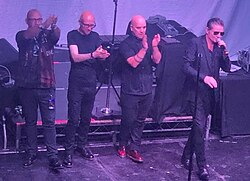
Nitzer Ebb (/ˈnaɪtsər ɛb, ˈnɪt-/) is an English EBM group formed in 1982 by Essex school friends Vaughan "Bon" Harris (programming, synthesizers, drums, vocals), Douglas McCarthy (vocals), and David Gooday (drums). The band were originally named La Comédie De La Mort but soon discarded that and chose the name Nitzer Ebb by cutting up words and letters and arranging them randomly to create something Germanic without using actual German words.[3]
Key Information


History
[edit]Initial releases (1983–1987)
[edit]The group released their demo Basic Pain Procedure in 1983,[4] but it was two years until they met PWL producer Phil Harding, who produced their 1985 debut single "Isn't It Funny How Your Body Works?" and helped them set up their own label, Power Of Voice Communications. The band at the time was inspired by the post-punk scene and specifically acts like "Siouxsie and the Banshees, Killing Joke and Bauhaus who were having a big influence on us, in some ways stylistically but also in the energy that they gave".[5]
They released three more singles on their own label, "Warsaw Ghetto" (1985), "Warsaw Ghetto Remixes" (1986) and "Let Your Body Learn" (1986), before signing to Mute Records in 1986. The singles "Murderous" (1986) and "Let Your Body Learn" (1987) followed, building their reputation in the Industrial Rock and EBM scenes,[6] as well as making inroads into the developing Chicago House scene.[7]
"Join In The Chant" (1987) became part of the Balearic beat scene that influenced the UK acid house scene.[8][9]
International success, disbandment (1987–1995)
[edit]Their debut album That Total Age was released in 1987. Depeche Mode invited them to open for the European leg of their successful Music for the Masses Tour in 1987.[10] David Gooday left after the tour and they completed their next album Belief (1989) as a duo. Mark 'Flood' Ellis became their new producer. They recruited Julian Beeston to assist them on their own world tour, and he soon became a regular contributor both on and off stage.[6]
In 1989, they teamed with German EBM pioneers Die Krupps to re-record their 1981 single "Wahre Arbeit - Wahrer Lohn" as "The Machineries of Joy".[11]
The third Nitzer Ebb album Showtime, released in 1990, revealed a less confrontational sound. The single "Fun to Be Had" (1990) featured a remix by George Clinton[12] and was a hit on the US dance charts.
Their fourth album, Ebbhead (1991), showcased a more traditional songwriting style with an emphasis on melodic choruses was produced by Alan Wilder from Depeche Mode and Flood. They promoted the album with a global tour that took them from the southern U.S. to northern Siberia (in the Siberian city of Barnaul).[6]
Their fifth album, Big Hit (1995), featured a greater use of 'real' instruments, especially guitars and drums. McCarthy and Harris recruited Jason Payne (percussion), to their main line-up and brought in John Napier (guitar, percussion) to assist with live performances.[6]
Big Hit was the final release by the band for almost 15 years. McCarthy was a regular collaborator with Alan Wilder's Recoil project, and he recorded with French electronic producer Terence Fixmer as Fixmer/McCarthy. Bon Harris moved to Los Angeles, where he became a successful producer and recorded as 13mg and as a member of Maven.
Reunion (2006–present)
[edit]
Nitzer Ebb began work on new material in Los Angeles in early 2007, with a retrospective documentary still in the pipeline. During 2007, Nitzer Ebb continued its trend of replacing drummers as Kourtney Klein left the band to be replaced by Jason Payne. A first track, "Once You Say", with Depeche Mode songwriter Martin L. Gore on backing vocals, was played in June 2007 by Dave Clarke in his White Noise show on VPRO's 3 Voor 12.[13] This track, along with "Payroll", were debuted live as Nitzer Ebb played a handful of shows and festivals during 2007. These tracks were then featured on Nitzer Ebb's album, Industrial Complex.
McCarthy and Harris reunited up with Jason Payne and producer Flood[14] to finish up the first new Nitzer Ebb record in over a decade. In the meantime, Fixmer/McCarthy released its second album in June 2008, Into the Night.
The band announced a US tour for fall–winter 2009 and were selected as the opening act of the January and February European and Russian dates of Depeche Mode's Tour of the Universe in 2010.[15]
In 2019, the band announced a North American tour that included the original band members David Gooday and Simon Granger.[16] In 2021, the band continued more tour dates including in Europe.[17]
During the COVID-19 pandemic, Harris and McCarthy got together to work on a side project called D-R-A-G.[1] In November 2021, McCarthy collapsed before a show in Palm Beach, Florida, and had to go to the hospital. The band emphasized it was due to complications from a pre-existing illness and it had nothing to do with COVID-19. The band went on to perform with Harris on lead vocals.[18]
In March 2024, McCarthy announced he was forced to withdraw from Nitzer Ebb’s foreseeable shows due to health concerns, regarding his diagnosis of cirrhosis of the liver. He stated: "I won’t be performing any live shows as Nitzer Ebb, Fixmer/McCarthy or any other vehicle, until I can do so safely and stress-free for myself and the amazing people I have around me who continue to stand by my side in full support of getting me better." Nitzer Ebb has continued to tour with Harris taking over fully on vocals, for the foreseeable future.[19] On 11 June 2025 the band announced that McCarthy had died.[20]
Band members
[edit]Members
[edit]- Bon Harris – programming, synthesizers, drums, vocals, bass (1982–present)
- David Gooday – vocals, drums (1982–1987, 2019–present)
- Simon Granger – writing, arrangement and artwork (1983–1995, 2019–present)
- Jason Payne – drums (1992–1995, 2007–2019 2025–present)
Former members
[edit]- Douglas McCarthy – vocals, guitars (1982–2025; his death; not touring during 2024–2025)
- Duc Nhan Nguyen – drums (1987–1988)
- Julian Beeston – drums (1989–1992)
Touring members
[edit]- David Lovering – drums (1994–1995)
- John Napier – guitars, percussion (1995)
- Kourtney Klein – drums (2006–2007)
- Rona Rougeheart – percussion (2024)
Timeline
[edit]
Discography
[edit]Studio albums
[edit]| Year | Album details | Chart peak positions | Certifications (sales thresholds) | |||||||||||
|---|---|---|---|---|---|---|---|---|---|---|---|---|---|---|
| UK |
US |
SWE | ||||||||||||
| 1987 | That Total Age | — | — | — | ||||||||||
| 1989 | Belief | — | — | 30 | ||||||||||
| 1990 | Showtime | — | — | — | ||||||||||
| 1991 | Ebbhead | — | 146 | 42 | ||||||||||
| 1995 | Big Hit | 126 | — | — | ||||||||||
| 2010 | Industrial Complex
|
— | — | 35 | ||||||||||
| "—" denotes albums that were released but did not chart, or albums not released in a particular territory. | ||||||||||||||
EPs and demo
[edit]| Year | Album details | Chart peak positions | Certifications (sales thresholds) | |||||||||||
|---|---|---|---|---|---|---|---|---|---|---|---|---|---|---|
| UK |
US |
SWE | ||||||||||||
| 1983 | Basic Pain Procedure (Demo)
|
— | — | — | ||||||||||
| 1989 | The Machineries of Joy (EP) | — | — | — | ||||||||||
| 1991 | As Is (EP) | — | — | — | ||||||||||
| 2011 | Join in the Rhythm of Machines (EP)
|
— | — | — | ||||||||||
| "—" denotes albums that were released but did not chart, or albums not released in a particular territory. | ||||||||||||||
Compilations
[edit]| Year | Album details | Chart peak positions | Certifications (sales thresholds) | |||||||||||
|---|---|---|---|---|---|---|---|---|---|---|---|---|---|---|
| UK |
US |
SWE | ||||||||||||
| 1988 | So Bright So Strong
|
— | — | — | ||||||||||
| 2006 | Body of Work
|
— | — | — | ||||||||||
| 2006 | Body Rework
|
— | — | — | ||||||||||
| 2010 | In Order
|
— | — | — | ||||||||||
| "—" denotes albums that were released but did not chart, or albums not released in a particular territory. | ||||||||||||||
Soundtracks
[edit]- Saw IV "Payroll (John O Mix)" (2007)
- Grand Theft Auto IV "Let Your Body Learn" (2008)
- NCIS "Promises" (2009)
- Saw VI "Never Known" (2009)
- Saw VII "Promises" (2010)
- Castle "Kiss Kiss Bang Bang" (2010)
- Tony Hawk: Ride (video game) "Kiss Kiss Bang Bang" (2010)
- The Following "Murderous" (2013)
Singles
[edit]| Title | Year | Peak chart positions | Album | ||
|---|---|---|---|---|---|
| UK [21] |
US Dance | US Alt. | |||
| "Isn't It Funny How Your Body Works" | 1985 | — | — | — | Non-album singles |
| "Warsaw Ghetto" | — | — | — | ||
| "So Bright, So Strong" | — | — | — | ||
| "Get Clean" | 1986 | — | — | — | |
| "Murderous" | — | — | — | That Total Age | |
| "Let Your Body Learn" | 1987 | — | — | — | |
| "Join in the Chant" | — | 9 | — | ||
| "Control I'm Here" | 1988 | 100 | 14 | 25 | Belief |
| "Hearts and Minds" | 1989 | — | 16 | — | |
| "Shame" | — | — | — | ||
| "The Machineries of Joy" (Die Krupps with Nitzer Ebb) |
— | 25 | — | Non-album single | |
| "Lightning Man" | 1990 | 97 | 14 | 28 | Showtime |
| "Fun to Be Had" | 99 | 5 | — | ||
| "Getting Closer" | — | — | — | ||
| "I Give to You" | 1991 | — | — | 27 | Ebbhead |
| "Godhead" | 56 | — | — | ||
| "Ascend" | 1992 | 52 | — | — | |
| "Kick It" | 1995 | 75 | — | — | Big Hit |
| "I Thought" | — | — | — | ||
| "—" denotes a recording that did not chart or was not released in that territory. | |||||
B-sides and non-album tracks
[edit]| Song | A-side | Year |
|---|---|---|
| "The Way You Live" | "Isn't It Funny How Your Body Works" | 1985 |
| "Crane" | "Isn't It Funny How Your Body Works" | 1985 |
| "Cold War" | "Isn't It Funny How Your Body Works" | 1985 |
| "So Bright, So Strong" | "Warsaw Ghetto" | 1985 |
| "Get Clean" | "Let Your Body Learn" | 1986 |
| "K.I.A." | "Control I'm Here" | 1988 |
| "Time Slips By" | "Hearts and Minds" | 1989 |
| "Backlash" | "Shame" | 1989 |
| "Who We Are" | "Lightning Man" | 1990 |
| "Out of Mind" | "Fun to Be Had" | 1990 |
| "Taken From Me (Servant Mix)" | "Fun to Be Had" | 1990 |
| "Lovesick" | 'As Is' EP | 1991 |
| "Come Alive" | 'As Is' EP | 1991 |
| "Higher" | 'As Is' EP | 1991 |
| "Stray Cat Blues" | "I Give to You" | 1991 |
| "Skintight" | "Kick It" | 1995 |
| "Dead & Gone" | "Kick It" | 1995 |
| "Friend (Brittle Mix)" | "I Thought" | 1995 |
| "Beats Me" | "I Thought" | 1995 |
| "Payroll (John O Mix)" | 'Saw IV' Soundtrack | 2007 |
| "Promises" | NCIS (The Official TV Series Soundtrack) | 2009 |
| "Never Known" | Saw VI Soundtrack | 2009 |
Music videos
[edit]- So Bright, So Strong (1985)
- Murderous (1987)
- Let Your Body Learn (1987)
- Control I'm Here (1988)
- Hearts and Minds (1989)
- Shame (1989)
- The Machineries of Joy (1989)
- Lightning Man (1990)
- Fun to Be Had (1990)
- Family Man (1991)
- I Give to You (1991)
- Godhead (1992)
- Ascend (1992)
- Kick It (1995)
- I Thought (1995)
References
[edit]- ^ a b Fuoco-Karasinski, Christina (23 November 2021). "Nitzer Ebb wants fans to join in the chant". Pasadena Weekly. Archived from the original on 24 November 2021. Retrieved 8 December 2021.
- ^ "www.nitzer-ebb.com ::: the official Nitzer Ebb Website – Archive: News 2009". www.nitzer-ebb.de. 12 August 2009. Archived from the original on 10 August 2022. Retrieved 8 December 2021.
- ^ "Interview: Nitzer Ebb by Fact Magazine". Fact Magazine. 3 May 2009. Archived from the original on 18 August 2024. Retrieved 25 September 2023.
- ^ "Discography Demo Basic Pain Procedure". Nitzer-ebb.de. Archived from the original on 22 January 2021. Retrieved 5 November 2017.
- ^ "Douglas McCarthy Interview". Documentaryevidence.co.uk. 2012. Retrieved 9 December 2013.
Rollmann, Hans (8 October 2018). "Nitzer Ebb: Three Decades of Pounding Beats and Smashing Stereotypes". Popmatters.com. Retrieved 8 October 2018. - ^ a b c d "Biography". Nitzer-ebb.de. Archived from the original on 22 January 2021. Retrieved 5 November 2017.
- ^ Arnold, Jacob (4 September 2013). "Medusa's: Chicago's missing link". Resident Advisor. Retrieved 5 November 2017.
- ^ "Various – Balearic Beats - Vol. 1 - The Album". Discogs.com. 19 September 1988. Retrieved 5 November 2017.
- ^ "Interview: Nitzer Ebb". Factmag.com. 3 June 2009. Retrieved 5 November 2017.
- ^ Paoletti, Ariana (24 September 2013). "The Ebb and Flow of Nitzer Ebb". Thump.vice.com. Retrieved 5 November 2017.
- ^ "Discography Mute Records Machineries Of Joy". Nitzer-ebb.de. Retrieved 5 November 2017.
- ^ "Nitzer Ebb – Fun To Be Had (George Clinton Remix)". Discogs.com. 19 September 1990. Retrieved 5 November 2017.
- ^ "Martin Gore (Depeche Mode) delivers backing vocals on new Nitzer Ebb track 'Once You Say". Side-line.com. Retrieved 7 November 2019.
- ^ "Flood joins Nitzer Ebb to complete first album in a decade". Side-line.com. Retrieved 7 November 2019.
- ^ "depeche mode dot com". Depechemode.com. Retrieved 29 March 2012.
- ^ "Nitzer Ebb announce North American tour, including Boston date". Vanyaland. 31 January 2019. Retrieved 7 October 2021.
- ^ "NITZEREBBPRODUKT". www.nitzer-ebb-produkt.com. Archived from the original on 21 January 2022. Retrieved 7 October 2021.
- ^ "Nitzer Ebb: Frontmann Douglas McCarthy im Krankenhaus, Tour wird fortgesetzt". www.sonic-seducer.de. Retrieved 25 November 2021.
- ^ "Nitzer Ebb's Douglas McCarthy Withdraws From Tour Due To Health Concerns". www.thequietus.com. 25 March 2024. Retrieved 25 March 2024.
- ^ "Douglas McCarthy has Passed Away". instagram.com. Retrieved 11 June 2025.
- ^ Roberts, David (2006). British Hit Singles & Albums (19th ed.). London: Guinness World Records Limited. p. 396. ISBN 1-904994-10-5.
External links
[edit]
- NitzerEbbProdukt – official website
- Nitzer Ebb discography at Discogs
- NitzerEbbProdukt discography at Discogs
- Nitzer Ebb at IMDb
| International | |
|---|---|
| National | |
| Artists | |

Nitzer Ebb
View on GrokipediaHistory
Formation and early years (1982–1986)
Nitzer Ebb was formed in 1982 in Chelmsford, Essex, England, by school friends Douglas McCarthy on vocals, Vaughan "Bon" Harris on programming and drums, and David Gooday on drums.[8][9] The trio, initially known as Nitzer Ebb Product, drew inspiration from industrial acts like DAF and Killing Joke, experimenting with affordable sequencers, synthesizers, and percussive elements to create a raw, aggressive electronic sound amid the suburban boredom of Essex.[8][9] In August 1983, the band self-recorded their debut demo cassette Basic Pain Procedure over two weekends, featuring tracks such as "Faded Smiles," "Tradition," and "Crane" that showcased their minimalistic EBM style with shouted vocals and driving rhythms.[10][11] The demo was independently distributed in limited quantities, helping to circulate their music within local underground circles and attracting attention from the post-punk and industrial scenes.[10] A live recording from December 9, 1983, at the Chelmer Institute for Higher Education in Chelmsford—capturing performances of demo tracks alongside covers like "A Whiter Shade of Pale"—further documented their early energetic stage presence.[11] By 1984, Nitzer Ebb had begun performing in UK clubs, particularly around London, where their militaristic imagery and intense, sequencer-driven sets built a dedicated underground following.[12] That year, they self-released their debut four-track EP Isn't It Funny How Your Body Works? on their own Power of Voice Communications label, marking their first vinyl outing and emphasizing themes of bodily mechanics through stark electronic percussion and McCarthy's confrontational vocals.[13][14] The EP's circulation, combined with ongoing live shows, led to collaboration with producer Phil Harding and additional singles in 1985–1986, culminating in a signing with Mute Records in late 1986.[12][13]Rise to prominence (1987–1990)
Nitzer Ebb achieved their breakthrough with the release of their debut studio album That Total Age on May 11, 1987, via Mute Records in the UK and June 9, 1987, via Geffen Records in the US. The album introduced the band's raw, aggressive electronic body music (EBM) style, blending pounding drum machines, sparse synthesizers, and Douglas McCarthy's shouted vocals. Key singles "Join in the Chant" and "Let Your Body Learn" captured this intensity, with the former reaching No. 9 on the US Billboard Dance Club Songs chart and helping define EBM's fusion of industrial aggression and danceable rhythms.[15][16][17] The band's visibility surged in 1987 when they opened for Depeche Mode on the European leg of the Music for the Masses tour, exposing their high-energy performances to larger audiences and solidifying their reputation in the electronic underground. This period marked a shift from self-released demos to commercial success, as That Total Age earned acclaim for its minimalist innovation and physicality, influencing the goth and industrial scenes. Critics highlighted its role in pioneering EBM's athletic, confrontational ethos, with tracks like "Murderous" exemplifying the genre's visceral drive.[17][18][19] In 1989, Nitzer Ebb followed with Belief, released on Mute in the UK and Geffen in the US, which refined their sound while amplifying its accessibility. Singles "Control I'm Here" (peaking at No. 14 on the US Dance chart) and "Hearts and Minds" showcased tighter production and anthemic hooks, broadening their appeal beyond Europe. The album received strong reviews for evolving EBM into a more melodic yet potent form, with its tracks emphasizing themes of control and surrender amid relentless beats.[20][21][22] The 1990 album Showtime, issued on February 26 via Mute and Geffen, captured the band's maturing stage with a slightly less abrasive edge, incorporating subtle guitar elements alongside their core electronic pulse. Supporting tours across Europe and North America, including opening slots on Depeche Mode's World Violation Tour, drew crowds to goth and industrial clubs, fostering a loyal following through explosive live shows. Critics lauded Showtime for balancing innovation with accessibility, cementing Nitzer Ebb's status as EBM trailblazers during their peak commercial years.[23][3][24]Later years and disbandment (1991–1995)
In 1991, Nitzer Ebb released their fourth studio album, Ebbhead, which marked a shift toward more structured songwriting and melodic elements compared to their earlier aggressive EBM sound. Co-produced by Depeche Mode's Alan Wilder and Flood at Konk Studios in London, the album incorporated influences from the burgeoning industrial rock scene, emphasizing choruses and traditional arrangements while retaining the band's signature electronic percussion and Douglas McCarthy's intense vocals.[25][26] The lead single "Ascend" highlighted this evolution with its driving rhythm and anthemic build-up, achieving moderate club play and video airtime on MTV.[27] Following the relative commercial peak of their late-1980s work, the band faced increasing challenges in maintaining momentum amid the 1990s rise of grunge and techno genres, which shifted audience preferences away from their core EBM style. Touring became more demanding, with logistical hurdles complicating international dates, though they continued to support Ebbhead across Europe and North America. By the mid-1990s, internal creative differences had intensified, straining the long-standing partnership between McCarthy and programmer Vaughan "Bon" Harris.[26][19] The band's final album, Big Hit, arrived in 1995 on Mute Records, representing a bolder push toward mainstream accessibility through alt-rock and industrial fusion. Featuring additional guitar contributions from Bad Brains' Dr. Know on tracks like "Kick It," the record blended house grooves with rock edges in an attempt to align with contemporaries like Nine Inch Nails, but it encountered promotion issues from the label and further exacerbated band tensions.[28][29] The single "Kick It" received some alternative radio exposure, yet overall reception was mixed, reflecting the group's struggle to adapt.[29] Without a formal announcement, Nitzer Ebb effectively disbanded later that year, as members pursued individual paths amid unresolved conflicts. McCarthy explored vocal collaborations in electronic and techno projects, including work with producers like Terence Fixmer, while Harris delved into techno production and scoring for film.[26][30] This period closed a chapter defined by experimentation but ultimately hindered by external market shifts and internal discord.[31]Reunion and recent activities (2006–2025)
In 2006, Nitzer Ebb announced their reunion, initially featuring core members Bon Harris and Douglas McCarthy, marking the band's return after an 11-year hiatus.[32] This revival coincided with the release of the compilation album Body of Work 1984–1997 on June 26, 2006, via Mute Records, which collected key tracks from their early catalog to celebrate the occasion.[33] The band's first full studio album in 15 years, Industrial Complex, arrived on January 22, 2010, through Major Records, emphasizing a return to their aggressive electronic body music (EBM) foundations with tracks like "Promises" and a guest appearance by Martin Gore on "Once You Say." To promote the release, Nitzer Ebb embarked on extensive international touring, including opening for Depeche Mode on 23 European dates during the "Tour of the Universe" in early 2010.[34] They also supported Nine Inch Nails on select North American shows later in the decade, solidifying their resurgence in the industrial scene. In 2011, the band collaborated with Die Krupps on the EP Join in the Rhythm of Machines, released exclusively during their joint European tour of the same name, featuring reimagined tracks such as "Blood Money" and "To the Hilt."[35] By 2019, Nitzer Ebb confirmed the return of their original lineup—including drummer David Gooday and bassist Simon Granger—for the first time since 1987, headlining a North American tour starting May 9 in Boston and appearances at festivals like Amphi in Cologne.[36] This period also saw the announcement of the career-spanning box set 1982-2010, released in 2018 via Pylon Records. In March 2024, however, McCarthy withdrew from all upcoming tours due to a diagnosis of liver cirrhosis stemming from years of alcohol abuse, with the band proceeding with select dates using a substitute vocalist.[37][36] McCarthy passed away on June 11, 2025, at the age of 58 in London, as confirmed by the band via social media, with no specific cause detailed beyond his prior health struggles.[38] In response, Nitzer Ebb announced plans to continue performing, with Harris stepping in as lead vocalist for their scheduled 2025 European tour dates, including tributes to McCarthy during shows and the posthumous release of his final recordings.[6] The band expressed commitment to honoring McCarthy's legacy through ongoing activity.[39]Musical style and influences
Core elements of EBM sound
Nitzer Ebb's contributions to electronic body music (EBM) are defined by a stark, aggressive sound that prioritizes raw energy and physicality over melodic complexity. At the core of their style is Douglas McCarthy's shouted, barked vocals, delivered in a commando-like manner that conveys righteous fury and anti-authoritarian themes, often chanted over sparse electronic backings to heighten the confrontational intensity.[40][17] This vocal approach, combined with Bon Harris's precise programming, creates a hypnotic, driving force intended to elicit a bodily response, embodying the "body music" ethos of the genre.[19] Instrumentally, the band eschewed traditional guitars and organic elements in their early work, relying instead on minimalistic sequencers and drum machines to build relentless 4/4 rhythms with heavy, looped basslines and emphasis on percussion. Harris's use of tools like the Roland SH-101 synthesizer and its built-in sequencer allowed for deconstructed layers of sound, focusing on essential, athletic grooves that propel tracks forward without unnecessary embellishment. Samplers were integral, capturing industrial noises to infuse the music with a gritty, mechanical edge, structuring songs around repetitive, hypnotic beats optimized for dancefloor immersion and physical exertion.[41][2][19] Complementing this sonic palette is a visual aesthetic that amplifies the band's militaristic and dystopian vibe, featuring stark military-inspired uniforms and synchronized choreography in performances and videos. This confrontational presentation, drawing from mid-twentieth-century totalitarian imagery, reinforces the music's themes of rebellion and intensity, making Nitzer Ebb's EBM a total sensory assault designed for provocation and movement.[40][17]Evolution and influences
Nitzer Ebb's sound evolved from its foundational electronic body music (EBM) roots, characterized by stark, rhythmic electronics, into more varied territories while maintaining a core of aggressive percussion and vocal intensity. Building on this baseline, the band began incorporating broader sonic palettes in response to the industrial landscape of the late 1980s and early 1990s.[2] In the 1990s, Nitzer Ebb shifted toward a guitar-driven industrial rock aesthetic, marking a departure from pure electronics toward a harder, more rock-infused edge that aligned with the mainstream surge of acts like Nine Inch Nails and Ministry. The 1991 album Ebbhead served as a pivotal point in this transition, introducing notable guitar elements and a tortured emotional depth that blended EBM aggression with rock structures, co-produced by Depeche Mode's Alan Wilder and Flood to enhance its commercial viability amid the rising industrial rock wave.[42][19][43] Following their 1995 disbandment and a decade-long hiatus, Nitzer Ebb reunited in the late 2000s, returning to a purer electronic focus with their 2010 album Industrial Complex. This release blended classic EBM rhythms and analog synth techniques with modern digital production methods, creating a "powerhouse" groove that echoed their early work while incorporating contemporary layering and virtual instrumentation for a matured sound.[44][45][46] The band's evolution was deeply shaped by post-punk influences such as Killing Joke, Siouxsie and the Banshees, and Bauhaus, which provided stylistic energy and angst, alongside Kraftwerk's pioneering electronics and Throbbing Gristle's raw industrial noise that informed their rhythmic and textural foundations. These inspirations fueled Nitzer Ebb's rejection of traditional rock guitars in favor of sequencers early on, though later adaptations reflected broader industrial trends. Their EBM ties were further reinforced through collaborations and remixes within the genre's community, including interactions with contemporaries like Skinny Puppy and Front 242, which solidified their position in the electronic-industrial nexus.[2][19][47]Band members
Current members
As of November 2025, following the death of longtime frontman Douglas McCarthy in June 2025, Nitzer Ebb's active lineup centers on its founding members handling core instrumentation and vocals, supplemented by longtime live collaborators for touring duties. This configuration allows the band to continue performing and honoring McCarthy's legacy through select dates in 2025 and 2026.[6][7] Vaughan "Bon" Harris serves as the band's primary keyboardist, programmer, and lead vocalist, roles he assumed fully in 2025 after previously contributing to vocals during McCarthy's health-related absences; as a founding member since 1982, Harris has been central to the group's electronic sound production throughout its history.[6][39] David Gooday, another founding member from 1982, provides percussion and rhythmic support, bringing live rhythmic energy to performances and marking his return to the stage with the band since the late 1980s, with drumming duties shared regionally in current tours.[36][7] Simon Granger provides synthesizers and sequencers and joined the live lineup for the band's reunion tours starting in 2006 (with full original lineup in 2019), contributing to both musical arrangements and the group's visual aesthetic from his earlier involvement in artwork design.[36][48] Jason Payne provides drums and percussion and was added for live performances in the 2000s, a longtime collaborator enhancing the band's stage presence with additional rhythmic layers during tours.[49] Tim Kroker provides drums for European tour dates (from 2025 onward), formerly of Front 242, supplementing the core lineup for select performances.[50]Former members
Douglas McCarthy served as the lead vocalist of Nitzer Ebb from the band's formation in 1982 until its initial disbandment in 1995, and rejoined for the 2006 reunion until his death on June 11, 2025, at the age of 58.[51][5] During his tenure, McCarthy's distinctive, aggressive vocal style became a cornerstone of the band's electronic body music sound. Following the band's hiatus, he pursued solo work, releasing the album Kill Your Friends in 2012, and collaborated extensively with producer Terence Fixmer under the moniker Fixmer/McCarthy, producing several EPs and albums blending industrial and techno elements from 2003 onward.[52][53] Duc Nhan Nguyen joined Nitzer Ebb as drummer during the band's 1987–1988 tours, temporarily replacing founding member David Gooday. His brief tenure supported the group's live performances amid their rising international profile. After leaving Nitzer Ebb, Nguyen transitioned to tour management, serving as the road manager for Front 242 during their 1989 tour. Julian Beeston contributed to Nitzer Ebb as drummer from 1989 to 1992, again filling in during David Gooday's absences and appearing on the album Belief (1990).[54] Post-Nitzer Ebb, Beeston joined the industrial electro group Cubanate in 1993, where he played a key role in their recordings and tours until the band's dissolution in 2016, and later formed the project Featured, releasing music with guest vocalists.[55]Timeline of Lineup Changes
Nitzer Ebb's lineup evolved through key formations, additions, and periods of stability or inactivity, reflecting shifts in membership focused on core creative and performance roles.| Year/Period | Key Lineup Change | Details |
|---|---|---|
| 1982 | Formation | The band was founded by school friends Vaughan "Bon" Harris (programming, synthesizers, drums, vocals), Douglas McCarthy (vocals), and David Gooday (drums) in Chelmsford, Essex, England.[13][56] |
| 1984–1986 | Core trio stable | Harris, McCarthy, and Gooday remained the consistent lineup, supporting the band's initial recordings and live performances during this foundational phase.[56][57] |
| 1989–1992 | Beeston tenure | Julian Beeston served as drummer from 1989 to 1992, appearing on Belief (1990) and Ebbhead (1991), contributing additional drums and percussion.[58][59] |
| 1995–2006 | Hiatus | The band entered a period of inactivity with all core members stepping back from group efforts following the mid-1990s releases and tours.[60][56] |
| 2006 | Reunion | Harris and McCarthy reunited as the core duo, augmented by Simon Granger (synthesizers, artwork) and Jason Payne (percussion, drums) for touring and subsequent recordings.[4][61][62] |
| 2024 | McCarthy withdraws | Douglas McCarthy withdrew from live performances due to health concerns related to cirrhosis of the liver.[63][6] |
| 2025 | McCarthy's death; Harris assumes vocals | McCarthy passed away on June 11 from complications of his illness; Bon Harris took over primary vocal duties for ongoing tours and activities. Tim Kroker joined as touring drummer for European dates.[52][5][6][38][50] |