Hubbry Logo
Cassette tapeCassette tapeMain
Open search
Cassette tape
Community hub
Cassette tape
logo
8 pages, 0 posts
0 subscribers
Be the first to start a discussion here.
Cassette tape
Cassette tape
from Wikipedia

Cassette tape
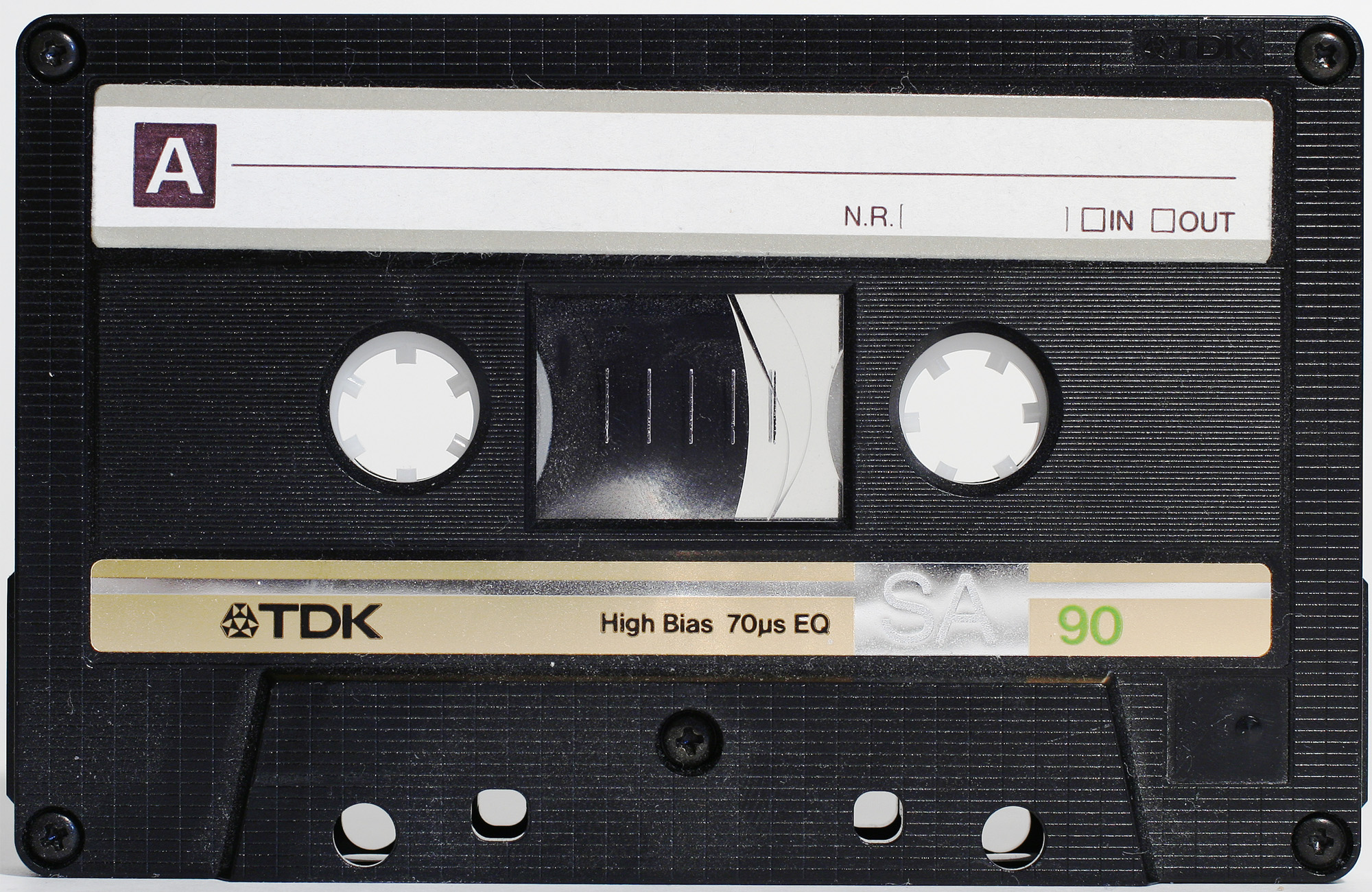
A TDK SA90 Type II Compact Cassette
Media typeMagnetic tape cassette
EncodingAnalog signal, in four tracks
CapacityMost commonly 30, 45, or 60 minutes per side (C60, C90, and C120)[1]
Read mechanismTape head
Write mechanismTape head
Developed byPhilips
UsageAudio and data storage
Extended fromReel-to-reel audio tape recording
Extended toDigital Compact Cassette
ReleasedAugust 1963; 62 years ago (1963-08)

The cassette tape,[2] also called Compact Cassette, audio cassette, or simply tape or cassette, is an analog magnetic tape recording format for audio recording and playback. Invented by Lou Ottens and his team at the Dutch company Philips, the Compact Cassette was introduced in August 1963.[3]

Cassette tapes come in two forms, either containing content as a prerecorded cassette (Musicassette), or as a fully recordable "blank" cassette. Both forms have two sides and are reversible by the user.[4] Although other tape cassette formats have also existed—for example the Microcassette—the generic term cassette tape is normally used to refer to the Compact Cassette because of its ubiquity.[5]

From 1983 to 1991, the cassette tape was the most popular audio format for new music sales in the United States.[6]

Cassette tapes contain two miniature spools, between which the magnetically coated, polyester-type plastic film (magnetic tape) is passed and wound[7]—essentially miniaturizing reel-to-reel audio tape and enclosing it, with its reels, in a small case (cartridge)—hence "cassette".[8] These spools and their attendant parts are held inside a protective plastic shell which is 4 by 2.5 by 0.5 inches (10.2 cm × 6.35 cm × 1.27 cm) at its largest dimensions. The tape itself is commonly referred to as "eighth-inch" tape, supposedly 18 inch (0.125 in; 3.175 mm) wide, but actually slightly larger, at 0.15 inches (3.81 mm).[9] Two stereo pairs of tracks (four total) or two monaural audio tracks are available on the tape; one stereo pair or one monophonic track is played or recorded when the tape is moving in one direction and the second (pair) when moving in the other direction. This reversal is achieved either by manually flipping the cassette when the tape comes to an end, or by the reversal of tape movement, known as "auto-reverse", when the mechanism detects that the tape has ended.[10]

History

[edit]

Precursors

[edit]
Wollensak portable reel-to-reel tape recorder
Compact Cassette vs. RCA Tape Cartridge

After the Second World War, magnetic tape recording technology proliferated across the world. In the United States, Ampex, using equipment obtained in Germany as a starting point, began commercial production of reel-to-reel tape recorders. First used by broadcast studios to pre-record radio programs, tape recorders quickly found their way into schools and homes. By 1953, one million U.S. homes had tape machines,[11] and several major record labels were releasing select titles on prerecorded reel-to-reel tapes.

In 1958, following four years of development, RCA introduced the RCA tape cartridge, which enclosed 60 minutes (30 minutes per side) of stereo quarter-inch reel-to-reel tape within a plastic cartridge that could be utilized on a compatible tape recorder/player without having to thread the tape through the machine.[12] This format was not very successful, and RCA discontinued it in 1964.[13]

Development and release

[edit]
Operating instructions for the Philips/Norelco Cartridge Tape Carry-Corder 150 (1964)
One of the first cassette recorders from Philips, the Typ EL 3302 (1968)
Inside of a cassette

In the early 1960s, Philips tasked two teams to design a high-quality tape cartridge for home use, using thinner and narrower tape than that used in reel-to-reel tape recorders. A team at its Vienna factory, which had experience with dictation machines, developed the Einloch-Kassette, or single-hole cassette, with Grundig.[14] At the same time, a team in Hasselt led by Lou Ottens developed a two-hole cassette under the name Pocket Recorder.[15][16][17]

Philips selected the two-spool cartridge as a winner and introduced the 2-track 2-direction mono version in Europe on 28 August 1963 at the Berlin Radio Show,[3][18][19][20][21][22][23] and in the United States (under the Norelco brand) in November 1964. The same year, mass production of blank compact cassettes began in Hanover.[18] Philips also offered a machine to play and record the cassettes, the Philips Typ EL 3300. An updated model, Typ EL 3301 was offered in the U.S. in November 1964 as Norelco Carry-Corder 150. The trademark name Compact Cassette came a year later.[citation needed]

Following rejection of the Einloch-Kassette, Grundig developed the DC-International (DC standing for Double Cassette) based on drawings of the Compact Cassette, introducing it in 1965 as companies were competing to establish their format as the worldwide standard.[24] After yielding to pressure from Sony to license the Compact Cassette format to them free of charge, Philips' format achieved market dominance,[25] with the DC-International cassette format being discontinued in 1967, just two years after its introduction.

Philips improved on the Compact Cassette's original design to release a stereo version. By 1966 over 250,000 compact cassette recorders had been sold in the U.S. alone. Japanese manufacturers soon became the leading source of recorders. By 1968, 85 manufacturers had sold over 2.4 million mono and stereo units.[18][26] By the end of the 1960s, the cassette business was worth an estimated $150 million,[18] and by the early 1970s compact cassette machines were outselling other types of tape machines by a large margin.[27]

Popularity of music cassettes

[edit]

Prerecorded music cassettes (also known as Music-Cassettes, and later just Musicassettes) were launched in Europe in late 1965. The Mercury Record Company, a US affiliate of Philips, introduced Musicassettes to the US in July 1966. The initial offering consisted of 49 titles.[28]

The compact cassette format was initially designed for dictation and portable use, and the audio quality of early players was not well-suited for music. In 1971, the Advent Corporation introduced their Model 201 tape deck that combined Dolby type B noise reduction and chromium(IV) oxide (CrO2) tape, with a commercial-grade tape transport mechanism supplied by the Wollensak camera division of 3M Corporation. This resulted in the format being taken more seriously for musical use, and started the era of high fidelity cassettes and players.[29]

British record labels began releasing Musicassettes in October 1967, and they exploded as a mass-market medium after the first Walkman, the TPS-L2, went on sale on 1 July 1979, as cassettes provided portability, which vinyl records could not. While portable radios and boom boxes had been around for some time, the Walkman was the first truly personal portable music player, one that not only allowed users to listen to music away from home, but to do so in private. According to the technology news website The Verge, "the world changed" on the day the TPS-L2 was released.[30][31][32] Stereo tape decks and boom boxes became some of the most highly sought-after consumer products of both decades, as the ability of users to take their music with them anywhere with ease[18] led to its popularity around the globe.[18][33]

The Sony Walkman TPS-L2

Like the transistor radio in the 1950s and 1960s, the portable CD player in the 1990s, and the MP3 player in the 2000s, the Walkman defined the portable music market for the decade of the '80s, with cassette sales overtaking those of LPs.[34][35] Total vinyl record sales remained higher well into the 1980s due to greater sales of singles, although cassette singles achieved popularity for a period in the 1990s.[35] Another barrier to cassettes overtaking vinyl in sales was shoplifting; compact cassettes were small enough that a thief could easily place one inside a pocket and walk out of a shop without being noticed. To prevent this, retailers in the US would place cassettes inside oversized "spaghetti box" containers or locked display cases, either of which would significantly inhibit browsing, thus reducing cassette sales.[36]

During the early 1980s some record labels sought to solve this problem by introducing new, larger packages for cassettes which would allow them to be displayed alongside vinyl records and compact discs, or giving them a further market advantage over vinyl by adding bonus tracks.[36] Willem Andriessen wrote that the development in technology allowed "hardware designers to discover and satisfy one of the collective desires of human beings all over the world, independent of region, climate, religion, culture, race, sex, age and education: the desire to enjoy music at any time, at any place, in any desired sound quality and almost at any wanted price".[37] Critic Robert Palmer, writing in The New York Times in 1981, cited the proliferation of personal stereos as well as extra tracks not available on LP as reasons for the surge in popularity of cassettes.[38]

Cassettes' ability to allow users to record content in public also led to a boom in bootleg cassettes made at live shows in the 1980s.[39] The Walkman dominated the decade, selling up to 350 million units. So synonymous did the name "Walkman" become with all portable music players—with a German dictionary at one point defining the term as such without reference to Sony—that the Austrian Supreme Court ruled in 2002 that Sony, which had not sought to have the publisher of that dictionary retract that definition, could not prevent other companies from using that name, as it had now become genericized.[40][41][42] As a result of this, a number of Sony's competitors produced their own version of the Walkman. Others made their own branded tape players, like JVC, Panasonic, Sharp, and Aiwa, the second-largest producer of the devices.[43]

Between 1985, when cassettes overtook vinyl, and 1992, when they were overtaken by CDs[32][failed verification] (introduced in 1983 as a format that offered greater storage capacity and more accurate sound),[44][failed verification] the cassette tape was the most popular format in the United States[32] and the UK. Record labels experimented with innovative packaging designs. A designer during the era explained: "There was so much money in the industry at the time, we could try anything with design."[This quote needs a citation] The introduction of the cassette single, called a cassingle, was also part of this era and featured a music single in Compact Cassette form. Until 2005, cassettes remained the dominant medium for purchasing and listening to music in some developing countries, but compact disc (CD) technology had superseded the Compact Cassette in the vast majority of music markets throughout the world by this time.[45][46]

Cassette culture

[edit]

Compact cassettes served as catalysts for social change. Their small size, durability and ease of copying helped bring underground rock and punk music behind the Iron Curtain, creating a foothold for Western culture among the younger generations.[47] Likewise, in Egypt cassettes empowered an unprecedented number of people to create culture, circulate information, and challenge ruling regimes before the internet became publicly accessible.[48]

Cassettes at a Cairo Kiosk (2015)[49]

One of the political uses of cassette tapes was the dissemination of sermons by the exiled Ayatollah Khomeini throughout Iran before the 1979 Iranian Revolution, in which Khomeini urged the overthrow of the regime of the Shah, Mohammad Reza Pahlavi.[50] During the military dictatorship of Chile (1973–1990) a "cassette culture" emerged where blacklisted music or music that was by other reasons not available as records was shared.[51][52][53] Some pirate cassette producers created brands such as Cumbre y Cuatro that have in retrospect received praise for their contributions to popular music.[53] Armed groups such as Manuel Rodríguez Patriotic Front (FPMR) and the Revolutionary Left Movement (MIR) made use of cassettes to spread their messages.[52]

Cassette technology was a booming market for pop music in India, drawing criticism from conservatives while at the same time creating a huge market for legitimate recording companies, as well as pirated tapes.[54] Some sales channels were associated with cassettes: in Spain filling stations often featured a display selling cassettes. While offering also mainstream music these cassettes became associated with genres such as Gipsy rhumba, light music and joke tapes that were common in the 1970s and 1980s.[55]

Decline

[edit]

Despite sales of CDs overtaking those of prerecorded cassettes in the early 1990s in the U.S.,[56] the format remained popular for specific applications, such as car audio, personal stereos, boomboxes, telephone answering machines, dictation, field recording, home recording, and mixtapes well into the decade. Cassette players were typically more resistant to shocks than CD players, and their lower fidelity was not considered a serious drawback in mobile use. With the introduction of electronic skip protection it became possible to use portable CD players on the go, and automotive CD players became viable. CD-R drives and media also became affordable for consumers around the same time.[57]

By 1993, annual shipments of CD players had reached 5 million, up 21% from the year before; while cassette player shipments had dropped 7% to approximately 3.4 million.[58] Sales of pre-recorded music cassettes in the US dropped from 442 million in 1990 to 274,000 by 2007.[59] For audiobooks, the final year that cassettes represented more than 50% of total market sales was 2002 when they were replaced by CDs as the dominant media.[60]

The last new car with an available cassette player was a 2014 TagAZ AQUiLA.[61] Four years prior, Sony had stopped the production of personal cassette players.[62] In 2011, the Oxford English Dictionary removed the phrase "cassette player" from its 12th edition Concise version,[63] which prompted some media sources to mistakenly report that the term "cassette tape" was being removed.[64]

In India, music continued to be released on the cassette format due to its low cost until 2009.[65]

21st century

[edit]
Burmese music cassette tapes for sale, Yangon, Myanmar (2006)

Although portable digital recorders are most common today, analog tape remains a desirable option for certain artists and consumers.[30][66] Underground and DIY communities release regularly, and sometimes exclusively, on cassette format, particularly in experimental music circles and to a lesser extent in hardcore punk, death metal, and black metal circles, out of a fondness for the format. Even among major-label stars, the form has at least one devotee: Thurston Moore stated in 2009, "I only listen to cassettes."[67] By 2019, few companies still made cassettes. Among those are National Audio Company, from the US, and Mulann, also known as Recording The Masters, from France.[68][69]

Sony announced the end of cassette Walkman production on 22 October 2010,[70] a result of the emergence of MP3 players such as Apple's iPod.[71] As of 2022, Sony uses the Walkman brand solely for its line of digital media players.[72]

The 2010 Lexus SC430 was the last automobile sold new in North America with a compact cassette player as standard equipment.[73][74]

In 2010, Botswana-based Diamond Studios announced plans[75] for establishing a plant to mass-produce cassettes in a bid to combat piracy. It opened in 2011.[76]

In South Korea, the early English education boom for toddlers encourages a continuous demand for English language cassettes, as of 2011, due to the affordable cost.[77]

National Audio Company in Missouri, the largest of the few remaining manufacturers of audio cassettes in the US, oversaw the mass production of the "Awesome Mix #1" cassette from the film Guardians of the Galaxy in 2014.[78] They reported that they had produced more than 10 million tapes in 2014 and that sales were up 20 percent the following year, their best year since they opened in 1969.[79] In 2016, cassette sales in the United States rose by 74% to 129,000.[80] In 2018, following several years of shortage, National Audio Company began producing their own magnetic tape, becoming the world's first known manufacturer of an all-new tape stock.[81] Mulann, a company which acquired Pyral/RMGI in 2015 and originates from BASF, also started production of its new cassette tape stock in 2018, basing on reel tape formula.[82]

In Japan and South Korea, the pop acts Seiko Matsuda,[83] SHINee,[84] and NCT 127 released their material on limited-run cassettes.[85] In Reiwa era Japan, the revived popularity of cassette tapes is an example of Showa retro.[86][87] As of 2021, Maxell was selling 8 million cassette tapes per year in Japan.[88]

In the mid-to-late 2010s, cassette sales saw a modest resurgence concurrent with the vinyl revival. As early as 2015, the retail chain Urban Outfitters, which had long sold LPs, started selling new pre-recorded cassettes (both new and old albums), blank cassettes, and players.[89] In 2016, cassette sales increased,[90] a trend that continued in 2017[91] and 2018.[92] In the UK, sales of cassette tapes in 2021 reached its highest number since 2003.[93]

Cassettes are favored by some artists and listeners, including those of older genres of music such as dansband,[94] as well as independent[30] and underground artists,[95] some of whom were releasing new music on tape by the 2020s, including Britney Spears and Busta Rhymes.[96] Reasons cited for this include tradition, low cost,[30] the DIY ease of use,[97] and a nostalgic fondness for how the format's imperfections lend greater vibrancy to low-fi, experimental music, despite the lack of the "full-bodied richness" of vinyl.[30][95][97]

Tape types

[edit]
Notches on the top surface of the Compact Cassette indicate its type. The rear-most cassette at the top of this picture, with only write-protect notches (here covered by write-protect tabs), is Type I, its tape consisting of iron oxide. The next cassette down, with additional notches adjacent to the write-protect tabs, is Type II, its tape consisting of chrome and cobalt. The bottom two cassettes, featuring the Type II notches plus an additional pair in the center of the cassette, are Type IV (metal); note the removal of the tabs on the second of these, meaning the tape is write-protected. Type III was a combination of Types I and II but never gained the popularity of the other three types and was made obsolete by Type IV.

Cassette tapes are made of a polyester-type plastic film with a magnetic coating. The original magnetic material was based on gamma ferric oxide (Fe2O3). c. 1970, 3M Company developed a cobalt volume-doping process combined with a double-coating technique to enhance overall tape output levels. This product was marketed as "High Energy" under its Scotch brand of recording tapes.[98] Inexpensive cassettes commonly are labeled "low-noise", but typically are not optimized for high frequency response. For this reason, some low-grade IEC Type I tapes have been marketed specifically as better suited for data storage than for sound recording.[citation needed]

In 1968,[99] DuPont, the inventor of a chromium dioxide (CrO2) manufacturing process, began commercialization of CrO2 media. The first CrO2 cassette was introduced in 1970 by Advent,[100] and later strongly backed by BASF, the inventor and longtime manufacturer of magnetic recording tape.[101] Next, coatings using magnetite (Fe3O4) such as TDK's Audua were produced in an attempt to approach or exceed the sound quality of vinyl records. Cobalt-adsorbed iron oxide (Avilyn) was introduced by TDK in 1974 and proved very successful. "Type IV" tapes using pure metal particles (as opposed to oxide formulations) were introduced in 1979 by 3M under the trade name Metafine. The tape coating on most cassettes sold as of 2024 are either "normal" or "chrome" consists of ferric oxide and cobalt mixed in varying ratios (and using various processes); there are very few cassettes on the market that use a pure (CrO2) coating.[34]

Simple voice recorders and earlier cassette decks are designed to work with standard ferric formulations. Newer tape decks usually are built with switches and later detectors for the different bias and equalization requirements for higher grade tapes. The most common are iron oxide tapes (as defined by the IEC 60094 standard).[10]

Notches on top of the cassette shell indicate the type of tape. Type I cassettes have only write-protect notches, Type II have an additional pair next to the write protection ones, and Type IV (metal) have a third set near the middle of the top of the cassette shell. These allow later cassette decks to detect the tape type automatically and select the proper bias and equalization.[102]

Features

[edit]
Visualization of the magnetic field on a stereo cassette containing a 1 kHz audio tone

The cassette was the next step following reel-to-reel audio tape recording, although, because of the limitations of the cassette's size and speed, it initially compared poorly in quality. Unlike the 4-track stereo open-reel format, the two stereo tracks of each side lie adjacent to each other, rather than being interleaved with the tracks of the other side. This permitted monaural cassette players to play stereo recordings "summed" as mono tracks and permitted stereo players to play mono recordings through both speakers. The tape is 0.15 in (3.81 mm) wide, with each mono track 1.5 millimetres (0.059 in) wide, plus an unrecorded guard band between each track. In stereo, each track is further divided into a left and a right channel of 0.6 mm (0.024 in) each, with a gap of 0.3 mm (0.012 in).[103] The tape moves past the playback head at 1+78 inches per second (4.76 cm/s), the speed being a continuation of the increasingly slower speed series in open-reel machines operating at 30 inches per second (76.20 cm/s), 15 inches per second (38.10 cm/s), 7+12 inches per second (19.05 cm/s) or 3+34 inches per second (9.53 cm/s).[9] For comparison, the typical open-reel 14-inch (6.35 mm) 4-track consumer format used tape that is 0.248 inches (6.3 mm) wide, each track .043 in (1.1 mm) wide, and running at either twice or four times the speed of a cassette.[citation needed]

Very simple cassette recorders for dictation purposes did not tightly control tape speed and relied on playback on a similar device to maintain intelligible recordings. For accurate reproduction of music, a tape transport incorporating a capstan and pinch roller system was used, to ensure tape passed over the record/playback heads at a constant speed.

Locating write-protect notches

[edit]

If the cassette is held with one of the labels facing the user and the tape opening at the bottom, the write-protect notch for the corresponding side is at the top-left.

Tape length

[edit]
Maxell compact cassettes, C60 (90 m) and C90 (135 m)

Tape length usually is measured in minutes of total playing time. Many of the varieties of blank tape were C60 (30 minutes per side), C90 (45 minutes per side) and C120 (60 minutes per side).[1] Maxell makes 150-minute cassettes (UR-150) - 75 minutes per side. The C46 and C60 lengths typically are 15 to 16 micrometers (0.59 to 0.63 mils) thick, but C90s are 10 to 11 μm (0.39 to 0.43 mils)[104] and (the less common) C120s are just 6 μm (0.24 mils) thick,[105] rendering them more susceptible to stretching or breakage. Even C180 tapes were available at one point.[106]

Other lengths are (or were) also available from some vendors, including C10, C12 and C15 (useful for saving data from early home computers and in telephone answering machines), C30, C40, C50, C54, C64, C70, C74, C80, C84, C94, C100, C105, C110, and C150. As late as 2010, Thomann still offered C10, C20, C30 and C40 IEC Type II tape cassettes for use with 4- and 8-track portastudios.[107]

Track width

[edit]

The full tape width is 3.8 mm. For mono recording the track width is 1.5 mm. In stereo mode each channel has width of 0.6 mm with a 0.3 mm separation to avoid crosstalk.[108]

Head gap

[edit]

The head-gap width[clarification needed] is 2 μm[according to whom?] which gives a theoretical maximum frequency[citation needed] of about 12 kHz (at the standard speed of 1 7/8 ips or 4.76 cm/s). A narrower gap would give a higher frequency limit but also weaker magnetization.[108]

Cassette tape adapter

[edit]

Cassette tape adapters allow external audio sources to be played back from any tape player, but were typically used for car audio systems. An attached audio cable with a phone connector converts the electrical signals to be read by the tape head, while mechanical gears simulate reel to reel movement without actual tapes when driven by the player mechanism.[109]

Optional mechanical elements

[edit]
Tape Guide via Security Mechanism (SM)

In order to wind up the tape more reliably, the former BASF (from 1998 EMTEC) patented the Special Mechanism or Security Mechanism advertised with the abbreviation SM in the early 1970s, which was temporarily used under license by Agfa. This feature each includes a rail to guide the tape to the spool and prevent an uneven roll from forming.[110]

Flaws

[edit]

Magnetic tape is not an ideal medium for long-term archival storage, as it begins to degrade after 10 – 20 years.[111]

A common mechanical problem occurs when a defective player or resistance in the tape path causes insufficient tension on the take-up spool. This would cause the magnetic tape to be fed out through the bottom of the cassette and become tangled in the mechanism of the player. In these cases, the player was said to have "eaten" or "chewed" the tape, often destroying the playability of the cassette.

Cassette recorders

[edit]
Tapematic 2002 audio cassette loaders, used to wind (load) magnetic tape from tape reels (pancakes) in the machine into empty cassette tape shells (known as C-0s or C-Zeros). The C-0s have just leader which is cut into two and the tape is attached to the leader, then wound.

The first cassette machines (e.g. the Philips EL 3300, introduced in August 1963[22][112])

Nakamichi RX-505 cassette deck. It has an auto-reverse feature that rotates the cassette, hence the bump in the middle.

One innovation was the front-loading arrangement. Pioneer's angled cassette bay and the exposed bays of some Sansui models eventually were standardized as a front-loading door into which a cassette would be loaded. Later models would adopt electronic buttons, and replace conventional meters (which could be driven over full scale when overloaded, a condition called "pegging the needle" or simply "pegging") with electronic LED or vacuum fluorescent displays, with level controls typically being controlled by either rotary controls or side-by-side sliders.

Radio–cassette players of the design also called ghetto-blasters and boomboxes

Applications for car stereos varied widely. Auto manufacturers in the US typically would fit a cassette slot into their standard large radio faceplates. Europe and Asia would standardize on DIN and double DIN sized faceplates. In the 1980s, a high-end installation would have a Dolby AM/FM cassette deck, and they rendered the 8-track player obsolete in car installations because of space, performance, and audio quality. In the 1990s and 2000s, as the cost of building CD players declined, many manufacturers offered a CD player. The CD player eventually supplanted the cassette deck as standard equipment, but some cars, especially those targeted at older drivers, were offered with the option of a cassette player, either by itself or sometimes in combination with a CD slot. Most new cars can still accommodate aftermarket cassette players, and the auxiliary jack advertised for MP3 players can be used also with portable cassette players, but 2011 was the first model year for which no American manufacturer offered factory-installed cassette players.[113]

A TDK head cleaning cassette

Applications

[edit]

Audio

[edit]
A dual cassette-based Panasonic answering machine
An early-2000s portable cassette recorder designed for basic dictation and voice recording

The Compact Cassette originally was intended for use in dictation machines.[3] In this capacity, some later-model cassette-based dictation machines could also run the tape at half speed (1516 inch per second or 2.38 centimetres per second) as playback quality was not critical. The cassette soon became a medium for distributing prerecorded music—initially through the Philips Record Company (and subsidiary labels Mercury and Philips in the US). As of 2009, one still found cassettes used for a variety of purposes, such as journalism, oral history, meeting and interview transcripts, audio books, and so on. Police are still big buyers of cassette tapes, as some lawyers "don't trust digital technology for interviews".[114] However, they are starting to give way to Compact Discs and more "compact" digital storage media. Prerecorded cassettes were also employed as a way of providing chemotherapy information to recently diagnosed cancer patients as studies found anxiety and fear often gets in the way of the information processing.[115]

The cassette quickly found use in the commercial music industry. One artifact found on some commercially produced music cassettes was a sequence of test tones, called SDR (Super Dynamic Range, also called XDR, or eXtended Dynamic Range) soundburst tones, at the beginning and end of the tape, heard in order of low frequency to high. These were used during SDR/XDR's duplication process to gauge the quality of the tape medium. Many consumers objected to these tones since they were not part of the recorded music.[116]

Leveraging high-speed duplication machines manufactured by companies such as Telex, Otari, and Sony, cassettes were widely used by the Christian faith community for sermon duplication during the 1970s-1990s. One ministry claims a quantity and distribution of "almost 9 million cassettes in 42 languages"[117]. Duplication was obsoleted during the 1980s-1990s when Compact Disc duplication and compressed digital audio files were popularized.

Multitrack recording

[edit]

Multitrack recorders utilizing the compact cassette were introduced beginning in 1979 with the TEAC 144 Portastudio. In the simplest configuration, rather than playing a pair of stereo channels of each side of the cassette, the typical portastudio used a four-track tape head assembly to access four tracks on the cassette at once (with the tape playing in one direction). Each track could be recorded to, erased, or played back individually, allowing musicians to overdub themselves and create simple multitrack recordings easily, which could then be mixed down to a finished stereo version on an external machine. To increase audio quality in these recorders, the tape speed sometimes was doubled to 3+34 inches per second (9.53 cm/s), in comparison to the standard 1+78 inches per second (4.76 cm/s); additionally, dbx, Dolby B or Dolby C noise reduction provided compansion (compression of the signal during recording with equal and opposite expansion of the signal during playback), which yields increased dynamic range by lowering the noise level and increasing the maximum signal level before distortion occurs. Multi-track cassette recorders with built-in mixer and signal routing features ranged from easy-to-use beginner units up to professional-level recording systems.[118] Cassette-based multitrack recorders are credited with launching the home recording revolution.[119][120]

Home dubbing

[edit]
A Magnavox dual deck recorder with high-speed dubbing. Doors are open showing capstans.

Most cassettes were sold blank, and used for recording (dubbing) the owner's records (as backup, to play in the car, or to make mixtape compilations), their friends' records, or music from the radio. This practice was condemned by the music industry with such alarmist slogans as "Home Taping Is Killing Music". However, many claimed that the medium was ideal for spreading new music and would increase sales, and strongly defended their right to copy at least their own records onto tape. For a limited time in the early 1980s Island Records sold chromium dioxide "One Plus One"[121]

Various legal cases arose surrounding the dubbing of cassettes. In the UK, in the case of CBS Songs v. Amstrad (1988), the House of Lords found in favor of Amstrad that producing equipment that facilitated the dubbing of cassettes, in this case a high-speed twin cassette deck that allowed one cassette to be copied directly onto another, did not constitute copyright infringement by the manufacturer.[122] In a similar case, a shop owner who rented cassettes and sold blank tapes was not liable for copyright infringement even though it was clear that his customers likely were dubbing them at home.[123] In both cases, the courts held that manufacturers and retailers could not be held accountable for the actions of consumers.[124]

As an alternative to home dubbing, in the late 1980s, the Personics company installed booths in record stores across America that allowed customers to make personalized mixtapes from a digitally encoded back-catalogue with customised printed covers.[125]

Data recording

[edit]
A C2N Datassette recorder for Commodore computers
A streamer cassette for data storage, adapted from the audio Compact Cassette format

Floppy disk storage had become the standard data storage medium in the United States by the mid-1980s; for example, by 1983 the majority of software sold by Atari Program Exchange was on floppy. Cassette remained more popular for 8-bit computers such as the Commodore 64, ZX Spectrum, MSX, and Amstrad CPC 464 in many countries such as the United Kingdom[126][127] (where 8-bit software was mostly sold on cassette until that market disappeared altogether in the early 1990s). Reliability of cassettes for data storage is inconsistent, with many users recalling repeated attempts to load video games;[128] the Commodore Datasette used very reliable, but slow, digital encoding.[129] In some countries, including the United Kingdom, Poland, Hungary, and the Netherlands, cassette data storage was so popular that some radio stations would broadcast computer programs that listeners could record onto cassette and then load into their computer.[130][131] See BASICODE.

The cassette was adapted into what is called a streamer cassette (also known as a "D/CAS" cassette), a version dedicated solely for data storage, and used chiefly for hard disk backups and other types of data. Streamer cassettes look almost exactly the same as a standard cassette, with the exception of having a notch about one quarter-inch wide and deep situated slightly off-center at the top edge of the cassette. Streamer cassettes also have a re-usable write-protect tab on only one side of the top edge of the cassette, with the other side of the top edge having either only an open rectangular hole, or no hole at all. This is due to the entire one-eighth inch width of the tape loaded inside being used by a streamer cassette drive for the writing and reading of data, hence only one side of the cassette being used. Streamer cassettes can hold anywhere from 250 kilobytes to 600 megabytes of data.[132]

Rivals and successors

[edit]
Size comparison of Elcaset (left) with standard Compact Cassette

Technical development of the cassette effectively ceased when digital recordable media, such as DAT and MiniDisc, were introduced in the late 1980s and early-to-mid 1990s, with Dolby S recorders marking the peak of Compact Cassette technology. Anticipating the switch from analog to digital format, major companies, such as Sony, shifted their focus to new media.[133] In 1992, Philips introduced the Digital Compact Cassette (DCC), a DAT-like tape in almost the same shell as a Compact Cassette. It was aimed primarily at the consumer market. A DCC deck could play back both types of cassettes. Unlike DAT, which was accepted in professional usage because it could record without lossy compression effects, DCC failed in home, mobile and professional environments, and was discontinued in 1996.[134]

A Compact Cassette and a Microcassette

The microcassette largely supplanted the full-sized cassette in situations where voice-level fidelity is all that is required, such as in dictation machines and answering machines. Microcassettes have in turn given way to digital recorders of various descriptions.[135] Since the rise of cheap CD-R discs, and flash memory-based digital audio players, the phenomenon of "home taping" has effectively switched to recording to a Compact Disc or downloading from commercial or music-sharing websites.[136]

Because of consumer demand, the cassette has remained influential on design, more than a decade after its decline as a media mainstay. As the Compact Disc grew in popularity, cassette-shaped audio adapters were developed to provide an economical and clear way to obtain CD functionality in vehicles equipped with cassette decks but no CD player. A portable CD player would have its analog line-out connected to the adapter, which in turn fed the signal to the head of the cassette deck. These adapters continue to function with MP3 players and smartphones, and generally are more reliable than the FM transmitters that must be used to adapt CD players and digital audio players to car stereo systems. Digital audio players shaped as cassettes have also become available, which can be inserted into any cassette player and communicate with the head as if they were normal cassettes.[137][138]

See also

[edit]

Further reading

[edit]

References

[edit]
[edit]
Revisions and contributorsEdit on WikipediaRead on Wikipedia
from Grokipedia

The Compact Cassette is an analog magnetic tape sound recording format developed by Philips engineers in the Netherlands, featuring a small, reversible plastic cartridge housing two spools of 3.81-millimeter-wide polyester tape that advances at 4.76 centimeters per second past recording and playback heads. Initially designed for portable dictation machines to replace cumbersome reel-to-reel recorders, the format debuted publicly at the 1963 Berlin Radio Exhibition with the Philips EL 3300 player, enabling simple one-handed operation and easy tape insertion without threading.
Pre-recorded music cassettes emerged in 1965, but mass adoption accelerated in the 1970s through affordable stereo players, blank tapes for home dubbing, and innovations like the 1979 Sony Walkman, which popularized personal portable audio and mixtape culture, fundamentally altering music consumption by allowing users to curate and share custom playlists. The format's versatility extended to data storage for early microcomputers, such as the Commodore PET, and voice recording in answering machines, though it faced limitations in audio fidelity compared to vinyl or later digital media due to tape hiss, wow and flutter, and variable bias requirements for different tape types (normal, chrome, metal). By the , cassettes dominated prerecorded music sales , outselling vinyl until the mid-1990s surge, yet they sparked industry concerns over home taping's impact on royalties—famously encapsulated in the campaign—while empirically democratizing access to music in developing regions through low-cost duplication. Despite declining with digital formats, the cassette's mechanical simplicity, durability, and analog warmth have fueled niche revivals among audiophiles and indie artists since the .

History

Precursors and Invention

Magnetic tape recording originated with Fritz Pfleumer's 1928 invention of a paper strip coated with particles for capturing audio signals via . This technology evolved into practical reel-to-reel systems in the 1930s, with AEG's machines achieving high-fidelity recordings at speeds like 30 cm/s, but requiring open reels that demanded manual threading and were prone to tangling. Post-World War II, consumer reel-to-reel recorders proliferated, offering speeds of 3.75 to 7.5 inches per second (ips) for audio playback, yet their bulk and operational complexity limited portability for everyday use such as dictation or mobile listening. Efforts to simplify tape handling led to enclosed cartridge formats in the 1950s. In 1952, inventor Cousino developed endless-loop cartridges for continuous playback in advertising and broadcast applications, influencing later designs by eliminating reel changes. RCA introduced its Sound Tape Cartridge in 1958, a quarter-inch tape system in a plastic enclosure providing audio at 3.75 ips with about 30 minutes per side, aimed at home and educational use like language labs, though it failed commercially due to high costs and limited prerecorded content availability before discontinuation in 1964. Similarly, Norelco's Carry-Corder around 1964 featured small internal reels for portable dictation at lower speeds, offering better convenience than open reels but still larger and less standardized than later formats. The compact cassette addressed these shortcomings through ' development in the early 1960s. Dutch engineer , working at ' Hasselt laboratory in , sought a pocket-sized alternative to bulky reel-to-reel portables for dictation, prototyping in 1962 by crafting a wooden block to define the cassette's dimensions—roughly matching a pack of cigarettes—and adapting thin magnetic tape into a self-contained, self-threading shell with dual hubs. This design used 1/8-inch tape at 1.875 ips for mono recording initially, prioritizing compactness over audio fidelity to enable easy insertion and ejection without exposed reels. unveiled the first compact cassette recorder, the EL 1903, at the Radio Exhibition on August 30, 1963, marking the format's public debut before broader commercialization.

Commercial Development and Release

The compact cassette, developed by a team at led by engineer , emerged as a response to the limitations of bulky reel-to-reel tape recorders for portable dictation purposes. In early 1962, Ottens created a by manually winding tape onto a small holder, aiming for a format compact enough to fit in a shirt while enabling easy insertion and removal without threading. By mid-1963, had refined the design into the EL 3300, a battery-powered mono recorder featuring the new cassette format with 3.81 mm tape width and four tracks for one direction playback. Philips unveiled the EL 3300 and compact cassette on August 28, 1963, at the Radio Exhibition, marking the format's public debut as the world's first mass-produced cassette recorder. Priced at approximately 150 Dutch guilders (equivalent to about $40 USD at the time), the device targeted business users for voice recording, with initial deemed insufficient for music reproduction due to narrow track width and basic tape formulation. To promote rapid adoption, adopted an open licensing policy, freely granting manufacturing rights to other companies without royalties, which facilitated global standardization and production. In , Philips licensed the technology to its subsidiary Norelco, releasing the Carry-Corder 150 in 1964 as the first U.S. commercial cassette recorder, rebranded with minor adaptations for the market. Early cassettes used BASF PES-18 tape stock, offering 30 or of recording time per side at 4.76 cm/s speed, though prerecorded music cassettes did not appear until 1965, starting with limited titles due to fidelity concerns. This initial commercial phase emphasized portability and convenience over audio performance, setting the stage for subsequent improvements by licensees like , who introduced capabilities in 1966.

Rise to Widespread Popularity

Following its initial commercialization in 1965 primarily for dictation purposes, the compact cassette saw gradual adoption in consumer audio applications during the late . Higher-fidelity tape formulations, such as TDK's SD cassette introduced in 1968 specifically for Hi-Fi playback, marked an early shift toward music recording and reproduction, appealing to audiophiles seeking alternatives to reel-to-reel systems. By 1969, over 85 manufacturers worldwide were producing cassette players, with annual unit sales reaching 2.5 million, reflecting growing beyond professional use. The accelerated the cassette's rise as pre-recorded music became widely available, supplanting 8-track cartridges in automotive and home stereos due to the format's superior portability, durability, and ease of use. In the United States, prerecorded cassettes debuted commercially in July 1966 through ' affiliate , but mass consumer acceptance surged mid-decade as player affordability improved and tape quality advanced with innovations like chromium dioxide formulations around 1970, which extended dynamic range and reduced distortion. Automakers increasingly integrated cassette decks as standard features by the late , capitalizing on the medium's compact size compared to vinyl records and 8-tracks, which facilitated widespread in-car listening. A pivotal catalyst occurred in 1979 with Sony's introduction of the TPS-L2, the first mass-market portable cassette player, which sold over 50,000 units within the first two months despite lacking recording capability. This device popularized personal, on-the-go audio consumption, enabling users to carry customized mixtapes and fostering a cultural shift toward individualized music experiences; by the early , Walkman variants and competitors had propelled cassette playback into everyday mobility, from jogging to commuting. The format's blank tape versatility also empowered and duplication, amplifying its appeal amid rising concerns, though legitimate sales benefited from the ecosystem's expansion. By 1983, cassettes had overtaken vinyl as the leading prerecorded music medium in key markets, setting the stage for peak dominance through the decade.

Cassette Culture and Peak Adoption

The Compact Cassette reached its zenith of commercial popularity during the , supplanting vinyl long-playing records as the primary format for music distribution. In , cassette shipments first exceeded those of LPs in 1984, capturing over 50% of the recorded music thereafter until the ascent of compact discs in the early 1990s. Globally, sales peaked in the mid- at approximately 900 million units annually, representing 54% of total music sales. In the , cassette revenues crested at $3.7 billion in 1989, reflecting widespread integration into automobiles, home stereos, and emerging portable devices. This era's proliferation owed much to innovations enhancing portability and accessibility, notably Sony's , introduced on July 1, 1979, which sold millions of units and propelled cassettes past vinyl in consumer preference by enabling on-the-go playback with . The device's success democratized personal audio consumption, fostering habits of individualized listening that extended to boomboxes and car cassette decks, embedding the format in youth and urban culture worldwide. Parallel to mass-market dominance, "" arose as a phenomenon, defined by the exchange of homemade audio tapes among enthusiasts, particularly in rock, alternative, and experimental genres, as an extension of and DIY ethos. Independent musicians and labels leveraged low-cost duplication—often via home recorders—to bypass traditional industry gatekeepers, distributing limited-run tapes through networks of fanzines, clubs, and international mail trades from the late 1970s into the 1990s. This subculture thrived on the format's affordability and ease of production, enabling genres like industrial, , and indie to proliferate outside mainstream channels, with compilations and bootlegs serving as key mediums for discovery and . Mixtapes epitomized cassette culture's creative core, allowing users to personalized compilations from radio broadcasts, vinyl rips, or live recordings, often shared as gifts or traded socially, which cultivated intimate, analog expressions of taste amid rising home taping practices. By the late 1980s, such practices had normalized cassette ownership, with peak adoption correlating to over 442 million pre-recorded units shipped in the alone in 1990, before digital alternatives eroded the format's ubiquity.

Decline and Technological Obsolescence

The compact cassette format reached its commercial zenith in the late and early , accounting for over 50% of U.S. prerecorded sales through 1991, but began a precipitous decline thereafter as compact discs (CDs) gained market dominance. CDs, introduced commercially in 1982, offered reproduction with superior fidelity, eliminating the inherent analog limitations of cassettes such as tape hiss, wow and flutter, and constraints typically limited to 15-18 kHz on high-end equipment. By 1992, CD unit sales had surpassed cassettes in the U.S., driven by random track access, greater durability without mechanical wear or magnetic degradation over time, and resistance to environmental factors like that plagued . Efforts to extend cassette viability, such as the (DCC) introduced by in 1992, failed to reverse the trend due to consumer reluctance to adopt yet another format amid the CD's momentum and the impending rise of digital file formats like MP3. DCC production ceased in 1996 after meager sales, underscoring cassettes' inability to compete with optical media's precision and convenience. Prerecorded cassette shipments plummeted from hundreds of millions annually in the early to under 5% by 2001, exacerbated by the advent of writable CDs and in the late . Major manufacturers discontinued pre-recorded cassette production by 2002-2003, rendering the format technologically obsolete for mainstream consumer audio as blank tape demand also waned with the shift to solid-state digital storage. While cassettes persisted in niche applications like dictation until the mid-2000s, their analog nature—prone to signal loss from print-through, demagnetization, and mechanical inconsistencies—yielded to digital alternatives providing lossless reproduction and infinite scalability without physical degradation. By the early 2010s, cassette decks were absent from new consumer electronics, confined to archival or hobbyist use.

21st-Century Revival

In the early , cassette tape production had dwindled to negligible levels following the dominance of compact discs and digital formats, with U.S. shipments falling below 10 million units annually by 2001. A resurgence began in the mid-2010s, driven by niche markets in scenes, where cassettes appealed to DIY labels and punk communities for their low-cost duplication and aesthetic appeal. By , U.S. cassette album sales had climbed to approximately 74,000 units, marking the start of consistent year-over-year growth. Sales accelerated through the late and into the , fueled by among and , who sought tangible alternatives to streaming amid a broader analog revival paralleling vinyl's popularity. U.S. cassette shipments reached 440,000 units in 2022, up from prior years, with major artists such as , , and issuing limited-edition releases to capitalize on collector demand. This growth exceeded 440% over the decade ending in 2023, according to industry tracking, though volumes remained a fraction of vinyl's 43 million units that year. In 2023, sales held steady at around 436,400 units, reflecting sustained interest despite supply constraints. Manufacturing capacity expanded to meet demand, with National Audio Company in —the world's largest cassette producer—ramping up to 30 million units annually by 2024, including custom runs for labels and artists. The format's revival emphasized short-run editions and aesthetic packaging over high-fidelity playback, positioning cassettes as affordable collectibles rather than primary listening media. Sales surged further in 2025, doubling in the U.S. first quarter to over 63,000 units and projecting annual totals above 600,000, attributed to and releases from acts like and . This trend underscores cassettes' niche endurance, supported by physical media's appeal for ownership and curation in an era of ephemeral digital consumption.

Physical Design and Components

Tape Formulations and Types

The magnetic tape employed in compact cassettes features a polyester base film, typically 12 micrometers thick, coated with a ferromagnetic layer composed of acicular particles suspended in a resin binder, incorporating dispersants, lubricants, and sometimes conductive materials to reduce static. The particles align longitudinally to store audio signals as varying magnetic orientations, with the original 1963 Philips formulation relying on gamma ferric oxide (γ-Fe₂O₃) for its balance of coercivity and remanence suitable for consumer recorders. Subsequent refinements included particle size reduction to 0.2–0.75 μm and doping with cobalt to enhance magnetic properties without altering type classifications fundamentally. Cassette tapes are differentiated into types (I–IV) by their magnetic formulations, which dictate required bias oscillator levels—high-frequency signals (around 100 kHz) added during recording to linearize the curve and minimize —and playback equalization curves. Type distinctions are indicated by notches on the cassette shell: absent for Type I, a single pair for Type II, and double pairs for Types III and IV.
TypePrimary Magnetic ParticlesBias LevelEqualizationKey Characteristics
I (Normal/Ferric)Gamma ferric (γ-Fe₂O₃)Normal (100%)120 μsCoercivity around 350–400 ; provides warm midrange but higher self-noise and limited high-frequency headroom; evolved with finer grains and doping for improved output.
II (Chrome/High Bias)Originally chromium dioxide (CrO₂); later predominantly -doped ferric (ferricobalt pseudochrome)High (150% of normal)70 μsHigher for better treble response and than Type I, though actual CrO₂ usage declined due to and cost; requires compatible decks to avoid overbias .
III (FerriChrome)Dual-layer: ferric base with chromium dioxide topcoatHigh70 μsAimed to merge Type I low-frequency strength with Type II highs but suffered from inconsistent performance and manufacturing complexity, leading to commercial obsolescence by the early .
IV (Metal)Pure metallic particles (e.g., iron alloyed with nickel-)Metal (200–250% of normal)70 μsElevated (3000–3500 gauss) and (>1000 ) enable superior , low , and extended up to 20 kHz on high-end decks; demands precise equipment matching to prevent saturation.
These formulations reflect trade-offs in material science: higher-coercivity tapes like Types II and IV demand stronger to counteract demagnetization effects from audio signals, yielding crisper highs and greater volume before , while Type I prioritizes broad compatibility and cost-effectiveness.

Cassette Shell Construction

The compact cassette shell comprises two precision-molded halves, typically constructed from or ABS materials, measuring approximately 100 mm × 63 mm × 12 mm. These halves enclose the internal components and are joined using four or five screws for structural rigidity or, in later designs, to create a seamless seal, though the latter risks thermal during production. The exterior includes three rectangular apertures aligned for the erase head, record/playback head, and pinch roller contact; two circular capstan holes; two square reference holes for precise deck alignment; and plastic tabs for write-protection switching. Transparent sections or windows, often integrated into the shell walls at uniform thickness, permit of the tape hubs. Internally, the shell houses two low-friction hubs (often Delrin-type material) with interlocking leader attachments for winding the ; a pad assembly featuring a tightly napped felt pad mounted on a or metal spring to ensure consistent tape-to-head contact; lubricated slip sheets coated with Teflon, , or to minimize and guide tape movement; and edge felt pads to prevent abrasion. A non-magnetic metal shield plate behind the pressure pad reduces with the heads. Some variants incorporate axle pins for optional roller guides to enhance tape alignment, while BASF's patented mechanism features flanged edges to mitigate tape edge damage during transport. Shell halves are produced via injection molding of molten , such as variants stable up to 85°C or resins filled with inorganic particles like for durability, requiring exact tolerances to eliminate seams, burrs, or concentricity errors that could impair tape tracking. Precision in molding the long window designs, as used by BASF, also reinforces the structure against skew and issues.

Track Layout and Length Variants

The compact cassette format utilizes a 3.81 mm wide magnetic tape wound between two reels within a plastic shell, employing a linear four-track configuration to enable two-sided stereo recording. In this setup, the tape travels at a standard speed of 4.76 cm per second (1 7/8 inches per second), with tracks arranged parallel along the tape's length to support playback in both directions without reversing the tape reels. For stereo operation, the forward direction (typically side A) records the left channel on track 1 and the right channel on track 3, while the reverse direction (side B) uses track 2 for the right channel and track 4 for the left channel, allowing a single stereo head to access the appropriate pair by flipping the cassette. Each stereo track measures 0.6 mm in width, separated by 0.3 mm guard bands to reduce between channels, with the total active recording area fitting within the tape's effective width after edge margins. Monaural recordings, less common in consumer applications, utilize a wider 1.5 mm track width, often employing configuration for two mono tracks per side or full-track for single-channel use across the tape width. This interleaved track design minimizes head wear and enables efficient use of the narrow tape, though it introduces challenges like misalignment upon cassette flipping, contributing to phase errors in . Cassette lengths are designated by the "C" prefix followed by the total nominal playing time in minutes for combined at standard speed, reflecting variations in tape quantity and base thickness. Common variants include the C46 (23 minutes per side), C60 (30 minutes per side), C90 (45 minutes per side), and C120 (60 minutes per side), with the C60 representing a balance between capacity and durability due to its standard 12-13 μm tape thickness. Longer tapes, such as C90 and C120, employ thinner bases (around 9-10 μm), which increase susceptibility to stretching, breakage, and higher wow and flutter during playback, as the reduced rigidity exacerbates mechanical inconsistencies in transport. Shorter C30 or C46 variants use thicker tape for enhanced robustness but offer limited recording time, primarily suited for voice or data applications rather than extended music sessions. These length differences arise from varying amounts of tape—approximately 108 meters for a C60—wound onto hubs of fixed diameter, directly impacting total playable duration while maintaining compatibility with universal cassette mechanisms.

Recording and Playback Mechanisms

Magnetic Recording Fundamentals

![Visualization of magnetically stored information on a stereo audio cassette][float-right] Magnetic recording on audio cassette tapes operates on the principle of , wherein an electrical audio signal is converted into a varying that orients the magnetic domains of ferromagnetic particles embedded in the tape's coating. The compact cassette, introduced by in , employs a base film approximately 12 micrometers thick coated with a dispersion of acicular gamma-ferric oxide (γ-Fe₂O₃) particles, typically 0.5 to 1 micrometer in length, suspended in a binder such as or polyester resin. During the recording process, the modulates the current flowing through the coil of an inductive record head, which features a narrow gap (around 1-2 micrometers) that concentrates the across the tape surface as it moves at a constant speed of 4.76 cm/s for standard cassettes. This aligns the particles' parallel or antiparallel to the tape's direction of travel, encoding the signal as regions of remnant ; however, the inherent of the ferromagnetic material—characterized by a (Hc) of about 250-350 oersteds for early tapes—causes significant nonlinearity and in direct recording, as low-level signals fail to overcome the threshold. To achieve linear response and minimize distortion (typically reducing to below 1-3%), a high-frequency (AC) bias signal, usually 80-120 kHz and 3-5 times the of the maximum , is superimposed on the audio input. This bias rapidly cycles the particles through saturation in both directions, effectively "demagnetizing" minor loops on the curve and allowing the audio signal to modulate the average magnetization incrementally within a linear portion of the transfer characteristic, akin to operating on a minor hysteresis loop rather than the major loop. Prior to recording, the tape must be erased using a strong AC field (around 10 times the amplitude) that progressively randomizes particle orientations to near-zero , preventing interference from prior signals; this is often accomplished by the record head itself during application or a dedicated bulk eraser. In playback, the varying on the tape induces a proportional voltage in a separate playback head via Faraday's law, with the output signal amplified and processed to recover the original audio.

Playback Heads, Bias, and Equalization

The playback head in compact cassette systems functions as an inductive , converting variations in the on the moving tape into corresponding electrical voltages via , with the head's core typically formed from high-permeability ferromagnetic materials such as manganese-zinc ferrite to minimize losses and noise while maximizing sensitivity. Stereo playback heads incorporate dual channels aligned precisely for the tape's left and right tracks, each with a gap width of approximately 1-5 micrometers to resolve high frequencies up to 15-20 kHz in premium setups, though misalignment or wear can introduce or frequency imbalance. The raw output signal from the head is microvolt-level and requires preamplification before further processing, with head and impedance varying by design—often around 100-500 mH—to match subsequent circuitry. AC , applied during recording rather than playback, is essential for achieving linear audio detectable by the playback head, as it superimposes a high-frequency carrier signal (typically 50-150 kHz at 80-120 kHz for cassettes) onto the audio input to overcome the nonlinear and self-demagnetization effects inherent in particulate magnetic tapes like ferric or dioxide. Without , low-level signals would distort severely due to the tape's S-shaped curve, but the oscillating field repeatedly saturates minor loops, allowing the resultant remanent to approximate the audio proportionally; amplitude is adjusted per tape type—standard for Type I (ferric), 150% higher for Type II (CrO2), and optimized for Type IV (metal)—to prevent overbiasing, which erodes high-frequency response, or underbiasing, which amplifies . In playback, the absence of residual artifacts (filtered out during recording) ensures cleaner signal recovery, though improper during can manifest as elevated noise or dullness in the head's output. Equalization in cassette playback compensates for the inherent high-frequency attenuation during magnetic recording and head-tape interaction, implementing de-emphasis filters in the replay electronics to restore a flat frequency response as per International Electrotechnical Commission (IEC) standards established in the 1970s and refined in 1981. Type I tapes (normal/ferric) use a 120 μs time-constant curve, providing moderate treble boost above 5 kHz, while Type II (high-bias CrO2) and Type IV (metal) employ a steeper 70 μs curve for enhanced HF recovery up to 16 kHz, with the playback head's output fed through switchable RC networks or active filters to apply this correction selectively based on tape notches. Mismatching equalization—such as replaying Type II tape on a Type I setting—results in exaggerated treble harshness or rolled-off highs, as the de-emphasis fails to counter the pre-emphasis applied during biased recording, underscoring the need for precise calibration in decks to align with tape formulation for accurate playback fidelity. These standards, derived from empirical measurements of tape sensitivity curves, prioritize causal fidelity over idealized uniformity, reflecting real-world compromises in particle coercivity and head gap losses.

Mechanical Transport and Optional Features

The mechanical transport in compact cassette systems relies on a capstan-pinch roller assembly to maintain a constant tape speed of 4.75 cm/s (1⅞ inches per second), pulling the tape from the supply across the heads to the take-up . The capstan, a precisely machined shaft driven by an , rotates at a fixed speed determined by its , while an idler engages the rubberized pinch roller to clamp the tape against the capstan, ensuring grip without slippage and isolating speed variations from reel friction. Tape guides and pads position the medium accurately against the head for recording or playback, with the supply reel braked to prevent backlash and the take-up reel torque-controlled to maintain tension. Drive mechanisms vary between belt-driven and direct-drive configurations. Belt-drive systems, common in consumer decks, use rubber belts or gears to couple the motor to the capstan and , offering mechanical isolation from motor cogging but prone to belt degradation, slippage, and speed inconsistencies over time. Direct-drive transports, where the capstan mounts directly on the motor shaft, eliminate intermediaries for speed regulation, lower wow and flutter (typically under 0.05% in quality units), and reliability, as seen in models like the TA-2055 from the 1980s. Optional mechanical features include auto-reverse systems for uninterrupted playback across both cassette sides. These employ mechanisms such as cassette-flipping (e.g., 's rotating holder) or tape-path reversal via idler redirection and head-gap switching, automating direction changes upon end-of-tape detection via optical or mechanical sensors. However, auto-reverse introduces complexities like variable head-to-tape alignment and tension shifts, often degrading and increasing , which is why premium decks like models frequently omitted it in favor of manual side-switching for precise control. Other enhancements encompass dual-capstan designs for independent tension control (reducing print-through and modulation noise) and automatic stop functions that disengage the pinch roller upon tape end to prevent damage.

Performance Characteristics

Audio Fidelity Advantages

The compact cassette's mechanical design ensures constant linear tape velocity at 4.76 cm/s, delivering uniform and dynamic performance across the entire recording length, in contrast to vinyl records where inner-groove and reduced linear speed degrade high-frequency reproduction and increase toward the disc's center. This stability minimizes pitch instability, with premium decks achieving wow and flutter below 0.04% weighted RMS, providing more precise timing fidelity than variable-speed analog alternatives like budget turntables or open-reel systems prone to capstan variations. Cassettes also exhibit inherently higher channel separation, often exceeding 40 dB on well-formulated tapes, due to the parallel track layout and fixed head positioning, reducing compared to vinyl's lateral modulation where tracking errors can compromise . Absent the physical contact wear of vinyl grooves or the susceptibility to dust-induced pops and clicks, cassette playback avoids cumulative mechanical degradation over multiple plays, preserving original recording fidelity without introducing extraneous artifacts like rumble (typically below -50 dB on isolated transports) or surface . With advancements in tape formulations and , such as Dolby C, compact cassettes achieve signal-to-noise ratios up to 70-75 dB, approaching the of early digital formats while maintaining an analog signal path free of quantization noise or artifacts. High-bias Type II chromedioxide or Type IV metal-particle tapes, combined with optimal oscillation and EQ curves (e.g., CCIR or NAB), enable responses from 20 Hz to 18-20 kHz at -20 dB, with under 0.5% at nominal levels, rivaling the extended bandwidth of professional reel-to-reel at consumer scales. These attributes stem from the format's electromagnetic recording principles, where AC linearizes the hysteresis loop for low-distortion capture, outperforming mechanical formats in repeatability and cleanliness for archival playback.

Inherent Technical Limitations and Flaws

The compact cassette format suffered from inherent limitations in audio fidelity due to its analog magnetic recording process and mechanical transport system. The (SNR) for standard Type I ferric tapes typically ranged from 50 to 55 dB without , resulting in audible tape hiss that masked low-level signals and limited overall clarity. High-frequency response was constrained, with many cassettes attenuating signals above 10-12.5 kHz, leading to rolled-off treble and loss of harmonic detail in instruments like cymbals or vocals. , encompassing both SNR and maximum output level before distortion, seldom exceeded 60-70 dB even with premium formulations and Dolby processing, far below the 90+ dB achievable on vinyl or , compressing musical peaks and quiet passages. Mechanical instabilities introduced wow and flutter, defined as low-frequency (wow, below 10 Hz) and high-frequency (flutter, above 10 Hz) variations in tape speed, typically measuring 0.1-0.3% weighted for consumer decks, causing perceptible pitch wavering and timing errors not present in stationary media. These arose from capstan-motor inconsistencies, pinch roller wear, and uneven tape packing within the shell, exacerbating distortion during playback and compounding with recording errors. Print-through, a phenomenon where adjacent tape layers magnetically imprint signals onto each other, produced pre- and post-echoes audible during pauses, particularly on high-output metal tapes stored wound for extended periods; the thin 1.25-mil tape base amplified this flaw compared to thicker reel-to-reel formats. Additional vulnerabilities included susceptibility to demagnetization from stray fields, physical dropouts from oxide shedding or debris, and progressive degradation via print-through acceleration and lubrication loss over repeated plays, reducing effective lifespan to hundreds of passes versus indefinite digital stability. These flaws stemmed fundamentally from the format's compact design prioritizing portability over .

Comparative Analysis with Rival Formats

The compact cassette provided greater portability and user-friendliness than reel-to-reel tapes, which demanded manual tape loading and occupied more space, but sacrificed audio fidelity due to its slower transport speed of 1 7/8 inches per second (ips) compared to reel-to-reel's typical 7.5 or 15 ips, resulting in narrower and higher levels on cassettes. High-end cassette decks with advanced like C could rival entry-level consumer reel-to-reel in signal-to-noise ratio (SNR) and overall performance, yet reel-to-reel inherently supported wider and reduced signal processing artifacts owing to its broader tape width (1/4-inch versus 1/8-inch). Relative to 8-track cartridges, which ran at 3 3/4 ips and used wider tape for theoretically superior bass response, cassettes excelled in rewind capability, home recordability, and avoidance of mechanical flaws like endless-loop splicing and track-switching noise, factors that hastened 8-track's obsolescence by the late despite initial edges in prerecorded media. Cassettes also offered longer continuous playtime, up to 120 minutes on C-120 variants, versus 8-track's typical 80 minutes across four programs. Against vinyl long-playing records, cassettes delivered more consistent linear velocity for reduced wow and flutter (typically <0.1% on quality decks versus variable turntable speeds), superior channel separation exceeding 40 dB, and immunity to stylus wear or surface noise, though both formats shared comparable dynamic ranges of 60-70 dB without compression; vinyl often preserved a warmer analog character in mastering but required meticulous maintenance to match cassette's playback reliability. Cassette frequency response on premium Type IV metal tapes reached 20 Hz to 18 kHz, approaching vinyl's potential 20 Hz to 20 kHz but hampered by tape saturation at high frequencies. In comparison to compact discs (CDs), launched commercially in 1982, cassettes lagged in objective fidelity metrics, with typical frequency response limited to 30 Hz-16 kHz and dynamic range of 50-75 dB even on high-bias formulations, versus CDs' full 20 Hz-20 kHz bandwidth and 96 dB range free of tape hiss or print-through; cassettes' analog nature enabled erasable recording but suffered cumulative degradation from repeated plays, while CDs resisted wear yet demanded separate hardware for user duplication until writable drives proliferated.
FormatTypical Frequency ResponseDynamic Range (dB)Key Advantages Over CassetteKey Disadvantages vs. Cassette
Reel-to-Reel20 Hz-20 kHz>70Higher speed, wider tape for fidelityBulkier, less portable
8-Track50 Hz-12 kHz approx.~60Faster speed for bassNo rewind, mechanical unreliability
Vinyl20 Hz-20 kHz60-70No hiss, detailed highs in pressingsWow/flutter, groove noise, wear
20 Hz-20 kHz96Digital precision, no degradationNon-rewritable, skip-prone initially
Formats like (1976-1979), a larger cassette alternative with 3/16-inch tape at 3 3/4 ips aiming for near-reel-to-reel quality ( to 25 kHz, SNR >70 dB), failed commercially due to higher cost and incompatibility with standard players, underscoring the compact cassette's triumph through affordability and ecosystem integration over specialized rivals.

Applications

Consumer Audio Recording and Playback

Consumer adoption of the compact cassette for audio recording and playback accelerated in the , as manufacturers developed affordable players and decks integrated into home stereos and portable devices. Initially designed for voice dictation, the format's ease of use and reversibility facilitated music duplication from vinyl records or radio broadcasts, enabling personalized compilations known as mixtapes. Portable playback gained prominence with the TPS-L2, released on July 1, 1979, which featured lightweight design, , and battery operation for on-the-go listening from prerecorded cassettes. Over 385 million units sold worldwide in subsequent years, underscoring the cassette's role in personal audio mobility. Car stereos and pocket players further expanded playback accessibility, with auto-reverse mechanisms allowing uninterrupted side-to-side playback without manual intervention. Home cassette decks supported both recording and playback, often with dual-well designs for dubbing between tapes at normal or high speeds to minimize generational loss. Features like noise reduction, providing approximately 10 dB of high-frequency hiss suppression, became standard in consumer models from the mid-1970s, applied during both encoding on recording and decoding on playback to improve perceived audio quality. Three-head configurations in higher-end consumer decks, such as those from , permitted off-tape monitoring during recording for immediate quality checks. Boomboxes, emerging in the late and peaking in the , combined cassette playback with amplified speakers and radio tuners in battery-powered portables, often including dual decks for on-the-spot . These devices emphasized loud, public playback, with models featuring separate woofers and tweeters for enhanced bass and treble response. Recording from built-in captured live performances or ambient sounds, though suffered from mechanical vibrations and tape saturation. Blank cassettes in lengths of 60 to 90 minutes per side dominated consumer purchases, balancing capacity with manageable spool tension. By the late , advanced consumer decks incorporated metal tapes and multiple settings to extend beyond 15 kHz, though wow and flutter remained inherent to the capstan-driven transport.

Multitrack and Professional Audio Production

The compact cassette format enabled through specialized devices that exploited its four-track configuration—two stereo pairs aligned for quarter-track operation—to capture up to four discrete mono channels simultaneously. In 1979, TEAC introduced the 144 , the first such integrated 4-track cassette recorder with a built-in mixer, priced at approximately $1,100, allowing and basic mixing in a portable unit operating at the standard 1 7/8 inches per second tape speed. Successor models, such as the 1982 244, added features like dbx , parametric EQ, and simultaneous recording on all tracks, enhancing usability for semi-professional applications. Later iterations expanded capacity; for instance, the 488 achieved eight tracks by halving the tape speed to 15/16 ips, though this further compromised audio due to reduced high-frequency response and increased self-noise. These systems democratized multitrack production by integrating transport, heads, and mixing in compact, affordable packages, but their narrow track widths (approximately 1/32 inch per channel on 1/8-inch tape) and low speed inherently limited to around 50-60 dB even with , far below the 70-80 dB of professional open-reel machines running at 15 ips on 1/2- to 2-inch tape. Wow and flutter typically measured 0.1-0.2%, and frequency response rarely exceeded 12-15 kHz on high-grade tapes, constraining their role to demos, location recording, and lo-fi aesthetics rather than full-scale studio mastering. In professional contexts, cassette multitrackers served as tools for preliminary compositions or intimate productions where portability outweighed sonic shortcomings. Bruce Springsteen's 1982 album was recorded entirely on a Tascam Portastudio 144, capturing raw acoustic performances directly to cassette without subsequent re-recording, preserving a sparse, unpolished sound deemed integral to the work. Similarly, demos for Lou Reed's 1989 album New York utilized cassette multitrack units, influencing the final sparse arrangements, as Reed noted the format's constraints fostered creative restraint. Indie acts like frequently employed 4- or 8-track cassette setups for albums such as (1995), leveraging the medium's saturation and noise for a distinctive "" texture that defined their output. Despite these successes, cassettes remained marginal in high-end production, supplanted by digital multitrack systems like the 1991 Alesis ADAT by the early 1990s, which offered 8 tracks of 16-bit without analog degradation. Professional engineers cited cassettes' susceptibility to print-through, alignment variability across machines, and inability to handle high-level signals without as disqualifying for critical mixing or archiving. Nonetheless, the format's influence persisted in niche genres valuing analog warmth and imperfection, with some producers bouncing tracks to cassette for deliberate coloration during hybrid workflows.

Data Storage and Computing Uses

Compact cassettes served as an economical medium for in early microcomputers and home computers during the and , leveraging existing audio cassette recorders to encode as analog audio signals. Binary data was typically represented using (FSK), where distinct tones—such as 1.2 kHz for zeros and 2.4 kHz for ones—corresponded to bit values, allowing standard cassette decks to read and write without specialized hardware. This approach, exemplified by the adopted in 1975, enabled data rates around 300 to 600 , translating to roughly 40-80 bytes per second depending on the . Prominent examples include the Commodore PET 2001 (introduced 1977), which used cassette interfaces for program and data storage, achieving capacities of about 100 kilobytes per 30-minute tape side at transfer speeds near 50 bytes per second. The Commodore 64 (1982) paired with the Datasette drive maintained similar performance, with load speeds of 60-70 bytes per second, though fast-loading techniques like turbo loaders could boost effective rates to several kilobytes per second by optimizing encoding and error correction. Other systems, such as the Sinclair ZX Spectrum (1982) and Atari 800 (1979), relied on cassette ports for distributing software, including games, where users endured load times of several minutes due to the nature and susceptibility to errors from tape imperfections or mechanical inconsistencies like wow and flutter. Despite their affordability—cassettes cost far less than emerging drives—the format's limitations, including low density (typically under 1 per full 90-minute tape) and high error rates from media degradation or misalignment, prompted a shift to magnetic disks by the mid-1980s. A 90-minute cassette could theoretically hold around 660 kilobytes per side at 2000 bits per second, but practical yields were lower owing to headers, checksums, and retries. Formats like Tarbell and schemes varied across platforms, but none achieved the reliability or speed of disk-based storage, confining cassettes primarily to budget-oriented hobbyist and educational . rarely adopted standard compact cassettes, favoring dedicated cartridge systems like QIC instead.

Niche and Emerging Modern Applications

In niche music production and distribution, compact cassettes persist among independent labels, experimental artists, and collectors who prioritize the format's physicality, custom artwork potential, and perceived analog warmth over digital convenience. Limited-edition releases on cassette, often sold via platforms like , cater to enthusiasts in genres such as , punk, and lo-fi hip-hop, where the medium's imperfections contribute to aesthetic appeal. By 2025, this revival has driven cassette unit sales to surge 204.7% in the first quarter year-over-year in the , reflecting demand from Gen Z consumers amid broader physical media trends, though volumes remain far below historical peaks of hundreds of millions annually. Emerging manufacturing supports this ecosystem, with firms like National Audio Company producing new blank tapes using formulations akin to 1980s chrome and metal types, enabling higher-fidelity dubs for runs. Duplication services have scaled for short-press runs of 100–500 units, reducing costs to under $5 per tape at volume, which suits artists bypassing major labels. New playback hardware, including the FiiO CP13 portable deck introduced in 2025 with improved mechanics and USB digitizing output, addresses reliability issues plaguing vintage units, fostering sustained use in live performances and home listening. Beyond audio, cassettes find limited application in retro computing emulation and maker communities, where modified decks serve as interfaces for data transfer in vintage systems like the Commodore 64, though Arduino-based alternatives increasingly supplant them. Archival efforts occasionally employ cassettes for preserving rare analog masters due to their compact storage and resistance to risks, but such uses are marginal compared to reel-to-reel formats. No widespread technological reinvention of the compact cassette for high-capacity has materialized, as larger variants dominate enterprise needs.

Cultural, Economic, and Societal Impact

Democratization of Media Creation

The compact cassette's low production cost and ease of duplication fundamentally enabled independent creators to produce and distribute audio content without institutional support, marking a shift from label-dominated music economies to in the and . Affordable blank tapes and dual-deck recorders allowed individuals to copy music at home, fostering mix tapes that personalized playlists and introduced underground tracks to wider audiences. This accessibility empowered DIY musicians, who could record demos or full albums using basic equipment, circumventing the high barriers of vinyl pressing and studio access required by major labels. In underground scenes, cassettes became central to punk and post-punk movements, particularly in the UK from 1978 to 1984, where they supported limited-run releases and tape-trading networks that built communities around non-commercial music. Indie labels exploited the format's economics to issue experimental and alternative works, as seen in the explosion of UK indie cassette output in the late 1970s and early 1980s, which bypassed traditional distribution channels. Similarly, early hip-hop relied on cassette mixtapes and bootlegs for nationwide spread in the 1980s, with DJs and producers trading tapes to document and promote performances before formal releases. These practices not only preserved raw, unpolished sounds but also accelerated genre evolution through rapid, informal sharing. Globally, cassettes democratized media in regions with limited or , enabling local artists in developing countries to reach audiences via street vendors and informal markets, often subverting major label monopolies or state controls. In the , for instance, tapes circulated protest songs, religious content, and regional music during the 1970s and 1980s, transforming the format into a vehicle for cultural and political expression. This proliferation supported niche economies, such as music in , and dissemination, where physical duplication outpaced digital alternatives until the 1990s. Overall, the cassette's portability and replicability laid groundwork for later digital disruptions by prioritizing creator agency over corporate gatekeeping.

Piracy Controversies and Industry Responses

The proliferation of affordable dual-cassette decks in the late 1970s and early enabled widespread home duplication of prerecorded music from vinyl records, radio broadcasts, and other tapes, sparking allegations from the recording industry. The (BPI) launched a prominent anti-copying campaign in 1981 under the slogan " – and It's Illegal," featuring skull imagery on cassette-shaped stickers affixed to covers and promoted through media advertisements. The initiative, chaired by executive Chris Wright, argued that unauthorized copying deprived artists and labels of royalties, estimating significant revenue losses though without publicly detailed empirical substantiation at the time. In response, industry groups lobbied for compensatory mechanisms, including taxes or levies on blank cassette sales to fund royalty distributions. In the , the BPI advocated for such a levy, but the government rejected it in the early , citing insufficient evidence linking home taping to declining music sales. In the United States, the (RIAA) pushed similar proposals, including a 1985 bill for a 1-cent-per-minute surcharge on blank tapes and a 5-10% on audio recorders' wholesale prices, framing duplication as a direct substitute for purchases. These efforts culminated in private copying levies adopted in several European countries by the mid-, where proceeds were redistributed to rights holders based on , though critics noted the funds often benefited major labels disproportionately over independent artists. Empirical assessments of home taping's impact revealed limited displacement of sales. A government-commissioned study found that individuals engaging in home taping purchased more recorded music on average than non-tapers, suggesting duplication often served as sampling that boosted legitimate buys rather than cannibalizing them. revenues in the grew from $4.1 billion in 1980 to $6.6 billion by 1985, coinciding with peak cassette adoption, undermining claims of existential harm from analog copying. Counter-movements emerged, particularly among punk and independent artists who distributed blank tapes with albums to encourage sharing as a promotional tool, viewing industry campaigns as overreach by corporate interests. Technical countermeasures were minimal due to cassettes' analog nature, which inherently allowed in duplicates, reducing incentive for mass bootlegging compared to later digital formats. The industry instead focused on legal and fiscal deterrents, foreshadowing responses to digital piracy, though blank tape levies persisted in some jurisdictions into the despite ongoing debates over their and fairness.

Long-Term Economic Consequences of Unauthorized Duplication

Unauthorized duplication of cassette tapes, encompassing both home taping and commercial bootlegging, imposed significant economic burdens on the recording industry during the format's peak in the and . The (RIAA) estimated that in 1983 alone, Americans duplicated prerecorded music valued at $3.8 billion onto blank cassettes, representing potential lost sales assuming direct displacement. This figure, cited by RIAA President Jason Berman, highlighted the scale of analog copying enabled by inexpensive dual-cassette decks and blank media, which eroded revenues from legitimate sales. Commercial bootlegging amplified these losses, particularly in developing markets across , , and the , where counterfeit cassettes outnumbered official releases by wide margins. In regions like , , and during the 1980s, millions of fake tapes were produced annually, bypassing royalties and undercutting formal distribution channels without contributing to artist or label compensation. Such practices starved international labels of income from high-volume emerging markets, with bootlegs dominating street sales and kiosks, as observed in informal economies from to . Over the long term, these duplications contributed to diminished industry investment and structural shifts. Lost revenues pressured record companies, distributors, retailers, and artists, reducing funds for talent development, , and production, while fostering job displacements in legitimate manufacturing and sales sectors. In response, governments imposed blank tape levies—such as those in the UK and in the —to compensate for private copying, though enforcement remained uneven and did little to curb commercial . The persistent revenue shortfalls, estimated in broader piracy studies at billions annually including analog forms, accelerated the transition to compact discs in the late , which offered superior copy resistance and prompted anti- campaigns like the British Phonographic Industry's "" initiative. Debates persist on net causality, with some economic analyses questioning whether home taping fully displaced purchases or instead boosted exposure and subsequent legitimate sales, as U.S. music revenues continued growing into the early despite rising duplication. Nonetheless, commercial bootlegging's direct competition demonstrably hollowed out markets in the Global South, delaying formal industry infrastructure and perpetuating reliance on underground economies well into the CD era. This legacy of normalized unauthorized copying also conditioned consumer attitudes, easing the path for digital file-sharing disruptions in the .

Environmental and Archival Preservation Challenges

Cassette tapes pose environmental challenges primarily due to their composition of non-biodegradable plastics such as for the shell and (PET) or Mylar for the backing, combined with magnetic oxide coatings containing metals like . These materials do not break down naturally, leading to long-term accumulation in landfills where degradation releases harmful chemicals into and waterways. is complicated by the metallic coatings on the tape, which contaminate standard streams, and the hazardous nature of Mylar, often rendering cassettes unsuitable for conventional municipal programs. Many end up incinerated or landfilled, contributing to air and from toxic emissions during breakdown. Archival preservation of compact cassettes is hindered by their projected lifespan of 10 to 30 years, far short of permanent storage requirements, due to inherent instabilities in the medium. A primary degradation mechanism is (SSS), caused by of the binder in back-coated tapes, which absorbs moisture and breaks down, leading to gummy residue deposition on playback heads, squealing, and signal loss. This condition, prevalent in tapes from the to 1990s, can be temporarily mitigated by low-temperature (typically 50-65°C for 4-8 hours) to drive off absorbed water and restore cohesion, though it does not halt ongoing deterioration. Additional risks include print-through, where adjacent tape layers magnetically imprint signals onto each other during storage; demagnetization from stray fields; and physical stretching or deformation under tension, exacerbated by improper winding. Environmental factors like high humidity (>50%), temperatures above 20°C, dust, mold, and vermin accelerate binder and surface abrasion. Optimal storage involves cool (10-15°C), dry conditions with periodic rewinding every 2-3 years to prevent pack slip and layer . Institutions recommend prioritizing for at-risk collections, as cassettes are deemed vulnerable and non-archival.

References

Add your contribution
Related Hubs
User Avatar
No comments yet.