



Community hub
Recent from talks
Knowledge base stats:
Talk channels stats:
Members stats:
Nok culture
9°30′N 8°0′E / 9.500°N 8.000°E
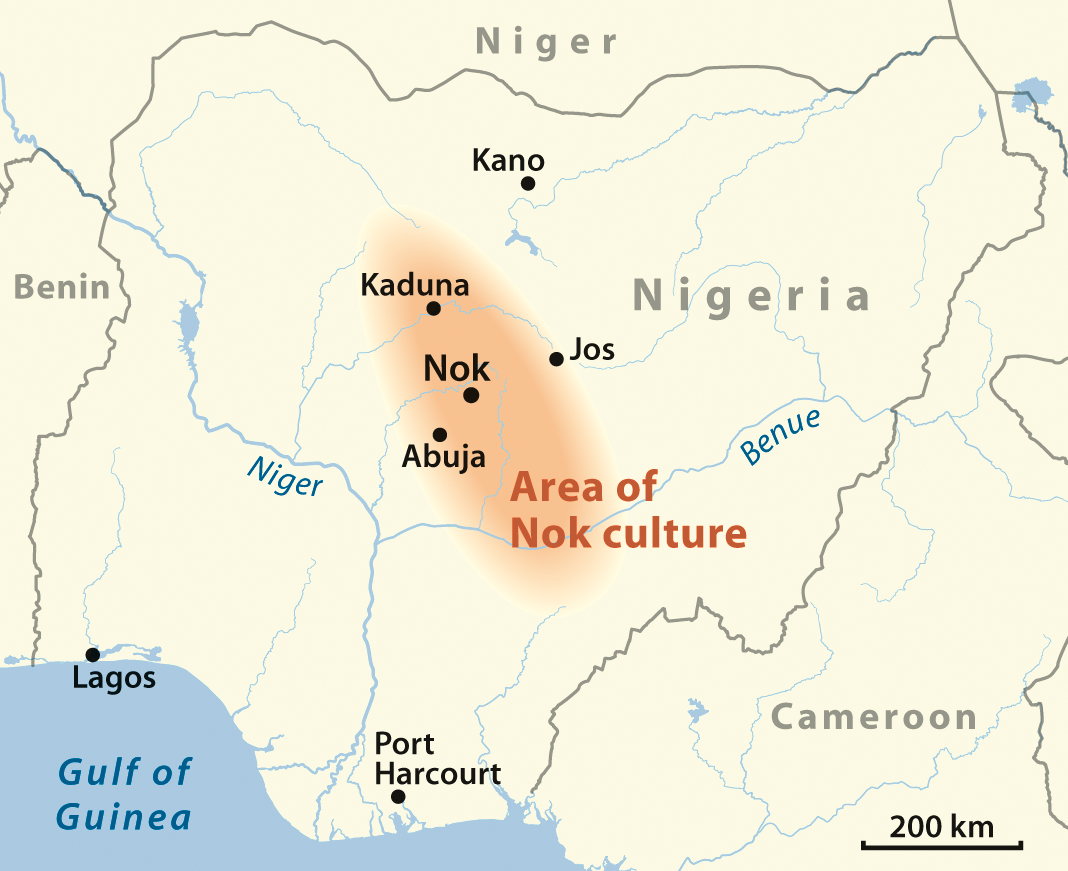
The Nok culture is a population whose material remains are named after the Ham village of Nok in southern Kaduna State of Nigeria, where their terracotta sculptures were first discovered in 1928. The Nok people and the Gajiganna people may have migrated from the Central Sahara, along with pearl millet and pottery, and diverged prior to arriving in the northern region of modern-day Nigeria. This may have led to their respective settlements in the regions of Gajiganna and Nok. Nok people may have also migrated from the West African Sahel to the region of Nok. Nok culture may have emerged in 1500 BCE and continued to persist until 1 BCE.
Nok people may have developed terracotta sculptures, through large-scale economic production, as part of a complex funerary culture that may have included practices such as feasting. The earliest Nok terracotta sculptures may have developed in 900 BCE. Some Nok terracotta sculptures portray figures wielding slingshots, as well as bows and arrows, which may be indicative of Nok people engaging in the hunting, or trapping, of undomesticated animals. A Nok sculpture portrays two individuals, along with their goods, in a dugout canoe. Both of the anthropomorphic figures in the watercraft are paddling. The Nok terracotta depiction of a dugout canoe may indicate that Nok people used dugout canoes to transport cargo, along tributaries (e.g., Gurara River) of the Niger River, and exchanged them in a regional trade network. The Nok terracotta depiction of a figure with a seashell on its head may indicate that the span of these riverine trade routes may have extended to the Atlantic coast. In the maritime history of Africa, there is the earlier Dufuna canoe, which was constructed approximately 8000 years ago in the northern region of Nigeria; as the second earliest form of water vessel known in Sub-Saharan Africa, the Nok terracotta depiction of a dugout canoe was created in the central region of Nigeria during the first millennium BCE. As part of Nok traditional medicine, Nok ceramics may have been used to process roots and bark as medicinal plants for the production of medicinal decoctions.
Excluding ancient Egyptian figurative art, Nok sculptures are regarded to be the earliest examples of large three-dimensional (sculptural) figurative art in continental Africa. Latter artistic traditions of West Africa – Bura of Niger (3rd century CE – 10th century CE), Koma of Ghana (7th century CE – 15th century CE), Igbo-Ukwu of Nigeria (9th century CE – 10th century CE), Jenne-Jeno of Mali (11th century CE – 12th century CE), and Ile Ife of Nigeria (11th century CE – 15th century CE) – may have been shaped by the earlier West African clay terracotta tradition of the Nok culture. Nok settlement sites are often found on mountaintops. Iron metallurgy may have independently developed in the Nok culture between 750 BCE and 550 BCE.
Breunig and Rupp (2016) stated: "Their origin is unknown, but since the plants they used as crops (especially millet) are indigenous to the Sahel region, a northern homeland is more probable than any other." Breunig (2017) expounded: "The people of the Nok culture must have come from somewhere else. So far, however, we have not found out what region, though we suspect the Sahel zone in West Africa." Champion et al. (2022) suggested that they may have come from the Central Sahara, and stated:
The cultivation of pearl millet diffused from the desiccating West and Central Sahara into the West African savanna zone after 2500 BCE, in the context of southwards population movements (Ozainne et al. 2014; Neumann 2018; Fuller et al. 2021)…The presence of pearl millet without roulette decorations or chaff temper, as seen in the Nok and early Gajiganna sites, suggests that the third diffusion originated directly from the central Sahara and possibly split before reaching northern Nigeria, accounting for the differences in Nok and Gajiganna pottery (Fig. 8; and see Champion 2020, p. 462).
The first Nok terracotta was discovered in 1928 by Colonel Dent Young, a co-owner of a mining partnership, near the village of Nok in Kaduna State, Nigeria. The terracotta was accidentally unearthed at a level of 24 feet (7 m) from an alluvial tin mine. Young presented the sculptures to the Museum of the Department of Mines in Jos.
Fifteen years later, in 1943 near the village of Nok, in the center of Nigeria, a new series of clay figurines were discovered by accident while mining tin. A clerk in charge of the mine had found a head and had taken it back to his home for use as a scarecrow, a role that it filled (successfully) for a year in a yam field. This scarecrow was eventually noticed by Bernard Fagg who at the time was an administrative officer who had studied archaeology at the University of Cambridge. Fagg noticed that the head on the scarecrow looked similar to the sculpture that Young had found. He traveled to Jos where Young showed Fagg other recently uncovered terracotta figures. Eventually it became clear that the tin mining in Nok and Jema'a areas was revealing and destroying archaeological material.
Hub AI
Nok culture AI simulator
(@Nok culture_simulator)
Nok culture
9°30′N 8°0′E / 9.500°N 8.000°E
The Nok culture is a population whose material remains are named after the Ham village of Nok in southern Kaduna State of Nigeria, where their terracotta sculptures were first discovered in 1928. The Nok people and the Gajiganna people may have migrated from the Central Sahara, along with pearl millet and pottery, and diverged prior to arriving in the northern region of modern-day Nigeria. This may have led to their respective settlements in the regions of Gajiganna and Nok. Nok people may have also migrated from the West African Sahel to the region of Nok. Nok culture may have emerged in 1500 BCE and continued to persist until 1 BCE.
Nok people may have developed terracotta sculptures, through large-scale economic production, as part of a complex funerary culture that may have included practices such as feasting. The earliest Nok terracotta sculptures may have developed in 900 BCE. Some Nok terracotta sculptures portray figures wielding slingshots, as well as bows and arrows, which may be indicative of Nok people engaging in the hunting, or trapping, of undomesticated animals. A Nok sculpture portrays two individuals, along with their goods, in a dugout canoe. Both of the anthropomorphic figures in the watercraft are paddling. The Nok terracotta depiction of a dugout canoe may indicate that Nok people used dugout canoes to transport cargo, along tributaries (e.g., Gurara River) of the Niger River, and exchanged them in a regional trade network. The Nok terracotta depiction of a figure with a seashell on its head may indicate that the span of these riverine trade routes may have extended to the Atlantic coast. In the maritime history of Africa, there is the earlier Dufuna canoe, which was constructed approximately 8000 years ago in the northern region of Nigeria; as the second earliest form of water vessel known in Sub-Saharan Africa, the Nok terracotta depiction of a dugout canoe was created in the central region of Nigeria during the first millennium BCE. As part of Nok traditional medicine, Nok ceramics may have been used to process roots and bark as medicinal plants for the production of medicinal decoctions.
Excluding ancient Egyptian figurative art, Nok sculptures are regarded to be the earliest examples of large three-dimensional (sculptural) figurative art in continental Africa. Latter artistic traditions of West Africa – Bura of Niger (3rd century CE – 10th century CE), Koma of Ghana (7th century CE – 15th century CE), Igbo-Ukwu of Nigeria (9th century CE – 10th century CE), Jenne-Jeno of Mali (11th century CE – 12th century CE), and Ile Ife of Nigeria (11th century CE – 15th century CE) – may have been shaped by the earlier West African clay terracotta tradition of the Nok culture. Nok settlement sites are often found on mountaintops. Iron metallurgy may have independently developed in the Nok culture between 750 BCE and 550 BCE.
Breunig and Rupp (2016) stated: "Their origin is unknown, but since the plants they used as crops (especially millet) are indigenous to the Sahel region, a northern homeland is more probable than any other." Breunig (2017) expounded: "The people of the Nok culture must have come from somewhere else. So far, however, we have not found out what region, though we suspect the Sahel zone in West Africa." Champion et al. (2022) suggested that they may have come from the Central Sahara, and stated:
The cultivation of pearl millet diffused from the desiccating West and Central Sahara into the West African savanna zone after 2500 BCE, in the context of southwards population movements (Ozainne et al. 2014; Neumann 2018; Fuller et al. 2021)…The presence of pearl millet without roulette decorations or chaff temper, as seen in the Nok and early Gajiganna sites, suggests that the third diffusion originated directly from the central Sahara and possibly split before reaching northern Nigeria, accounting for the differences in Nok and Gajiganna pottery (Fig. 8; and see Champion 2020, p. 462).
The first Nok terracotta was discovered in 1928 by Colonel Dent Young, a co-owner of a mining partnership, near the village of Nok in Kaduna State, Nigeria. The terracotta was accidentally unearthed at a level of 24 feet (7 m) from an alluvial tin mine. Young presented the sculptures to the Museum of the Department of Mines in Jos.
Fifteen years later, in 1943 near the village of Nok, in the center of Nigeria, a new series of clay figurines were discovered by accident while mining tin. A clerk in charge of the mine had found a head and had taken it back to his home for use as a scarecrow, a role that it filled (successfully) for a year in a yam field. This scarecrow was eventually noticed by Bernard Fagg who at the time was an administrative officer who had studied archaeology at the University of Cambridge. Fagg noticed that the head on the scarecrow looked similar to the sculpture that Young had found. He traveled to Jos where Young showed Fagg other recently uncovered terracotta figures. Eventually it became clear that the tin mining in Nok and Jema'a areas was revealing and destroying archaeological material.