


Community hub
Recent from talks
Contribute something
Nothing was collected or created yet.
Nokia 8110
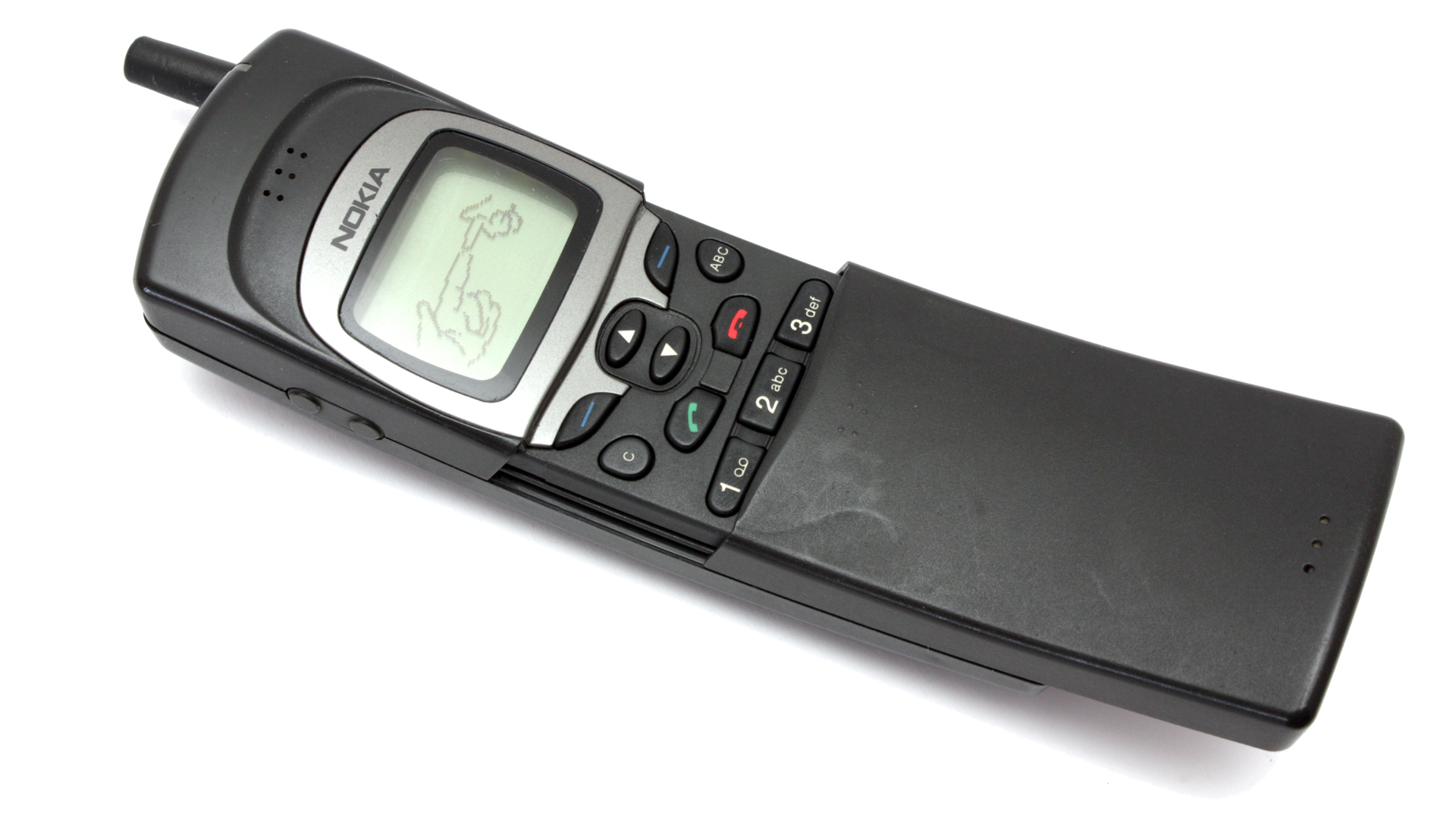
View on Wikipedia The Nokia 8110i, with its distinctive slide cover closed. | |
| Manufacturer | Nokia |
|---|---|
| Availability by region | Discontinued |
| Predecessor | Nokia 2140 (8110) Nokia 2140i (8110i) Nokia 2146 (8146) Nokia 2148 (8148) Nokia 2148i (8148i) |
| Successor | Nokia 7110 (8146) Nokia 7160 (8148) Nokia 7190 (8148i) Nokia 8110 4G (revival) Nokia 8810 (8110) Nokia 8860 (8110i) |
| Related | Nokia 3110 |
| Compatible networks | GSM-900 |
| Form factor | Slider |
| Dimensions | 141×48×25 mm (5.55×1.89×0.98 in) |
| Weight | 145 g (5 oz) |
| CPU | ARM7[1] |
| Memory | No |
| Removable storage | No |
| Battery | Slim 400 mAh Li-Ion, Extended 900 mAh Li-Ion |
| Display | Monochrome partly-graphic LCD |

Nokia 8110 is a mobile phone released in 1996. It was announced on 9 September 1996, as the first of Nokia's high-end 8000 series of phones.[2] Its distinctive styling was the first example of a 'slider' form factor. A sliding cover protected the keypad when being carried in the pocket and extended downwards in use, bringing the microphone closer to the mouth.[3] The action of opening the cover also answered an incoming call. The prominent curvature of the case, particularly when open, earned it the nickname "banana phone". It was also the first Nokia phone with monochrome graphic LCD.
The phone was designed for the business market and was one of the smallest and lightest (152 grams) phones on the market, but still had better battery life than its predecessor Nokia 2110. The phone was also the first GSM cellphone to use an ARM processor.[1]
The improved 8110i model, announced in March 1997, was the first phone with the SSMS (Smart SMS) engine.[4] The handsets could be updated OTA (Over The Air) with an intelligent menu structure, which allowed simple information input, input which was sent through a simple structured text message to an MT receiver. This station could interpret information and send a structured text message back to the handset. Ring tone receiving by SMS was also part of the smart messaging protocol, so 8110i was also the first mobile phone to support it. Nokia later stopped marketing Smart messaging and concentrated on the upcoming WAP standard, but has not dropped smart messaging support from later phones. The 8110 is visually the same as the 8110i, apart from on the earlier model, the Nokia logo appears in white. 8110 and 8110i models were succeeded by Nokia 8810 in 1998, while the 8146 and 8148 models were succeeded by Nokia 7110 in 1999.
Cultural references
[edit]An altered version of this phone was famously featured in the science fiction action film The Matrix (1999), for which it was modified featuring a spring-loaded mechanism (this actually appeared on the Nokia 7110).[5][6]
Variants
[edit]- The Nokia 8146/8148 for the GSM-1800 band.
- The Nokia 3110 shared the same engine.
See also
[edit]- Nokia 8110 4G
- Samsung SPH-N270, the phone from The Matrix Reloaded
References
[edit]- ^ a b Jeremy Reimer (21 November 2022). "A history of ARM, part 2: Everything starts to come together". Retrieved 31 January 2023.
- ^ "The Nokia 8110 - a New Generation Mobile Phone - Nokia". Nokia.
- ^ "The Nokia 8110 - a New Generation Mobile Phone" (Press release). Nokia. 1996-09-09. Retrieved 2018-01-23.
- ^ "Nokia Unveils a Range of New Superior Products at CeBIT'97 -Offering enhanced usability, new products enable fast and easy access to digital cellular services - Nokia". Nokia.
- ^ Phelan, David. "Nokia 8110 4G: The Coolest Secrets Of The New Matrix Banana Phone Revealed By Nokia's Design Elite". Forbes.
- ^ "Nokia slots itself into The Matrix" (Press release). Nokia. 1996-09-09. Retrieved 2018-01-23.
Nokia-branded mobile devices | |||
|---|---|---|---|
| 1000 series | |||
| 2000 series | |||
| 3000 series | |||
| 5000 series | |||
| 6000 series |
| ||
| 7000 series | |||
| 8000 series | |||
| 9000 series (Communicator) | |||
| 3-digit series (feature phone) | |||
| Asha series |
| ||
| Cseries | |||
| Eseries | |||
| Nseries |
| ||
| Xseries | |||
| 3-digit series (Symbian phone) | |||
| Lumia |
| ||
| Internet tablet | |||
| N-Gage | |||
| X family | |||
| Android smartphones2 | |||
| Originals2 | |||
| C series2 | |||
| G series2 | |||
| T series2 | |||
| X series2 | |||
| Other | |||

Nokia 8110
View on GrokipediaDevelopment and release
Development history
The development of the Nokia 8110 began in 1992 as part of the Nokia Mobile Phones design team's efforts in Finland to create a new visual language for mobile devices, led by industrial designer Andrea Finke-Anlauff during her diploma project at the company.[11][12] The project aimed to introduce a high-end model in what would become the 8000 series, emphasizing simplicity, elegance, and user familiarity to make emerging mobile technology feel approachable rather than intimidating.[2] Finke-Anlauff's concept drew inspiration from traditional telephone receivers, prioritizing privacy during calls and a form factor that users could intuitively grasp.[11] A core innovation was the introduction of Nokia's first sliding cover mechanism, designed for one-handed operation to reveal the keypad and microphone while protecting them when closed.[2] The phone's distinctive curved "banana" shape emerged from ergonomic considerations, bending the form to fit naturally against the face and provide a shield for the mouth during conversations, enhancing both grip and call comfort.[11] This plastic chassis construction allowed for a lightweight yet visually seamless design, with no distinct "back" side to maintain aesthetic appeal, integrating elements like the battery and antenna into the overall curve.[13] Development faced challenges in balancing advanced ideas with the technological constraints of the era, including shelving early concepts for a touchscreen interface above the keypad due to infeasibility in 1992.[14] The team revisited the banana-shaped prototype in 1994, adapting it to incorporate a two-softkey user interface and a full dot-matrix display while ensuring the slider's stability and the plastic materials' durability for GSM 900 standards.[11] This iterative process addressed the need to combine growing phone functionalities with a clean, premium look suitable for business users.[15]Launch and availability
The Nokia 8110 was announced on September 9, 1996, and released later that year as the first model in Nokia's high-end 8000 series of mobile phones.[16] It was designed primarily for GSM 900 networks and initially targeted European markets, where it quickly positioned itself at the premium end of the digital mobile phone segment.[1][17] Availability began through Nokia's established global distribution channels, with early rollout in Europe via partnerships with GSM operators such as Vodafone and Cellnet in the UK.[18] The phone also saw distribution in Asia-Pacific regions, supported by multilingual interfaces including Chinese, Thai, and Bahasa, reflecting Nokia's expanding presence in those markets.[19] The 8110 received positive early reception for its innovative slider mechanism and ergonomic design, which contributed to its premium appeal among business users and early adopters, though its positioning came with a relatively high cost compared to more basic handsets of the era.[17] Production continued through the late 1990s, with the model being succeeded by the Nokia 8810 in 1998 as consumer preferences shifted toward enhanced features like improved data capabilities.[2]Design and specifications
Physical design
The Nokia 8110 introduced an iconic curved, ergonomic form factor known as the "banana" shape, measuring 141 mm in height, 48 mm in width, and 25 mm in depth, with a weight of 152 grams, making it compact and suitable for pocket carry among business users seeking a premium handheld device.[1][18] This design emphasized one-handed operation, with a manual sliding cover that extended downward and outward to reveal the keypad and optimize the mouthpiece position for calls.[2][18] The phone's build utilized durable high-impact plastic construction in colors including black, orange, and cyan, contributing to its robust yet lightweight feel and resistance to everyday wear.[1][18] The slider mechanism protected the keypad when closed and was engineered for smooth, intuitive use, reflecting Nokia's focus on Scandinavian-inspired organic aesthetics harmonized with user ergonomics.[2][18] Key user interaction elements included an external antenna positioned at the top for signal reception, a dedicated navigation key for scrolling through menus, and a microphone integrated behind the slider to enhance voice clarity during extended use.[20][1][2] The design was recognized for its innovative slider mechanics, earning the "Best GSM Phone" award for 1996/1997 from What Cellphone magazine, underscoring its pioneering role in compact, user-friendly mobile form factors targeted at professional audiences.[18][21]Technical specifications
The Nokia 8110 was compatible with the GSM 900 MHz network, supporting fundamental voice calls and SMS messaging without advanced data capabilities beyond text.[1] It featured a monochrome LCD display with a resolution of 84 × 48 pixels for basic text and icon rendering, paired with an alphanumeric keypad that included dedicated keys for call functions, menu navigation, and quick access to features like the phonebook.[1][2] Power was supplied by a removable NiMH battery, rated at up to 300 minutes of talk time and 150 hours of standby, charged via a proprietary Nokia connector; the slider mechanism helped protect the battery and other internal components during pocket carry.[1] The device supported up to 100 phonebook contacts (with name and number fields) and call logs for 20 dialed, received, and missed calls each.[22]Features and software
User interface and software
The Nokia 8110 ran a proprietary operating system developed by Nokia, built on the DCT2 (Digital Core Technology 2) hardware platform, which provided the foundational software architecture for basic GSM functionality without support for advanced features like Java or WAP. This OS emphasized simplicity and reliability, featuring a text-based menu system that users navigated primarily via a single rocker-style scroll key located below the display, allowing up and down movement to select options. The interface displayed fixed icons alongside alphanumeric text on its monochrome LCD screen (84 x 48 pixels), prioritizing readability over graphics.[23][24] The menu structure was strictly hierarchical, organized into numbered categories accessible by entering short codes or scrolling sequentially—for instance, pressing the menu key followed by "2" for call log, then "2 1" for missed calls, and suboptions like profiles (Menu 3), settings (Menu 4, including language selection under 4 8), calls (Menu 1), messages (Menu 2), and basic applications (Menu 5 onward). Without graphical icons for quick selection, navigation relied on numeric input or the rocker key to traverse these levels, with two softkeys below the screen for actions like "Select" or "Back." This design facilitated efficient access to core functions but required users to memorize or reference menu numbers for speed. Multilingual support was integrated, allowing selection of European languages such as English, German, French, and Spanish through the settings menu, enabling text display and input adaptation without hardware changes.[25][26] For text input, particularly in SMS composition (limited to 160 characters), the phone used a standard multi-tap method on its 12-key alphanumeric keypad, where users pressed keys multiple times to cycle through letters (e.g., pressing "2" once for A, twice for B, three times for C). No predictive text system like T9 was available on the original model, making longer messages time-consuming compared to later Nokia devices. The software architecture imposed clear limitations, including no support for multitasking—users could not run multiple processes simultaneously—and firmware updates were infrequent, typically handled through carrier-specific service centers rather than over-the-air methods, often varying by region and requiring physical hardware flashing. These constraints reflected the era's focus on durable, single-task voice and messaging capabilities.[23][27][24]Key functionalities
The Nokia 8110 provided essential communication tools that facilitated reliable mobile connectivity in the late 1990s. It supported SMS messaging, enabling users to send and receive text messages limited to 160 characters each, a standard feature for GSM phones at the time. Speed dialing allowed quick access to up to eight stored numbers (memory locations 2 through 9), streamlining frequent calls without manual entry. The device also incorporated network-dependent services like call waiting, which notified users of incoming calls during active conversations, and call divert, which redirected calls to another number or voicemail.[1][26][28][29] For productivity, the Nokia 8110 included practical built-in aids to support routine organization and calculations. The phonebook accommodated up to 125 entries in the phone's memory, plus additional entries on the SIM card, with speed dialing integration for efficient retrieval. An alarm clock function permitted setting timed alerts, useful for appointments or wake-ups, while a basic calculator handled arithmetic operations like addition, subtraction, multiplication, and division. These features, accessible via the menu system, emphasized simplicity for on-the-go use without complex navigation.[30][31][31][32] Entertainment options on the Nokia 8110 were modest but engaging for the era, focusing on lightweight diversions during downtime. It came pre-installed with the Memory game, a pair-matching puzzle where players flipped cards on the monochrome display to find identical icons within a grid, promoting quick sessions of mental exercise. Users could compose simple monophonic ringtones by selecting and sequencing notes from a basic editor, personalizing alerts beyond the pre-set monophonic tones. A stopwatch tool offered timing capabilities for sports or informal tracking, rendered clearly on the phone's graphic LCD.[33][30][1] Security features on the Nokia 8110 helped protect against unauthorized access and control usage costs. PIN protection required a four-to-eight digit code to unlock the SIM card upon startup, preventing use if the device was lost or stolen. Call barring allowed users to restrict outgoing or incoming calls via network services, often secured by a separate PIN2 code, while additional options like fixed dialing limited calls to pre-approved numbers for added control. These measures provided foundational safeguards in an era of emerging mobile theft concerns.[34][29][30]Variants
Original model
The Nokia 8110, designated as type NHE-6BX, was released in 1996 as Nokia's inaugural slider phone, emphasizing core voice calling and SMS messaging capabilities without any internet connectivity features.[1][2] This model operated on the 2G GSM 900 network, supporting up to 100 phone book entries and basic text messaging, with a monochrome graphic LCD display measuring 84 x 48 pixels for simple menu navigation and adjustable text sizes.[1] Its design prioritized portability, weighing 152 grams and measuring 141 x 48 x 25 mm, making it a compact alternative to the bulkier brick-style phones prevalent at the time.[35] The original 8110 featured a standard sliding mechanism with an ergonomically curved body—earning it the nickname "banana phone"—that protected the keypad when closed and allowed quick access for one-handed use.[2] Available primarily in black with limited color variants, it included a removable 400 mAh NiMH battery offering up to 300 minutes of talk time and 150 hours of standby, alongside infrared connectivity for data transfer with compatible accessories.[1][3] Unlike later iterations, this base model lacked enhancements such as WAP browsing or expanded network bands, focusing instead on reliable basic functionality.[3] Targeted at professionals desiring a stylish yet practical mobile solution, it represented Nokia's entry into the premium segment with Scandinavian design aesthetics that balanced form and utility over rugged durability.[36] The model was phased out around 1998-1999, succeeded by the Nokia 8810 as market demands shifted toward more advanced displays and features like color screens in subsequent devices.[1][18]Enhanced models
The Nokia 8110i, released in early 1997, represented a key enhancement to the original Nokia 8110 by introducing support for the company's Smart Messaging protocol, which enabled dynamic menus and text-based information services like downloadable ringtones and over-the-air updates. This upgrade positioned the 8110i as the first Nokia phone to offer such capabilities, bridging basic SMS functionality with emerging data services. The model also added an infrared (IrDA) port for wireless data transfer between compatible devices, enhancing connectivity options without altering the phone's core form factor.[3][37][27] Retaining the iconic curved "banana" slider design of its predecessor, the 8110i maintained ergonomic appeal with a sliding cover that protected the keypad and facilitated one-handed use. Internally, it featured a monochrome graphic display with a 96 x 65 pixel resolution, allowing for improved visibility of menus and messages compared to earlier iterations. Weighing 152 grams, the phone emphasized portability for business users, with firmware optimizations that contributed to better battery efficiency over prolonged use.[38][39][10] Other variants included regional adaptations like the 8146, tailored for specific markets with adjusted GSM frequency support—such as dual-band 900/1800 MHz configurations—to ensure compatibility in diverse networks, along with minor firmware tweaks for localized performance. Additional custom variants were the NK502 and NK503 for the Orange network in the UK, and the 8148i as an improved dual-band model. These enhancements extended the 8110 series' relevance through the late 1990s, sustaining its market presence against competitors introducing similar slider mechanisms.[18]Cultural significance
In popular media
The Nokia 8110 achieved widespread recognition through its prominent role in the 1999 science fiction film The Matrix, where it served as the signature phone of the character Trinity, portrayed by Carrie-Anne Moss.[2] The device appeared in multiple key scenes, often used to facilitate escapes from the simulated reality by dialing into the real world, symbolizing a portal between dimensions.[40] For the film, production designers modified the standard Nokia 8110 by painting it black and adding a custom spring-loaded slider mechanism, allowing the cover to snap open dramatically during action sequences—a feature absent from the commercial model.[14] This enhanced version, with its sleek, curved form, amplified the phone's futuristic appeal and contributed to its enduring association with cyberpunk aesthetics.[41] The film's success drove a notable surge in popularity of the Nokia 8110 during 1999–2000, elevating the device from a niche high-end product to a cultural symbol. Its distinctive curved design also earned it the affectionate nickname "banana phone" in media portrayals.[21] Beyond The Matrix, the Nokia 8110 appeared in various late-1990s advertisements and music videos, showcasing its innovative slider and ergonomic form as a status symbol for tech-savvy users.[42]Legacy and influence
The Nokia 8110 pioneered the slider form factor in mobile phones, introducing a curved, ergonomic sliding mechanism in 1996 that revealed the keypad, setting a precedent for innovative designs in the industry.[43][2] This distinctive "banana" shape and sliding action influenced subsequent devices, including the Motorola Razr series in the early 2000s, which popularized sliders further, and even later Android-based sliding phones that echoed its compact, stylish appeal.[44] The 8110's design contributed to Nokia's dominance in the 1990s mobile market, where the company became the world's leading cellphone producer through a series of iconic, user-friendly devices that emphasized form and function.[45] Its appearance in the 1999 film The Matrix as Trinity's phone amplified its cultural fame, cementing the slider's association with futuristic style. In 2018, HMD Global revived the Nokia 8110 as the 8110 4G, retaining the signature banana-shaped slider while updating it with 4G LTE connectivity, a curved 2.4-inch screen, and basic smart features on the S30+ platform to appeal to modern users seeking simplicity.[14][46] This remake evoked strong nostalgia, offering multi-day battery life and wireless hotspot capabilities without the complexities of full smartphones.[47] In December 2024, the Nokia Design Archive opened at Aalto University in Finland, showcasing the 8110 among thousands of documents, prototypes, and designs that highlight its role in shaping 1990s mobile phone aesthetics and pop culture impact.[48] Today, original Nokia 8110 units are highly collectible in retro markets, with well-preserved examples fetching $100 or more on platforms like eBay, valued for their durable build and representation of pre-smartphone era reliability.[49] They symbolize a time of straightforward communication, free from app overload, appealing to enthusiasts who appreciate the phone's mechanical charm and historical significance.[50] The 8110 helped shift mobile phones toward fashion accessories in the late 1990s and 2000s, with its sleek, curvaceous design influencing feature phone trends that prioritized aesthetics and personalization over raw functionality, driving brand loyalty in a maturing market.[51] This legacy endures in ongoing revivals and design archives that highlight Nokia's role in making mobiles stylish everyday items.[52]References
- https://lpcwiki.miraheze.org/wiki/Nokia_8110