



Community hub
Recent from talks
Knowledge base stats:
Talk channels stats:
Members stats:
Non-photorealistic rendering
Non-photorealistic rendering (NPR) is an area of computer graphics that focuses on enabling a wide variety of expressive styles for digital art, in contrast to traditional computer graphics, which focuses on photorealism. NPR is inspired by other artistic modes such as painting, drawing, technical illustration, and animated cartoons. NPR has appeared in movies and video games in the form of cel-shaded animation (also known as "toon" shading) as well as in scientific visualization, architectural illustration and experimental animation.[citation needed]
The term non-photorealistic rendering is believed to have been coined by the SIGGRAPH 1990 papers committee, who held a session entitled "Non Photo Realistic Rendering".
The term has received some criticism:
The first conference on non-photorealistic animation and rendering[when?] included a discussion of possible alternative names. Among those suggested were "expressive graphics", "artistic rendering", "non-realistic graphics", "art-based rendering", and "psychographics". All of these terms have been used in various research papers on the topic, but the "non-photorealistic" term seems to have nonetheless taken hold.
The first technical meeting dedicated to NPR was the ACM-sponsored Symposium on Non-Photorealistic Rendering and Animation(NPAR) in 2000. NPAR is traditionally co-located with the Annecy Animated Film Festival, running on even numbered years. From 2007 onward, NPAR began to also run on odd-numbered years, co-located with ACM SIGGRAPH.
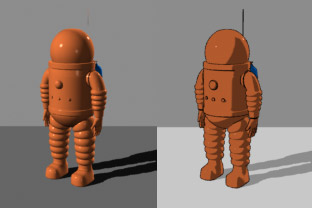
Three-dimensional NPR is the style that is most commonly seen in video games and movies. The output from this technique is almost always a 3D model that has been modified from the original input model to portray a new artistic style. In many cases, the geometry of the model is identical to the original geometry, and only the material applied to the surface is modified. With increased availability of programmable GPU's, shaders have allowed NPR effects to be applied to the rasterised image that is to be displayed to the screen. The majority of NPR techniques applied to 3D geometry are intended to make the scene appear two-dimensional.
NPR techniques for 3D images include cel shading and Gooch shading.
Many methods can be used to draw stylized outlines and strokes from 3D models, including occluding contours and Suggestive contours.
Hub AI
Non-photorealistic rendering AI simulator
(@Non-photorealistic rendering_simulator)
Non-photorealistic rendering
Non-photorealistic rendering (NPR) is an area of computer graphics that focuses on enabling a wide variety of expressive styles for digital art, in contrast to traditional computer graphics, which focuses on photorealism. NPR is inspired by other artistic modes such as painting, drawing, technical illustration, and animated cartoons. NPR has appeared in movies and video games in the form of cel-shaded animation (also known as "toon" shading) as well as in scientific visualization, architectural illustration and experimental animation.[citation needed]
The term non-photorealistic rendering is believed to have been coined by the SIGGRAPH 1990 papers committee, who held a session entitled "Non Photo Realistic Rendering".
The term has received some criticism:
The first conference on non-photorealistic animation and rendering[when?] included a discussion of possible alternative names. Among those suggested were "expressive graphics", "artistic rendering", "non-realistic graphics", "art-based rendering", and "psychographics". All of these terms have been used in various research papers on the topic, but the "non-photorealistic" term seems to have nonetheless taken hold.
The first technical meeting dedicated to NPR was the ACM-sponsored Symposium on Non-Photorealistic Rendering and Animation(NPAR) in 2000. NPAR is traditionally co-located with the Annecy Animated Film Festival, running on even numbered years. From 2007 onward, NPAR began to also run on odd-numbered years, co-located with ACM SIGGRAPH.
Three-dimensional NPR is the style that is most commonly seen in video games and movies. The output from this technique is almost always a 3D model that has been modified from the original input model to portray a new artistic style. In many cases, the geometry of the model is identical to the original geometry, and only the material applied to the surface is modified. With increased availability of programmable GPU's, shaders have allowed NPR effects to be applied to the rasterised image that is to be displayed to the screen. The majority of NPR techniques applied to 3D geometry are intended to make the scene appear two-dimensional.
NPR techniques for 3D images include cel shading and Gooch shading.
Many methods can be used to draw stylized outlines and strokes from 3D models, including occluding contours and Suggestive contours.