Hubbry Logo
Scientific visualizationScientific visualizationMain
Open search
Scientific visualization
Community hub
Scientific visualization
logo
8 pages, 0 posts
0 subscribers
Be the first to start a discussion here.
Scientific visualization
from Wikipedia
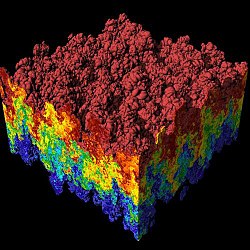
A scientific visualization of a simulation of a Rayleigh–Taylor instability caused by two mixing fluids.[1]
Surface rendering of Arabidopsis thaliana pollen grains with confocal microscope.

Scientific visualization (also spelled scientific visualisation) is an interdisciplinary branch of science concerned with the visualization of scientific phenomena.[2] It is also considered a subset of computer graphics, a branch of computer science. The purpose of scientific visualization is to graphically illustrate scientific data to enable scientists to understand, illustrate, and glean insight from their data. Research into how people read and misread various types of visualizations is helping to determine what types and features of visualizations are most understandable and effective in conveying information.[3][4]

History

[edit]
Charles Minard's flow map of Napoleon's March.

One of the earliest examples of three-dimensional scientific visualisation was Maxwell's thermodynamic surface, sculpted in clay in 1874 by James Clerk Maxwell.[5] This prefigured modern scientific visualization techniques that use computer graphics.[6]

Notable early two-dimensional examples include the flow map of Napoleon's March on Moscow produced by Charles Joseph Minard in 1869;[2] the "coxcombs" used by Florence Nightingale in 1857 as part of a campaign to improve sanitary conditions in the British Army;[2] and the dot map used by John Snow in 1855 to visualise the Broad Street cholera outbreak.[2]

Data visualization methods

[edit]

Criteria for classifications:

  • dimension of the data
  • method
    • textura based methods
    • geometry-based approaches such as arrow plots, streamlines, pathlines, timelines, streaklines, particle tracing, surface particles, stream arrows, stream tubes, stream balls, flow volumes and topological analysis

Two-dimensional data sets

[edit]

Scientific visualization using computer graphics gained in popularity as graphics matured. Primary applications were scalar fields and vector fields from computer simulations and also measured data. The primary methods for visualizing two-dimensional (2D) scalar fields are color mapping and drawing contour lines. 2D vector fields are visualized using glyphs and streamlines or line integral convolution methods. 2D tensor fields are often resolved to a vector field by using one of the two eigenvectors to represent the tensor each point in the field and then visualized using vector field visualization methods.

Three-dimensional data sets

[edit]

For 3D scalar fields the primary methods are volume rendering and isosurfaces. Methods for visualizing vector fields include glyphs (graphical icons) such as arrows, streamlines and streaklines, particle tracing, line integral convolution (LIC) and topological methods. Later, visualization techniques such as hyperstreamlines[7] were developed to visualize 2D and 3D tensor fields.

Topics

[edit]
Maximum intensity projection (MIP) of a whole body PET scan.
Solar System image of the main asteroid belt and the Trojan asteroids.
Scientific visualization of Fluid Flow: Surface waves in water
Chemical imaging of a simultaneous release of SF6 and NH3.
Topographic scan of a glass surface by an Atomic force microscope.

Computer animation

[edit]

Computer animation is the art, technique, and science of creating moving images via the use of computers. It is becoming more common to be created by means of 3D computer graphics, though 2D computer graphics are still widely used for stylistic, low bandwidth, and faster real-time rendering needs. Sometimes the target of the animation is the computer itself, but sometimes the target is another medium, such as film. It is also referred to as CGI (Computer-generated imagery or computer-generated imaging), especially when used in films. Applications include medical animation, which is most commonly utilized as an instructional tool for medical professionals or their patients.

Computer simulation

[edit]

Computer simulation is a computer program, or network of computers, that attempts to simulate an abstract model of a particular system. Computer simulations have become a useful part of mathematical modelling of many natural systems in physics, and computational physics, chemistry and biology; human systems in economics, psychology, and social science; and in the process of engineering and new technology, to gain insight into the operation of those systems, or to observe their behavior.[8] The simultaneous visualization and simulation of a system is called visulation.

Computer simulations vary from computer programs that run a few minutes, to network-based groups of computers running for hours, to ongoing simulations that run for months. The scale of events being simulated by computer simulations has far exceeded anything possible (or perhaps even imaginable) using the traditional paper-and-pencil mathematical modeling: over 10 years ago, a desert-battle simulation, of one force invading another, involved the modeling of 66,239 tanks, trucks and other vehicles on simulated terrain around Kuwait, using multiple supercomputers in the DoD High Performance Computing Modernization Program.[9]

Information visualization

[edit]

Information visualization is the study of "the visual representation of large-scale collections of non-numerical information, such as files and lines of code in software systems, library and bibliographic databases, networks of relations on the internet, and so forth".[2]

Information visualization focused on the creation of approaches for conveying abstract information in intuitive ways. Visual representations and interaction techniques take advantage of the human eye's broad bandwidth pathway into the mind to allow users to see, explore, and understand large amounts of information at once.[10] The key difference between scientific visualization and information visualization is that information visualization is often applied to data that is not generated by scientific inquiry. Some examples are graphical representations of data for business, government, news and social media.

Interface technology and perception

[edit]

Interface technology and perception shows how new interfaces and a better understanding of underlying perceptual issues create new opportunities for the scientific visualization community.[11]

Surface rendering

[edit]

Rendering is the process of generating an image from a model, by means of computer programs. The model is a description of three-dimensional objects in a strictly defined language or data structure. It would contain geometry, viewpoint, texture, lighting, and shading information. The image is a digital image or raster graphics image. The term may be by analogy with an "artist's rendering" of a scene. 'Rendering' is also used to describe the process of calculating effects in a video editing file to produce final video output. Important rendering techniques are:

Scanline rendering and rasterisation
A high-level representation of an image necessarily contains elements in a different domain from pixels. These elements are referred to as primitives. In a schematic drawing, for instance, line segments and curves might be primitives. In a graphical user interface, windows and buttons might be the primitives. In 3D rendering, triangles and polygons in space might be primitives.
Ray casting
Ray casting is primarily used for realtime simulations, such as those used in 3D computer games and cartoon animations, where detail is not important, or where it is more efficient to manually fake the details in order to obtain better performance in the computational stage. This is usually the case when a large number of frames need to be animated. The resulting surfaces have a characteristic 'flat' appearance when no additional tricks are used, as if objects in the scene were all painted with matte finish.
Radiosity
Radiosity, also known as Global Illumination, is a method that attempts to simulate the way in which directly illuminated surfaces act as indirect light sources that illuminate other surfaces. This produces more realistic shading and seems to better capture the 'ambience' of an indoor scene. A classic example is the way that shadows 'hug' the corners of rooms.
Ray tracing
Ray tracing is an extension of the same technique developed in scanline rendering and ray casting. Like those, it handles complicated objects well, and the objects may be described mathematically. Unlike scanline and casting, ray tracing is almost always a Monte Carlo technique, that is one based on averaging a number of randomly generated samples from a model.

Volume rendering

[edit]

Volume rendering is a technique used to display a 2D projection of a 3D discretely sampled data set. A typical 3D data set is a group of 2D slice images acquired by a CT or MRI scanner. Usually these are acquired in a regular pattern (e.g., one slice every millimeter) and usually have a regular number of image pixels in a regular pattern. This is an example of a regular volumetric grid, with each volume element, or voxel represented by a single value that is obtained by sampling the immediate area surrounding the voxel.

Volume visualization

[edit]

According to Rosenblum (1994) "volume visualization examines a set of techniques that allows viewing an object without mathematically representing the other surface. Initially used in medical imaging, volume visualization has become an essential technique for many sciences, portraying phenomena become an essential technique such as clouds, water flows, and molecular and biological structure. Many volume visualization algorithms are computationally expensive and demand large data storage. Advances in hardware and software are generalizing volume visualization as well as real time performances".

Developments of web-based technologies, and in-browser rendering have allowed of simple volumetric presentation of a cuboid with a changing frame of reference to show volume, mass and density data.[11]

Applications

[edit]

This section will give a series of examples how scientific visualization can be applied today.[12]

In the natural sciences

[edit]

Star formation: The featured plot is a Volume plot of the logarithm of gas/dust density in an Enzo star and galaxy simulation. Regions of high density are white while less dense regions are more blue and also more transparent.

Gravitational waves: Researchers used the Globus Toolkit to harness the power of multiple supercomputers to simulate the gravitational effects of black-hole collisions.

Massive Star Supernovae Explosions: In the image, three-Dimensional Radiation Hydrodynamics Calculations of Massive Star Supernovae Explosions The DJEHUTY stellar evolution code was used to calculate the explosion of SN 1987A model in three dimensions.

Molecular rendering: VisIt's general plotting capabilities were used to create the molecular rendering shown in the featured visualization. The original data was taken from the Protein Data Bank and turned into a VTK file before rendering.

In geography and ecology

[edit]

Terrain visualization: VisIt can read several file formats common in the field of Geographic Information Systems (GIS), allowing one to plot raster data such as terrain data in visualizations. The featured image shows a plot of a DEM dataset containing mountainous areas near Dunsmuir, CA. Elevation lines are added to the plot to help delineate changes in elevation.

Tornado Simulation: This image was created from data generated by a tornado simulation calculated on NCSA's IBM p690 computing cluster. High-definition television animations of the storm produced at NCSA were included in an episode of the PBS television series NOVA called "Hunt for the Supertwister." The tornado is shown by spheres that are colored according to pressure; orange and blue tubes represent the rising and falling airflow around the tornado.

Climate visualization: This visualization depicts the carbon dioxide from various sources that are advected individually as tracers in the atmosphere model. Carbon dioxide from the ocean is shown as plumes during February 1900.

Atmospheric Anomaly in Times Square In the image the results from the SAMRAI simulation framework of an atmospheric anomaly in and around Times Square are visualized.

View of a 4D cube projected into 3D: orthogonal projection (left) and perspective projection (right).

In mathematics

[edit]

Scientific visualization of mathematical structures has been undertaken for purposes of building intuition and for aiding the forming of mental models.[16]

Domain coloring of f(x) = (x2−1)(x−2−i)2/x2+2+2i

Higher-dimensional objects can be visualized in form of projections (views) in lower dimensions. In particular, 4-dimensional objects are visualized by means of projection in three dimensions. The lower-dimensional projections of higher-dimensional objects can be used for purposes of virtual object manipulation, allowing 3D objects to be manipulated by operations performed in 2D,[17] and 4D objects by interactions performed in 3D.[18]

In complex analysis, functions of the complex plane are inherently 4-dimensional, but there is no natural geometric projection into lower dimensional visual representations. Instead, colour vision is exploited to capture dimensional information using techniques such as domain coloring.

In the formal sciences

[edit]

Computer mapping of topographical surfaces: Through computer mapping of topographical surfaces, mathematicians can test theories of how materials will change when stressed. The imaging is part of the work on the NSF-funded Electronic Visualization Laboratory at the University of Illinois at Chicago.

Curve plots: VisIt can plot curves from data read from files and it can be used to extract and plot curve data from higher-dimensional datasets using lineout operators or queries. The curves in the featured image correspond to elevation data along lines drawn on DEM data and were created with the feature lineout capability. Lineout allows you to interactively draw a line, which specifies a path for data extraction. The resulting data was then plotted as curves.

Image annotations: The featured plot shows Leaf Area Index (LAI), a measure of global vegetative matter, from a NetCDF dataset. The primary plot is the large plot at the bottom, which shows the LAI for the whole world. The plots on top are actually annotations that contain images generated earlier. Image annotations can be used to include material that enhances a visualization such as auxiliary plots, images of experimental data, project logos, etc.

Scatter plot: VisIt's Scatter plot allows visualizing multivariate data of up to four dimensions. The Scatter plot takes multiple scalar variables and uses them for different axes in phase space. The different variables are combined to form coordinates in the phase space and they are displayed using glyphs and colored using another scalar variable.

In the applied sciences

[edit]

Porsche 911 model (NASTRAN model): The featured plot contains a Mesh plot of a Porsche 911 model imported from a NASTRAN bulk data file. VisIt can read a limited subset of NASTRAN bulk data files, in general enough to import model geometry for visualization.

YF-17 aircraft Plot: The featured image displays plots of a CGNS dataset representing a YF-17 jet aircraft. The dataset consists of an unstructured grid with solution. The image was created by using a pseudocolor plot of the dataset's Mach variable, a Mesh plot of the grid, and Vector plot of a slice through the Velocity field.

City rendering: An ESRI shapefile containing a polygonal description of the building footprints was read in and then the polygons were resampled onto a rectilinear grid, which was extruded into the featured cityscape.

Inbound traffic measured: This image is a visualization study of inbound traffic measured in billions of bytes on the NSFNET T1 backbone for the month of September 1991. The traffic volume range is depicted from purple (zero bytes) to white (100 billion bytes). It represents data collected by Merit Network, Inc.[19]

Organizations

[edit]

See also

[edit]
General
Publications
Software

References

[edit]

Further reading

[edit]
[edit]
Revisions and contributorsEdit on WikipediaRead on Wikipedia
from Grokipedia
Scientific visualization is a discipline within and that employs computational methods to generate interactive visual representations of complex scientific data, such as scalar fields, vector fields, and multidimensional datasets, thereby facilitating the , , and interpretation of phenomena that are otherwise invisible or abstract. This field transforms symbolic and numerical information into geometric and perceptual forms, enabling researchers to observe simulations, computations, and real-world measurements in intuitive ways to derive insights and drive discoveries. Emerging as a formal area of study in the mid-1980s, scientific visualization gained prominence through a 1986 U.S. (NSF) panel and a subsequent 1987 report titled Visualization in Scientific Computing, which highlighted its potential to unify , image processing, and for handling the deluge of data from supercomputers and sensors. The primary goals include enhancing human understanding by leveraging the brain's visual processing capabilities—to which approximately 30–50% of the is dedicated—to compress vast datasets into comprehensible formats, support interactive exploration, and communicate findings efficiently across disciplines. Key techniques encompass for scalar data, streamline and particle for vector fields, extraction, glyph-based representations, and contour mapping, often implemented using toolkits like and . In contemporary applications, scientific visualization is indispensable in fields such as physics, , science, and engineering, where it aids in modeling , , astronomical simulations, and molecular structures. Recent advances integrate techniques, including convolutional neural networks (CNNs) for feature extraction and super-resolution, generative adversarial networks (GANs) for data synthesis, and graph neural networks (GNNs) for multivariate analysis, dramatically improving rendering efficiency and handling petabyte-scale datasets from modern simulations. These developments, surging since 2016 alongside hardware improvements, address challenges like data uncertainty, , and multifield interactions, while emphasizing perceptual principles to ensure accurate and effective visual encodings. Overall, scientific visualization not only revolutionizes scientific inquiry by making the unseen visible but also enhances collaborative and in data-driven .

Overview and Fundamentals

Definition and Scope

Scientific visualization refers to the use of computer-supported, interactive visual representations to depict abstract scientific data, thereby amplifying human cognition and facilitating deeper understanding of complex phenomena. This process transforms symbolic and numerical data into geometric forms, allowing researchers to observe and interpret simulations, computations, and empirical observations that would otherwise be inaccessible. As a formal discipline within computer science, it integrates user interfaces, data processing algorithms, and sensory presentation techniques to enable exploratory analysis. Unlike general data visualization, which typically emphasizes , statistical summaries, or non-spatial information, scientific visualization concentrates on data with inherent physical or spatial properties, such as results from simulations, measurements, or experimental instruments. For instance, it prioritizes rendering spatial-temporal datasets like or over abstract relational graphs common in information visualization. The scope of scientific visualization includes scalar fields (e.g., temperature distributions), vector fields (e.g., velocity flows), and tensor fields (e.g., stress tensors), accommodating both static images and dynamic animations across diverse scientific fields like physics, , and earth sciences. These representations draw from multi-dimensional data sources, including outputs, , and medical scanners, supporting interdisciplinary applications. This field emerged prominently in the , driven by advances in power that enabled handling vast sets, though its foundations trace back to manual scientific illustrations used for centuries to communicate empirical findings.

Key Principles and Goals

Scientific visualization is guided by core principles that ensure visualizations serve as reliable tools for scientific . Central among these is accuracy, which demands faithful representation of without introducing or misleading interpretations, such as preserving topological relationships in spatial data mappings. Complementing accuracy is clarity, which prioritizes avoiding visual clutter through simplification and emphasis on salient features, enabling viewers to discern patterns without cognitive overload. Finally, interactivity empowers users to drive exploration, such as through dynamic views or manipulations that reveal hidden structures in complex sets. The primary goals of scientific visualization extend beyond mere depiction to facilitate active scientific processes. It supports hypothesis generation by allowing users to identify trends and relationships that inspire testable predictions, as in correlating variables to form initial conjectures. Data validation is another key objective, where visualizations help confirm or refute expectations by highlighting anomalies or consistencies in datasets. Additionally, it enables pattern discovery, uncovering clusters or distributions that might otherwise remain obscured in raw data. A further aim is communication of scientific insights to non-experts, translating complex findings into accessible narratives that bridge disciplinary gaps. At its foundation, scientific visualization leverages human to accelerate insight, drawing on cognitive principles for effective design. Gestalt principles, such as proximity and similarity, guide how viewers group and interpret visual elements into coherent wholes, reducing perceptual effort in complex scenes. Visual encoding maps data attributes to perceptual channels—like position, color, and size—ranked by decoding accuracy to optimize interpretability; for instance, position along a common scale is more precise than color hue for quantitative comparisons. These aspects exploit the brain's to enable rapid , far surpassing textual analysis in speed and intuition. Success in scientific visualization is assessed through metrics that quantify its utility in real tasks. Visual effectiveness is commonly evaluated via task completion time, measuring how quickly users derive insights, and error rates in interpretation, tracking inaccuracies in data judgments. These metrics, often derived from controlled user studies, provide of a visualization's support for accurate and efficient , though they are supplemented by qualitative measures for deeper validation. For example, in natural sciences like , reduced task times via effective encodings can accelerate discoveries in simulation data.

Historical Development

Early Origins and Analog Methods

The roots of scientific visualization extend to prehistoric times, where early humans employed pictorial representations to convey environmental and astronomical observations. The Lascaux cave paintings in France, dating back approximately 17,000 years, are among the earliest known examples, with certain motifs interpreted as depictions of constellations and celestial events, serving as a means to record and communicate astronomical data visually. In the early modern period, Leonardo da Vinci advanced anatomical visualization through meticulous sketches based on dissections, producing over 200 detailed drawings that illustrated human physiology with unprecedented accuracy, blending artistic technique with scientific inquiry to reveal internal structures. These works, created around 1500–1510, exemplified the use of cross-sections and layered perspectives to aid understanding of complex biological forms. By the 19th century, scientific visualization evolved toward more systematic graphical methods, particularly in geography and meteorology. Alexander von Humboldt pioneered the use of isolines—contour lines connecting points of equal value—in his 1817 map of global isotherms, which visualized temperature distributions across continents and oceans, revealing climatic patterns and influencing subsequent cartographic practices. This approach marked a shift from tabular data to spatial representations, enabling scientists to discern trends in environmental data that were otherwise obscured in numerical lists. Analog tools further supported computational visualization during this era; slide rules, invented by William Oughtred in 1622, functioned as portable analog computers with logarithmic scales for rapid multiplication, division, and function evaluation in engineering and scientific calculations. Mechanical integrators, developed in the mid-19th century such as the planimeter by Jakob Amsler in 1854, mechanically computed areas under curves to integrate functions, aiding in the graphical analysis of physical phenomena like fluid dynamics. Physical models also played a crucial role in analog visualization, particularly in , where wireframe constructions—simple skeletal frameworks of wires or rods—allowed designers to represent three-dimensional structures and test structural integrity before full-scale building. These models, used extensively from the in bridge and ship , provided tangible insights into load distribution and form without computational aid. Key milestones in the late included the refinement of isolines for meteorological applications; by the , isobars and isotherms became standard on weather charts produced by emerging national services, such as the U.S. Signal Service established in 1870, facilitating the prediction of storm paths through hand-drawn contour maps. Concurrently, photographic techniques like , invented by August Toepler in 1864, enabled the visualization of air density gradients in flows by exploiting , offering a non-invasive method to observe supersonic and turbulent motions in aerodynamic experiments. Despite their ingenuity, analog methods faced inherent limitations in and precision, particularly as scientific datasets grew more voluminous and multidimensional in the early , often requiring laborious manual plotting that hindered real-time analysis and introduced . This bottleneck underscored the need for automated tools, setting the stage for digital innovations in visualization.

Digital Era Advancements

The advent of digital computing in the mid-20th century marked a pivotal shift in scientific visualization, transitioning from manual methods to automated graphical representations. In the 1950s, institutions like pioneered early through simulations on the computer, completed in 1952, where large-scale hydrodynamic calculations were visualized using printed plots to depict complex physical processes. This era's advancements laid the groundwork for interactive systems, exemplified by Ivan Sutherland's in 1963, a groundbreaking program developed at MIT that introduced constraint-based drawing, pop-up menus, and light-pen interaction for real-time manipulation of graphical elements on a cathode-ray tube display. By the 1970s, these innovations evolved into more sophisticated techniques, enabling diffuse lighting models and foundational algorithms that enhanced the realism of computed visualizations. The 1980s witnessed a boom in scientific visualization, fueled by federal initiatives from agencies such as and the Department of Energy (DOE), which invested in computational resources to handle growing datasets from space and nuclear research. The field gained formal recognition following a 1986 U.S. (NSF) panel report, which led to the 1987 NSF report titled Visualization in Scientific Computing. The term "scientific visualization" was formally coined in this 1987 report, which advocated for a dedicated field to bridge and graphical representation, emphasizing its role in transforming symbolic into observable geometric forms. Concurrently, prototypes for emerged, with Marc Levoy's 1988 algorithm at Stanford enabling the display of surfaces from 3D scalar volume through , a technique that integrated of semitransparent voxels to reveal internal structures without geometric preprocessing. Entering the 1990s and 2000s, parallel computing architectures facilitated real-time visualization of complex simulations, allowing scientists to interact with dynamic datasets at speeds previously unattainable. The inaugural IEEE Visualization Conference in 1990, held in San Francisco, solidified the discipline by fostering collaboration on techniques like parallel coordinates for multidimensional data analysis. Integration with virtual reality advanced notably through the CAVE (Cave Automatic Virtual Environment) system, introduced in 1992 at the University of Illinois, which projected stereoscopic images on room-sized screens for immersive, multi-user exploration of 3D scientific data. These developments scaled with supercomputing growth, enabling applications in fluid dynamics and molecular modeling where parallel processing reduced rendering times from hours to seconds. From the 2010s onward, scientific visualization has grappled with volumes and incorporated for automated feature detection and in vast datasets, such as those from climate models and . GPU-accelerated rendering has become central, leveraging parallel processing on graphics hardware to achieve interactive frame rates for terabyte-scale volumes, as seen in 's tools that optimize ray tracing and denoising for scientific workflows. The push toward , with systems like becoming operational in 2022, has intensified challenges in and visualization, prompting innovations like in-situ rendering to process petabytes without full storage. By 2025, trends in immersive analytics emphasize augmented and interfaces, enabling intuitive 3D data navigation and collaborative analysis, as surveyed in foundational works tracing IA's evolution from prototypes to AI-enhanced environments.

Core Techniques

Two-Dimensional Visualization

Two-dimensional visualization techniques project scientific data onto planar representations, enabling the analysis of scalar fields—where each point has a single value—and vector fields, which include magnitude and direction at each point. These methods are foundational in scientific visualization, as they transform complex datasets into interpretable images that highlight gradients, patterns, and anomalies without requiring specialized hardware. By focusing on 2D formats, researchers can quickly discern trends in data from simulations, measurements, or observations across disciplines like physics and biology. For scalar fields, contour plots connect loci of equal value (isocontours) to delineate regions of interest, such as or gradients, while heatmaps encode scalar magnitudes through color intensity across a grid, and scatter plots display discrete point to reveal correlations. The algorithm generates these contours by dividing the into a grid and evaluating each 2x2 cell against an isovalue, classifying configurations into 16 cases to approximate line segments and form closed polygons, ensuring efficient extraction of level sets from sampled fields. To mitigate perceptual biases in heatmaps and contours, color mapping schemes apply perceptually uniform colormaps like viridis, which maintain consistent lightness steps across the spectrum to prevent misinterpretation of data variations, unlike non-uniform maps that can exaggerate or obscure features. Vector fields in 2D are visualized using streamlines, which follow curves tangent to the field to depict flow trajectories, and vector arrows (or glyphs), where arrows at sampled points indicate local direction and length proportional to magnitude, providing an intuitive snapshot of motion or force. These techniques integrate seamlessly with scalar visualizations; for instance, arrows can overlay color-mapped backgrounds to show over distributions. Streamlines are computed by of the field equations, starting from seed points to avoid overcrowding while covering critical regions. In , 2D slices from MRI scans are commonly rendered as density plots or heatmaps to visualize tissue contrasts, where grayscale or pseudocolor represents proton or relaxation times, facilitating of anomalies like tumors through planar cross-sections. Similarly, meteorological maps employ contour plots to illustrate isobars—lines of constant —revealing high- and low- systems that predict fronts and paths. These examples underscore the utility of 2D methods in handling real-world datasets, where MRI slices might derive from 256x256 grids and pressure maps from global model outputs at 0.25° resolution. The primary advantages of two-dimensional visualization lie in its computational and perceptual , rendering quickly on standard displays and allowing straightforward without depth cues that can introduce occlusion or errors. However, limitations include the inherent loss of volumetric when projecting higher-dimensional , potentially masking spatial relationships that require multi-slice navigation or complementary techniques. Such planar approaches naturally extend to three-dimensional datasets via orthogonal or oblique slicing, bridging to more complex volumetric methods.

Three-Dimensional and Volume Visualization

Three-dimensional visualization techniques extend two-dimensional methods by representing spatial structures and relationships in volumetric data, enabling scientists to explore complex geometries such as molecular structures or simulations. Wireframe models provide a foundational approach, depicting 3D objects as skeletal frameworks of lines and edges that outline vertices and connectivity without filled surfaces, facilitating quick assessment of topological features in datasets like finite element meshes. Isosurfaces, another key method, extract continuous surfaces from scalar fields by identifying contours where data values equal a specified threshold, often used to delineate boundaries in distributions. The marching cubes algorithm, developed by Lorensen and Cline in 1987, remains a seminal technique for generating polygonal meshes from isosurfaces in voxel-based data. It processes the volume as a grid of cubes, evaluating vertex values within each to determine edge intersections and triangulate the surface, producing high-resolution approximations suitable for medical imaging and geophysical modeling. This method's efficiency in handling discrete scalar data has made it widely adopted, though it requires careful ambiguity resolution to avoid topological errors. Volume visualization techniques, in contrast, render the entire 3D dataset without explicit surface extraction, preserving internal structures and gradients. Direct volume rendering via traces rays through the volume, accumulating color and opacity contributions from sampled points to simulate light propagation. The core computation follows the , where the intensity II along a ray is given by I=tmintmaxc(t)α(t)exp(tmintα(s)ds)dtI = \int_{t_{\min}}^{t_{\max}} c(t) \alpha(t) \exp\left( -\int_{t_{\min}}^{t} \alpha(s) \, ds \right) dt with c(t)c(t) as the color, α(t)\alpha(t) as the opacity, and the exponential term representing at parameter tt along the ray path. This integral-based approach, pioneered by Levoy in , allows for flexible depiction of semi-transparent volumes like tissue densities or atmospheric simulations. To enhance computational efficiency, methods like shear-warp factorization decompose the viewing transformation into shearing, warping, and stages, reducing the complexity of ray traversal in object-order rendering. Introduced by Lacroute and Levoy in , this technique achieves interactive frame rates on large datasets by aligning the volume with principal viewing axes before 2D , making it practical for real-time exploration in scientific applications. Common data types for these visualizations include voxel grids, which discretize 3D space into uniform cubic cells storing scalar values, derived from sources such as (CT) scans for anatomical reconstruction or simulations for flow analysis. For tensor fields, such as stress distributions in materials engineering, hyperstreamlines offer a specialized representation by integrating tensor eigenvectors along pathlines, visualizing orientation and magnitude through elliptical cross-sections that evolve with the field's principal directions. This method, developed by Delmarcelle and Hesselink in 1993, aids in interpreting anisotropic properties without reducing dimensionality. Interactivity enhances interpretability through user controls like to inspect spatial orientations, dynamic slicing to reveal cross-sections at arbitrary planes, and transfer functions that map scalar values to opacity and color for highlighting features of interest. Transfer functions, often multi-dimensional to incorporate gradients, enable selective emphasis of boundaries or interiors, supporting iterative refinement in exploratory .

Advanced Topics and Methods

Rendering Techniques

Surface rendering techniques approximate complex geometric structures by converting volumetric or implicit data into polygonal meshes, a process known as polygonization, which enables efficient hardware-accelerated rendering of surfaces in scientific visualization. Once polygonized, shading models compute illumination to simulate realistic light interactions on these surfaces. Gouraud shading, introduced by Henri Gouraud in 1971, interpolates vertex colors across polygons to achieve smooth transitions, reducing computational cost by performing lighting calculations only at vertices before rasterization. However, it can produce artifacts like Mach bands at edges due to linear interpolation. In contrast, Phong shading, developed by Bui Tuong Phong in 1975, computes normals and lighting per pixel for more accurate specular highlights and smoother gradients, though at higher computational expense. The Phong illumination model is defined by the equation: I=Ia+Id(NL)+Is(RV)nI = I_a + I_d ( \mathbf{N} \cdot \mathbf{L} ) + I_s ( \mathbf{R} \cdot \mathbf{V} )^n where IaI_a is ambient intensity, IdI_d is diffuse intensity modulated by N\mathbf{N} and direction L\mathbf{L}, IsI_s is specular intensity based on reflection R\mathbf{R} and viewer V\mathbf{V}, and nn controls shininess. Volume rendering directly visualizes scalar fields without intermediate geometry, integrating data along rays or projecting voxels to produce translucent images of internal structures. traces rays through the , sampling and accumulating color and opacity at discrete steps to simulate , offering high fidelity for semi-transparent media like fluids or tissues. Splatting, conversely, projects elements (voxels) onto the as Gaussian footprints, them in back-to-front order for efficient approximation, particularly suited for low-opacity data. in both methods often employs the emission-absorption model, which accumulates radiance while accounting for , formulated as: C=g(s)eτ(s)dsC = \int g(s) e^{-\tau(s)} \, ds where g(s)g(s) is emission at position ss along the ray, and τ(s)\tau(s) is optical depth representing cumulative absorption. This model, rooted in radiative transfer principles, ensures physically plausible depictions of density variations. Hybrid approaches merge surface and volume rendering to leverage strengths for multi-scale visualization, extracting opaque isosurfaces via algorithms like marching cubes and overlaying them with direct volume rendering for contextual transparency. This combination allows precise boundary definition alongside internal feature exploration, as seen in applications like medical imaging where surfaces delineate organs while volumes reveal subsurface anomalies. Optimizations are essential for real-time performance on large datasets, with GPU implementations using programmable shaders to parallelize or splatting, achieving interactive rates even for gigavoxel volumes by exploiting texture hardware and fragment pipelines. For datasets exceeding GPU memory, out-of-core techniques stream subsets via hierarchical caching and level-of-detail schemes, minimizing I/O bottlenecks while maintaining visual quality during . Recent advancements as of 2025 include the adoption of the ANARI standard for portable, cross-platform rendering in tools like VisIt, and neural rendering techniques that enhance realism and in real-time applications.

Simulation and Animation Integration

Scientific visualization often integrates dynamic simulations by coupling visualization tools directly with (PDE) solvers, enabling real-time rendering of evolving data from numerical methods such as finite element analysis (FEA). This coupling allows researchers to monitor and interact with simulation outputs instantaneously, facilitating and analysis in fields like , where FEA models approximate solutions to PDEs governing physical behaviors. For instance, systems like ElVis provide accurate, interactive visualization of high-order finite element simulations from PDE solvers, supporting adaptive refinement and real-time updates as parameters change. Animation techniques in scientific visualization enhance the representation of time-dependent data through methods like particle tracing and keyframe interpolation. Particle tracing involves advecting discrete points along velocity fields V\mathbf{V} to depict flow patterns, such as streamlines or pathlines in vector data, which reveals dynamic behaviors in unsteady fields without overwhelming the viewer with dense information. Keyframe interpolation, meanwhile, generates smooth transitions for scalar field evolutions by defining states at discrete time steps and interpolating intermediate frames, often using spline-based methods to ensure continuity in visualizations like isosurface deformations over time. A prominent example is the animation of fluid dynamics, particularly smoke simulations governed by the incompressible Navier-Stokes equations: ut+(u)u=pρ+ν2u+f\frac{\partial \mathbf{u}}{\partial t} + (\mathbf{u} \cdot \nabla) \mathbf{u} = -\frac{\nabla p}{\rho} + \nu \nabla^2 \mathbf{u} + \mathbf{f} Here, u\mathbf{u} represents the velocity field, pp the pressure, ρ\rho the density, ν\nu the viscosity, and f\mathbf{f} external forces; visualization techniques advect particles or render density fields to animate turbulent flows, as demonstrated in stable fluid solvers that project velocity onto divergence-free spaces for realistic motion. These animations, often produced via voxel-based methods, allow scientists to observe phenomena like vorticity and diffusion in real-time or post-processed sequences. One key challenge in these animations is maintaining temporal coherence to prevent visual artifacts such as flickering or abrupt jumps between frames, which can arise from inconsistencies in particle advection or field interpolation across time steps. Techniques addressing this include level-of-detail adaptations that preserve flow continuity while reducing computational load, ensuring smooth progression in texture-based or particle representations of evolving fields.

Perception and Interface Design

Scientific visualization relies on principles of human to ensure that complex representations are interpretable and effective. Human , the ability to resolve fine details, is limited to approximately 1 arcminute of , equivalent to distinguishing features separated by about 0.017 degrees. This constraint implies that visualizations must avoid overcrowding displays with excessive points, as details below this resolution become indistinguishable, leading to perceptual or loss of . Seminal work by and McGill established a of graphical tasks, ranking elementary perceptual tasks like position alignment as more accurate than color or area judgments, guiding designers to prioritize high-fidelity encodings for quantitative . Color perception plays a critical role in distinguishing data categories, but accommodations for color vision deficiencies, affecting about 8% of males and 0.5% of females, are essential for . Common strategies include selecting color palettes with sufficient contrast and hue separation that remain distinguishable under protanopia, deuteranopia, or tritanopia simulations, such as avoiding red-green pairings in favor of blue-orange schemes. Tools like Color Oracle or empirical testing ensure these palettes maintain perceptual uniformity across deficiency types. Depth perception in visualizations, particularly for three-dimensional data, leverages cues like occlusion—where nearer objects partially obscure farther ones—and linear perspective, where converge to a , to convey spatial relationships without . These cues, as detailed in perceptual models, enhance the of depth in static images but can introduce if over-relied upon without motion or binocular support. Interface technologies in scientific visualization extend beyond traditional screens to immersive environments, integrating (VR) and (AR) via head-mounted displays (HMDs) for enhanced spatial understanding. HMDs, such as those used in VR systems, provide stereoscopic viewing and head-tracked perspectives, allowing users to navigate volumetric data intuitively, as demonstrated in applications for molecular modeling where users manipulate structures in 3D space. Touch and gesture controls further facilitate natural interaction; for instance, mid-air gestures on AR interfaces enable pinching to scale datasets or swiping to rotate views, reducing the need for physical controllers and aligning with principles. These technologies, while promising, require calibration to user to prevent or fatigue. Design guidelines emphasize task-oriented interfaces that support exploratory analysis, such as brushing and linking, where selections in one view (e.g., highlighting data points in a scatterplot) dynamically update linked views (e.g., filtering a plot) to reveal multivariate relationships. This technique, rooted in Shneiderman's "overview first, zoom and filter, details on demand" mantra, enables efficient pattern discovery in high-dimensional data without overwhelming users. metrics from human-computer interaction (HCI) studies, including task completion time, error rates, and workload scores, validate these designs; for example, brushing interfaces have shown up to 40% faster insight generation compared to static views in empirical evaluations. A primary challenge in perception and interface design is reducing when visualizing complex datasets, where extraneous mental effort from poor layout or redundant encodings can hinder insight extraction. Strategies include minimizing clutter through progressive disclosure—revealing details only on interaction—and leveraging preattentive attributes like contrast to guide attention without taxing , which holds only 4-7 chunks of at once. Physiological measures, such as EEG for suppression indicating load, have been used to evaluate visualizations, showing that simplified interfaces lower subjective in tasks involving large-scale simulations. Effective designs thus balance perceptual fidelity with cognitive efficiency to support expert users in domains like climate modeling or bioinformatics.

Applications Across Disciplines

Natural and Earth Sciences

Scientific visualization plays a crucial role in the natural sciences by enabling researchers to interpret complex datasets from biological and physical processes. In biology, tools like Visual Molecular Dynamics (VMD) are widely used to visualize molecular dynamics simulations, particularly for protein folding trajectories. VMD supports the display, animation, and analysis of large biomolecular systems in 3D graphics, allowing scientists to observe conformational changes and interactions at the atomic level. For instance, VMD has facilitated the study of protein stretching and folding mechanisms through scripted animations derived from simulation data. In physics, particularly , volume rendering techniques are essential for depicting formation simulations. These methods process adaptive mesh refinement (AMR) data to render high-resolution volumetric representations of cosmic structures, revealing details such as gas distributions and halos that would be obscured in 2D projections. Advanced approaches, like Doppler volume rendering, incorporate spectral shifts to dynamically visualize light propagation in simulated collisions, enhancing the understanding of evolutionary dynamics. A landmark application occurred in 2019 when the Event Horizon Telescope (EHT) collaboration produced the first image of a supermassive black hole in the galaxy Messier 87, using radio interferometry data visualized as a ring-like shadow against glowing plasma. This visualization, achieved through imaging algorithms that reconstructed sparse visibility data into a coherent 3D model, confirmed general relativity predictions and marked a pivotal discovery in astrophysics. In 2022, the EHT released the first image of Sagittarius A* (Sgr A*), the supermassive black hole at the center of the Milky Way, employing similar radio interferometry observations and imaging algorithms to visualize its event horizon shadow. Similarly, in ecology, visualization supports modeling of biodiversity by mapping species distributions and environmental variables in interactive interfaces, aiding analyses of faunal composition, as demonstrated by web-based tools for ant species occurrence data. Turning to Earth sciences, seismic data visualization employs isosurface extraction to delineate fault lines within 3D volumes, transforming raw reflection data into watertight surfaces that highlight structural discontinuities and potential seismic hazards. In climate modeling, 3D animations of ocean currents illustrate global circulation patterns, such as those derived from the Estimating the Circulation and Climate of the Oceans () model, which integrate satellite and in situ observations to depict surface and subsurface flows over time. These animations reveal phenomena like gyre formations and heat transport, informing predictions of climate variability. Post-2020 advancements have integrated to enhance scientific visualization in climate science, with deep learning-based systems creating interactive visuals that improve communication of and public understanding. Such AI-driven techniques improve the scalability and interpretability of spatiotemporal data, supporting more accurate scenario analyses for environmental policy. Tools like further enable these applications by providing open-source platforms for rendering large-scale geophysical datasets in natural and Earth sciences contexts.

Mathematics and Formal Sciences

In mathematics and formal sciences, scientific visualization plays a crucial role in representing abstract structures and processes that are otherwise difficult to intuit, enabling researchers to explore complex relationships and verify theoretical constructs. Techniques such as and iterations transform symbolic representations into visual forms that facilitate and hypothesis generation. For instance, in , force-directed algorithms simulate physical forces to position nodes and edges in a way that minimizes crossings and reveals underlying connectivity, as introduced in the seminal work on aesthetically pleasing graph drawings. These methods, which treat vertices as repelling particles connected by attractive springs, produce layouts that highlight clusters and hierarchies in networks, aiding in the analysis of combinatorial problems. Fractal geometry provides another cornerstone, where iterative visualizations uncover self-similar patterns in infinite processes. The , defined by the quadratic zn+1=zn2+cz_{n+1} = z_n^2 + c starting from z0=0z_0 = 0, is rendered through iterative plotting of points in the , revealing intricate boundaries that embody chaotic dynamics. This visualization technique, pioneered in Mandelbrot's exploration of complex iterations, allows mathematicians to study boundary behaviors and connectivity without exhaustive computation, emphasizing the set's boundary as a quintessential example of . In formal sciences like and logic, visualizations extend to algorithmic and deductive structures. Algorithm is often depicted through heatmaps that color-code runtime or usage across input sizes and parameters, providing a matrix view of efficiency profiles for comparing sorting or search methods. Such representations, as implemented in interactive platforms for , help identify bottlenecks by interpolating gradients. Similarly, proof visualizations in theorem provers, such as those for Coq or resolution-based systems, display branching deduction paths as hierarchical trees, where nodes represent subgoals and edges indicate inference rules, facilitating inspection of proof validity. Topological data analysis further exemplifies this through persistence diagrams, which plot birth and times of topological features like holes in data filtrations, offering a stable summary of shape invariants. Originating from , these scatter plots in the plane—where points above the diagonal indicate persistent features—enable quantitative comparison of datasets via metrics like Wasserstein distance, as formalized in early persistence algorithms. In , wavefunction plots visualize superpositions as density surfaces or phase-colored contours, capturing probability amplitudes for states in ; for example, qubism techniques recursively tile many-body wavefunctions to reveal entanglement structures without loss of detail. Overall, these visualizations uniquely support theorem intuition by bridging formal proofs with geometric insights—echoing historical precedents like Euler's diagrams for syllogistic logic—and enhance error detection in computational verifications by highlighting anomalies in abstract derivations.

Engineering and Applied Sciences

In engineering, scientific visualization plays a crucial role in analyzing complex simulations, particularly in computational fluid dynamics (CFD) where streamlines illustrate airflow patterns around aerodynamic structures. For instance, particle traces and stream surfaces are used to visualize flow over aircraft components, enabling engineers to identify turbulence and optimize designs for reduced drag. Similarly, in finite element analysis (FEA), color maps represent stress distributions across structural components, with perceptually uniform schemes preferred over rainbow maps to avoid misleading interpretations of strain gradients in materials under load. In the medical field, visualization techniques transform volumetric data from MRI and CT scans into 3D reconstructions, facilitating surgical planning through that highlights anatomical features like tumors or vessels in interactive, see-through models. Biomechanical simulations further apply these methods to model tissue deformations and movements, providing engineers with animated views of forces during procedures such as placements. Applied technologies leverage visualization for , where of microstructures reveals phase distributions and defects in alloys, aiding in the prediction of material failure under stress. In robotics, path planning animations depict trajectory optimizations in cluttered environments, using tools like probabilistic roadmaps to simulate obstacle avoidance and motion sequences for autonomous systems. These applications enhance design iteration and safety; for example, automotive crash simulations use deformed visualizations to assess impact forces, reducing physical prototyping needs and improving vehicle structures over decades. In personalized medicine, patient-specific models from imaging data enable tailored visualizations of organ geometries, supporting precise interventions like custom prosthetics.

Tools, Software, and Organizations

Prominent Software and Frameworks

Scientific visualization relies on a variety of software tools and frameworks that enable researchers to process, render, and interact with complex datasets. Among open-source options, the , first released in 1993, provides a pipeline-based architecture for , image processing, and , supporting modular data manipulation from reading to display. Built on VTK, offers multi-platform capabilities for analyzing and visualizing large-scale datasets, particularly those from simulations, using parallel processing to handle data from supercomputers to laptops. Similarly, VisIt, developed at , specializes in post-processing scientific simulation data, enabling scalable visualization, animation, and analysis across Unix, Windows, and Mac platforms for datasets ranging from small to exascale. Commercial software complements these with specialized features for professional workflows. , through its integrated graphics and toolboxes like the Image Processing Toolbox, facilitates scientific data visualization, including 2D/3D plotting, , and interactive exploration of geospatial and data. Tecplot 360 targets (CFD) post-processing, allowing users to analyze flow-field data and generate publication-quality visuals with tools for contouring, streamlines, and multi-frame animations. Python-based frameworks have become essential for scripting and interactive visualization in research. Matplotlib, a versatile library, excels in creating static and animated 2D plots for scientific publication, with syntax inspired by MATLAB for ease of use in pipelines. For 3D visualization, Mayavi builds on VTK to offer high-level interfaces for plotting volumetric data, isosurfaces, and glyphs in Python, enabling interactive exploration of multidimensional scientific datasets. Web-based tools like support interactive 2D and 3D visualizations through its Python library, allowing embedding of dynamic graphs in web applications for collaborative sharing of scientific insights. Recent advancements incorporate AI and to enhance accessibility. In Blender, extensions like SciBlend integrate Python scripting for advanced scientific data workflows, including automated rendering of large, time-varying datasets for publication-ready visuals as of 2025. Cloud-based platforms, such as those leveraging Plotly's framework, enable collaborative, browser-accessible visualization of scientific data without local high-performance hardware, supporting real-time updates and sharing in distributed environments.

Professional Organizations and Standards

The IEEE Visualization and Graphics Technical Committee (VGTC), part of the IEEE Computer Society, promotes research and technical activities in visualization, , , virtual and , and . It organizes conferences, awards, and resources to advance the field, including leadership in areas like scientific representation. The ACM Special Interest Group on and Interactive Techniques () overlaps with scientific visualization by hosting sessions, courses, and demonstrations on -driven and for scientific outreach. Key conferences drive collaboration and innovation in scientific visualization. The IEEE Conference on Visualization (IEEE VIS), established in 1990, is an annual premier event that unites researchers and practitioners to explore advancements in visualization, , and related technologies. EuroVis, the annual Eurographics Conference on Visualization held since 1990 as a workshop and formalized as a in 1999, strengthens connections between European and global visualization experts through peer-reviewed papers and workshops. The IEEE Pacific Visualization Symposium (PacificVis), launched in 2008, focuses on fostering exchanges among researchers in the region, emphasizing novel visualization methods and applications. Standards ensure interoperability and efficiency in scientific visualization workflows. OpenGL and Vulkan serve as foundational rendering APIs; OpenGL has long been the de facto standard for high-performance graphics in scientific applications, while Vulkan provides low-level access for ultra-fast GPU-accelerated rendering of complex scientific datasets. The Digital Imaging and Communications in Medicine (DICOM) standard enables the uniform transmission, storage, processing, and display of medical imaging data, supporting visualization tools in healthcare diagnostics. ISO/IEC guidelines, particularly through ISO 10303-46, define integrated resources for the visual presentation of product properties and data, aiding standardized representation in scientific and engineering visualization. Professional contributions include funding and publication outlets that sustain the field. The (NSF) supports scientific visualization through programs in the Directorate for Computer and and (CISE), funding tools and research for handling complex datasets. The IEEE Transactions on Visualization and Computer Graphics (TVCG), a monthly peer-reviewed journal, publishes seminal research on visualization algorithms, theories, and applications, serving as a primary venue for high-impact contributions.

References

Add your contribution
Related Hubs
User Avatar
No comments yet.