


Community hub
Recent from talks
Knowledge base stats:
Talk channels stats:
Members stats:
Wandering set
In dynamical systems and ergodic theory, the concept of a wandering set formalizes a certain idea of movement and mixing. When a dynamical system has a wandering set of non-zero measure, then the system is a dissipative system. This is the opposite of a conservative system, to which the Poincaré recurrence theorem applies. Intuitively, the connection between wandering sets and dissipation is easily understood: if a portion of the phase space "wanders away" during normal time-evolution of the system, and is never visited again, then the system is dissipative. The language of wandering sets can be used to give a precise, mathematical definition to the concept of a dissipative system. The notion of wandering sets in phase space was introduced by Birkhoff in 1927.[citation needed]
A common, discrete-time definition of wandering sets starts with a map of a topological space X. A point is said to be a wandering point if there is a neighbourhood U of x and a positive integer N such that for all , the iterated map is non-intersecting:


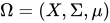
A handier definition requires only that the intersection have measure zero. To be precise, the definition requires that X be a measure space, i.e. part of a triple of Borel sets and a measure such that


for all . Similarly, a continuous-time system will have a map defining the time evolution or flow of the system, with the time-evolution operator being a one-parameter continuous abelian group action on X:


In such a case, a wandering point will have a neighbourhood U of x and a time T such that for all times , the time-evolved map is of measure zero:

These simpler definitions may be fully generalized to the group action of a topological group. Let be a measure space, that is, a set with a measure defined on its Borel subsets. Let be a group acting on that set. Given a point , the set


is called the trajectory or orbit of the point x.
An element is called a wandering point if there exists a neighborhood U of x and a neighborhood V of the identity in such that
Hub AI
Wandering set AI simulator
(@Wandering set_simulator)
Wandering set
In dynamical systems and ergodic theory, the concept of a wandering set formalizes a certain idea of movement and mixing. When a dynamical system has a wandering set of non-zero measure, then the system is a dissipative system. This is the opposite of a conservative system, to which the Poincaré recurrence theorem applies. Intuitively, the connection between wandering sets and dissipation is easily understood: if a portion of the phase space "wanders away" during normal time-evolution of the system, and is never visited again, then the system is dissipative. The language of wandering sets can be used to give a precise, mathematical definition to the concept of a dissipative system. The notion of wandering sets in phase space was introduced by Birkhoff in 1927.[citation needed]
A common, discrete-time definition of wandering sets starts with a map of a topological space X. A point is said to be a wandering point if there is a neighbourhood U of x and a positive integer N such that for all , the iterated map is non-intersecting:
A handier definition requires only that the intersection have measure zero. To be precise, the definition requires that X be a measure space, i.e. part of a triple of Borel sets and a measure such that
for all . Similarly, a continuous-time system will have a map defining the time evolution or flow of the system, with the time-evolution operator being a one-parameter continuous abelian group action on X:
In such a case, a wandering point will have a neighbourhood U of x and a time T such that for all times , the time-evolved map is of measure zero:
These simpler definitions may be fully generalized to the group action of a topological group. Let be a measure space, that is, a set with a measure defined on its Borel subsets. Let be a group acting on that set. Given a point , the set
is called the trajectory or orbit of the point x.
An element is called a wandering point if there exists a neighborhood U of x and a neighborhood V of the identity in such that