Hubbry Logo
Normal schemeNormal schemeMain
Open search
Normal scheme
Community hub
Normal scheme
logo
7 pages, 0 posts
0 subscribers
Be the first to start a discussion here.
Normal scheme
Normal scheme
from Wikipedia

In algebraic geometry, an algebraic variety or scheme X is normal if it is normal at every point, meaning that the local ring at the point is an integrally closed domain.[1] An affine variety X (understood to be irreducible) is normal if and only if the ring O(X) of regular functions on X is an integrally closed domain.[citation needed] A variety X over a field is normal if and only if every finite birational morphism from any variety Y to X is an isomorphism.[citation needed]

Normal varieties were introduced by Zariski.[2]

Geometric and algebraic interpretations of normality

[edit]

A morphism of varieties is finite if the inverse image of every point is finite and the morphism is proper. A morphism of varieties is birational if it restricts to an isomorphism between dense open subsets. So, for example, the cuspidal cubic curve X in the affine plane A2 defined by x2 = y3 is not normal, because there is a finite birational morphism A1X (namely, t maps to (t3, t2)) which is not an isomorphism. By contrast, the affine line A1 is normal: it cannot be simplified any further by finite birational morphisms.

A normal complex variety X has the property, when viewed as a stratified space using the classical topology, that every link is connected. Equivalently, every complex point x has arbitrarily small neighborhoods U such that U minus the singular set of X is connected. For example, it follows that the nodal cubic curve X in the figure, defined by y2 = x2(x + 1), is not normal. This also follows from the definition of normality, since there is a finite birational morphism from A1 to X which is not an isomorphism; it sends two points of A1 to the same point in X.

Curve y2 = x2(x + 1)

More generally, a scheme X is normal if each of its local rings

OX,x

is an integrally closed domain. That is, each of these rings is an integral domain R, and every ring S with RS ⊆ Frac(R) such that S is finitely generated as an R-module is equal to R. (Here Frac(R) denotes the field of fractions of R.) This is a direct translation, in terms of local rings, of the geometric condition that every finite birational morphism to X is an isomorphism. For instance, in the case of the nodal cubic X in the figure, the local ring is not integrally closed in its field of fractions, since y/x is integral over A but is not in A. Therefore X is not normal at the point (0,0).[3]

An older notion is that a subvariety X of projective space is linearly normal if the linear system giving the embedding is complete. Equivalently, XPn is not the linear projection of an embedding XPn+1 (unless X is contained in a hyperplane Pn). This is the meaning of "normal" in the phrases rational normal curve and rational normal scroll.

Every regular scheme is normal. Conversely, Zariski showed that every normal variety is regular outside a subset of codimension at least 2, and a similar result is true for schemes.[4][5] So, for example, every normal curve is regular.

The normalization

[edit]

Any reduced scheme X has a unique normalization: a normal scheme Y with an integral birational morphism YX. (For X a variety over a field, the morphism YX is finite, which is stronger than "integral".[6]) The normalization of a scheme of dimension 1 is regular, and the normalization of a scheme of dimension 2 has only isolated singularities. Normalization is not usually used for resolution of singularities for schemes of higher dimension.

To define the normalization, first suppose that X is an irreducible reduced scheme X. Every affine open subset of X has the form Spec R with R an integral domain. Write X as a union of affine open subsets Spec Ai. Let Bi be the integral closure of Ai in its fraction field. Then the normalization of X is defined by gluing together the affine schemes Spec Bi.

If the initial scheme is not irreducible, the normalization is defined to be the disjoint union of the normalizations of the irreducible components.

Examples

[edit]

Normalization of a cusp

[edit]

Consider the affine curve

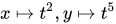
with the cusp singularity at the origin. Its normalization can be given by the map

induced from the algebra map

Normalization of axes in affine plane

[edit]

For example,

is not an irreducible scheme since it has two components. Its normalization is given by the scheme morphism

induced from the two quotient maps

Normalization of reducible projective variety

[edit]

Similarly, for homogeneous irreducible polynomials in a UFD, the normalization of

is given by the morphism

See also

[edit]

Notes

[edit]

References

[edit]
Revisions and contributorsEdit on WikipediaRead on Wikipedia
from Grokipedia
In algebraic geometry, a normal scheme is defined as a scheme XX such that the local ring OX,x\mathcal{O}_{X,x} at every point xXx \in X is a normal domain, meaning it is an that is integrally closed in its . This condition ensures that the scheme is reduced, as normal domains have no elements, and locally integral in the sense that the local rings are domains. For affine schemes Spec(A)\operatorname{Spec}(A), normality is equivalent to the ring AA being normal, i.e., all localizations of AA at prime ideals are normal domains. A key property of normal schemes is their behavior under localization and gluing: open subschemes of a normal scheme are normal, and a scheme is normal if and only if it can be covered by normal affine open subschemes. In the Noetherian case, a normal scheme decomposes as a finite of normal schemes, each corresponding to an irreducible component. For locally Noetherian normal schemes, connectedness is equivalent to integrality, highlighting the scheme's "global" integrity. Regular schemes, where local rings are regular local rings, are normal, but the converse does not hold; for instance, in 2 or higher, there exist normal but non-regular schemes. The normalization of a scheme provides a way to "resolve" non-normality: for a reduced Noetherian scheme XX, the normalization X~X\tilde{X} \to X is a morphism from a normal scheme that is an isomorphism over the normal locus and birational on each irreducible component. This construction is affine and finite when the residue fields are separable, preserving dimension. Examples include the normalization of the nodal cubic curve Speck[x,y]/(y2x2(x+1))\operatorname{Spec} k[x,y]/(y^2 - x^2(x+1)), which resolves to the affine line Speck\operatorname{Spec} k, or the cusp y2=x3y^2 = x^3, which normalizes to a line but introduces a map of degree 2. Normal schemes play a crucial role in studying singularities, as they represent a mild form of singularity where the only issue is failure of integrality rather than more severe geometric defects.

Definitions and Properties

Definition of Normal Schemes

A scheme XX is said to be integral if it is nonempty, reduced, and irreducible. Equivalently, XX is integral if for every affine open subscheme Spec(R)X\operatorname{Spec}(R) \subset X, the ring RR is an integral domain. Integral schemes often arise as the basic building blocks in algebraic geometry, capturing geometric objects without embedded components or multiple irreducible parts. An RR is normal if it is integrally closed in its fraction field Frac(R)\operatorname{Frac}(R), meaning that every element of Frac(R)\operatorname{Frac}(R) that is integral over RR already belongs to RR. More generally, a is normal if it is integrally closed in its total quotient ring. A scheme XX is normal if, for every point xXx \in X, the stalk OX,x\mathcal{O}_{X,x} is a normal domain. Formally, XX is normal if and only if every OX,x\mathcal{O}_{X,x} is a normal domain. In the Noetherian setting, this condition is equivalent to the scheme satisfying Serre's conditions (R1)(R_1) and (S2)(S_2): it is regular in 1, and has depth at least 2 at every point. For Noetherian schemes, normality implies regularity in codimension 1. In particular, when the dimension of XX is at most 1, normality implies that XX is regular. However, in dimension 2 and higher, there exist normal schemes that are not regular; a standard example is the affine quadratic Speck[x,y,z]/(xyz2)\operatorname{Spec} k[x,y,z]/(xy - z^2) over an kk, whose vertex local ring is normal of dimension 2 but not regular.

Key Properties and Characterizations

A scheme XX is normal if and only if for every affine open subscheme U=\Spec(A)XU = \Spec(A) \subset X, the ring AA is normal, i.e., integrally closed in its total ring of fractions. This characterization follows from the fact that a scheme is normal precisely when all of its local rings are normal domains, and normality of \Spec(A)\Spec(A) is equivalent to normality of the ring AA. The integral closure of an integral domain RR in its fraction field L=Frac(R)L = \operatorname{Frac}(R) is the subset of LL consisting of all elements xLx \in L that satisfy a monic polynomial with coefficients in RR. Thus, RR is normal if and only if it equals its integral closure in LL. Normality is a local property on the Zariski topology in the sense of the characterization above, but it is also local on the étale topology: a scheme XX is normal if and only if étale locally on XX it is normal. This holds because étale homomorphisms of Noetherian local domains preserve normality. There are caveats in the Zariski case for non-Noetherian schemes, where the property requires checking on a Zariski open cover rather than solely on affines. Normal schemes are closed under finite products. Specifically, if XX and YY are normal schemes over a field kk, then the fiber product X×kYX \times_k Y is a normal scheme. This extends to finite products by iteration. Let f:YXf: Y \to X be a birational of integral schemes with XX normal. Then YY is normal if ff is an over a dense open subset of XX. In particular, if ff is a finite birational , then ff is an . By the Cohen structure theorem, normal local rings in equicharacteristic exhibit unique factorization properties. For complete equicharacteristic local normal domains of depth at least 3, they satisfy the S3S_3 condition and have controlled localizations.

Interpretations of Normality

Geometric Interpretation

In , normal schemes exhibit singularities that are geometrically mild, with the singular locus confined to at least 2, ensuring that the scheme is regular along codimension-1 subsets. This geometric constraint implies that any "bad" behavior, such as unexpected gluings of subvarieties or tangent spaces, is isolated to lower-dimensional strata, preventing widespread irregularities across the scheme. Normalization, as a birational to a normal scheme, geometrically resolves these mild singularities by disentangling intersecting components or pinch points, effectively separating self-intersecting branches without altering the overall birational type of the scheme. For curves, this geometric perspective aligns precisely with desingularization: a normal curve is nonsingular, and the normalization map provides a finite birational morphism from a smooth curve that resolves all singularities, such as nodes or cusps, by parametrizing and separating the branches at singular points. Consider a nodal curve defined by y2=x2(x+1)y^2 = x^2(x + 1) in the affine plane; geometrically, it features a pinch point where two smooth branches cross transversely, and normalization introduces a t=y/xt = y/x to yield a single smooth affine line mapping birationally onto the original curve, where the node is resolved by two distinct points on the normalization corresponding to the two branches, thus eliminating the self-intersection. In higher dimensions, however, normalization is weaker than full resolution, as it only addresses codimension-1 singularities, leaving potential issues in the singular locus unresolved. This distinction underscores the role of normal schemes in broader resolution processes, such as those in Hironaka's theorem, which guarantees a for varieties over fields of characteristic zero via successive blow-ups, producing a smooth model birational to the original. Normal varieties frequently arise as intermediate or minimal models in , where their mild singularities facilitate contractions or further modifications, though normality does not inherently imply stronger properties like rational singularities.

Algebraic Interpretation

In the algebraic interpretation, normality of a scheme is characterized by the property that all its local rings are integrally closed domains. This ring-theoretic condition algebraically encodes the absence of "holes" in the , meaning that the structure sheaf at every point contains all elements of the fraction field that are over it, preventing non-trivial integral extensions within the local rings. For an domain AA, the integral closure ClA(L)\mathrm{Cl}_A(L) in an extension ring LL (such as the fraction field of AA) consists of all elements in LL that are over AA, i.e., satisfy a monic polynomial equation with coefficients in AA. The domain AA is normal if and only if A=ClA(Frac(A))A = \mathrm{Cl}_A(\mathrm{Frac}(A)), ensuring that AA coincides with the largest subring over which it is integrally closed. This property has significant implications for morphisms of schemes. Specifically, if f:Spec(B)Spec(A)f: \mathrm{Spec}(B) \to \mathrm{Spec}(A) is a corresponding to a ring extension where AA is a Noetherian normal domain and BB is the closure of AA in a finite of the fraction field Frac(A)\mathrm{Frac}(A), then BB is also normal, and the extension B/AB/A is finite as a module. Such morphisms arise naturally in normalization processes, where the target scheme inherits normality from the source under these integrality conditions. In dimension one, the Krull-Akizuki theorem sharpens these implications: for a Noetherian domain RR of dimension 1 with fraction field KK, and any ring AA with RALR \subset A \subset L where L/KL/K is finite, AA is Noetherian. This result ensures that integral closures in low-dimensional settings remain Noetherian, and it connects normality to discrete valuation rings (DVRs), as every local normal domain of dimension 1 is a DVR. The concept of normality in this algebraic framework emerged from and was formalized by Oscar Zariski in the for the study of algebraic varieties, where he showed that normal (or simple) points form an open dense subset of an irreducible variety.

Normalization Process

Construction of the Normalization

For an scheme X=Spec(A)X = \operatorname{Spec}(A), where AA is an with fraction field L=Frac(A)L = \operatorname{Frac}(A), the normalization X~\tilde{X} is constructed as X~=Spec(ClA(L))\tilde{X} = \operatorname{Spec}(\operatorname{Cl}_A(L)), where ClA(L)\operatorname{Cl}_A(L) denotes the integral closure of AA in LL. The integral closure ClA(L)\operatorname{Cl}_A(L) consists of all elements αL\alpha \in L that are integral over AA, meaning α\alpha satisfies a monic polynomial equation xn+an1xn1++a0=0x^n + a_{n-1} x^{n-1} + \cdots + a_0 = 0 with coefficients aiAa_i \in A. The canonical morphism ν:X~X\nu: \tilde{X} \to X induced by the inclusion AClA(L)A \hookrightarrow \operatorname{Cl}_A(L) is birational, as it becomes an isomorphism over the generic point of XX. This construction satisfies a universal property: ν\nu is the unique morphism such that X~\tilde{X} is a normal integral scheme, and for any normal integral scheme YY with a birational morphism π:YX\pi: Y \to X, there exists a unique morphism h:YX~h: Y \to \tilde{X} making the diagram YhX~πνX=X\begin{CD} Y @>h>> \tilde{X} \\ @V{\pi}VV @VV{\nu}V \\ X @= X \end{CD}
Add your contribution
Related Hubs
User Avatar
No comments yet.