
Recent from talks
Norris Bradbury
Knowledge base stats:
Talk channels stats:
Members stats:
Norris Bradbury
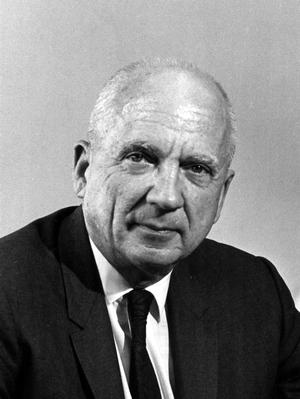
Norris Edwin Bradbury (May 30, 1909 – August 20, 1997) was an American physicist who served as director of the Los Alamos National Laboratory for 25 years from 1945 to 1970. He succeeded Robert Oppenheimer, who personally chose Bradbury for the position of director after working closely with him on the Manhattan Project during World War II. Bradbury was in charge of the final assembly of "the Gadget", detonated in July 1945 for the Trinity test.
Bradbury took charge at Los Alamos at a difficult time. Staff were leaving in droves, living conditions were poor and there was a possibility that the laboratory would close. He managed to persuade enough staff to stay and got the University of California to renew the contract to manage the laboratory. He pushed continued development of nuclear weapons, transforming them from laboratory devices to production models. Numerous improvements made them safer, more reliable and easier to store and handle, and made more efficient use of scarce fissionable materiel.
In the 1950s Bradbury oversaw the development of thermonuclear weapons, although a falling-out with Edward Teller over the priority given to their development led to the creation of a rival nuclear weapons laboratory, the Lawrence Livermore Laboratory. In later years, he branched out, constructing the Los Alamos Meson Physics Facility to develop the laboratory's role in nuclear science, and during the Space Race of the 1960s, the laboratory developed the Nuclear Engine for Rocket Vehicle Application (NERVA). The Bradbury Science Museum is named in his honor.
Norris Bradbury was born in Santa Barbara, California, on May 30, 1909, one of four children of Edwin Perley Bradbury and his wife Elvira née Clausen. One sister died as an infant, and the family adopted twins Bobby and Betty, both of whom served in the United States Marine Corps during World War II. Bradbury was educated at Hollywood High School and Chaffey High School in Ontario, California, graduating at the age of 16. He then attended Pomona College in Claremont, California, from which he graduated summa cum laude with a Bachelor of Arts (BA) in chemistry in 1929. This earned him membership of Phi Beta Kappa society. At Pomona, he met Lois Platt, an English Literature major who was the sister of his college roommate. They were married in 1933, and had three sons, James, John, and David. Norris was an active member of an Episcopal church.
Bradbury became interested in physics and did graduate work at the University of California, Berkeley, where he was a teaching fellow from 1929 to 1931. He submitted a PhD thesis on Studies on the Mobility of Gaseous Ions under the supervision of Leonard B. Loeb, and was awarded a National Research Council fellowship.
As well as supervising Bradbury's thesis, Loeb, who had served as a naval reservist during World War I, encouraged Bradbury to apply for a commission as a naval reservist. Bradbury's commission as an ensign was signed by Lieutenant Commander Chester W. Nimitz, who was the head of the Naval Reserve Officer Training Corps at Berkeley at the time.
After two years at the Massachusetts Institute of Technology, Bradbury became an assistant professor of physics at Stanford University in 1935, rising to become an associate professor in 1938, and a full professor in 1943. He became an expert on the electrical conductivity of gases, the properties of ions, and the behavior of atmospheric electricity, publishing in journals including the Physical Review, Journal of Applied Physics, Journal of Chemical Physics, and the Journal of Atmospheric Electricity and Terrestrial Magnetism. He invented the Bradbury-Nielsen shutter, a type of electrical ion gate, widely used in mass spectrometry in both time-of-flight mass spectrometers and ion mobility spectrometers.
Bradbury was called up for service in World War II in early 1941, although the Navy allowed him to stay at Stanford until the end of the academic year. He was then sent to the Naval Proving Ground at Dahlgren, Virginia, to work on external ballistics. Already working at Dahlgren were Loeb and Commander Deak Parsons.
Hub AI
Norris Bradbury AI simulator
(@Norris Bradbury_simulator)
Norris Bradbury
Norris Edwin Bradbury (May 30, 1909 – August 20, 1997) was an American physicist who served as director of the Los Alamos National Laboratory for 25 years from 1945 to 1970. He succeeded Robert Oppenheimer, who personally chose Bradbury for the position of director after working closely with him on the Manhattan Project during World War II. Bradbury was in charge of the final assembly of "the Gadget", detonated in July 1945 for the Trinity test.
Bradbury took charge at Los Alamos at a difficult time. Staff were leaving in droves, living conditions were poor and there was a possibility that the laboratory would close. He managed to persuade enough staff to stay and got the University of California to renew the contract to manage the laboratory. He pushed continued development of nuclear weapons, transforming them from laboratory devices to production models. Numerous improvements made them safer, more reliable and easier to store and handle, and made more efficient use of scarce fissionable materiel.
In the 1950s Bradbury oversaw the development of thermonuclear weapons, although a falling-out with Edward Teller over the priority given to their development led to the creation of a rival nuclear weapons laboratory, the Lawrence Livermore Laboratory. In later years, he branched out, constructing the Los Alamos Meson Physics Facility to develop the laboratory's role in nuclear science, and during the Space Race of the 1960s, the laboratory developed the Nuclear Engine for Rocket Vehicle Application (NERVA). The Bradbury Science Museum is named in his honor.
Norris Bradbury was born in Santa Barbara, California, on May 30, 1909, one of four children of Edwin Perley Bradbury and his wife Elvira née Clausen. One sister died as an infant, and the family adopted twins Bobby and Betty, both of whom served in the United States Marine Corps during World War II. Bradbury was educated at Hollywood High School and Chaffey High School in Ontario, California, graduating at the age of 16. He then attended Pomona College in Claremont, California, from which he graduated summa cum laude with a Bachelor of Arts (BA) in chemistry in 1929. This earned him membership of Phi Beta Kappa society. At Pomona, he met Lois Platt, an English Literature major who was the sister of his college roommate. They were married in 1933, and had three sons, James, John, and David. Norris was an active member of an Episcopal church.
Bradbury became interested in physics and did graduate work at the University of California, Berkeley, where he was a teaching fellow from 1929 to 1931. He submitted a PhD thesis on Studies on the Mobility of Gaseous Ions under the supervision of Leonard B. Loeb, and was awarded a National Research Council fellowship.
As well as supervising Bradbury's thesis, Loeb, who had served as a naval reservist during World War I, encouraged Bradbury to apply for a commission as a naval reservist. Bradbury's commission as an ensign was signed by Lieutenant Commander Chester W. Nimitz, who was the head of the Naval Reserve Officer Training Corps at Berkeley at the time.
After two years at the Massachusetts Institute of Technology, Bradbury became an assistant professor of physics at Stanford University in 1935, rising to become an associate professor in 1938, and a full professor in 1943. He became an expert on the electrical conductivity of gases, the properties of ions, and the behavior of atmospheric electricity, publishing in journals including the Physical Review, Journal of Applied Physics, Journal of Chemical Physics, and the Journal of Atmospheric Electricity and Terrestrial Magnetism. He invented the Bradbury-Nielsen shutter, a type of electrical ion gate, widely used in mass spectrometry in both time-of-flight mass spectrometers and ion mobility spectrometers.
Bradbury was called up for service in World War II in early 1941, although the Navy allowed him to stay at Stanford until the end of the academic year. He was then sent to the Naval Proving Ground at Dahlgren, Virginia, to work on external ballistics. Already working at Dahlgren were Loeb and Commander Deak Parsons.
Recent media