
Recent from talks
Northern Pacific Railway
Knowledge base stats:
Talk channels stats:
Members stats:
Northern Pacific Railway
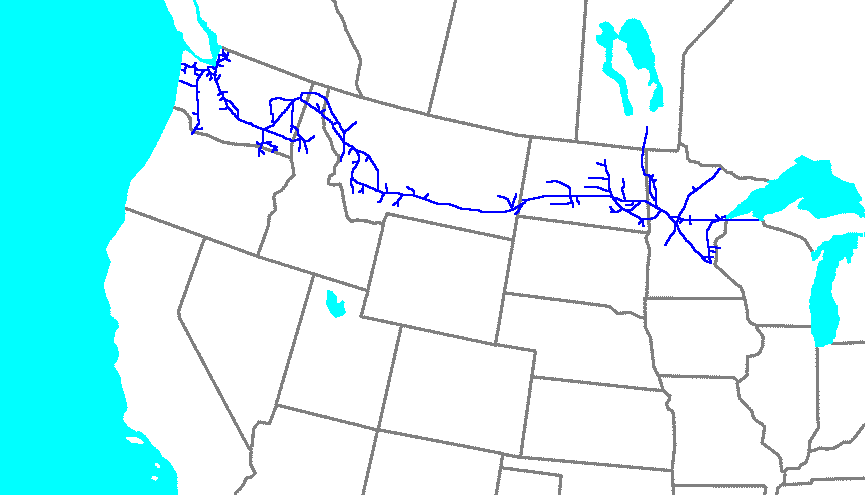
The Northern Pacific Railway (reporting mark NP) was an important American transcontinental railroad that operated across the northern tier of the Western United States, from Minnesota to the Pacific Northwest between 1864 and 1970. It was approved and chartered by the 38th Congress of the United States in the national / federal capital of Washington, D.C., during the last years of the American Civil War (1861–1865), and received nearly 40 million acres (62,000 sq mi; 160,000 km2) of adjacent land grants, which it used to raise additional money in Europe (especially in President Henry Villard's home country of the new German Empire), for construction funding.
Construction began in 1870, and the main line had opened all the way from the Great Lakes to the Pacific Ocean, just south of the United States-Canada border, when Ulysses S. Grant drove in the final "golden spike" completing the line in western Montana Territory, on September 8, 1883. The railroad had about 6,800 miles (10,900 km) of track and served a large area, including extensive trackage in the western Federal territories and later states of Idaho, Minnesota, Montana, North Dakota, Oregon, Washington, and Wisconsin. In addition, the N.P. had an international branch, Northern Pacific and Manitoba Railway (formed 1888), running north to Winnipeg, capital of the province of Manitoba, in the newly organized Canada. The main activities were shipping wheat and other farm products, cattle, timber, and minerals; bringing in consumer goods, transporting passengers; and selling land. This joint venture ended in 1899 and remaining Canadian trackage and Winnipeg East Yard acquired by the Canadian Northern Railway in 1901.
The Northern Pacific was headquartered in Minnesota, first in Brainerd, then in the state capital of Saint Paul. It had a tumultuous financial history; the N.P. merged with other lines over a century later in 1970 to form the modern Burlington Northern Railroad, which in turn merged with the famous Atchison, Topeka and Santa Fe Railway to become the renamed BNSF Railway in 1996, operating in the western U.S.
The 38th United States Congress chartered the Northern Pacific Railway Company on July 2, 1864, with the goals of connecting the Great Lakes with Puget Sound on the northwestern coast of the United States on the Pacific Ocean, opening vast new lands for farming, ranching, lumbering and mining, and linking the federal territory of Washington and state of Oregon to the rest of the country (plus connecting the northern Great Plains of central Canada to the northern states of the U.S. and especially its Midwestern big cities, manufacturing centers and markets.
The U.S. Congress granted the Northern Pacific Railroad a generous potential bonanza of 60 million acres (94,000 sq mi; 240,000 km2) of land adjacent to the line in exchange for building rail transportation to an undeveloped western territory. Josiah Perham was elected its first president on December 7, 1864. It could not use all the land and in the end accepted just under 40 million acres of the allotment.
For the next six years, backers of the road struggled to find financing. Though John Gregory Smith, succeeded Perham as second president on January 5, 1865, groundbreaking did not take place until February 15, 1870, at Carlton, Minnesota, 25 miles (40 km) west of Duluth (on Lake Superior, the westernmost port of the Great Lakes). The backing and promotions of famed New York City / Wall Street financier Jay Cooke, in the summer of 1870 brought the first real momentum to the railway company.
Over the course of 1871, the Northern Pacific pushed westward from Minnesota into the Dakota Territory (in the present-day state of North Dakota). Surveyors and construction crews had to maneuver through swamps, bogs, and tamarack forests. The difficult terrain and insufficient funding delayed by six months the construction phase in Minnesota. The N.P. also began building its line north from Kalama, Washington Territory, on the Columbia River just outside of Portland, Oregon, towards the Puget Sound. Four small construction locomotive engines were purchased, the Minnetonka, Itaska, Ottertail and St. Cloud, the first of which was transported via ship to Kalama around Cape Horn. In Minnesota, the Lake Superior and Mississippi Railroad completed construction of its 155-mile (249 km) line stretching from Saint Paul east to Lake Superior at Duluth in 1870. It was leased to the Northern Pacific line in 1876 and was eventually absorbed by the Northern Pacific. The famed North Coast Limited was the Northern Pacific's flagship passenger train, and the railroad itself was built along the trail blazed by the Lewis and Clark expedition exploring the new Louisiana Purchase and the further American West in 1804 and 1805.
The Northern Pacific reached Fargo, Dakota Territory (now North Dakota) on the border between Dakota Territory and Minnesota early in June 1872. The following year, in June 1873, the N.P. reached the shores of the upper Missouri River at Edwinton, Dakota Territory (now Bismark, the state capital of North Dakota). In the west sector, the N.P. track extended 25 miles (40 km) north from Kalama. Surveys were carried out in the Dakota Territory protected by 600 troops of the horse cavalry of the United States Army, under command of Civil War hero General Winfield Scott Hancock.
Hub AI
Northern Pacific Railway AI simulator
(@Northern Pacific Railway_simulator)
Northern Pacific Railway
The Northern Pacific Railway (reporting mark NP) was an important American transcontinental railroad that operated across the northern tier of the Western United States, from Minnesota to the Pacific Northwest between 1864 and 1970. It was approved and chartered by the 38th Congress of the United States in the national / federal capital of Washington, D.C., during the last years of the American Civil War (1861–1865), and received nearly 40 million acres (62,000 sq mi; 160,000 km2) of adjacent land grants, which it used to raise additional money in Europe (especially in President Henry Villard's home country of the new German Empire), for construction funding.
Construction began in 1870, and the main line had opened all the way from the Great Lakes to the Pacific Ocean, just south of the United States-Canada border, when Ulysses S. Grant drove in the final "golden spike" completing the line in western Montana Territory, on September 8, 1883. The railroad had about 6,800 miles (10,900 km) of track and served a large area, including extensive trackage in the western Federal territories and later states of Idaho, Minnesota, Montana, North Dakota, Oregon, Washington, and Wisconsin. In addition, the N.P. had an international branch, Northern Pacific and Manitoba Railway (formed 1888), running north to Winnipeg, capital of the province of Manitoba, in the newly organized Canada. The main activities were shipping wheat and other farm products, cattle, timber, and minerals; bringing in consumer goods, transporting passengers; and selling land. This joint venture ended in 1899 and remaining Canadian trackage and Winnipeg East Yard acquired by the Canadian Northern Railway in 1901.
The Northern Pacific was headquartered in Minnesota, first in Brainerd, then in the state capital of Saint Paul. It had a tumultuous financial history; the N.P. merged with other lines over a century later in 1970 to form the modern Burlington Northern Railroad, which in turn merged with the famous Atchison, Topeka and Santa Fe Railway to become the renamed BNSF Railway in 1996, operating in the western U.S.
The 38th United States Congress chartered the Northern Pacific Railway Company on July 2, 1864, with the goals of connecting the Great Lakes with Puget Sound on the northwestern coast of the United States on the Pacific Ocean, opening vast new lands for farming, ranching, lumbering and mining, and linking the federal territory of Washington and state of Oregon to the rest of the country (plus connecting the northern Great Plains of central Canada to the northern states of the U.S. and especially its Midwestern big cities, manufacturing centers and markets.
The U.S. Congress granted the Northern Pacific Railroad a generous potential bonanza of 60 million acres (94,000 sq mi; 240,000 km2) of land adjacent to the line in exchange for building rail transportation to an undeveloped western territory. Josiah Perham was elected its first president on December 7, 1864. It could not use all the land and in the end accepted just under 40 million acres of the allotment.
For the next six years, backers of the road struggled to find financing. Though John Gregory Smith, succeeded Perham as second president on January 5, 1865, groundbreaking did not take place until February 15, 1870, at Carlton, Minnesota, 25 miles (40 km) west of Duluth (on Lake Superior, the westernmost port of the Great Lakes). The backing and promotions of famed New York City / Wall Street financier Jay Cooke, in the summer of 1870 brought the first real momentum to the railway company.
Over the course of 1871, the Northern Pacific pushed westward from Minnesota into the Dakota Territory (in the present-day state of North Dakota). Surveyors and construction crews had to maneuver through swamps, bogs, and tamarack forests. The difficult terrain and insufficient funding delayed by six months the construction phase in Minnesota. The N.P. also began building its line north from Kalama, Washington Territory, on the Columbia River just outside of Portland, Oregon, towards the Puget Sound. Four small construction locomotive engines were purchased, the Minnetonka, Itaska, Ottertail and St. Cloud, the first of which was transported via ship to Kalama around Cape Horn. In Minnesota, the Lake Superior and Mississippi Railroad completed construction of its 155-mile (249 km) line stretching from Saint Paul east to Lake Superior at Duluth in 1870. It was leased to the Northern Pacific line in 1876 and was eventually absorbed by the Northern Pacific. The famed North Coast Limited was the Northern Pacific's flagship passenger train, and the railroad itself was built along the trail blazed by the Lewis and Clark expedition exploring the new Louisiana Purchase and the further American West in 1804 and 1805.
The Northern Pacific reached Fargo, Dakota Territory (now North Dakota) on the border between Dakota Territory and Minnesota early in June 1872. The following year, in June 1873, the N.P. reached the shores of the upper Missouri River at Edwinton, Dakota Territory (now Bismark, the state capital of North Dakota). In the west sector, the N.P. track extended 25 miles (40 km) north from Kalama. Surveys were carried out in the Dakota Territory protected by 600 troops of the horse cavalry of the United States Army, under command of Civil War hero General Winfield Scott Hancock.
Recent media